

If you saw 39 medals and wondered what Bharat’s Glasgow campaign means beyond a place on the table, resist two easy reactions. Do not reduce athletes to numbers, and do not use their victories as proof that every part of the sporting system already works.
The more useful question is what made each achievement possible: the athlete’s agency, the relationships that sustained it, the adversity that should never have been necessary, and the duties that now fall on those of us celebrating from a distance.
Key takeaways
- Bharat’s Glasgow campaign had produced 39 medals by 18 August 2026, with records and historic firsts also reported. Treat 39 as a dated tally unless a later authoritative result confirms the final total.
- Sharmila Dhankar’s shot-put gold deserves particular attention: at 40, she threw 9.81 metres and became India’s first Commonwealth Games para-athletics gold medallist.
- Her recovery from domestic abuse should be described as an exercise of agency supported by her parents, not as evidence that suffering creates champions.
- Nari Shakti, Savitri and Durga can provide a Dharmic language for courage, but the athlete’s verified life and achievement must come before the archetype.
- National pride becomes useful when it produces disciplined memory: learn the athlete’s name, event, result, support system and the barrier that future athletes should not have to overcome.
Begin with the scoreboard, then look beneath it
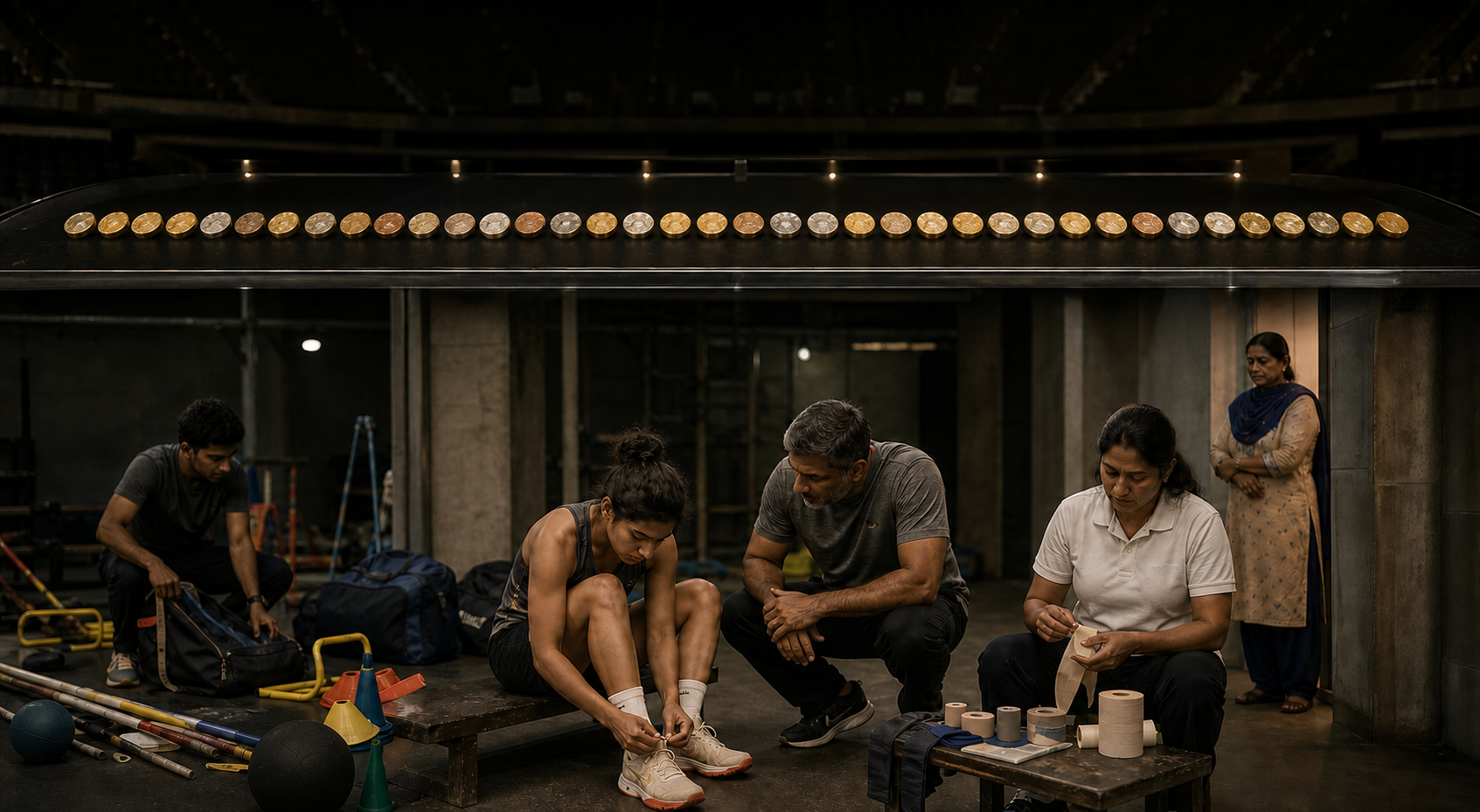
By 18 August, India’s Glasgow 2026 campaign had produced 39 medals, several records and historic firsts. That is a substantial result. It is also a snapshot. If you are discussing the campaign after that date, verify whether the tally changed before presenting 39 as the final number.
A medal table answers one question: what was won. It cannot tell you what the athlete survived, who made continued training possible, whether the obstacle was inherent to competition or imposed by society, and whether another talented person could find the same support. You need four layers to read a result responsibly:
- The achievement: Name the event, medal, mark and genuine first. Avoid vague praise when a precise result is available.
- The athlete’s agency: Identify what the athlete chose and did. Words such as resilience are useful only when they point to actual decisions rather than turning hardship into a personality trait.
- The enabling relationships: Name parents, family members, gurus, coaches or institutions only when their role is known. Generic invocations of family or culture conceal who actually helped.
- The unfinished duty: Ask which hardship demanded courage and which hardship should have been prevented. Athletic difficulty is part of sport; abuse, exclusion and avoidable deprivation are not.
This distinction lets you be proudly pro-Bharat without becoming uncritical. A mature national culture can honour excellence while asking whether its institutions made excellence needlessly difficult. Celebration and scrutiny belong together because both take the athlete seriously.
Sharmila Dhankar’s gold requires moral precision

Sharmila Dhankar endured years of domestic abuse and was forced from her home with two young daughters. Her parents supported her while she rebuilt her life. Twelve years later, at the age of 40, she won shot-put gold with a throw of 9.81 metres, becoming India’s first Commonwealth Games para-athletics gold medallist.
The order of those facts matters. Abuse was something done to her; it was not the source of her excellence. The decisions to rebuild, continue as a mother, return to purposeful work and compete at an elite level were hers. Her parents’ support mattered because it created a refuge after another household had become unsafe.
Three common retellings would diminish that truth. The first says adversity made her strong, as though violence were a useful trial. The second treats her victory as proof that women can manage everything if they try hard enough. The third praises the Indian family without distinguishing between the home that harmed her and the parents who stood behind her.
A more accurate formulation is simple: Sharmila exercised courage after abuse, and dependable parental support helped her exercise it. Her achievement shows that motherhood, self-respect and professional ambition can coexist in one life. It does not prove that this balance is easy, that every family is protective, or that women should be expected to carry unequal domestic burdens while pursuing excellence.
If you share her story, do not lead with lurid details about the violence. Lead with her name and sporting achievement, state the adversity without sensationalising it, identify the support she received, and return the focus to her agency. That sequence honours the person rather than turning her pain into motivational content.
Nari Shakti must preserve the individual woman
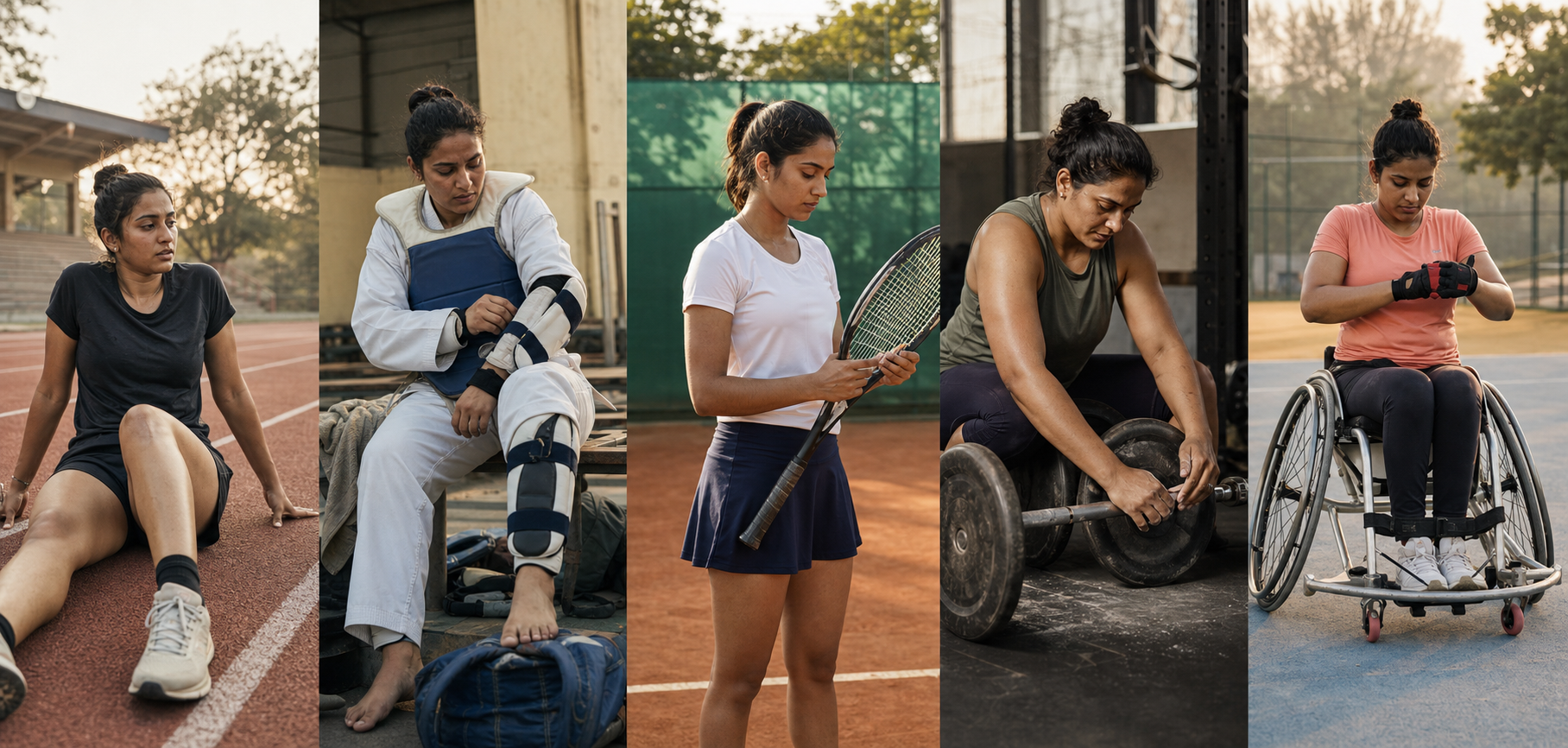
Sharmila Dhankar, Seema Kaliramna and Asmita Dey are among the women whose Glasgow achievements have carried a larger cultural meaning. Yet a collective phrase such as Nari Shakti is valuable only when it helps us see each woman more clearly. It fails when it turns distinct athletes into interchangeable symbols.
Dharmic memory offers powerful interpretive figures. Savitri represents determination that refuses to accept a seemingly fixed ending, while Durga embodies strength summoned in the face of danger. These figures can illuminate resolve, moral clarity and active resistance. They should not replace biography or be used to claim that a modern athlete is merely repeating a predetermined ideal.
The sequence should therefore be biography first, archetype second. Establish what the athlete actually achieved, what she endured, what she chose and who supported her. Only then ask whether a traditional image helps articulate the virtue on display. This prevents mythology from swallowing the human being it was meant to honour.
It also keeps sacrifice in its proper place. Sacrifice freely undertaken for a worthy purpose may be admirable. Harm imposed by an abusive person is not sacrifice, and tolerating it is not a woman’s dharma. Savitri should never become an instruction to remain in danger. Durga should never become a decorative compliment offered after society has failed to protect a woman.
Sharmila’s parents show what family can mean at its best: a relationship that restores safety, confidence and room to act. That is a concrete instance of kinship fulfilling a protective duty. It is not evidence that every traditional arrangement automatically serves women. Tradition deserves allegiance when it upholds dignity and reciprocal responsibility, not merely because it is old or familiar.
Read Dharmic values as duties, not decorations
The Glasgow campaign has been associated with resourcefulness in adversity, family sacrifice, respect for the Guru, courage in service, humility and refusal to give up. Each value can deepen our understanding, but each can also be misused. The practical test is whether the value clarifies a duty or merely decorates a victory.
| Value | What to notice | What it must not excuse |
|---|---|---|
| Jugaad or resourcefulness | Creative action when conditions are constrained | Preventable shortages or permanent institutional neglect |
| Respect for the Guru | Teaching, discipline, correction and transmission of knowledge | Erasure of the athlete’s agency or unaccountable authority |
| Family sacrifice | Specific people giving time, security or sustained encouragement | The assumption that women must absorb unlimited domestic burdens |
| Courage in service | Action directed towards a responsibility larger than personal acclaim | Compulsory self-erasure or silence about mistreatment |
| Humility | Perspective and steadiness after success | Minimising a real achievement or denying earned recognition |
| Perseverance | Continuing purposeful action despite difficulty | Remaining in danger or accepting injustice as destiny |
Jugaad illustrates the distinction particularly well. Improvisation under constraint can reveal intelligence and tenacity. But once we romanticise scarcity, the very ingenuity we admire becomes an excuse not to build reliable support. The Dharmic response to extraordinary perseverance is not to manufacture more hardship so that future athletes can display the same virtue. It is to reduce preventable hardship while preserving the discipline that sporting excellence genuinely demands.
Respect for the Guru requires similar care. A guru, teacher or coach can transmit technique, form character and see possibility before the student sees it. Gratitude for that relationship does not make the athlete passive. The achievement emerges through disciplined reciprocity: teaching is offered, practice is undertaken, correction is absorbed and performance remains the athlete’s own.
This is why dharma is more demanding than inspirational language. Dharma asks who owed protection, who offered it, who violated it, who kept faith and what responsibility follows. It does not ask us to admire suffering from a safe distance.
Use a five-line test before sharing a medal story

You can apply this reading whenever a Glasgow clip, family message or social-media tribute reaches you. Before forwarding it, see whether you can tell the story in five responsible lines:
- Name the athlete and exact achievement. For Sharmila, that means shot-put gold, 9.81 metres and India’s first Commonwealth Games para-athletics gold.
- Fix the information to its date. The 39-medal tally was current on 18 August; do not silently turn a dated figure into a final result.
- Describe adversity without making it the protagonist. State what happened plainly, then return attention to the athlete’s decisions.
- Name support precisely. Say that Sharmila’s parents supported her rather than crediting an abstract family system.
- State the duty created by admiration. Ask what would make safety, access, disciplined coaching and sustained encouragement more ordinary for the next athlete.
This test is useful in a home, classroom, temple community or sports discussion. It gives young people something more substantial than a slogan: a way to separate achievement from spectacle, resilience from preventable suffering, and cultural pride from complacency.
It also gives para-athletics its rightful place in the main account of Bharat’s sporting life. Sharmila’s gold is not an inspirational footnote to a supposedly normal campaign. It is a sporting result with a measurable mark and a historic national first. Mention the performance before praising the inspiration.
Your next step is straightforward: choose one name from Glasgow, verify the event and result, learn who enabled the performance, and tell the story in that order. Pride then becomes disciplined memory, and disciplined memory can influence what Bharat notices, honours and supports next.
References
