
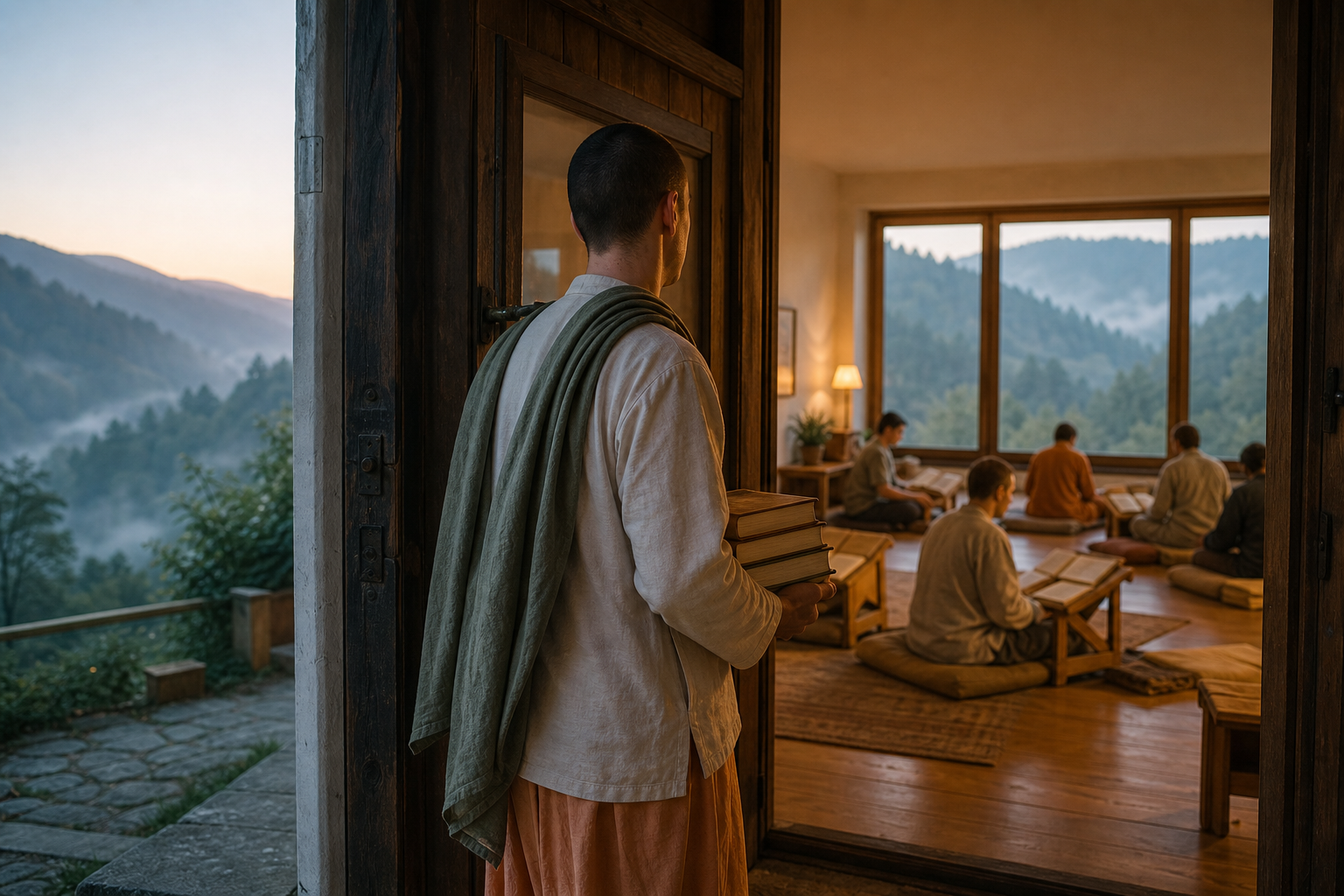
You may already know that you want to study shastra more deeply. The harder question is whether you should leave your ordinary routine and enter residential ashram life for five months. Make that decision by examining the whole discipline being offered, not merely the certificate at the end.
The residential opportunity in the Tryavna Balkans of Bulgaria is an English-language, on-site program for a small community of devotees. Its basic exchange is clear: the course, accommodation and prasadam carry no charge, while participants commit their time, service, participation and willingness to live as members of the community.
Begin with the purpose, not the certificate
Successful completion brings a Bhakti Shastri certificate, but the stated purpose reaches beyond academic completion. The program is intended to deepen your relationship with Krishna and His devotees, strengthen spiritual practice, and cultivate friendship, affection and a sense of family through study, sadhana, seva, preaching and shared life.
That distinction should govern your decision. A certificate records completion. Residential education asks whether knowledge is entering your conduct: how you practise when enthusiasm is low, how you serve when another task would be more appealing, and how you treat devotees when shared life becomes inconvenient.
Before applying, divide a page under the headings knowledge and formation. Under knowledge, write the questions you want to investigate in the prescribed texts. Under formation, name the habits and relationships you hope will change. Include your sadhana, reliability in seva, ability to cooperate and willingness to communicate Krishna consciousness. If the formation side remains empty, pause. You may want a course, but you may not yet want what a residential Bhakti Shastri program is designed to demand.
Also distinguish spiritual aspiration from escape. If your strongest motive is simply to get away from work, family tension or uncertainty about your next step, address that honestly before committing. An ashram can provide a disciplined setting, but joining a community transfers responsibilities; it does not erase them.
Test your readiness for the entire five-month discipline
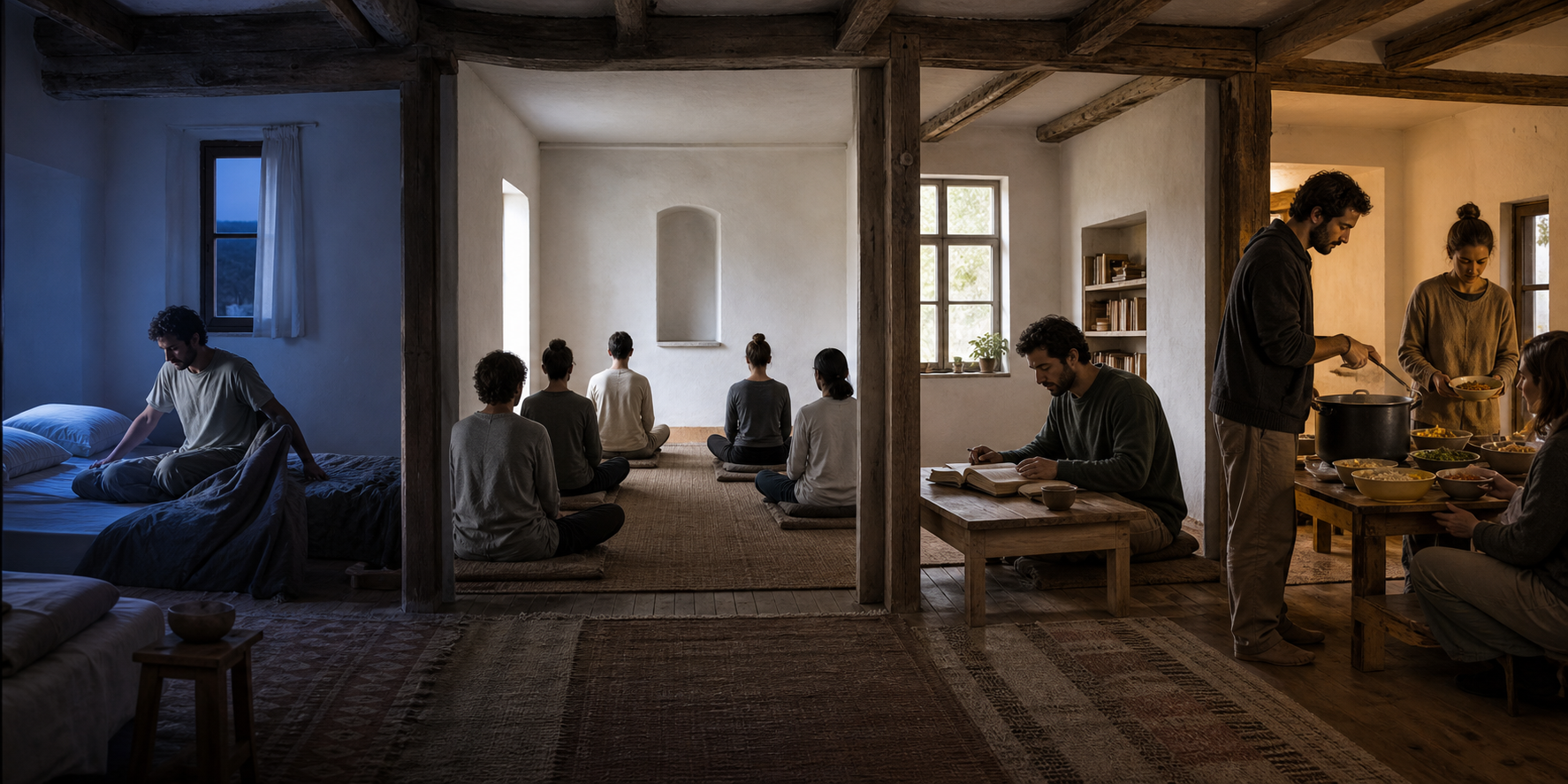
Five months is not a retreat weekend. It is long enough for initial inspiration to give way to routine, and routine is where your actual readiness becomes visible. With only ten available places, each participant’s presence, absence, service and cooperation will matter to the rest of the group.
Assess yourself against every part of the commitment:
- Study: Can you give sustained attention to assigned reading and discussion, rather than relying on occasional bursts of interest?
- Sadhana: Do you want your daily practice to become steadier, and are you prepared for it to shape the rest of the day?
- Seva: Are you willing to perform necessary community service even when the task is not the one you would have chosen?
- Preaching: Are you already involved in preaching or book distribution, or do you have a sincere intention to become involved? The program explicitly identifies this orientation as part of its intended participant profile.
- Community: Can you share space, time and responsibilities without treating the ashram as a private study residence?
- Language: Since instruction is in English, can you follow sustained classes and express questions clearly enough to benefit from them?
Do not answer these questions with aspiration alone. Attach a recent example to each answer. Name a reading commitment you maintained, a service you completed reliably, a devotional routine you kept through an inconvenient period, or a shared responsibility you handled without withdrawing. Where you cannot find an example, identify that area as preparation still to be done.
Residential bhakti is relational. You will not only encounter ideas about humility, cooperation and service; you will have repeated opportunities to practise them with the same people. That can be one of the program’s greatest strengths, but only if you consent to being a contributing member rather than a consumer of classes and facilities.
Read the curriculum as a plan for lived practice

The curriculum consists of Bhagavad-gita, Sri Isopanishad, Nectar of Instruction and Nectar of Devotion. These are not four disconnected reading assignments. Together they can carry you from a broad understanding of the self, action and devotion into the disciplines, relationships and theological vocabulary of bhakti.
- Bhagavad-gita gives the broad frame: the self, duty, action, knowledge, yoga, surrender and devotion.
- Sri Isopanishad concentrates attention on the Supreme, the world, possession, knowledge and ignorance in a compact Upanishadic form.
- Nectar of Instruction brings the discussion into practical discipline, association, relationships among devotees and progress in devotional life.
- Nectar of Devotion supplies a systematic vocabulary for understanding the practices and development of bhakti.
Prepare for this curriculum by making a working page for each text. Record passages you do not understand, teachings you can explain but do not consistently practise, and questions arising from your current service. This gives you something more useful than a general wish to learn more. It gives teachers and fellow students concrete material with which to help you.
You should also ask how successful completion is determined. Find out whether assessment includes examinations, essays, memorisation, presentations, attendance, teaching exercises or another method. Ask how much preparation is expected outside class and which editions or study materials are required. The existence of a certificate is stated; the precise assessment method and issuing body should be confirmed before you rely on that certificate for any later purpose.
Most importantly, ask how the parts of the day reinforce one another. A well-integrated residential course should allow study to illuminate sadhana, seva to expose questions about character, and preaching to reveal whether you can communicate what you have understood. You are choosing a form of education in which the classroom is only one part of the learning environment.
Use the personal interview for mutual discernment

The offer is described as completely free, but the specified coverage is limited to the course, accommodation and prasadam. Do not translate that into a promise that every personal expense is covered. Travel, entry requirements, insurance, learning materials, local transport, personal supplies and continuing obligations at home are not detailed in the available program information.
Resolve those gaps before making arrangements. Where an answer affects your money or your legal ability to enter and remain in Bulgaria, obtain it in writing and independently verify applicable travel or immigration requirements with the relevant official authority. A program organiser can explain the program; only the appropriate authorities can determine your entry status.
Bring a written checklist to the personal interview:
- What are the exact arrival, departure and orientation expectations?
- What does a normal daily and weekly timetable include?
- How are class time, personal study, sadhana, seva and preaching balanced?
- What attendance is required, and what happens if illness or an emergency causes an absence?
- What kind of accommodation is provided, and which personal items should you bring?
- Which expenses fall outside the stated course, accommodation and prasadam coverage?
- Who teaches the four texts, how is learning assessed, and who issues the certificate?
- What preaching and book-distribution activities are expected from participants?
- Are there rules concerning visitors, phones, internet use, quiet time or leaving the ashram?
- How are dietary, health or accessibility needs handled within the limits of the community?
- What is the process for raising a concern, resolving a conflict or leaving early if continuation becomes impossible?
Answer the organisers’ questions with the same precision. Describe your present sadhana as it is, not as you hope it will appear after admission. Be clear about your experience or aspiration in preaching and book distribution. Disclose obligations, health needs or practical constraints that could affect full participation. With a small cohort, hiding a serious limitation does not protect your application; it transfers the difficulty to the community later.
Treat the interview as mutual discernment rather than an audition. The organisers are deciding whether you fit the ashram, and you are deciding whether its discipline, teaching and practical conditions will support the commitment you intend to make. Scarcity should sharpen your honesty, not rush your judgment.
Key takeaways
- A residential Bhakti Shastri course is a commitment to formation through study, sadhana, seva, preaching and community life, not merely a route to a certificate.
- The Bulgaria program requires five months of on-site participation in English and is limited to ten devotees.
- Its curriculum covers Bhagavad-gita, Sri Isopanishad, Nectar of Instruction and Nectar of Devotion.
- The stated no-charge provision covers the course, accommodation and prasadam; confirm every other likely expense and requirement.
- Use the personal interview to establish mutual fit, clarify completion standards and disclose anything that could prevent full participation.
Your next step is concrete: write your formation goal, test each area of readiness against your present conduct, and send your unresolved questions before committing. If the answers align, apply and enter the interview prepared to offer more than enthusiasm. If they do not, continue preparing. A sincere refusal to make an unsustainable promise is more responsible than taking a place you cannot faithfully serve.
References
