

When you hear someone called a dimagi Naxal, the real question is not whether the phrase sounds plausible. It is whether the available evidence identifies a genuine support function, an ideological affinity, organized protest activity, or nothing more than dissent that somebody finds inconvenient.
You need a test that can recognize an insurgency’s intellectual ecosystem without turning every radical professor, student activist, lawyer, writer, or government critic into an underground operative. The sound rule is simple: classify conduct before classifying people, and never substitute political proximity for evidence of a network.
The phrase must name a function, not merely an attitude
Prime Minister Narendra Modi’s reference to dimagi Naxals in his 2026 Independence Day address brought attention to an important problem: an armed revolutionary movement can draw strength from people who never enter an armed squad. Ideas can legitimize violence, attract sympathizers, obscure victims, or create social protection around more committed actors.
That does not make every person with a similar vocabulary part of a Naxal network. Five different things are often collapsed into one accusation:
- Dissent: criticism of the government, police, corporations, development policy, or social inequality.
- Ideological sympathy: agreement with part of a Maoist analysis of class, land, or state power.
- Legitimation: presenting armed revolutionary violence as necessary, admirable, or morally exempt from ordinary scrutiny.
- Organized political support: sustained recruitment, propaganda, mobilization, fundraising, or protection undertaken for a revolutionary project.
- Operational assistance: knowingly supplying money, intelligence, shelter, communications, transport, equipment, couriers, or access to armed cadres.
These categories are not interchangeable. A democratic society may strongly reject a person’s ideology while still recognizing that an opinion is not operational assistance. Conversely, a polished academic vocabulary does not make the deliberate enablement of violence harmless. Precision protects both freedoms and national security.
The word network also carries a burden of proof. A network requires relationships, continuity, and some division of labor. Several people repeating a fashionable argument may form a milieu. They become a support network only when evidence connects their roles, communications, resources, or coordinated activity to a common project.
Map the alleged network in five layers

If you are evaluating a speech, news report, campus controversy, or protest, map the alleged conduct by function. This prevents a dramatic label from doing the work that evidence should do.
| Layer | What to look for | What it can establish |
|---|---|---|
| Ideological production | Arguments that endorse armed revolution, excuse Maoist violence, deny agency to its perpetrators, or portray democratic institutions as inherently illegitimate | Possible ideological sympathy or legitimation; not membership or operational coordination |
| Narrative amplification | Repeated slogans, synchronized framing, selective omission of violence, common media packets, or coordinated distribution across organizations | Possible message discipline or a shared political campaign; not necessarily a Naxal connection |
| Recruitment and socialization | Direct invitations, introductions, closed organizing structures, assigned reading or training tied to participation, and movement from public advocacy into defined roles | A pathway from sympathy to organization, if the people and relationships can be authenticated |
| Mobilization and logistics | Transport, tactical instructions, communications groups, equipment, designated responsibilities, or preparation for a particular confrontation | Organization and possibly premeditation; a Naxal link still requires separate evidence |
| Operational enablement | Authenticated money transfers, shelter, intelligence, procurement, courier activity, command messages, or sustained contact with armed cadres | The strongest basis for alleging concrete support, subject to investigation and due process |
The most common error is to leap from the first layer to the fifth. A writer who romanticizes revolutionary violence may be helping to normalize it, and that deserves a direct intellectual rebuttal. It does not, without more evidence, prove that the writer receives instructions from an underground organization. In the other direction, an apparently moderate public profile does not cancel authenticated evidence of funds, logistics, or command relationships.
How intellectual cover can produce practical effects
Intellectual support matters because political violence needs a moral vocabulary. A grievance is identified; constitutional remedies are declared futile; the revolutionary actor is recast as the only authentic voice of the oppressed; violence by that actor becomes resistance; and every state response is then presented as proof of the original theory. Once that circle closes, contrary evidence can be dismissed in advance.
You can interrupt that process without denying genuine grievances. Ask four separate questions: Is the grievance real? Is the proposed account of responsibility accurate? Is political violence being excused? Is there evidence connecting the speaker to organization or operations? A truthful answer to the first question does not predetermine the other three.
This distinction is especially important for a Dharmic public culture. Viveka requires discrimination between things that merely resemble one another. Ahimsa does not require passivity toward violent movements, and concern for national unity does not justify reckless accusations. You can reject both romanticized insurgency and guilt by association.
What the Delhi protest allegations show and what they do not
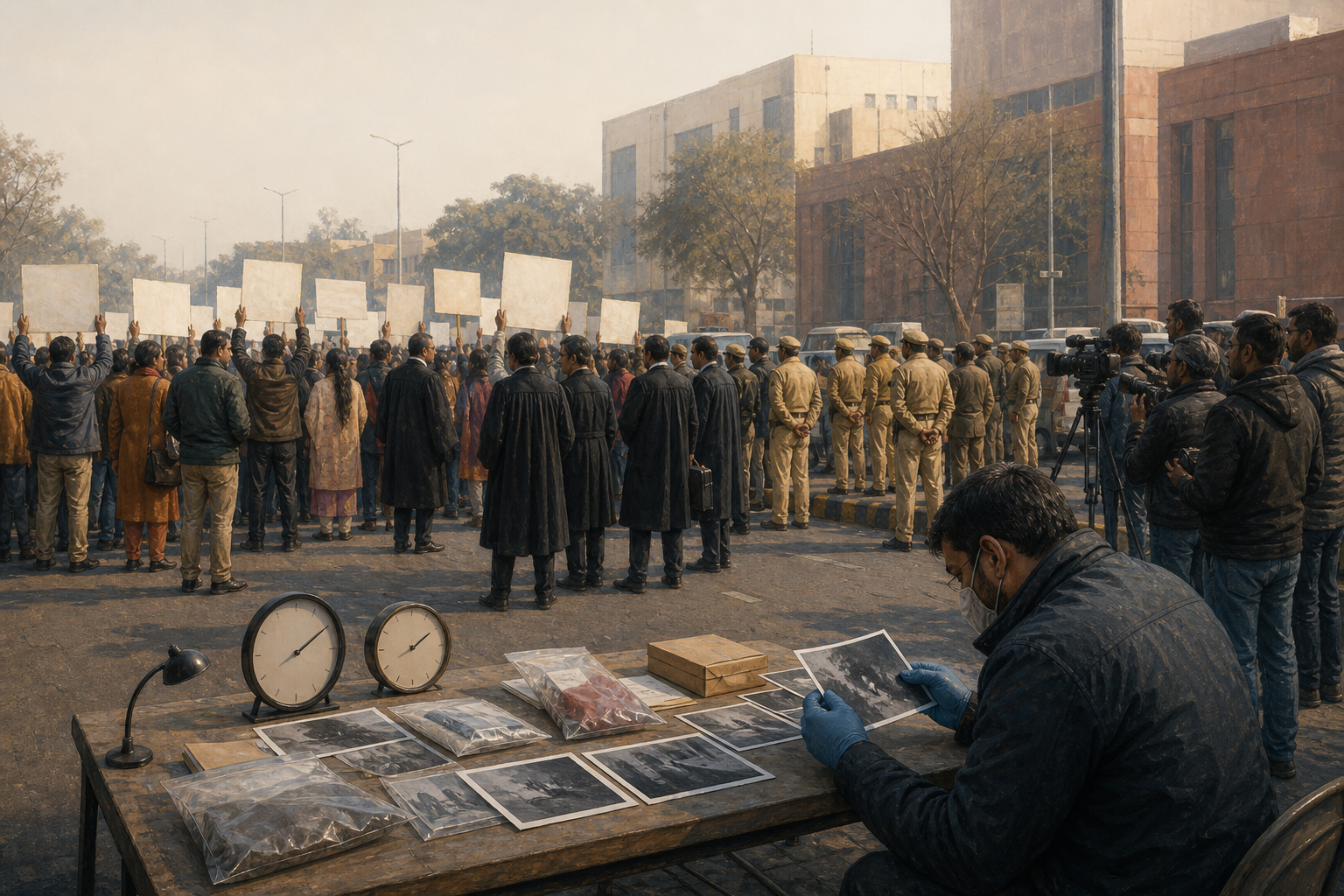
The immediate context for the renewed phrase was alleged organized violence during the July 20 CJP protests in central Delhi. AISA, SFI, and AISF were accused of mobilizing street power through a repeated protest playbook. The alleged indicators included coordination through social media and WhatsApp, wet blankets or towels used against tear-gas shells, attacks on police barriers, and a subsequent narrative of government highhandedness.
If authenticated, such communications and preparations could support a conclusion that participants anticipated confrontation and assigned practical roles. An assault on police barriers or the possession and use of petrol bombs would be serious conduct in its own right. Those propositions should be investigated on their own evidence rather than diluted into a vague cultural argument.
They still do not automatically establish Naxal direction. Social-media coordination is common across contemporary political campaigns. Protective measures against tear gas can indicate tactical preparation, but they do not reveal the ideology, command structure, or ultimate sponsor of the people using them. Even an organized riot and an organized Naxal support operation are different claims requiring different proof.
The comparison with earlier unrest raises a legitimate question about repetition. In the December 2019 Jamia Millia episode, protesters were accused of arriving with wet blankets and towels as well as petrol bombs. Similar tactics across separate events may justify examining whether organizers, training materials, communication channels, or logistics overlapped. Similarity alone proves a shared tactical repertoire, not a shared command.
The missing bridge is therefore decisive. To move from protest organization to a defensible claim about a Naxal support network, look for authenticated communications with identified cadres, traceable resource flows, recurring intermediaries, explicit instructions, stable organizational relationships, credible testimony, or findings tested through legal process. Without that bridge, the responsible conclusion is limited: there may be coordinated militancy, but the asserted insurgent connection remains unproven.
This is not softness. Overstatement helps sophisticated networks because it surrounds strong evidence with weak accusations. When every adversary becomes a Naxal, the term stops distinguishing an armed revolutionary ecosystem from ordinary opposition politics.
Use an evidence ladder before accepting or publishing a claim

You can assess a claim systematically even when information is incomplete. For each name or organization, move through these steps in order:
- Write the exact allegation. Replace labels with a sentence describing conduct: endorsing violence, coordinating a protest, recruiting participants, transferring funds, carrying messages, or receiving directions. If you cannot state the conduct, you do not yet have a usable claim.
- Classify the layer. Decide whether the material concerns ideology, narrative amplification, recruitment, mobilization, or operational enablement. Do not import a conclusion from a higher layer.
- Authenticate the underlying material. Locate the complete speech, message thread, video, financial record, official filing, or testimony. Check identity, date, sequence, and context. A cropped screenshot or short clip may generate a lead; it should not carry a grave public accusation by itself.
- Test alternative explanations. Shared slogans can arise from imitation. Common tactics can spread without central command. Attendance at the same event can reflect coalition politics. Ask what evidence would distinguish coordination from convergence.
- Look for continuity and reciprocal ties. A network is more than a one-time encounter. Repeated communication, assigned roles, resource exchange, introductions between nodes, and action following instructions are more probative than social or professional proximity.
- Connect the conduct to an insurgent benefit and knowing intent. Show not only that an action occurred, but why it assisted the revolutionary organization and what indicates that the person understood that function. Benefit without knowledge and sympathy without assistance are materially different cases.
- State the conclusion at the level the evidence supports. Use terms such as allegation, verified fact, inference, and unknown accurately. Only competent authorities and courts can determine criminal liability.
Editors, researchers, and citizens should keep a simple evidence ledger. Put each important assertion under one of four labels: verified fact, attributed allegation, inference, or unresolved question. If an inference is doing most of the work, say so. This makes advocacy more credible because readers can see where the evidence ends and judgment begins.
Public naming also carries consequences. An unsupported accusation can damage an innocent person, expose a publisher to legal risk, and make later reporting about genuine support activity easier to dismiss. Do not dox, infiltrate, or circulate private data of uncertain origin. Preserve lawfully obtained material, record its provenance, report credible threats to the proper authorities, and obtain legal review before attaching criminal implications to identifiable people.
Key takeaways for a precise response

- An intellectual support network should be identified by functions, relationships, continuity, and evidence, not by profession or political identity.
- Ideological sympathy, legitimation of violence, organized mobilization, and operational assistance are distinct categories.
- Coordinated protest tactics may establish preparation or organization without establishing a Naxal command relationship.
- Violent conduct should be investigated directly; attaching a broader ideological label does not remove the need to prove the act or the connection.
- A defensible network claim needs bridge evidence such as authenticated communications, recurring intermediaries, resource flows, instructions, or durable ties.
- Rejecting Maoist violence and protecting lawful dissent are complementary democratic duties.
The next time the phrase dimagi Naxal appears, translate it into a specific allegation and mark the evidentiary layer. If the case stops at rhetoric, association, or tactical resemblance, say that plainly. If it reaches verified coordination with armed cadres, document the relationship precisely and let due process follow. Bharat is better protected when a serious accusation has a serious standard of proof.
References
