
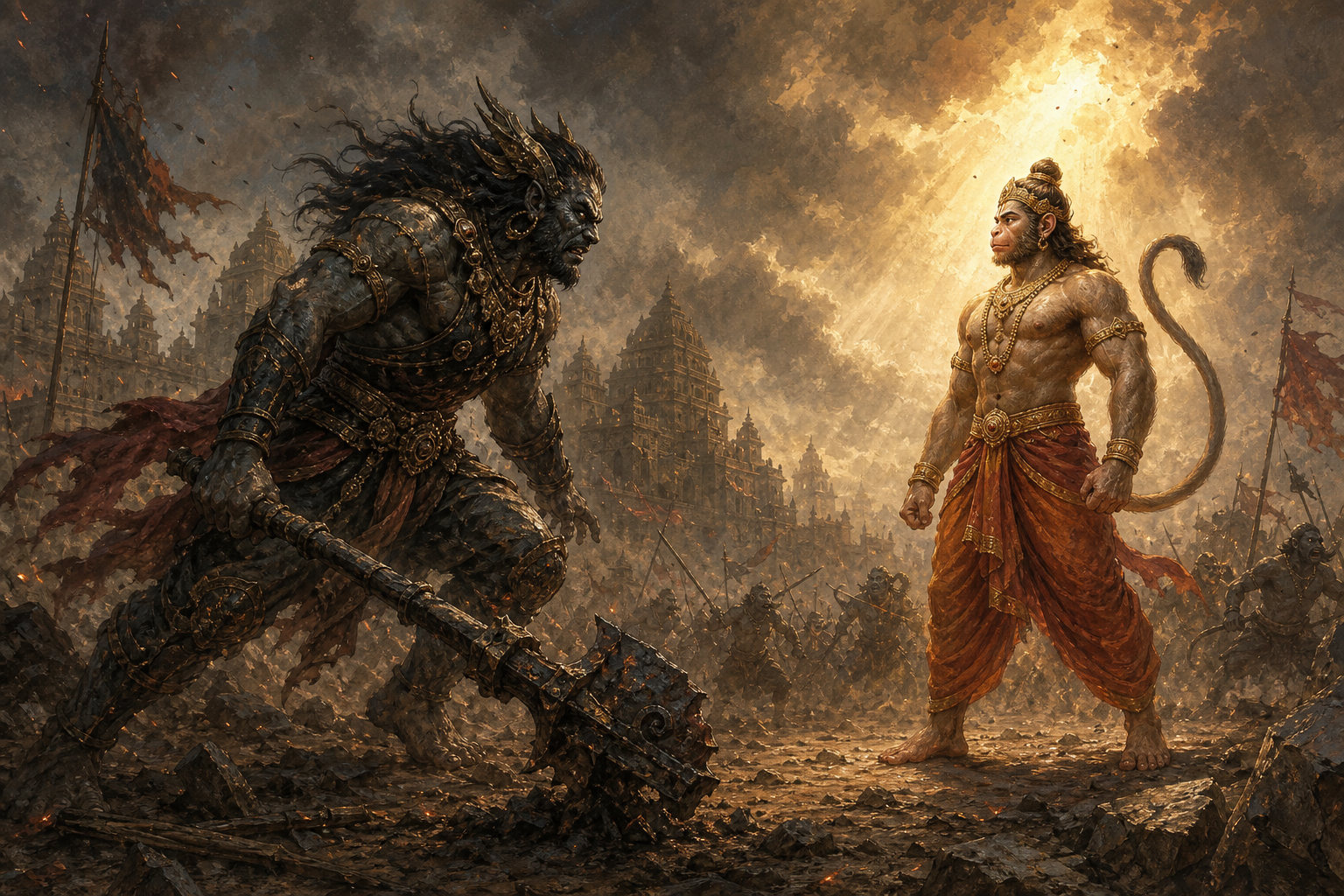
If you came to Nikumbh’s final battle wondering whether the Ramayana simply condemns anger, the episode gives you a more demanding answer. The first surge of anger is not the whole problem. The danger begins when anger becomes your commander and leaves dharma no room to examine the order.
Nikumbh has strength, courage, lineage and loyalty. None of them saves him once grief hardens into an unquestioned demand for retaliation. His fall therefore gives you a practical test for your own moments of injury: before you act, separate what you feel, whom you love and what dharma actually requires.
What happens in Nikumbh’s final battle
Nikumbh and Kumbh are the powerful sons of Kumbhakarna and devoted defenders of their uncle Ravana. Their father’s death has already placed them inside a cycle of bereavement, loyalty and vengeance. When Kumbh also falls in battle, Nikumbh’s grief erupts as fury.
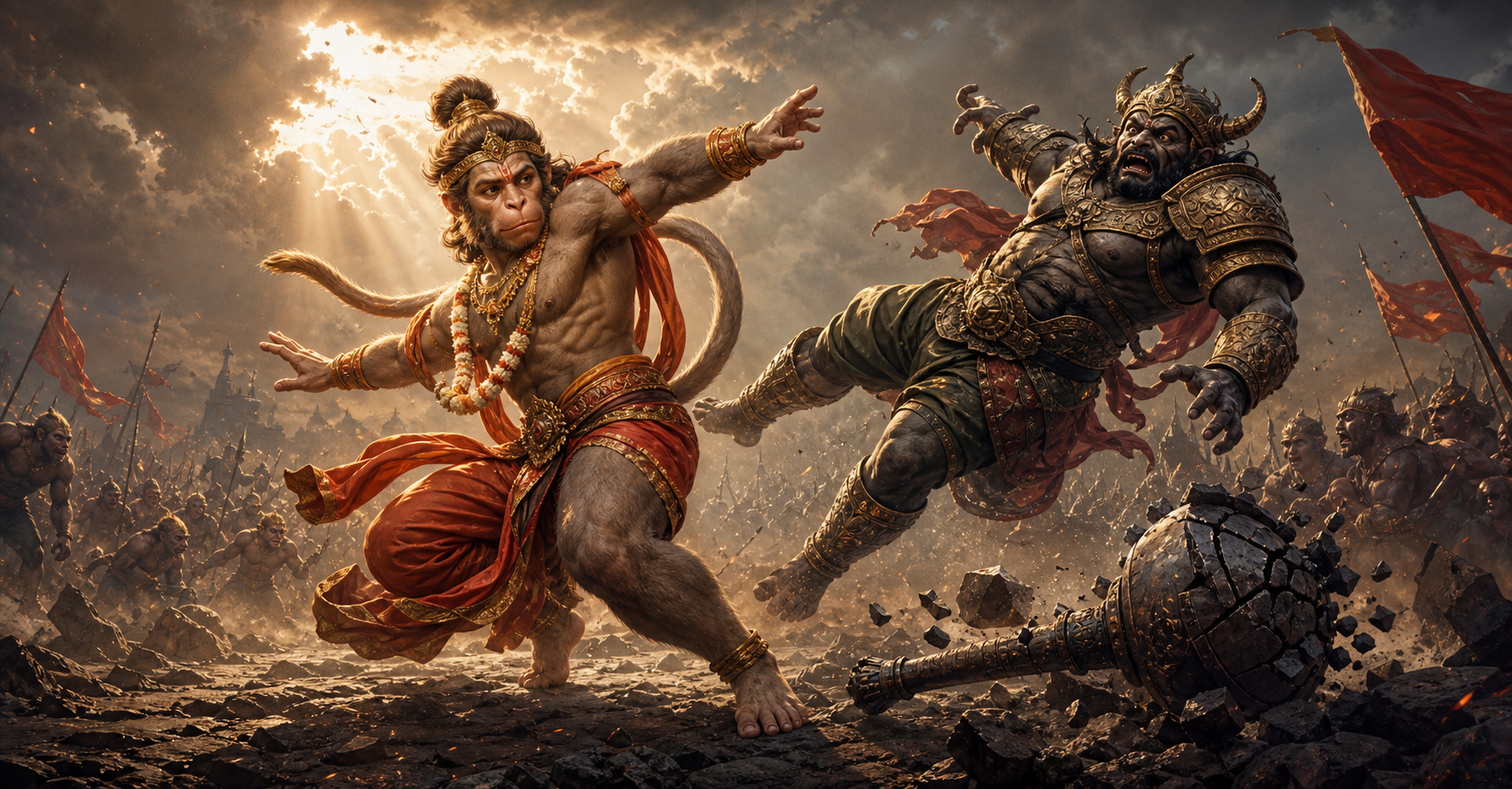
He turns that fury against Hanuman. Nikumbh attacks with immense force, but his blow does not overcome his opponent. Hanuman withstands the assault, counters it and ultimately kills Nikumbh in close combat. The sequence is short but morally precise: a painful loss is followed by rage, immediate escalation, a failed decisive attack and no meaningful reassessment before the fatal end.
Two common readings miss the point. Nikumbh does not fall because he is weak or cowardly; the narrative presents him as formidable. Nor does anger operate like a magical curse that instantly removes his physical power. His strength remains, but it is no longer governed by clear discernment. He allows the wound to choose both the objective and the method.
That distinction matters when you apply the episode to life outside a battlefield. Feeling anger after loss can be understandable. Treating that feeling as proof that your next action is righteous is the mistake.
Anger can identify a wound, but it cannot determine dharma

Anger carries information. It may tell you that a bond has been broken, a boundary crossed, a duty neglected or something precious lost. But information is not instruction. Anger can announce that something matters without knowing what a proportionate and dharmic response should be.
Nikumbh’s attachment to his family makes his rage intelligible. It does not make Ravana’s cause righteous, and it does not transform retaliation into dharma. A sincere emotion can accompany a wrong judgment. Deep loyalty can intensify an error just as easily as it can sustain a virtue.
Anger also compresses the moral field. It encourages a person to see only injury and retaliation, ally and enemy, victory and humiliation. Questions about the original cause, the justice of one’s allegiance, the proportionality of the response and the likely consequences are pushed aside. Nikumbh’s power then serves the most immediate impulse rather than the highest obligation.
You do not have to deny anger in order to refuse its command. A more disciplined response begins by holding three things apart: the fact that occurred, the emotion it produced and the duty that remains. If you merge them, whatever feels urgent will appear obligatory. If you separate them, you can acknowledge the wound without granting it moral authority.
Loyalty becomes dangerous when it stops examining its cause
Nikumbh’s story is not an argument against loyalty. Loyalty gives relationships endurance and makes sacrifice possible. The warning is about loyalty severed from moral examination. When devotion to a person becomes unconditional obedience to that person’s cause, virtue can be recruited into adharma.
Nikumbh is brave, but courage alone cannot sanctify the side on which it is used. He is loyal, but loyalty alone cannot absolve the purpose it serves. He is powerful, but power cannot correct a morally disordered allegiance. These qualities are instruments. Dharma depends on what directs them.
The contrast with Hanuman is therefore more instructive than a simple contest between a stronger warrior and a weaker one. Both possess extraordinary force. Nikumbh’s force is seized by fury and tied to Ravana’s cause; Hanuman’s force remains ordered toward service to Rama and the purpose for which he entered the war. One warrior tries to discharge anger through destruction. The other absorbs the attack and responds effectively without surrendering his purpose to his opponent’s emotional state.
When loyalty puts you under pressure, ask four concrete questions. Are you defending a principle or merely protecting a person from accountability? Would you approve of the same conduct if it came from the opposing side? Does your proposed response correct the wrong or merely multiply it? Would you still choose it after the immediate desire to retaliate has passed?
These questions do not demand passivity. Dharma may require resistance, a firm boundary or decisive protection of another person. The distinction is between an action designed to fulfil a duty and a reaction designed to make someone else carry your pain.
Use a five-step Dharmic pause before anger chooses for you

Nikumbh’s mistake occurs in the gap he does not preserve: the interval between being struck by loss and deciding what the loss permits him to do. You can preserve that interval before sending a hostile message, making a public accusation, breaking a relationship or entering a confrontation.
- State the event without adding a verdict. Write what occurred in language that another observer could verify. “They rejected my proposal” is a fact; “they decided to humiliate me” assigns a motive you may not know.
- Name what the anger is defending. Identify whether the threatened thing is safety, duty, a relationship, reputation, status or pride. A real danger and an injured self-image do not call for the same response.
- Test the cause as well as the emotion. Ask whether the person or group you support is acting dharmically. Kinship, friendship and shared identity deserve consideration, but they do not erase accountability.
- Choose the least harmful action that still fulfils the duty. Depending on the situation, that may mean asking for clarification, documenting the facts, setting a boundary, withdrawing from the exchange or involving a trusted mediator. Firmness does not require vindictiveness.
- Examine your purpose once more before acting. If you can state the correction you seek in one calm sentence, your response has a usable aim. If the honest aim is only to embarrass, frighten or hurt the other person, do not rename retaliation as righteousness.
This pause is not suppression. Suppression pretends the anger is absent. Self-command admits that the anger is present while refusing to let it occupy the seat of judgment. If immediate protection is necessary, create safety first; the pause is not an excuse to remain exposed to harm. In every other case, let discernment catch up before you make the situation harder to repair.
Key takeaways
- Nikumbh remains physically powerful, but anger deprives his power of disciplined direction.
- Grief and loyalty can explain an emotion without making the resulting action dharmic.
- A virtue such as courage or loyalty must still be judged by the cause, means and consequences it serves.
- Hanuman’s advantage is not force alone; it is force kept subordinate to purpose.
- Before acting in anger, separate the verifiable event, the threatened attachment and the duty that genuinely remains.
At your next provocation, write three lines before you respond: what happened, what duty remains and what action would fulfil that duty without feeding revenge. That small interval between heat and action is where Nikumbh’s fall becomes a discipline rather than merely a remembered battle.
References
