

You may have encountered Shikhandi in a list of Shaiva deities and wondered whether the name refers to the warrior of the Mahabharata. In this setting, it does not. Shikhandi is a form associated with the Shaiva Agamas and must be understood through the category of Vidyeshvara.
That distinction changes how you read the name, the theology, and any image identified with it. The reliable approach is to establish the Agamic context first, understand what an emanational form does, and only then examine iconography or symbolism.
Separate the Agamic Shikhandi from the epic character

The same English spelling can refer to two very different figures. The Mahabharata’s Shikhandi belongs to an epic narrative of lineage, conflict, vows, and the Kurukshetra war. The Shikhandi discussed in Shaiva Agama belongs to a theological classification of Shiva’s manifestations.
This is not a minor scholarly distinction. If you carry the epic character’s biography, gender history, or role in battle into the Agamic setting, you will build an interpretation on the wrong identity. A shared name does not establish a shared narrative.
You can usually identify the intended context by noticing the company the name keeps:
- If the passage concerns the Pandavas, Bhishma, Drupada, war, lineage, or a personal vow, it is the epic character.
- If Shikhandi appears in a liturgical or cosmological list, especially beside the term Vidyeshvara, it is the Agamic manifestation.
- If a museum label, temple caption, or online image gives only the name, treat the identification as incomplete until you find its textual or ritual context.
The practical rule is simple: classify before interpreting. Do not let a familiar story supply details that the Shaiva setting has not supplied.
Why the Vidyeshvara category is the key

Shaiva theology does not reduce Shiva to a single visible personality. Shiva is the all-pervading reality who can become present through distinct forms associated with differentiated cosmic and spiritual functions. Those functions may concern creation, sustenance, spiritual knowledge, and liberation without dividing Shiva into competing divine beings.
Within that framework, Shikhandi is identified as a Vidyeshvara and belongs to a group of eight such manifestations. The number eight therefore tells you that Shikhandi is part of an ordered theological structure, not an isolated epithet or a stray regional name.
The word Vidyeshvara combines the ideas of vidya, knowledge, and ishvara, lordship or governing power. The compound gives you an important orientation, but a dictionary gloss is not a complete theology. Here, knowledge is not merely information collected by the mind. It belongs to the sacred order through which bondage is overcome and liberation becomes possible.
Three distinctions help you understand the category correctly:
- Manifestation is not competition. Shikhandi should not be imagined as a rival to Shiva. The form expresses Shiva’s ordered presence within a particular theological function.
- Multiplicity does not cancel unity. Eight Vidyeshvaras can express differentiated operations while remaining grounded in the one Shaiva reality.
- A divine form can signify an office as well as an appearance. Asking what Shikhandi does within the Agamic order is at least as important as asking what an image looks like.
This prevents two opposite mistakes. One is to treat every named manifestation as a wholly independent god. The other is to flatten every manifestation into an interchangeable image of Shiva. Shaiva thought can preserve both unity and meaningful differentiation.
Read Shikhandi’s iconography without filling the gaps
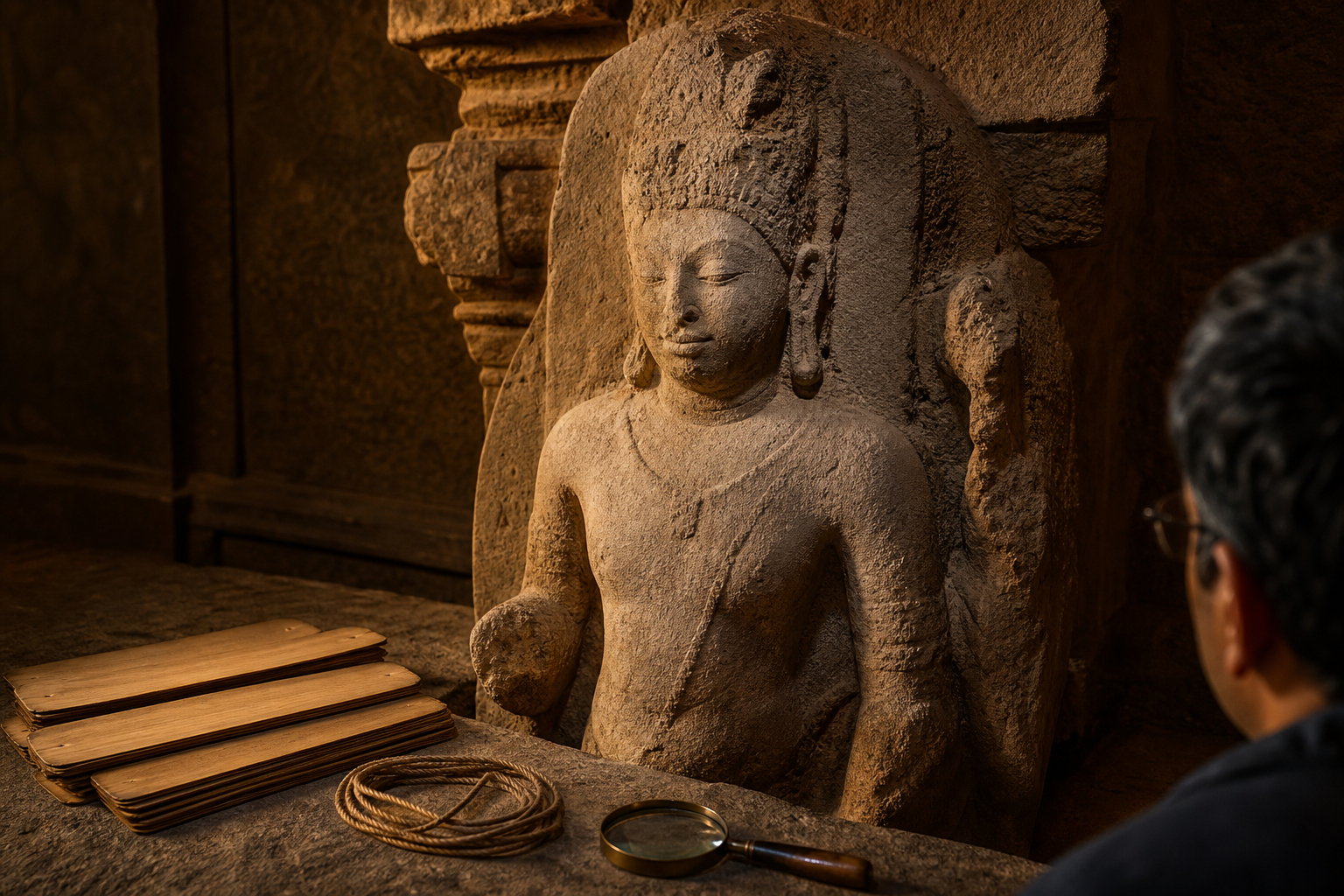
Agamic images are not free-form illustrations. Posture, hands, emblems, ornaments, faces, attendant figures, placement, and ritual use can carry precise meaning. Yet the name Shikhandi by itself does not authorize you to assign any of those features.
A generic Shiva attribute is not automatically a Shikhandi attribute. A trident, drum, serpent, crescent, or particular hand gesture may immediately look Shaiva, but familiarity is not evidence for a form-specific identification. Likewise, a striking visual resemblance found in an online image cannot replace a textual label, inscription, catalog record, or living temple tradition.
Use this sequence when you encounter a claimed image of Shikhandi:
- Record where the identification came from. Note the temple, manuscript, catalog, inscription, book, or website rather than saving an uncaptioned image alone.
- Check whether Vidyeshvara is explicitly named. This is the strongest immediate clue that the Agamic Shikhandi is intended.
- Look at adjacent names. Membership in an eightfold list is more informative than the isolated name because it establishes the theological category.
- Describe before interpreting. Write down only what is visible: number of arms, objects, gestures, posture, headgear, attendant figures, and placement. Keep observation separate from symbolic explanation.
- Verify the relevant tradition. An Agamic passage, temple manual, traditional commentary, inscription, or qualified teacher should establish which features belong to Shikhandi in that setting.
- State the level of certainty. Use identified when a dependable label or tradition supports the name, probable when contextual evidence is strong, and possible when resemblance is the main evidence.
This method may feel cautious, but it preserves what sacred iconography is meant to convey. Invented precision is worse than an admitted gap. If the available material does not specify Shikhandi’s weapons, color, direction, posture, or mantra, leave those points open.
What the emanational form asks you to notice

The word emanation can be misunderstood as if Shiva were a material object broken into smaller pieces. A more useful reading is ordered self-expression: the one divine reality becomes intelligible and operative through distinguishable forms without ceasing to be one.
Seen this way, Shikhandi draws your attention to three connected ideas:
- Divine unity can contain real differentiation. A form has a particular place and meaning without being cut off from Shiva.
- Sacred knowledge is transformative. The Vidyeshvara designation points beyond intellectual accumulation toward knowledge involved in release from limitation.
- Iconography serves recognition. A consecrated form gives disciplined attention a concrete support; it is not merely decoration added to an abstract doctrine.
For contemplation, begin with the relationship between unity and function. Ask how one reality can be present through many ordered forms, and how knowledge changes the knower rather than merely adding facts. That question stays close to Shikhandi’s Vidyeshvara identity without pretending to reconstruct a form-specific meditation that has not been transmitted to you.
The same discipline applies to worship. If your lineage or temple preserves a Shikhandi mantra, visualization, or ritual procedure, follow that established transmission. If it does not, do not improvise an esoteric practice from an image caption. You can honor the form as an expression of Shiva while continuing the ordinary Shaiva practice taught within your tradition.
Key takeaways and your next step
- Agamic Shikhandi is a manifestation associated with Shiva, not the Mahabharata warrior who bears the same name.
- Shikhandi belongs to a group of eight Vidyeshvaras, so the name must be read within an ordered Shaiva theological system.
- Vidyeshvara points toward the governing and liberating role of sacred knowledge, not merely book learning.
- The category establishes theological identity, but it does not by itself establish every visual attribute, mantra, direction, or ritual detail.
- A secure iconographic identification requires context: a textual list, inscription, catalog record, temple tradition, or transmitted explanation.
- When evidence is incomplete, preserve the distinction between what is visible, what is traditionally identified, and what is your own interpretation.
Your best next step is to return to the exact place where you found the name. Record its spelling, the names around it, the work or temple in which it appears, and any stated attributes. Those four details will tell you whether you have an Agamic classification, an iconographic prescription, a local temple identification, or only an unsupported caption.
Approach the next reference to Shikhandi with three notes in front of you: context, category, and certainty. That small habit will keep the epic and Agamic identities separate while allowing the Vidyeshvara form to disclose its proper Shaiva meaning.
References
