

If you have come to remember Vamsidas Babaji and Raghunandana Thakura, the difficult question is not how many extraordinary accounts you can retell. It is what their remembrance should change in your next act of seva.
Their lives can seem unreachable from ordinary household practice. Raghunandana Thakura embodies childlike trust; Vamsidas Babaji embodies consuming absorption. You do not honor either saint by copying an outward action. You honor them by noticing where worship has become hurried, impersonal, or merely correct, and then restoring the relationship at its center.
Why these two Vaishnavas belong in one remembrance
Gaudiya Vaishnava remembrance places Vamsidas Babaji Maharaja and Sri Raghunandana Thakura together, but their spiritual personalities should not be flattened into a single type. Raghunandana’s remembered mood is transparent and uncomplicated. Vamsidas Babaji’s absorption appears intense, unpredictable, and difficult for an ordinary observer to measure.
The common ground is Sri Vigraha-seva. In Gaudiya Vaishnava theology, the Deity is not a decorative representation placed in a sacred corner. Bhagavan mercifully makes personal service possible through the worshipable form. Preparing an offering, cleaning a plate, bringing flowers, singing, bowing, and receiving prasada are therefore parts of a relationship. They are not stage properties surrounding an idea.
This gives you a practical test. Before your next offering, ask whether you are preparing something for someone or simply finishing a religious task. Correct procedure still matters; sincerity is not permission to disregard the standards received through guru, sadhu, and shastra. Yet procedure has fulfilled its purpose only when it supports attentive service. Form protects the relationship, and the relationship gives the form its life.
Raghunandana Thakura corrects our distance from the Deity
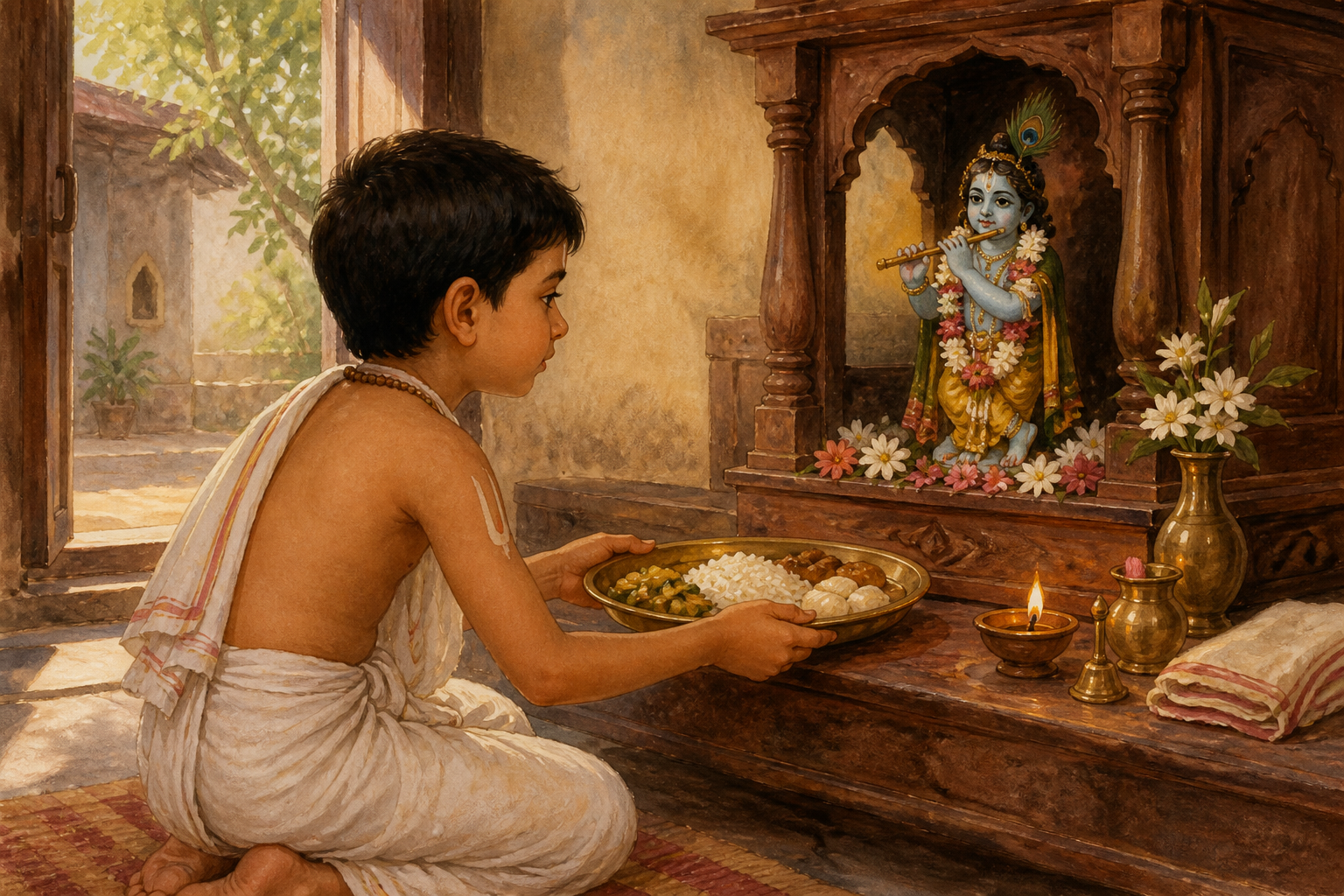
The familiar remembrance of Raghunandana Thakura centers on a child entrusted with service to the household Deity. He does not approach the instruction with the guarded distance of someone merely completing a convention. He takes both the instruction and the Lord’s presence seriously.
That mood is childlike, not childish. Childishness demands an experience on its own terms. Childlike bhakti offers itself without maintaining a cynical observer outside the act of worship. Raghunandana’s example does not teach you to demand a miracle, test the Deity, or expect your devotional life to reproduce a sacred narrative. It teaches you to stop acting as though Bhagavan were absent while you perform a ceremony addressed to Him.
You can apply that distinction without inventing an elevated inner state:
- Prepare the offering before beginning the act of worship, so you are not repeatedly leaving to find missing items.
- Put the phone away. An offering divided between the altar and notifications trains divided attention.
- Address the Lord directly and simply. A sincere request to accept the offering is more truthful than elaborate words spoken automatically.
- Allow the offering to remain an offering. Do not spend the moment mentally planning when you will eat the prasada.
- Receive prasada with gratitude rather than treating it as ordinary food that has completed a religious formality.
If your household worship follows instructions given by a guru or a temple tradition, keep those instructions. The change needed is not novelty. It is presence. Perform the same authorized service with less distraction and less inner distance.
Vamsidas Babaji shows why absorption cannot be performed
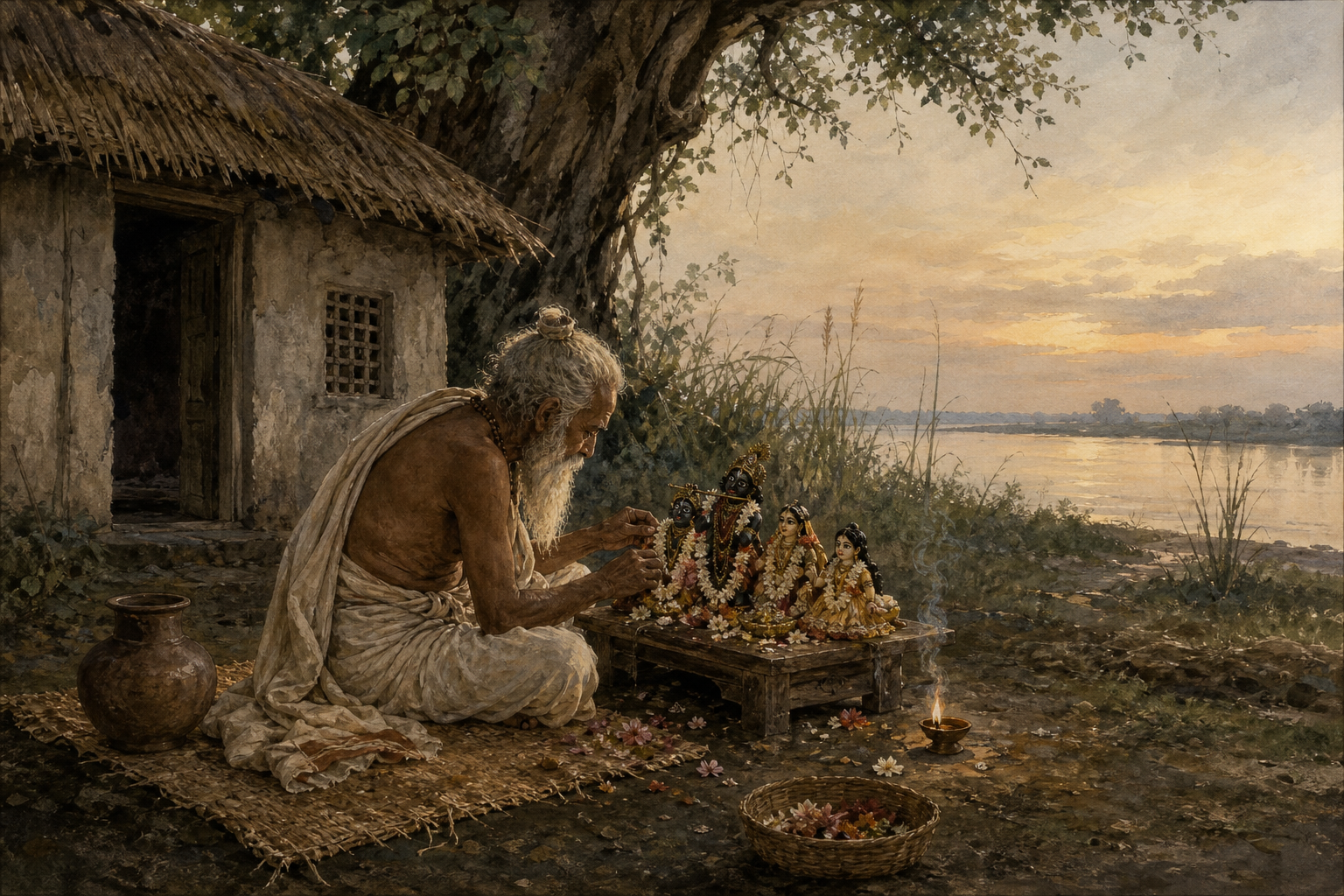
Vamsidas Babaji is remembered for making service to his Deities the living center of his existence. Accounts of such a saint can unsettle readers because his dealings do not always resemble the orderly public behavior by which we usually judge religious seriousness.
The wrong response is to imitate the strangeness. The right response is to notice the absorption. His outward conduct belonged to his realization and relationship; it is not a technique that another person can adopt. Copying an advanced devotee’s external manner does not produce that devotee’s consciousness, just as copying the movements of a musician does not produce mastery of the raga.
For an ordinary practitioner, Vamsidas Babaji’s example raises more useful questions:
- Do you handle the Lord’s paraphernalia as entrusted property, or as miscellaneous household objects?
- Does cleaning the altar feel like part of worship, or like an interruption before the worship begins?
- Do you speak prayers as direct address, or only discuss Bhagavan in the third person?
- When seva is inconvenient, do you simplify it responsibly or quietly abandon it?
- Has familiarity made you careless with something you once approached reverently?
Choose one answer that makes you uncomfortable and repair that part of your practice. Clean and store neglected paraphernalia. Reestablish an offering you can sustain. Learn the meaning of a prayer you already recite. Give the altar your full attention while you are there. These are modest actions, but they move in the direction indicated by absorption.
You do not need to manufacture conversations, visions, or unusual moods. Prayer is already direct address. Seva is already an encounter shaped by the tradition. A sincere practitioner has enough work in becoming attentive, steady, truthful, and humble without performing signs of attainment.
Do not turn extraordinary saints into excuses
Sacred biographies often preserve conduct that cannot be converted into a general rule. That is especially true when a saint’s inner realization is presented through unusual outward behavior. Reverence therefore requires discrimination. We can honor what the tradition remembers without pretending that every reader is qualified to reproduce it.
Three mistakes commonly obscure the lesson:
- Imitating irregularity: An exceptional act by a realized devotee does not cancel the disciplines governing your own stage of practice.
- Using emotion as a license: Strong feeling does not excuse broken commitments, neglect of dependants, disrespect toward devotees, or disregard for guidance.
- Rejecting whatever looks unfamiliar: A saint need not conform to a modern image of calm, polished spirituality before you can acknowledge the depth of his devotion.
The safest interpretive test is the fruit produced in you. If hearing about a saint makes you more conscientious in seva, more respectful toward devotees, and less eager to advertise yourself, you have probably received the account well. If it makes you feel exempt from discipline or qualified to judge everyone else’s devotion, you have missed its direction.
This approach also avoids a false choice between gullibility and contempt. You can receive a devotional narrative within the theological world that gives it meaning without turning it into a demand for laboratory proof. You can also admit that you do not understand an exalted person’s conduct. Humility sometimes means neither imitating nor dismissing.
Make their remembrance visible in your next seva

A disappearance-day observance should leave a trace after the katha ends. Keep the observance small enough to perform honestly and concrete enough to affect your routine.
- Hear before interpreting. Give your attention to a reliable Vaishnava narration of their lives instead of assembling impressions from isolated anecdotes.
- Offer one service without multitasking. It may be cooking, cleaning, arranging flowers, chanting, reading, or serving prasada. The important change is undivided attention.
- Repair one neglected standard. Restore a duty you already know belongs in your practice rather than inventing an impressive new vow.
- Identify the obstacle precisely. Name whether the problem is haste, forgetfulness, resentment, disorder, excessive ambition, or simple inconsistency. A vague resolution rarely changes a routine.
- Choose a sustainable correction. Let the correction fit your actual responsibilities and the guidance you have received. Steady seva is more useful than a dramatic promise that disappears quickly.
- Offer the result. Do not use the observance to build an identity as a serious devotee. Ask instead that your service become pleasing and free from pretence.
Key takeaways
- Raghunandana Thakura teaches you to approach the Deity without the inner assumption that the Lord is absent.
- Vamsidas Babaji teaches you to value absorption without imitating the external behavior of an advanced saint.
- Correct ritual form and personal devotion are partners: discipline protects seva, while attention keeps it from becoming mechanical.
- The best tribute is a specific repair in your own practice, performed quietly and sustained after the observance.
Before your next offering, remove one distraction and correct one careless habit. Let Raghunandana Thakura challenge your distance, and let Vamsidas Babaji challenge your half-heartedness. Then perform the service already in front of you as though it truly belongs to Bhagavan.
References

Leave a Reply
You must be logged in to post a comment.