
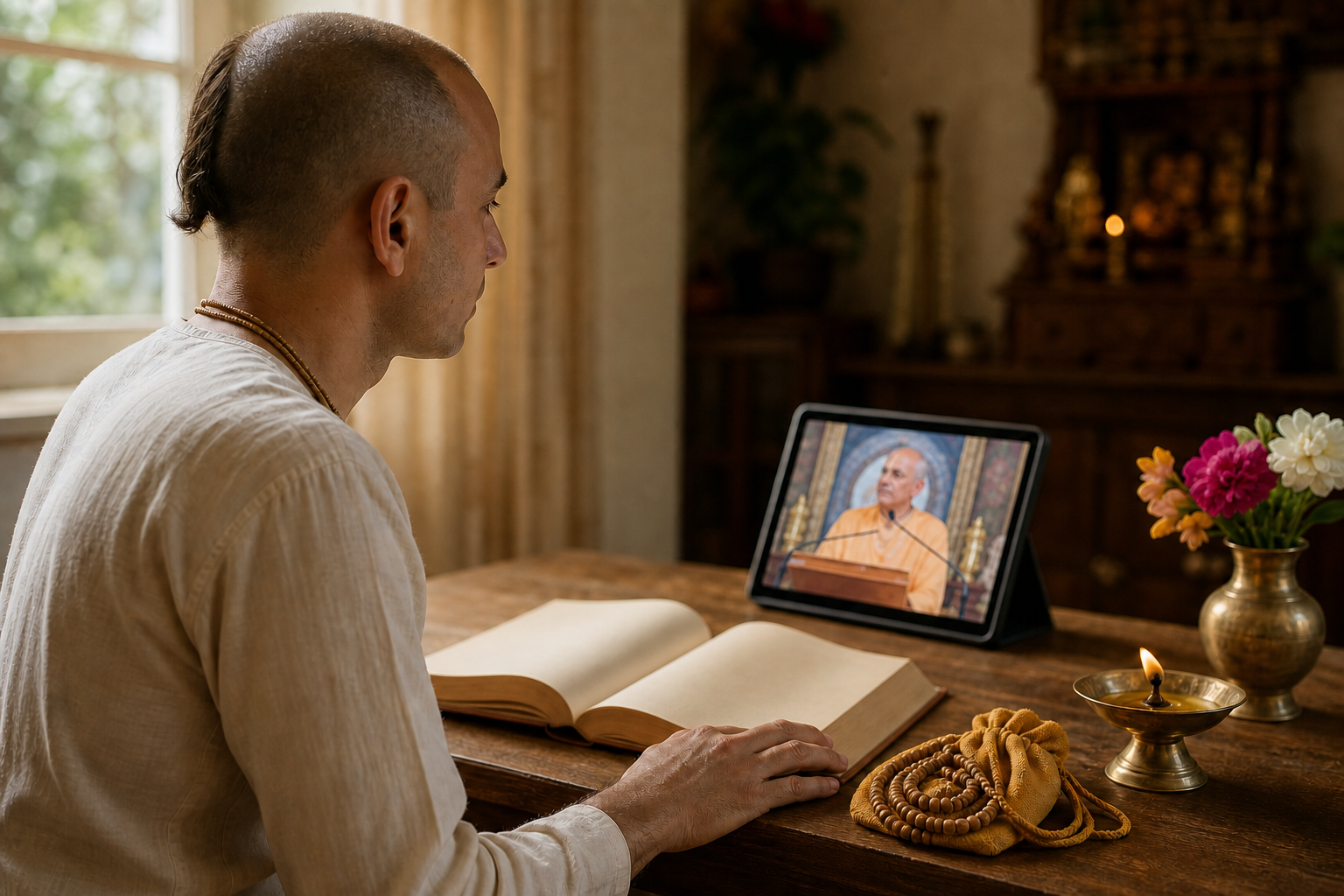
You may want a regular rhythm of ISKCON teaching, yet a weekly feed can give you more choices than one sitting can absorb. A Sunday selection dated August 16, 2026 moved among Srimad Bhagavatam and Caitanya Caritamrita classes, a talk on dissatisfaction, memories of a disciple of Srila Prabhupada, and the life of a Vaishnava saint. If you simply click whatever looks interesting, the feed ends up choosing your course of study for you.
A better method is to arrive with one question, keep the relevant passage open, and leave with one practice to carry into the week. You do not need to consume every discourse. You need to hear one teaching carefully enough that it changes what you notice and what you do.
Choose the talk by the work you need it to do

Begin by naming why you are listening. Are you trying to understand a passage, work through a recurring tendency, learn how devotees embodied bhakti, or become better acquainted with the Vaishnava lineage? These are different purposes, and they call for different kinds of talks.
- For close scriptural study, choose a title that gives you a precise textual address. Recent examples include Srimad Bhagavatam 3.27.28-29 with Rasamaya Nityananda Das, 11.5.28 with Bhima Prabhu, and 11.3.44 with Chakravarti Prabhu. A verse number lets you prepare, verify what you hear, and return to the passage afterward.
- For study within the Gaudiya Vaishnava narrative and theological tradition, choose a Caitanya Caritamrita class. The same weekly stream included Madhya-lila 17.179 with Subhag Swami and Adi-lila 14.67-68 with Dayal Mora Das. Record the lila division as well as the chapter and verse; dropping part of the reference makes later review harder.
- For a practical question, a thematic title may be the better doorway. The Cure for Dissatisfaction, for example, clearly names the condition it intends to address. The title does not tell you what the proposed cure is, however. Listen to discover the argument rather than assuming that the title has already given you the teaching.
- For lineage and devotional character, choose remembrance or biography. Memories of Gopal Prabhu, identified as a disciple of Srila Prabhupada, and a presentation on the devotion of Sri Vamsidasa Babaji belong to this category. Approach them for remembered conduct, devotional disposition, and historical orientation rather than expecting verse-by-verse exposition.
Write your purpose in one sentence before you press play: this week, you want to understand a named passage, examine a named tendency, or learn from a named devotee. That sentence is your filter. A renowned speaker, respected honorific, familiar temple, or appealing title may draw your attention, but none of those automatically answers the question you brought.
If you want continuity, stay with one textual thread for a while. Moving from the Bhagavatam to Caitanya Caritamrita, then to biography and back again can broaden your exposure, but it does not by itself build depth. Survey deliberately when you want breadth; otherwise, let the scripture you are studying determine your next choice.
Open the cited scripture before you open the video

A passage number is more than metadata. It gives you an independent point of return. Without it, the speaker’s illustrations, the wording of your translation, and your own conclusions can blend into one indistinct memory. Keeping them separate is part of responsible devotional hearing.
- Copy the complete reference exactly. Srimad Bhagavatam 11.5.28 is not Srimad Bhagavatam 11.3.44, and Caitanya Caritamrita Adi-lila 14.67-68 is not Madhya-lila 17.179. Small omissions can send your later study in the wrong direction.
- Read the cited passage in the edition you normally use. Read enough of the surrounding section to identify who is speaking, what question or event is in view, and how the cited verse fits the movement of the chapter.
- Write a real question before listening. Ask what the passage establishes, which words carry the main idea, and why a teacher might select this verse for a class. A vague intention to learn something produces vague notes.
- Keep separate note headings for the text, the speaker’s explanation, your practical response, and unresolved questions. This prevents an illustration from being remembered as if it were the verse itself.
- After listening, return to the passage without the video playing. State its central point in your own words, then check whether your summary came from the text, an established commentary you consulted, the speaker’s reasoning, or your own inference.
This method does not reduce a discourse to fact-checking. A teacher may illuminate a verse through analogy, application, or the lives of devotees. The distinction simply keeps the chain of understanding visible. You can value an explanation more intelligently when you know what the scripture states directly and what the speaker has drawn from it.
The same discipline helps with thematic talks. If a speaker cites a passage during a discussion of dissatisfaction, service, remembrance, or another practical concern, add that reference to your notes and examine it afterward. If no textual anchor is given, treat the session as a devotional reflection on its own terms. Do not silently convert a memorable phrase into a scriptural quotation.
Turn one insight into a practice you can observe

Devotional notes often stop at admirable nouns: humility, surrender, gratitude, service, steadiness. Such words can name a direction, but they do not yet tell you what to do when an old tendency appears. A weekly teaching becomes usable when you connect it to a recurring situation and a small response.
- State the teaching as a complete sentence. If you cannot do this, listen again to the relevant portion rather than collecting more disconnected quotations.
- Name the situation in which the teaching matters. It might be the moment you become dissatisfied, resist service, speak impatiently, lose attention during an existing practice, or seek recognition.
- Choose an observable response. Decide what you will pause, say, read, remember, or do when that situation arises.
- Attach the response to a cue already present in your day, such as the beginning of japa, the end of a period of service, or the moment before an avoidable complaint leaves your mouth.
- Review what actually happened before choosing another application. The question is not whether the note still sounds inspiring. It is whether you remembered it when the relevant tendency appeared.
Suppose you select a talk titled The Cure for Dissatisfaction. Do not begin by assuming that you already know either the diagnosis or the cure. Listen for what the speaker means by dissatisfaction, what cause is identified, which scriptural or devotional reasoning supports the explanation, and what response is proposed. If the talk leads you to examine your own complaining, your weekly practice could be to pause when a complaint forms, identify the expectation underneath it, and redirect your attention to prayer, japa, or service already present in your routine. Label that response as your application, not as a quotation from the speaker.
A verse class calls for a slightly different application. Return to the exact passage before your next listening session and explain it without looking at your notes. Then compare your explanation with the text and the points you recorded. This exposes the difference between something that felt clear while you were listening and something you have actually understood well enough to retain.
Do not turn every talk into a new vow. Accumulating commitments is easy; repeating a chosen practice is training. If a discourse appears to call for a substantial change to an established sadhana or a personal vow, discuss that change with the person responsible for your spiritual guidance rather than building a private programme from a single recording.
Keep context when you learn across speakers and temples

Online access lets you hear teachers and communities far beyond your local temple. Listeners moving among Bhaktivedanta Manor Media, ISKCON of DC, ISKCON Juhu Mumbai, and ISKCON Sri Narasimha Giridhari Mandir are crossing channels as well as topics. That range can deepen your education, provided you preserve enough context to understand what you are comparing.
Keep a compact record for every talk you intend to retain:
- The scripture and complete passage reference, or the exact thematic title.
- The genre: textual class, thematic reflection, remembrance, or devotional biography.
- The speaker’s name.
- The temple, organisation, or media channel named with the recording.
- The date when one is supplied.
- The central claim, its stated basis, your application, and any question that remains unresolved.
Compare like with like. Two classes based on different passages may emphasise different duties, moods, or problems without contradicting each other. A remembrance of Gopal Prabhu relies on recollection, while a presentation on Vamsidasa Babaji uses the shape of a devotee’s life; neither genre should be treated as though it were identical to a class whose title supplies a chapter and verse.
When two teachings seem difficult to reconcile, first check whether you recorded both references correctly. Then ask whether one statement described a general principle while the other addressed a particular circumstance. Check whether the apparent conflict came from the speakers themselves or from your paraphrases. If the tension remains, take the exact references and the relevant points to a qualified teacher. A precise question invites instruction; a vague claim that two speakers disagree usually produces more confusion.
Production quality and familiarity can affect what holds your attention, but they are poor measures of spiritual usefulness. A better test is whether you can identify the textual or thematic centre, distinguish scripture from explanation and illustration, state the application without exaggerating it, and return to your practice with greater care. Devotional hearing should make you more attentive to shastra, service, and conduct, not merely more eager for the next item in an autoplay queue.
Key takeaways
- Choose a talk by your present purpose: close study, practical reflection, lineage remembrance, or devotional biography.
- When a title supplies a chapter and verse, read that passage before listening and keep the text distinct from the speaker’s explanation and your own inference.
- Carry one teaching into a recurring situation through an observable response; do not collect a fresh vow from every recording.
- Record genre, passage, speaker, channel, and date so that variety across the ISKCON world becomes context-rich learning rather than an undifferentiated stream.
Before opening the next weekly list, write the question you are bringing to it. Choose the recording whose form best serves that question, keep the relevant text beside you, and decide when you will revisit your application. One talk heard with attention is enough to begin a serious week of practice.
References
