
You may be looking at a threatening message, a disrupted festival, an attack on a Hindu, or an institution applying one rule to Hindu practice and another to everyone else. Your immediate question is not only whether it feels hostile. You need to know what can be established, what should be recorded, and which response is most likely to protect people and produce accountability.
The strongest response refuses two failures at once: normalising anti-Hindu hostility and exaggerating evidence that is not yet conclusive. Precision is not timidity. A carefully documented case is harder for police, employers, schools, media organisations, platforms, and elected officials to ignore.
Name the harm before you name the pattern
Not every offence against a Hindu is an anti-Hindu offence. Hindu identity, practice, symbols, or institutions must be connected to the targeting. The victim’s identity alone does not establish motive, just as the accused person’s religion or politics alone does not establish motive.
Start by placing the incident in the narrowest category the evidence supports:
- Identity-linked harassment: slurs, threats, mockery, intimidation, or repeated hostile conduct directed at someone because of a Hindu name, tilak, clothing, belief, observance, or association.
- Discrimination: a materially worse decision in employment, education, housing, access, discipline, public services, or institutional accommodation that is connected to Hindu identity or practice.
- Targeted violence: assault, sexual violence, murder, or a credible threat in which religious motive is explicit or supported by surrounding evidence.
- Interference with worship or community life: desecration, vandalism, obstruction of a temple or festival, land seizure, coerced religious conduct, or unequal restrictions on Hindu observance.
- Persecution: a sustained pattern of serious harms, tolerated or carried out by powerful institutions or organised actors, that substantially restricts a community’s safety, rights, property, or religious life.
These categories should not be collapsed into one another. A hateful insult can be serious without being persecution. A murder can be horrific without an established religious motive. Conversely, a bureaucratic rule that appears mild in isolation may become evidence of persecution when it forms part of a repeated, coercive pattern.
Ask six questions before describing an incident publicly:
- What exactly happened: an insult, threat, denial, assault, restriction, desecration, or institutional decision?
- Which part is directly observed, which part was reported by someone else, and which part is your inference?
- Was Hindu identity or practice mentioned explicitly through words, symbols, demands, or the selection of a target?
- If motive was not explicit, what comparison, history, coordination, or repeated conduct supports the inference?
- What independent material corroborates the claim: original media, witnesses, written decisions, official records, or physical evidence?
- Is the case currently an allegation, a corroborated report, an officially recorded complaint, or an adjudicated finding?
Two reported killings show why this discipline matters. In Ahilyanagar, Dheeraj Kacharusingh Rajput died after an assault, and his wife and Hindu organisations alleged that he had been singled out for wearing a tilak. That attributed allegation makes religious motive central to the case, but it should still be labelled as an allegation unless an investigation or adjudication confirms it.
In Delhi, 16-year-old Neeraj was killed after an altercation shortly after returning from the Kanwar Yatra. The available account establishes the timing but does not establish that his pilgrimage caused the attack. The connection deserves investigation; it should not be announced as settled motive merely because the two events occurred close together.
This distinction is not pedantry. If one unsupported inference is exposed, institutions may use it to dismiss stronger cases. State the gravest fact you can prove, identify the unresolved question, and demand that the question be investigated.
Preserve evidence that can survive a hostile reading

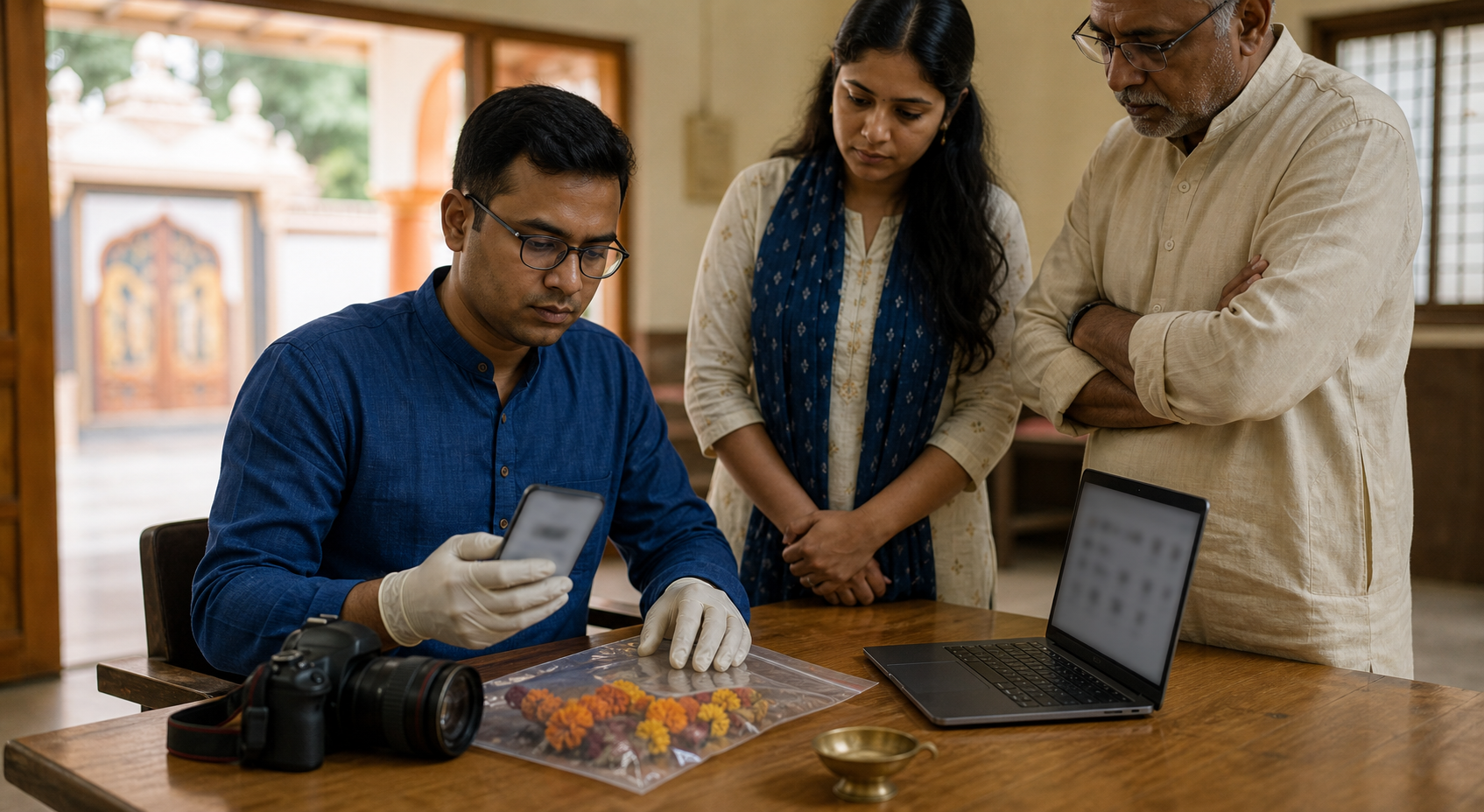
A social-media post can draw attention, but it is not an evidence system. Posts disappear, videos lose context, witnesses forget exact words, and forwarded claims acquire details that were never in the original account. Build a private evidence bundle before you build a public campaign.
- Put safety first. If violence is underway or a threat appears imminent, leave the location and contact local emergency services. Do not remain in danger to obtain a clearer video. Seek medical attention where needed, and preserve medical and damage records afterward.
- Keep the original file. Save the unedited photo, video, audio file, message, email, notice, or letter. Do not crop, annotate, compress, or enhance the only copy. If you create an enlarged or captioned version, retain it as a separate derivative.
- Record the context immediately. Write down the date, time, precise location, sequence of events, exact words you remember, people present, injuries, damage, and actions taken. Separate what you saw from what another person told you.
- Capture online material completely. Preserve the account name, full post or thread, visible date and time, URL, surrounding context, and any replies that clarify intent. A cropped image containing only the offensive sentence is easier to dispute than a complete record.
- Identify witnesses carefully. Obtain contact details with permission and ask each witness to write an independent account. Do not circulate their personal information. Matching recollections are more credible when witnesses have not coordinated wording.
- Put institutional decisions in writing. If a school, employer, landlord, venue, platform, or authority imposes a restriction, ask for the decision, policy, reason, appeal route, and responsible office in writing. Preserve earlier versions of the policy and examples of how it was applied.
- Create an official trail. Retain complaint acknowledgements, reference numbers, names or roles of officials contacted, dates of follow-up, and written responses. If an office refuses to record a complaint, note who refused, when, and what reason was given.
- Prepare a separate public copy. Redact home addresses, phone numbers, identity documents, medical details, children’s identities, and information that could expose a victim or witness to retaliation.
If sexual violence is alleged, do not publish the survivor’s identity or intimate details without informed consent. Prioritise immediate safety, trained medical support, and appropriate legal assistance. Public curiosity is not more important than the survivor’s privacy or control over the case.
Use visible status labels in every working record: “unverified report,” “first-person allegation,” “corroborated,” “officially recorded,” or “adjudicated.” A widely shared allegation does not become verified through repetition. When new evidence changes the status, preserve the earlier entry and add a dated correction rather than silently rewriting history.
Match the response to the kind of harm

Different harms require different first moves. Treating every case as a social-media battle can endanger victims, destroy evidence, or leave the institution responsible for a decision with no formal complaint to answer.
| Situation | First action | Evidence to preserve | Common mistake |
|---|---|---|---|
| Imminent violence or a credible threat | Move to safety and contact local emergency services | Exact words, time, location, descriptions, injuries, damage, and original recordings once safe | Confronting the aggressor or remaining nearby to film |
| Workplace, school, housing, or service discrimination | Request the decision, reason, policy, and appeal route in writing | Emails, notices, dates, prior treatment, relevant comparators, and names of decision-makers | Keeping the dispute entirely verbal or posting before securing the record |
| Temple, procession, or festival disruption | Notify organisers, the property custodian, and the appropriate local authority | Permits, notices, conditions, scene photographs, original video, damage, and witness accounts | Cleaning, repairing, or moving material before documentation, unless safety requires it |
| Online hate, threats, or a coordinated campaign | Preserve the complete material, then use the platform’s reporting process | URLs, account identifiers, full context, timestamps, repeated posts, and report acknowledgements | Saving only a cropped screenshot or mobilising others before securing the evidence |
| A repeated institutional pattern | Create a standardised case register and seek qualified legal or civil-rights guidance | Consistent fields, policies, comparable decisions, complaint outcomes, and status updates | Combining rumours, duplicates, and verified incidents into one undifferentiated total |
Run two tracks when a case warrants public attention. The first is protective and official: safety, medical care, preservation, reporting, legal guidance, and support for the affected person. The second is public and corrective: a factual statement, responsible media contact, community coordination, and a specific demand. Do not let the public track interfere with the protective one.
Name the remedy before launching the campaign. Depending on the case, that may be a recorded complaint, protection for a threatened family, restoration of damaged property, equal access to a facility, withdrawal of a discriminatory rule, a correction, an internal disciplinary review, or a lawful investigation. “Take action” gives an institution room to offer sympathy without changing anything.
Legal definitions of discrimination, incitement, and hate crime vary by jurisdiction. Describe facts plainly in the initial record and seek a qualified local lawyer or rights organisation when classification affects criminal charges, employment rights, immigration status, limitation periods, or a civil claim. Do not advise a victim to sign a settlement, withdraw a complaint, waive confidentiality, or publish sensitive evidence without understanding the consequences.
Keep advocacy forceful, factual, and Dharmic

Defending Hindus does not require collective accusation. Hold the identifiable actor, institution, network, or policy responsible for the conduct you can demonstrate. The faith, ethnicity, or politics of an accused person becomes relevant only when evidence connects it to motive, coordination, or an institutional pattern.
This rule protects both truth and strategy. Blaming an entire Muslim, Christian, secular, left-wing, or other population turns uninvolved people into defendants and gives the responsible actor somewhere to hide. Where a doctrine, political programme, sermon, policy, or organised campaign is relevant, quote or preserve the exact material and show its connection to the conduct. Do not substitute a label for evidence.
Claims of unequal restrictions on Hindu festivals require a matched comparison. Ask whether the same authority dealt with a genuinely comparable activity, at a similar scale, in the same type of location, under the same safety or environmental conditions. Then compare permits, exemptions, duration, penalties, enforcement, and appeal rights. If those variables differ, explain why the remaining difference still indicates unequal treatment. Without that work, a double standard may be plausible but not yet demonstrated.
Use the same care when challenging media framing. Preserve the headline, image, caption, publication date, relevant passage, and later edits. Distinguish a reported fact from an opinion columnist’s argument. Compare how the same outlet describes closely similar processions, disturbances, or religious accommodations. Then request a precise correction: identify the inaccurate statement, supply the evidence, and state the replacement wording or missing context. A general accusation of bias is easier to ignore than a documented editorial inconsistency.
A reliable public statement can follow this formula: “On [date] at [place], [identified actor or institution] carried out [verifiable act], affecting [person, practice, or institution]. The preserved evidence includes [items]. Religious motive is [explicit, alleged, inferred, or not yet established] because [specific basis]. The matter is [unreported, reported under reference number, under investigation, or adjudicated]. We seek [specific remedy].”
Satya requires us to state no more certainty than the evidence permits. Ahimsa forbids turning a genuine injury into intimidation or collective retaliation. Neither principle requires passivity. They require a response disciplined enough to defend the victim without creating another injustice.
Build the record before the next incident

A single case calls for care and accountability. A claim of persecution requires a record capable of showing repetition, severity, institutional involvement, official response, and change over time. That record must use the same rules for cases that support your expectations and cases that do not.
For each entry in a community tracker, record:
- A unique incident identifier, date, location, and narrow harm category.
- A neutral description of the alleged act, separate from commentary.
- The Hindu person, symbol, practice, festival, temple, or institution said to have been targeted.
- The evidence supporting religious motive and whether that motive is explicit, alleged, or inferred.
- Original evidence locations, archived copies, witnesses, and official reference numbers.
- Verification status, responsible reviewer, last review date, and unresolved questions.
- Police, court, employer, school, platform, or government response, where applicable.
- Privacy restrictions governing names, images, medical information, and witness details.
- A dated correction and outcome log.
A communal clash, crime, security operation, or political controversy belongs in an anti-Hindu tracker only when evidence connects it to the targeting of Hindu identity, people, practice, property, or institutions. This boundary keeps the database focused and prevents unrelated events from inflating the pattern.
Keep the raw archive private and access-controlled. Publish only the fields needed for accountability. Have one person enter a case and another review the classification, evidence, duplication risk, and privacy concerns. If you publish on a weekly schedule, set a clear cutoff and carry later developments into the correction log rather than forcing unfinished claims into a deadline.
Key takeaways
- A Hindu victim does not by itself prove anti-Hindu motive; connect the harm to identity, practice, symbols, or institutions.
- Distinguish allegations, corroborated reports, official records, and adjudicated findings every time you describe a case.
- Leave danger before filming, preserve original files, and protect victims and witnesses from exposure.
- Match the response to the harm: emergency action for danger, written records for discrimination, and consistent data for pattern claims.
- Demand a specific remedy instead of relying on general outrage.
- Reject both silence and collective blame; disciplined truth makes Hindu advocacy stronger.
If you are handling a case now, create the private evidence bundle first. Write one sentence stating the verified act, one sentence explaining the status of religious motive, and one sentence naming the remedy sought. That small discipline can turn a fleeting allegation into a case that institutions must answer.
For longer-term work, establish the incident form, verification labels, privacy rules, and review responsibility before the next crisis. The goal is not merely to collect stories of harm. It is to protect people, identify defensible patterns, correct false claims, and make sustained anti-Hindu conduct increasingly difficult to deny.
References
