
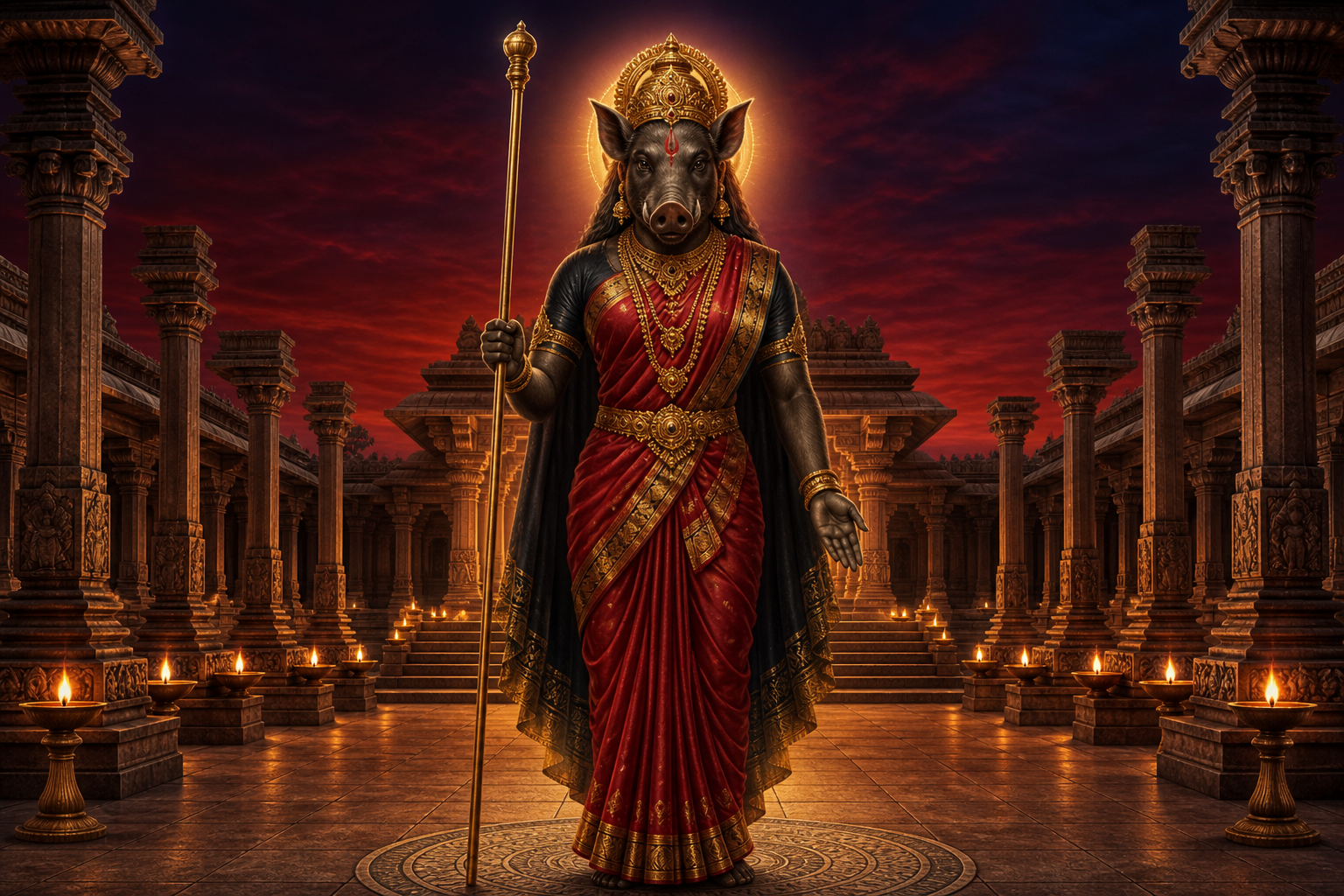
If you encountered the name Mahi Varahi while trying to identify a form of Devi, choose a mantra, or understand Varahi’s fierce character, the first task is to separate what is actually established from what has merely been attached to her name online.
The reliable core is compact but meaningful: Mahi Varahi is a distinct Tantric form of Goddess Varahi, she is also called Bhairavi in this classification, and her defining association is with Yama, the ruler of death and cosmic justice. That gives you a sound basis for understanding her without borrowing unsupported imagery, rituals, or promises from other forms.
The shortest reliable answer about Mahi Varahi

Mahi Varahi is one of five recognized forms of Varahi named in the Varahi Tantra. The five are Swapna Varahi, Chanda Varahi, Mahi Varahi, Krccha Varahi, and Matsya Varahi. Mahi Varahi is additionally identified as Bhairavi and is distinguished by her close connection with Yama.
This immediately corrects three common interpretive mistakes. Mahi Varahi is not simply another spelling for Varahi in general. The title Bhairavi in this setting does not mean that every deity called Bhairavi is Mahi Varahi. And a mantra, image, or ritual associated with another Varahi form cannot automatically be transferred to her.
When you find a new claim about Mahi Varahi, therefore, ask a precise question: does the claim belong to Mahi Varahi specifically, to Goddess Varahi generally, or to a different Varahi form? If that distinction is missing, the material may still be devotional, but it is not enough to establish a form-specific Tantric practice.
Read Dandanatha through order, not spectacle

Mahi Varahi’s Dandanatha character is best understood through the meanings carried by the title. The Sanskrit word danda can indicate the rod of authority, discipline, correction, or punishment, while natha indicates a lord, master, or guardian. Dandanatha consequently points toward authority that enforces order rather than ferocity without purpose.
Her association with Yama sharpens that reading. Yama is not connected only with the biological fact of death; he also governs cosmic justice and the consequences that follow conduct. Read together, Dandanatha and Yama place Mahi Varahi within an ethical field of law, restraint, mortality, judgment, and accountability.
This does not make Mahi Varahi identical with Yama. Nor does it reduce her to a frightening personality who inflicts punishment. The more careful interpretation is that her fierceness serves dharmic order. It confronts the fantasy that actions can be separated from their consequences.
That distinction matters when you evaluate a teaching about her. If it speaks only about defeating enemies, acquiring power, or escaping consequences, it has neglected the very feature that makes this form distinctive. Look instead for an account that joins power to discipline, justice to self-examination, and mortality to responsible action.
You can also apply this symbolism without pretending to possess an esoteric practice. Before asking Mahi Varahi to correct the world around you, identify the disorder within your own conduct: an obligation postponed, a truth avoided, an appetite left without limits, or a harmful action treated as though it carried no result. Her Dandanatha character becomes spiritually serious when danda is first allowed to measure the worshipper.
The five forms are a map, not interchangeable labels

The Varahi Tantra’s five names establish differentiation within the larger reality of Varahi:
- Swapna Varahi
- Chanda Varahi
- Mahi Varahi, also called Bhairavi
- Krccha Varahi
- Matsya Varahi
A list like this is a map of forms, not permission to fill every blank through guesswork. A familiar-looking name may tempt you to infer a form’s function from its ordinary meaning. A generic picture of Varahi may be relabeled as Mahi Varahi. Details from separate traditions may then be combined until the resulting figure has no clear textual or lineage home.
Use a four-part test before accepting an identification:
- Check the exact name. Is Mahi Varahi explicitly named, or has someone inferred the identity merely because the figure is Varahi?
- Check the context. Does the explanation identify the Tantra, lineage, temple tradition, or ritual setting in which the name is used?
- Check form-specific evidence. Are the claimed attributes actually tied to Mahi Varahi, or are they generic features of Varahi or another fierce goddess?
- Check the boundary between description and practice. Identifying a deity does not by itself authenticate a mantra, initiation, visualization, or ritual procedure.
This method is especially important with the name Bhairavi. In this particular fivefold classification, Bhairavi is another designation for Mahi Varahi. Bhairavi also appears in other Shakta and Tantric settings, however, so the shared title alone cannot prove that two forms, mantras, or ritual systems are the same.
If an image or practice cannot pass these checks, leave it labeled simply as Varahi or as an uncertain identification. Honest uncertainty protects the integrity of the tradition better than an elaborate but unsupported answer.
Approach worship in three deliberate stages

Knowing that Mahi Varahi is a Tantric form does not mean that every Tantric procedure connected with her should be attempted independently. Tantra commonly transmits mantras, visualizations, nyasa, ritual sequences, and their interpretations through particular lineages. A name copied without that setting is not a substitute for instruction.
1. Begin with study
Fix the basic distinctions in your mind: Mahi Varahi belongs to a five-form classification; she is called Bhairavi there; and she has a special relationship with Yama’s domains of death and cosmic justice. Keep a record of the exact text or lineage attached to every additional detail you encounter. Do not merge accounts merely because each uses the word Varahi.
2. Keep public devotion within what you know
If your family, temple, or established sampradaya already honors this form, follow its recognized procedure. Without such a setting, you can still offer respectful namaskara and contemplate the dharmic meaning of consequence, restraint, and moral accountability. You do not need to invent an esoteric rite to respond sincerely to the deity.
3. Seek qualified guidance for formal sadhana
Before adopting a form-specific mantra or ritual, ask a teacher where it comes from, whether initiation is required, what preliminary disciplines accompany it, and whether the instructions belong specifically to Mahi Varahi. A responsible answer should identify the tradition and its boundaries. Claims of guaranteed victory, control, punishment of enemies, or instant results do not become trustworthy merely because a fierce deity’s name is attached to them.
This staged approach is not reluctance toward Tantra. It is respect for Tantra as a disciplined mode of transmission. The boundary between reverence and formal sadhana allows you to remain devotional without claiming an authority or initiation you do not possess.
Key takeaways
- Mahi Varahi is a distinct form within a fivefold Varahi classification, not a synonym for every manifestation of Varahi.
- She is also called Bhairavi in this specific context, but that does not make every Bhairavi form identical with her.
- Her close association with Yama places death, cosmic justice, consequence, and accountability at the center of her interpretation.
- Dandanatha is most usefully read as disciplined authority serving order, not as uncontrolled violence.
- Generic Varahi imagery or ritual details should not be assigned to Mahi Varahi without form-specific textual or lineage support.
- Study and simple reverence can begin immediately; formal Tantric mantra or ritual practice calls for qualified lineage guidance.
Your next step is simple: preserve the exact form name, context, and lineage before adding anything to your practice. If all you have is the name Mahi Varahi, begin with reverence and reflection on dharmic consequence. Let reliable instruction, rather than urgency or fascination, determine what comes next.
References
