

If your salary has risen, your city has transformed and every screen encourages another upgrade, you face a harder question than whether Bharat is getting richer: has your family become more secure, or merely more expensive to maintain?
You need a better test than the car in the driveway or the crowd at the airport. Bharat’s expanding middle class is being shaped by better-paid work, business formalisation, rising property values, dual incomes, wider access to goods and remarkably easy credit. Those forces can create lasting prosperity, but they can also create a polished lifestyle resting on fragile finances. Here is how to tell the difference—and how to make new wealth answer to dharma rather than ego.
First ask whether your household is richer or merely spending more
There is no single middle-class experience. The label spans lower-middle, middle and upper-middle households whose incomes, assets, obligations and exposure to risk can be completely different. A salaried couple without children, a shopkeeper reinvesting in an enterprise, a pensioner living in an appreciated family home and a young renter with a large compensation package may all be called middle class. Their financial positions are not interchangeable.
Do not classify yourself by salary alone. Assess your household through three separate lenses:
- Income capacity: How much dependable money reaches the household after deductions, and how much of it is already committed? Count regular salary or conservative business income. Do not build your normal lifestyle around bonuses, asset sales or an unusually strong business month.
- Balance-sheet strength: What do you own after subtracting what you owe? Keep liquid savings, financial investments, business assets and residential property in separate lines. A valuable home strengthens net worth, but it does not automatically provide cash for next month’s obligations.
- Resilience and choice: Could you handle an interruption in income, a major repair or another unavoidable expense without immediately taking expensive debt? Can you refuse a bad job, a dubious business arrangement or a status purchase without destabilising the family? That freedom is a more meaningful sign of prosperity than outward display.
Build a one-page household dashboard and update it every three months. Record dependable income, essential obligations, total monthly debt repayments, liquid reserves, financial investments, property, business assets and discretionary spending. If income and consumption rise together while reserves and unencumbered assets remain flat, your standard of living has expanded but your security has not.
Property requires particular care. Expressways, metro networks and urban expansion have produced large gains for some owners of suburban land and housing. That gain is real for a family that owns the asset, but much of it may be unrealised. The same price rise that enriches an existing owner can make entry harder for a first-time buyer. Never treat an estimated property value as if it were salary in the bank.
Credit needs the opposite adjustment. A car bought with a loan appears in your life immediately, while the claim on future income remains for years. Digital payments, pre-approved loans, credit cards and buy-now-pay-later facilities have made discretionary consumption available almost on demand. Access to credit can be useful. It is not evidence that the borrower is wealthy.
The expansion is real, but its engines produce different kinds of wealth

Bharat’s changing consumption is not simply a story of recklessness. Several structural shifts have increased what households can earn, own and buy. You will understand the opportunity more clearly if you separate those engines instead of treating every visible sign of affluence as the same phenomenon.
Higher-value work is reaching younger professionals
More than 1,500 Global Capability Centres have established operations in Bharat, with work extending beyond traditional back-office processing into engineering, artificial intelligence and corporate strategy. The startup ecosystem has added another route to technology and management income.
The upper edge includes reported compensation packages of ₹25 lakh to more than ₹1 crore for some younger professionals. Treat those figures as examples from a highly paid cohort, not as a description of the typical middle-class salary. Compensation quoted as CTC is also not identical to spendable monthly income. Taxes, variable pay, benefits and employment risk still matter.
If you receive a large early-career increase, base recurring commitments on the dependable portion of your income. A larger house, two vehicle loans, private memberships and frequent travel can turn an exceptional salary into a household that cannot tolerate a career break. Let assets and reserves rise before fixed lifestyle costs become difficult to reverse.
Two incomes can change a household faster than one promotion
Urban dual-earner couples can combine salaries and cross an income boundary much faster than a single earner waiting for successive promotions. The effect is especially visible among DINK households—double income, no children—that can direct a larger share of current earnings toward investment, travel or discretionary purchases.
Do not assume that two incomes are permanently guaranteed. Test the household budget using one dependable income as well as two. You do not need to live indefinitely on one salary, but you should know which obligations would become difficult if either income stopped. That exercise exposes whether the second income is creating wealth or merely supporting a more elaborate fixed-cost structure.
Tier 2 and tier 3 prosperity has a different cost structure
Affluence is no longer confined to Bengaluru, Chennai, Delhi or Mumbai. Better goods, roads, electricity and digital connectivity have reached smaller cities and towns, while remote work and local enterprise can bring higher earnings into places with different housing costs. In cities such as Jaipur, Chandigarh, Kochi and Lucknow, a family that already owns its home can convert more of a strong income into savings or discretionary spending than a similarly paid renter in a major metro.
This is why national salary comparisons often mislead. When evaluating a job move or deciding where to establish a business, compare the whole household equation: housing, commuting, support networks, career depth, education needs and the durability of local demand. A lower nominal salary can support more choice when the largest recurring cost is already controlled. A metro-level remote salary can be powerful, but it also depends on the continuity of that particular work arrangement.
Formalisation can turn enterprise into scalable wealth
Small and medium business owners gain something important when cash flow becomes visible within the banking system. Cleaner records and balance sheets can provide access to formal credit for expansion, reducing dependence on informal borrowing. That is a deeper form of progress than a single season of high sales because it can improve the enterprise’s capacity to plan, borrow and reinvest.
If you run an enterprise, do not measure success by household withdrawals alone. Keep business and personal money distinct. Track receivables, debt, working capital, taxes and owner withdrawals separately. A prosperous-looking family can still be weakening the enterprise if every good month is extracted for consumption rather than used to strengthen operations.
When you encounter any claim about the growing middle class, ask which engine is operating. Is the household living on earned income, realised investment gains, appreciated property, business cash flow or borrowed money? Does it have one income or two? Does it own its home or face a large housing payment? Is the improvement repeatable? These questions tell you more than a photograph of a mall, restaurant or airport.
Convert a good decade into durable household freedom
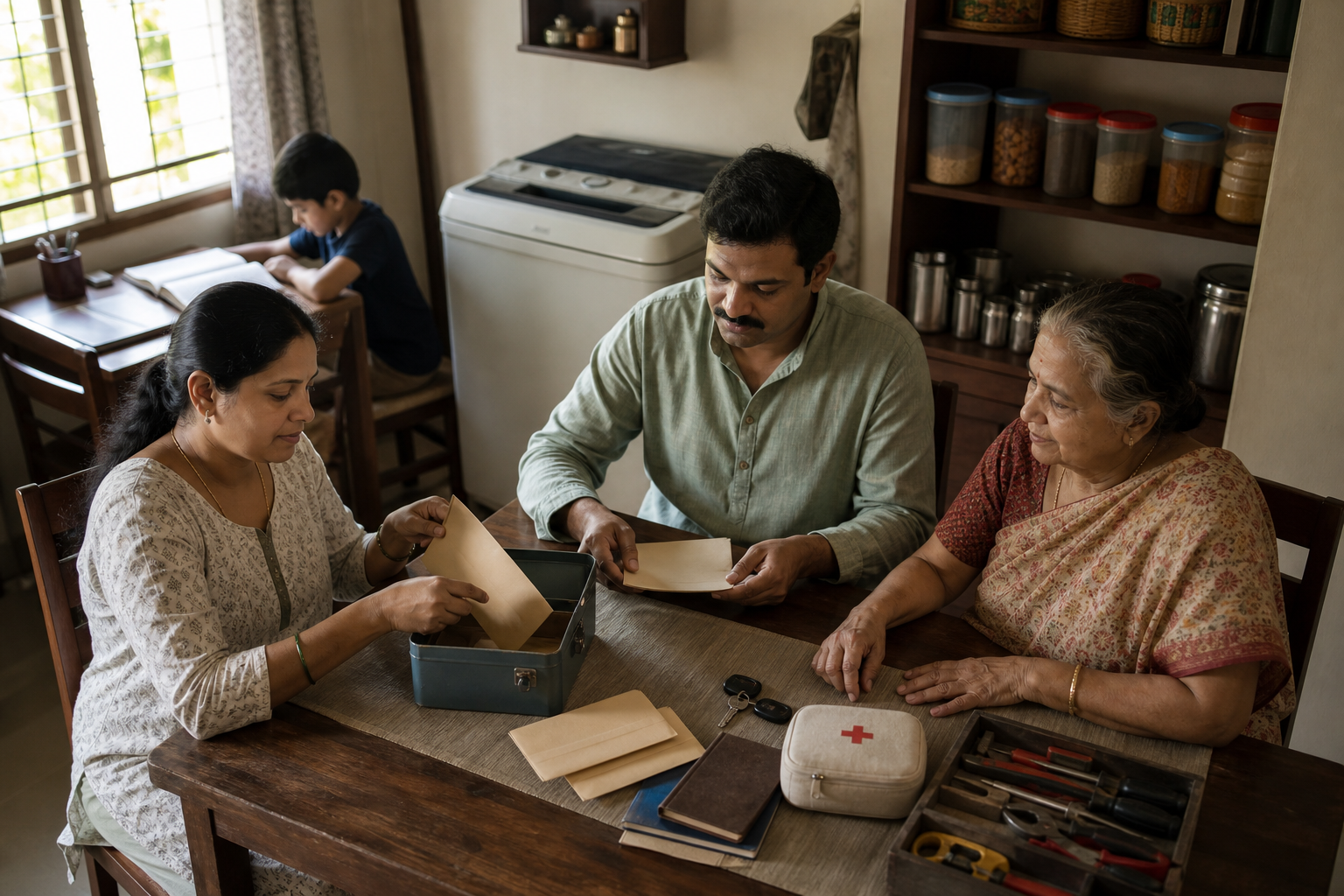
The cultural movement from scarcity toward aspiration has an understandable basis. Goods that once required a foreign trip are now widely available, and experiences once treated as rare—domestic holidays, flights, restaurant meals and foreign travel—have become normal aspirations for many families. The problem is not enjoyment. It is allowing every increase in income to become a permanent increase in obligation.
Give each rupee one of three jobs
Separate surplus income into security, growth and enjoyment. Your family must choose the amounts because job stability, age, dependants, health needs and business risk differ. The three-part distinction is more important than a universal percentage:
- Security money must be accessible when ordinary income is disrupted. Its purpose is not to impress anyone or maximise return.
- Growth money can be invested for longer goals and may fluctuate. It should not be confused with cash needed for near-term obligations.
- Enjoyment money can be spent without guilt once the household has consciously protected its responsibilities. A holiday funded from this pool is different from a holiday whose instalments consume future income.
Many households moved beyond fixed deposits, physical gold and jewellery by using Systematic Investment Plans in mutual funds. Regular investing helped participants accumulate equity assets during a long bull market. Preserve the distinction between the method and the outcome: an SIP automates contributions, but it does not guarantee profit, eliminate market losses or make every fund suitable for every goal.
Before choosing a financial product, examine risk, fees, liquidity, tax treatment, time horizon and what happens if you must stop contributing. Product and tax decisions depend on personal circumstances; when the consequences are material, use a properly regulated financial adviser or qualified tax professional rather than a social-media tip or a relative’s recent return.
Make status purchases pass a written test
Choose a rupee threshold that is meaningful for your household. Before any discretionary purchase above it, answer five questions in writing:
- Would we still want this if nobody outside the household could see it?
- What is the full cost, including interest, maintenance, insurance, storage and replacement?
- Which goal will receive less money if we buy it?
- Will its useful value last longer than the debt used to obtain it?
- Could we wait for one billing cycle and pay without consumer debt?
A negative answer does not automatically forbid the purchase. It reveals its true nature. You may consciously choose celebration, beauty or convenience, but you should not disguise status expenditure as investment or pretend that available credit has made it affordable.
Apply an additional rule to every pay rise: decide the destination of the increase before the first enhanced salary reaches your account. Otherwise the market will decide through a larger car, a more expensive rental, subscriptions and habitual dining. Lifestyle costs are easy to add one at a time and difficult to unwind together.
Write a short Dharmic household constitution
A Dharmic answer is not to condemn artha or romanticise deprivation. Wealth earned honestly can protect dependants, support learning, fund enterprise, sustain temples and institutions, enable dana and give a family the freedom to refuse adharma. The governing question is whether wealth remains a means or becomes the master.
Write five commitments with the adults and older children in your household. Keep them concrete enough to settle an actual disagreement:
- We will not knowingly build income through fraud, exploitation or bribery.
- We will not borrow merely to make strangers think we are richer.
- We will protect agreed responsibilities before expanding lifestyle.
- We will reserve a recurring share of time or money for dana, seva or community institutions.
- We will review major purchases and debts together rather than concealing them from one another.
Names and emphases differ across Hindu, Buddhist, Jain and Sikh traditions, but restraint is not helplessness. It is the capacity to enjoy without being governed by craving, to possess without being possessed and to increase one’s ability to serve as one’s means increase. That is a more demanding standard than either conspicuous consumption or performative austerity.
The public test of prosperity is conduct in shared spaces
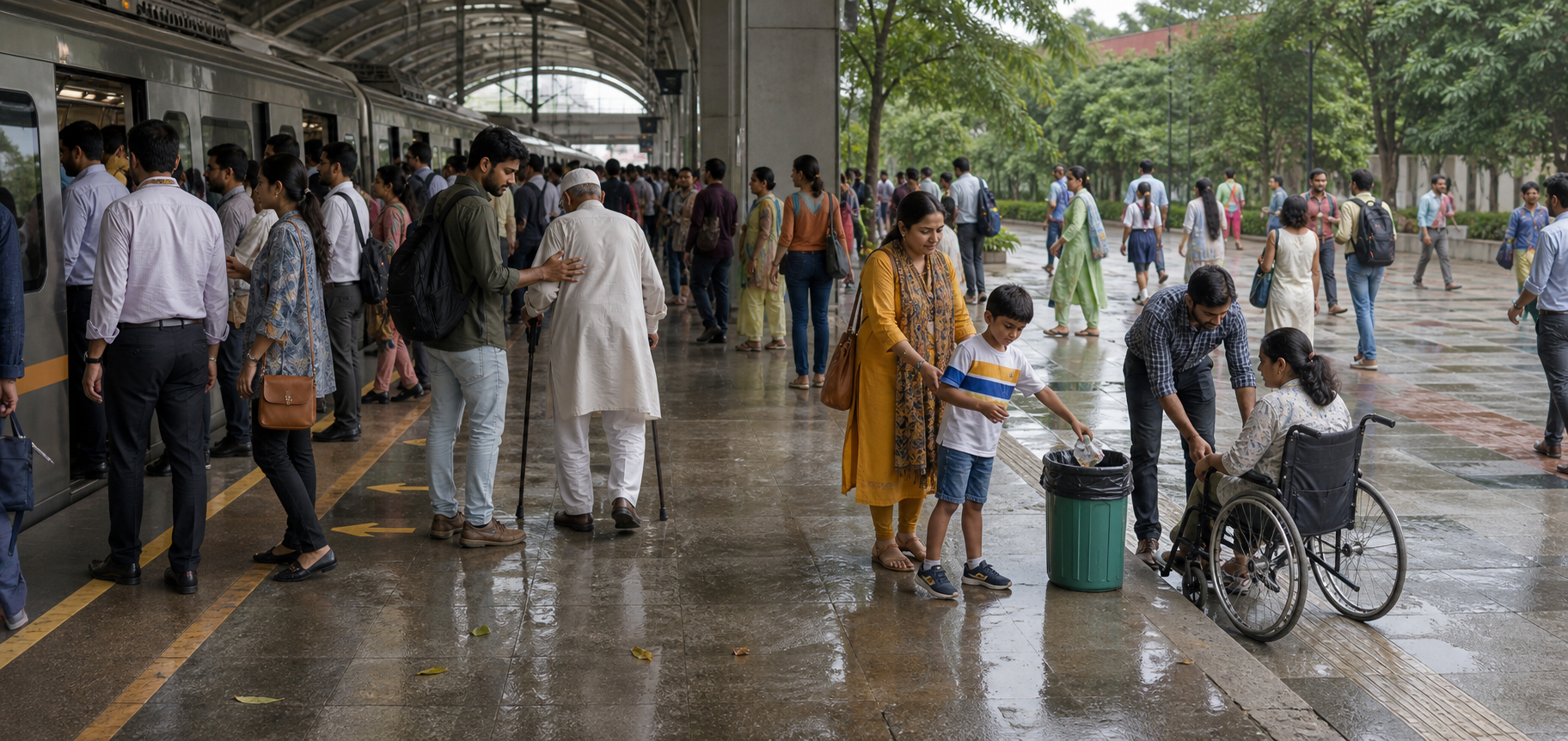
Private comfort is only half the middle-class story. The other half appears on roads, in queues, inside apartment complexes and wherever personal convenience meets a shared rule. More money can widen choice without deepening civic character. When that happens, a vehicle becomes a claim to priority, an affordable fine becomes a fee for misbehaviour and influence becomes a way to escape the obligations imposed on everyone else.
The warning signs are ordinary: road rage, careless parking, littering, spitting and contempt for lawful authority. None of these behaviours is exclusive to an income group, and first-generation prosperity should not be caricatured as moral failure. A first car, a better home or a long-awaited holiday is not shameful. The line is crossed when possession is treated as permission to endanger, intimidate or burden another person.
Adopt a household civic code as clearly as you adopt a financial budget:
- Obey traffic and parking rules even when breaking them would be convenient and the fine affordable.
- Never combine alcohol with driving, and never turn access to a powerful vehicle into a reward without responsibility.
- Do not use money, staff, family standing or professional influence to jump a queue or humiliate a worker.
- Keep waste with you until it can be disposed of properly. Treat corridors, roads, parks, water and common facilities as shared assets, not as nobody’s property.
- Repair or pay for damage you cause without waiting to be forced.
- Refuse bribery as a shortcut. Being able to pay does not convert an unlawful act into a legitimate service.
Parents have a particular responsibility when young adults inherit comfort they did not build. Pair every privilege with a duty. Access to the family vehicle should depend on lawful and sober conduct. Control over money should come with transparent accounting. Household workers should receive the same basic dignity in front of children that the family expects from employers and officials.
This is not merely private virtue. An expanding middle class has the numbers, education, purchasing power and institutional reach to raise standards in schools, workplaces, neighbourhoods, markets and public administration. But it cannot credibly demand clean streets while littering, impartial law while seeking exceptions, or honest government while offering a bribe for convenience.
The proper symbol of arrival is therefore not the ability to bend a rule. It is the confidence to obey a fair rule even when status could help you escape it. Artha governed by dharma creates freedom with responsibility. Artha governed by ahankara creates dependence wearing the costume of success.
Key takeaways
- Bharat’s middle-class expansion has structural foundations: higher-value employment, dual incomes, appreciated assets, formalised enterprises and wider market access.
- Visible consumption is not a reliable measure of security. Separate dependable income, net assets, liquidity and debt before deciding how prosperous a household really is.
- A large CTC, an appreciated home and an available credit limit are three different financial facts. Do not treat any of them as spendable wealth.
- An SIP is a contribution method, not a promise of returns. Match financial products to risk, liquidity and time horizon.
- A Dharmic household can enjoy prosperity while placing honest earnings, restraint, family responsibility, dana and civic conduct ahead of status.
- The social value of a larger middle class depends on whether private comfort produces stronger citizens or merely more demanding consumers.
During your next household review, complete the one-page dashboard, choose a threshold for written purchase decisions and agree on five rules of public conduct. Those small disciplines will tell you whether rising income is enlarging your freedom or simply enlarging your appetite. Bharat does not need its middle class to apologise for prosperity. It needs prosperous families capable of carrying greater responsibility.
References
