

You have found a vrata katha, but you still do not know whether it belongs to your family’s Shravan observance, which calendar fixes the day, or whether reading the story completes the vrata. Those are the right questions. A katha becomes practically useful when you keep its calendar, deity, narrative frame, and ritual procedure in their proper places.
The method below will help you prepare without inventing missing rules or combining distinct observances. It uses Shitala Satam as a direct Shravan example and Hartalika as a second example of how carefully identifying the speaker and setting can change your reading.
Start with the calendar, not a generic festival date

The same month-name or festival-name can be handled differently across regional calendars and family traditions. For example, Shitala Satam belongs to Shravan in the Gujarati calendar. That qualifier matters. It tells you which calendrical setting must govern the observance; it does not automatically establish the date for every region or household.
Before arranging the puja or announcing a date to relatives, verify four things:
- Exact name: Record the name used by your family, temple, or sampradaya. Similar names do not necessarily indicate an identical vrata.
- Calendar tradition: Check the panchanga actually followed by your household or local temple. Do not transfer a date from a differently labelled regional calendar without verification.
- Matching katha: Confirm that the narrative belongs to the exact vrata you intend to observe, rather than merely involving the same deity.
- Ritual authority: Ask where your puja sequence comes from: a family practice, temple instruction, sampradaya manual, or guidance from a knowledgeable acharya or pandit.
If two calendars disagree, do not resolve the difference by choosing whichever date is more convenient. Name the tradition you are following and remain consistent with it. That is more honest than presenting one regional practice as universal.
Keep the calendar, ritual procedure, and katha distinct

A vrata usually reaches you through several connected layers. They support one another, but they do not answer the same question:
- The calendar tells you when the observance is kept within a particular tradition.
- The vidhi tells you what is to be done: the sankalpa, worship sequence, offerings, recitation, and any discipline received through that tradition.
- The katha gives the observance its narrative world. It identifies relationships, choices, consequences, remembrance, and devotion.
- Family achara preserves inherited details that may not be stated inside the narrative itself.
This distinction prevents a common mistake: treating the katha as though every ritual rule must be hidden somewhere in the plot. If your copy supplies the narrative but not the vidhi, it has not necessarily failed. It may simply be serving a different function. Obtain the missing procedure from the tradition you actually follow instead of filling the gaps with details borrowed from another vrata.
The same care applies to fasting. If your received observance includes food restriction and fasting could be unsafe for you, follow qualified medical advice and ask a trusted religious guide about an appropriate non-food discipline, prayer, or seva. A sacred narrative does not determine whether fasting is medically suitable for an individual.
Read Shitala and Hartalika through their own narrative frames
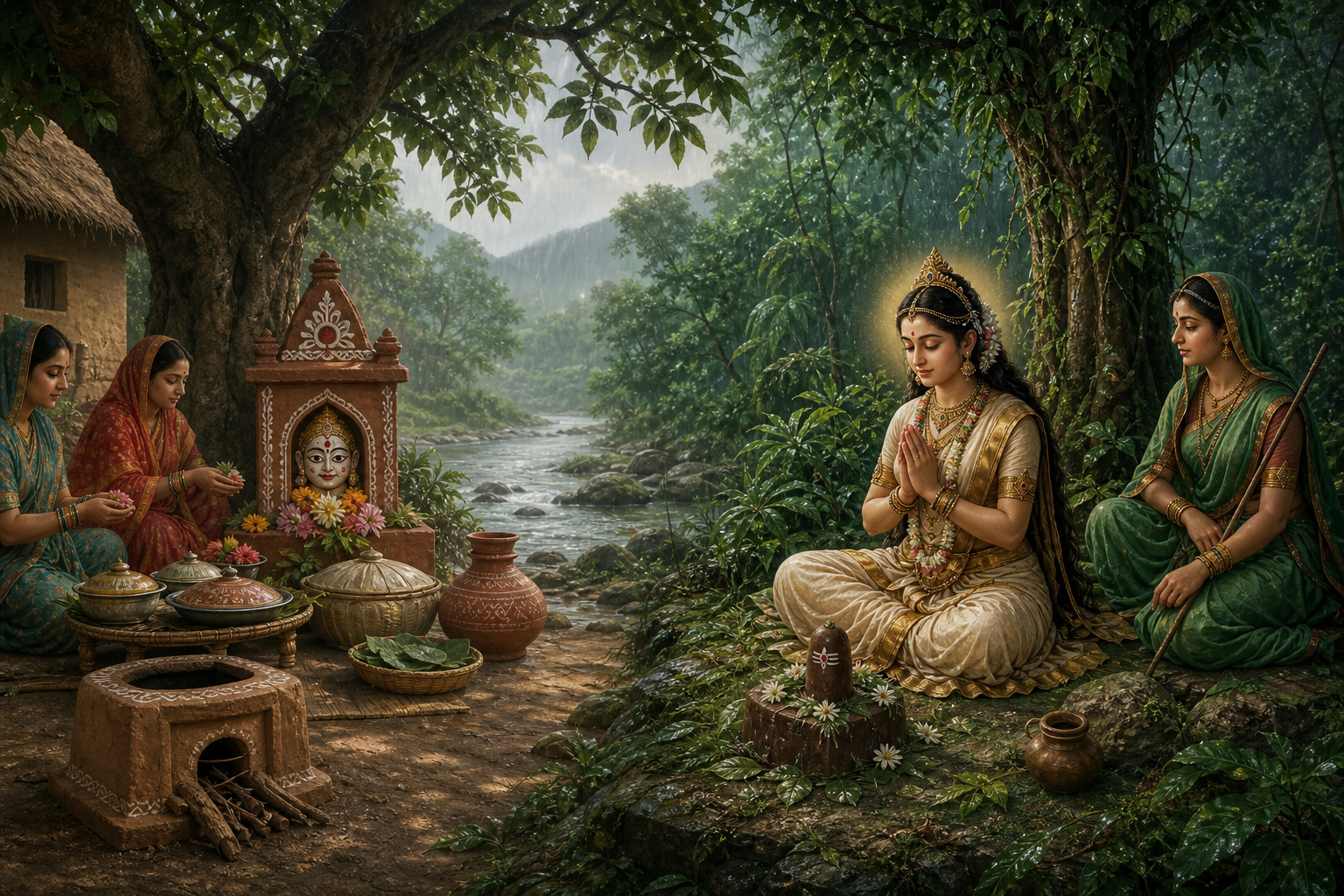
Shitala Satam: identify which layer you are reading
Shitala Satam shows why textual distinctions matter. The Skanda Purana is associated with the iconography of Shitala Mata, while the vrata katha is identified with the Bhavishyottara Purana. The story is also associated with King Indralumna of Hastinapur.
You should therefore avoid expecting one passage to supply the goddess’s visual description, the complete household procedure, and the full vrata narrative. Before reading, make three notes: the deity being worshipped, the occasion being observed, and the story being recited. When these are clear, the absence of one kind of detail from another layer will not tempt you to improvise.
This also gives you a useful question for family discussion: which parts of your observance come from the katha, and which have been preserved through household practice? Record the answers without declaring one layer more authentic merely because it appears in writing.
Hartalika: identify the speaker, listener, and remembered life
The Hartalika narrative requires a different kind of attention. Shiva narrates it to Parvati in order to recall her previous birth, when she was the daughter of Daksha Prajapati. Speaker, listener, and remembered identity are therefore part of the meaning, not disposable introductions.
Before reciting, write a short orientation in the margin or on a separate card: Shiva is speaking; Parvati is listening; the narration turns toward a previous birth. This simple preparation helps a group follow changes in person and time. It is especially useful when younger listeners encounter several divine names without already knowing how the relationships fit together.
Hartalika is useful here as a reading example, not as permission to place it on Shitala Satam’s calendar or give both observances the same vidhi. Similar devotional themes do not erase differences in occasion, narration, or inherited practice.
Use a disciplined method for home or community recitation

You do not need to turn a household recitation into an academic seminar. You do need enough preparation to distinguish received tradition from your own explanation.
- Write the full vrata name. Add the regional calendar or family tradition you are following.
- Separate the materials. Label the date guidance, puja vidhi, katha, deity description, and family customs instead of assuming that they are interchangeable.
- Identify the narrative frame. Note who speaks, who listens, where the story turns to an earlier event or birth, and which named figures the listener must recognise.
- Mark what is not established. If an offering, prohibition, or ritual action is absent from the tradition available to you, leave it unresolved until you can ask a reliable guide.
- Read without silently rewriting. If you simplify language for children, say that you are paraphrasing. Do not present your modern commentary as though it were part of the received katha.
- Discuss one concrete point. Ask what act, relationship, failure, remembrance, or form of devotion the narrative asks the listener to notice.
- Record the tradition for next time. Note the calendar used, the person who supplied the vidhi, the version read, and any family-specific practice that should not be mistaken for a universal rule.
If you are leading a community recitation, state regional qualifiers aloud. A brief sentence such as “we are following our Gujarati family calendar” gives listeners the context they need without turning a local practice into a claim about every Hindu household.
Key takeaways
- Verify the exact vrata and regional calendar before fixing the observance.
- Do not treat the katha as a substitute for the puja vidhi or inherited family achara.
- For Shitala Satam, keep iconography, narrative, calendar, and household procedure conceptually distinct.
- For Hartalika, identify Shiva as speaker, Parvati as listener, and the previous-birth setting before recitation.
- When a detail is missing, mark it as unknown and consult the tradition you follow instead of importing a rule from another vrata.
Before your next observance, prepare a single page containing the verified calendar tradition, the source of the vidhi, the katha’s speaker and listener, and the family customs you intend to preserve. That small act of clarity will help you recite with attention while handing the tradition forward without unnecessary confusion.
References
- Hindu Pad – Shitala Satam Vrat Katha | Story of Sheetala Saptami
- Hindu Pad – Hartalika Teej Vrat Katha, Story
