
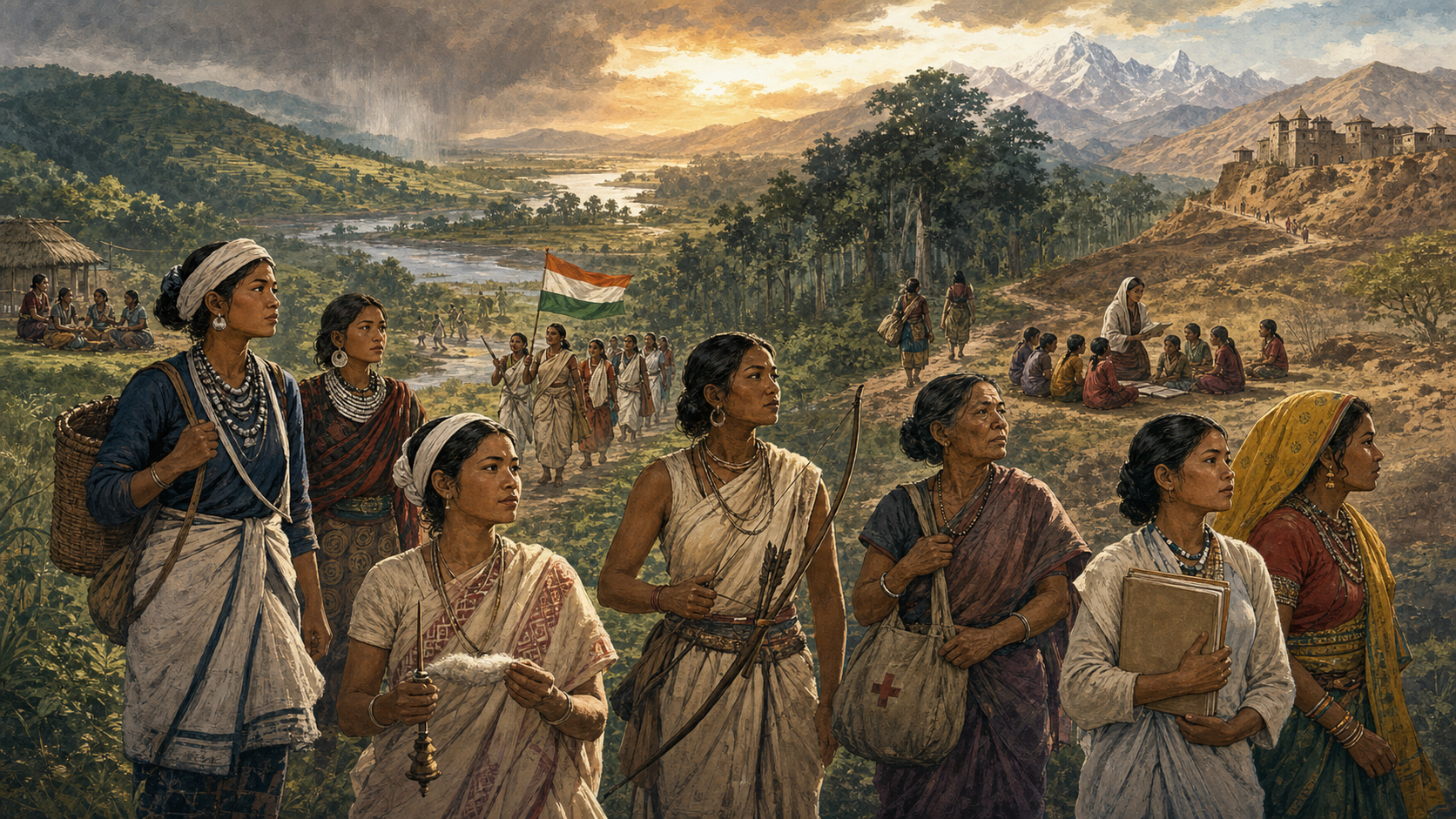
If your picture of Bharat’s freedom struggle contains a few national leaders, a few great cities and one familiar sequence of movements, it is too narrow. The missing geography is not peripheral. It includes Khasi hills, Naga villages, Assam’s processions, Jharkhand’s women’s networks, Sikkim’s Swadeshi work, Odisha’s institutions, Bastar’s intellectual life and Rajasthan’s struggle over education.
You may have arrived looking for names. You will find nine here, but a list is not enough. The useful question is what each woman actually did: defend sovereignty, disarm an enemy, spin khadi, organize labour, publish ideas, carry the tricolour, protect a teacher or turn resistance into lifelong seva. Once you learn the verbs as well as the names, the freedom struggle becomes a much larger and more truthful story.
Key takeaways
- Janjatiya women did not enter one unified movement at one moment. Their resistance stretched from the Anglo-Khasi War of 1829-1833 to the final weeks before Independence.
- Freedom meant more than replacing British rule. It could mean defending ancestral sovereignty, protecting a community’s spiritual inheritance, resisting labour exploitation, gaining an education or keeping a local school alive.
- The methods were equally varied: armed defiance, tactical deception, Swadeshi work, journalism, poetry, women’s organizing, labour mobilization, flag processions and social service.
- Janjatiya is not the name of one interchangeable population. The Zeliangrong Naga, Khasi, Lepcha, Ho, Bhil and other communities in these histories must be named in their own right.
- Several participants were children or adolescents. Their courage deserves remembrance, but their deaths should never be softened into sentimental patriotic tales.
Sovereignty in the hills came before the familiar national timeline
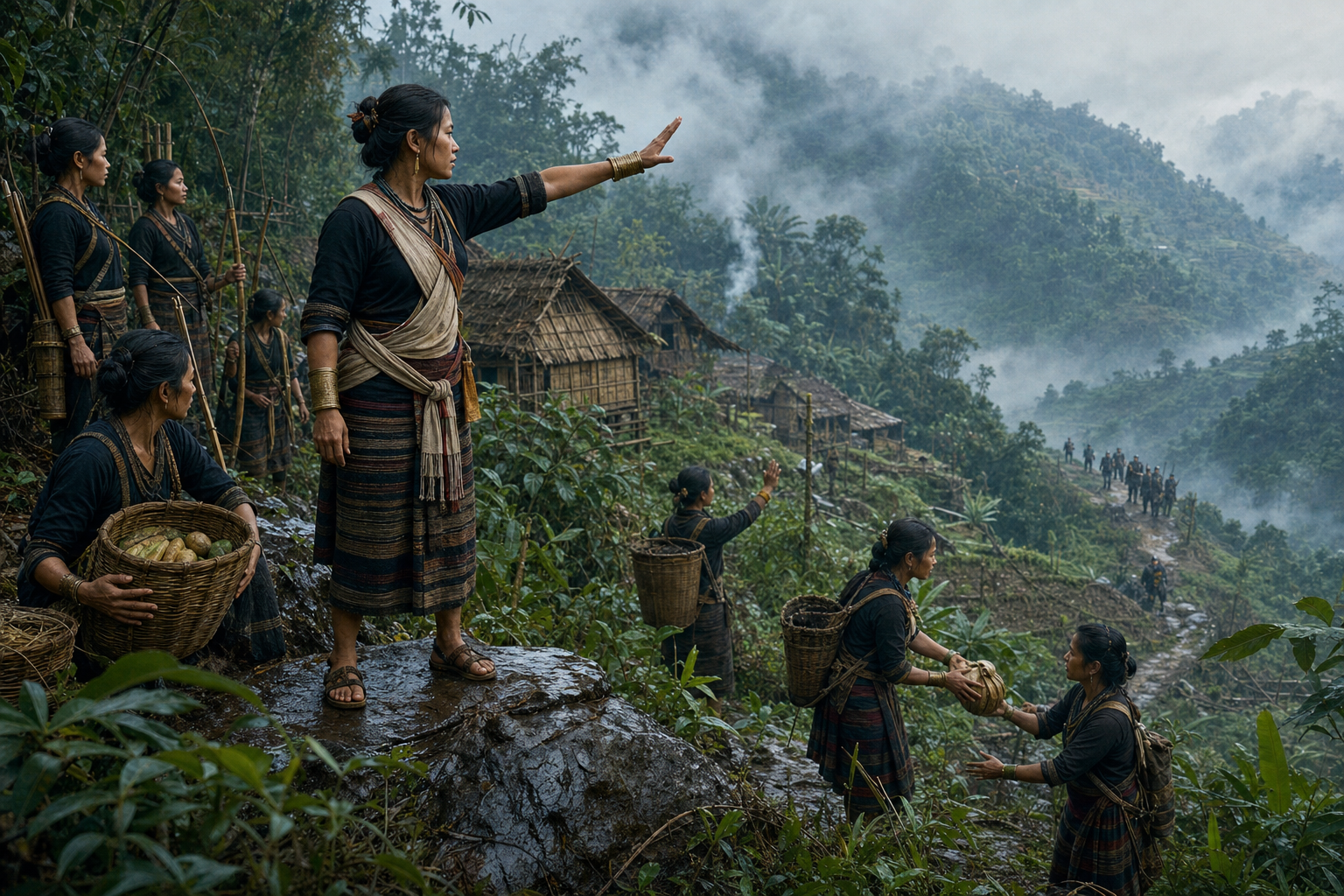
A common telling makes regional resistance look like a local prelude to the supposedly real national movement. Ka Phan Nonglait and Rani Gaidinliu make that hierarchy impossible to sustain. Their actions arose from the political and cultural worlds of their own peoples. They belong to Bharat’s freedom struggle precisely because the defence of those worlds challenged imperial power.
Ka Phan Nonglait turned familiarity into a battlefield advantage
Ka Phan Nonglait, who lived from 1799 to 1850, is remembered as the first woman freedom fighter of the Khasi hills. During the Anglo-Khasi War of 1829-1833, she fought alongside the Khasi ruler U Tirot Sing Syiem.
Her best-known exploit did not resemble a conventional charge. She offered refreshments to British soldiers near a waterfall, waited until they relaxed, seized their weapons and threw them into the gorge. She is said to have enabled an attack in which 32 British soldiers died. That number should be presented as a reported element of the story, not as an independently settled count. The underlying lesson needs no embellishment: she understood terrain, expectation and timing well enough to turn a familiar social gesture into a tactical opening.
Ka Phan Nonglait Falls now carries her name. When you teach this episode, place the waterfall beside the battle. The landscape is not background scenery; it is both part of her method and a continuing site of memory.
Rani Gaidinliu joined spiritual renewal to political freedom
Rani Gaidinliu came from the Zeliangrong Naga community of Tamenglong in Manipur. In 1930, at only 13, she joined her cousin Haipou Jadonang in the Heraka movement. It joined spiritual renewal to the political goals of restoring Naga sovereignty and driving British authority from ancestral lands.
The British arrested her in 1932 and sentenced her to life imprisonment. She spent 14 years in different prisons and was released only after Independence. Those facts matter because they prevent two opposite misreadings. If you describe Heraka only as a religious movement, you erase its challenge to imperial rule. If you describe Gaidinliu only through generic nationalism, you erase the community, spiritual tradition and conception of sovereignty that gave her resistance its form.
Her later public honours show how remembrance moved from suppression to national recognition: the Padma Bhushan in 1982, a commemorative stamp in 1996 and a coin in 2015. Yet the best way to remember her is not through a comparison with a more famous heroine. Use her own name, name the Zeliangrong community and explain Heraka. That gives her historical agency instead of making her understandable only through someone else.
Swadeshi, print and the tricolour carried resistance into public life
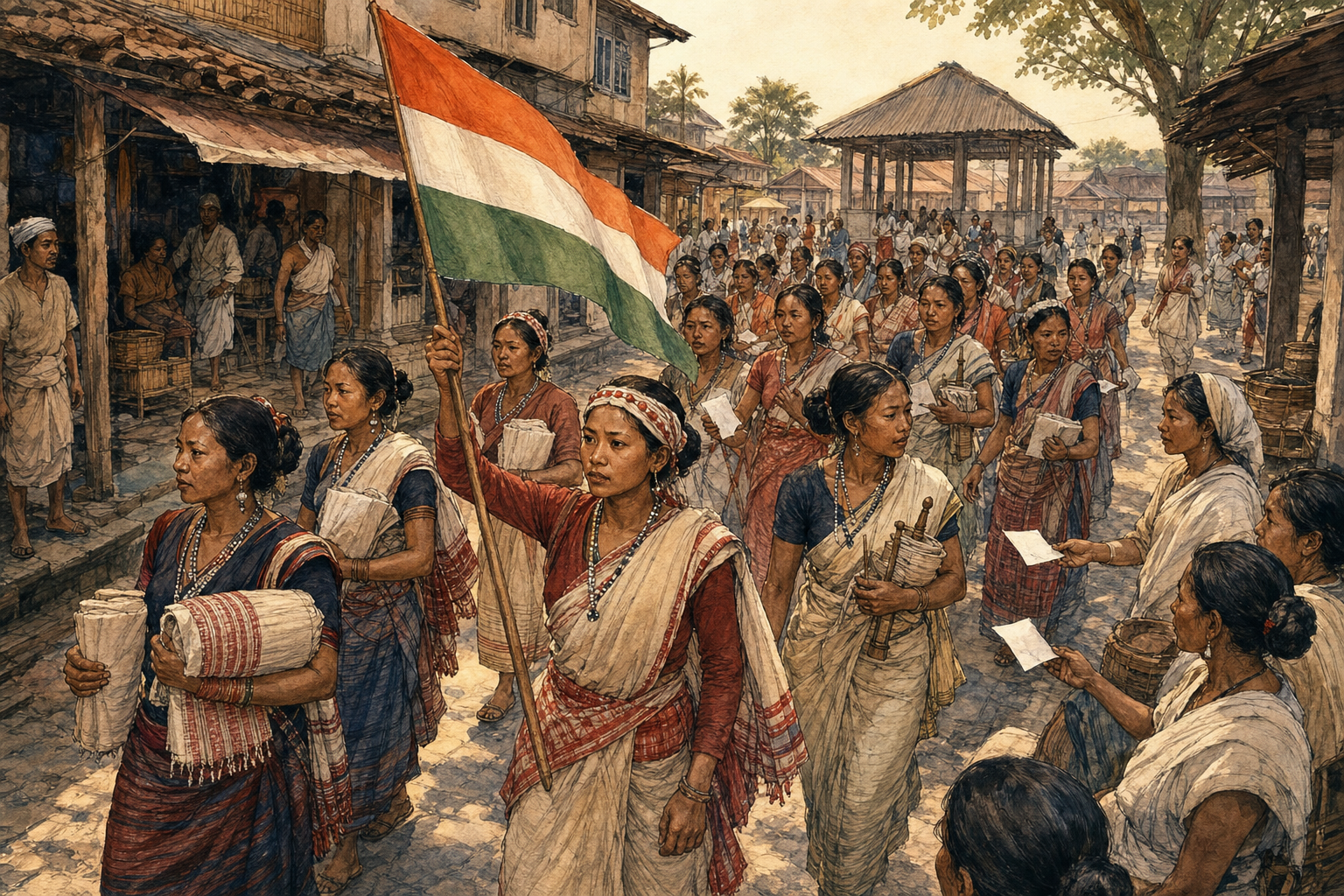
Not every confrontation took place in a forest or on a battlefield. Janjatiya women also built the human infrastructure of a mass movement. They moved between villages, relief work, labour gatherings, classrooms, periodicals and political processions. These activities could appear less dramatic than armed resistance, but they made collective action possible.
Helen Lepcha connected khadi, seva and labour organizing
Helen Lepcha was born in 1902 in Sangmoo village, Sikkim. She carried the Swadeshi message through villages by spinning khadi and encouraging patriotic participation. During the 1920 Bihar floods, she travelled to Muzaffarpur to serve affected people. Mahatma Gandhi admired her work and gave her the name Savitri Devi.
Her range is the important part. She attended the Ahmedabad Congress session in 1921 alongside Sarojini Naidu, then went beyond Congress assemblies to the conditions of industrial labour. In Jharia, she led a procession of more than 10,000 coal miners against the exploitation of Janjatiya workers.
Do not reduce the charkha in her life to a decorative symbol. It was one point in a chain that ran from household production to village communication, disaster relief and organized labour. Helen Lepcha’s example helps you notice that seva and protest can be parts of the same political ethic.
Sushila Samad made education serve collective awakening
Sushila Samad, born in 1906, belonged to the Ho community of West Singhbhum in present-day Jharkhand. Educated at Prayag Mahila Vidyapith, she became Bharat’s first Janjatiya woman to earn a B.A. Honours degree, receiving the distinction “Vidushi.” She was also a Hindi poet, journalist, editor and publisher.
When the Dandi March began in 1930, Samad mobilized Janjatiya women across the Jharkhand region for the Salt Satyagraha. The sequence is worth noticing: learning, writing, editing and organizing were not separate careers. Each increased her capacity to bring women into political life.
Her story corrects a persistent false choice. Education did not have to detach a Janjatiya woman from her community, and intellectual work did not have to remain inside a literary circle. In Samad’s hands, the degree and the periodical became instruments of public participation.
Tileshwari and Kanaklata Barua exposed the cost borne by the young
Assam’s Quit India history carries two names that should be spoken together without collapsing one into the other. Tileshwari Barua of Dhekiajuli was about 12. Kanaklata Barua was 17. Both joined the Mrityu Bahini, a women’s formation whose members were prepared to risk death while trying to raise the tricolour over institutions of colonial authority.
On September 20, 1942, Tileshwari was killed by police gunfire. Kanaklata led a procession forward with the tricolour despite a police warning and was also shot dead on the same day. Assam observes September 20 as Shaheed Divas in Tileshwari’s memory.
The responsible way to tell these stories is neither to hide their ages nor to use those ages merely for emotional effect. State the political act, the expected danger and the lethal response. These girls were participants with a defined objective, but their deaths also reveal a colonial order willing to fire on adolescents advancing with a flag.
Medicine, education and seva were also forms of nation-building
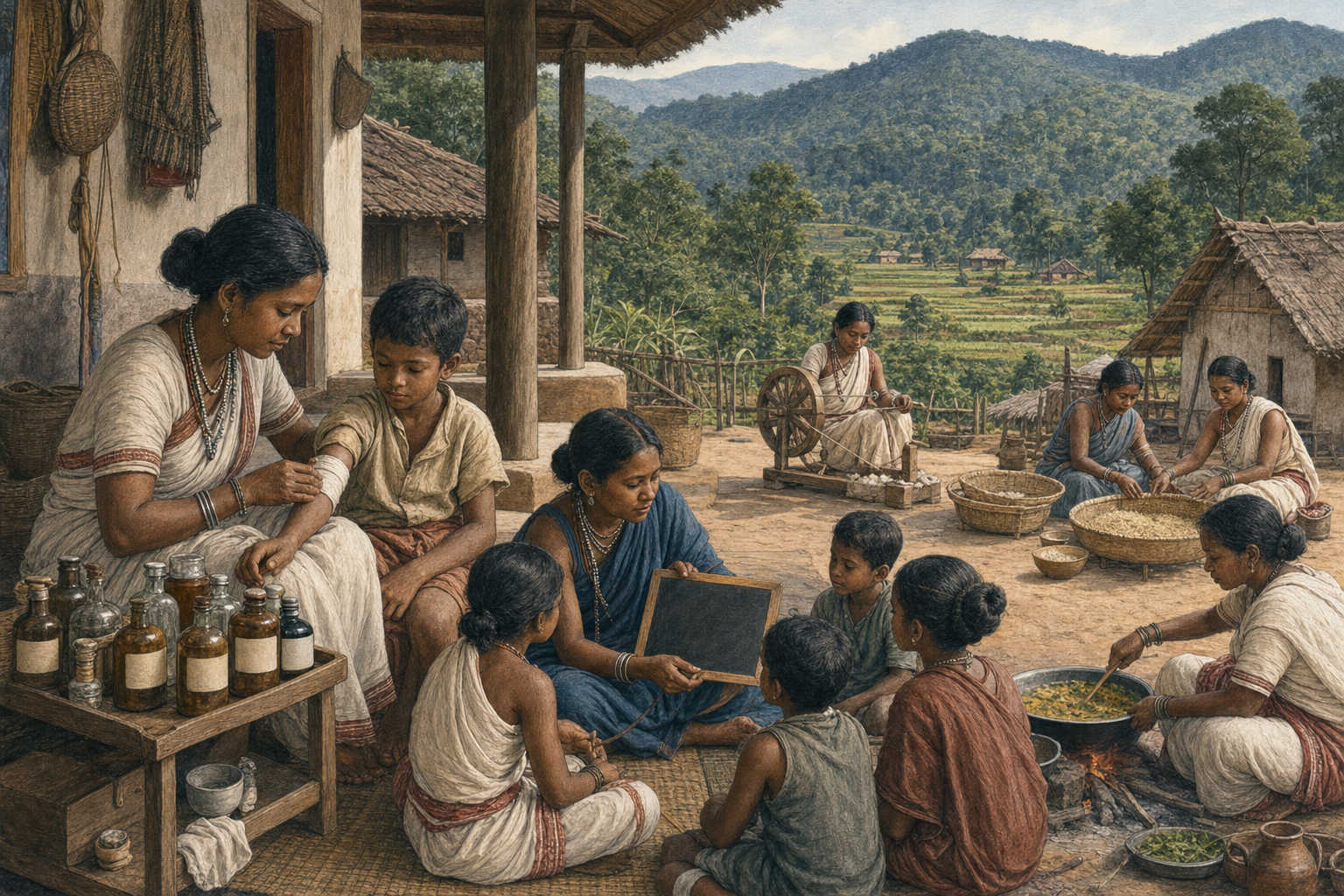
A history made only of arrests and martyrdom ends too early. It misses the people who used professional knowledge, literature and social institutions to change the society for which political freedom was being sought. Kuntala Kumari Sabat, Parbati Giri and Kalibai Bhil allow you to see education in three roles: a platform for public speech, a means of reconstruction and a right defended at the cost of life.
Kuntala Kumari Sabat worked through medicine and literature
Born in the Bastar region in 1901, Kuntala Kumari Sabat became Odisha’s first woman doctor as well as an influential poet. She studied at Ravenshaw Girls’ School and Cuttack Medical School. Her poem Anjali helped awaken patriotic feeling, while her involvement with the Nav Vidhan and Brahmo Samaj connected literary work to social reform.
Her life widens the meaning of action. A doctor can serve bodies, a poet can shape public imagination and a reformer can challenge the habits that restrict participation. Kuntala held those roles together. When you encounter cultural work in a freedom narrative, ask what capacity it created: a language for dignity, a readership, a reform network or the confidence to enter public life.
Parbati Giri carried resistance into post-Independence service
Parbati Giri of Sambalpur entered public life while young and openly defied British authority during the Quit India Movement. She was imprisoned at 16 and released because she was a minor. Afterward, she travelled across Odisha to build support for the movement.
Independence did not end her work. She completed her formal education at Prayag Mahila Vidyapith in 1950, established homes for orphans and worked for education and healthcare. Her later reputation as the “Mother Teresa of Western Odisha” can obscure the continuity in her life: resistance to an unjust state became institution-building for people who still lacked care.
This is a useful test for any freedom-fighter biography. Do not stop reading at 1947 if the person survived it. Ask what freedom required next and whether the activist turned toward schools, health, labour, relief or other forms of public responsibility. In Giri’s case, post-Independence seva was not an appendix to the struggle. It was its constructive continuation.
Kalibai Bhil made the defence of a teacher a defence of education
Kalibai Bhil lived in the Janjatiya region of Dungarpur, Rajasthan. On June 19, 1947, only weeks before Independence, armed authorities tied her teacher, Nana Bhai Khant, to a jeep and dragged him away. Kalibai, remembered as barely 12, ran forward and cut the rope with her sickle. She was then shot and killed.
Her action can be read through guru-bhakti, but it was not only private devotion to a teacher. In a region where education could alter the future of an entire community, saving the teacher meant defending the institution and possibility he represented. That is why her memory became attached to education: schools, colleges, crossroads and a panorama museum later took her name.
Do not let the title “Goddess of Education” turn her into a distant icon. Keep the concrete sequence visible: a teacher under attack, a rope, a sickle, a child making a decision and gunfire. The memorial names acquire their meaning from that sequence.
Teach the history without flattening the women or their communities
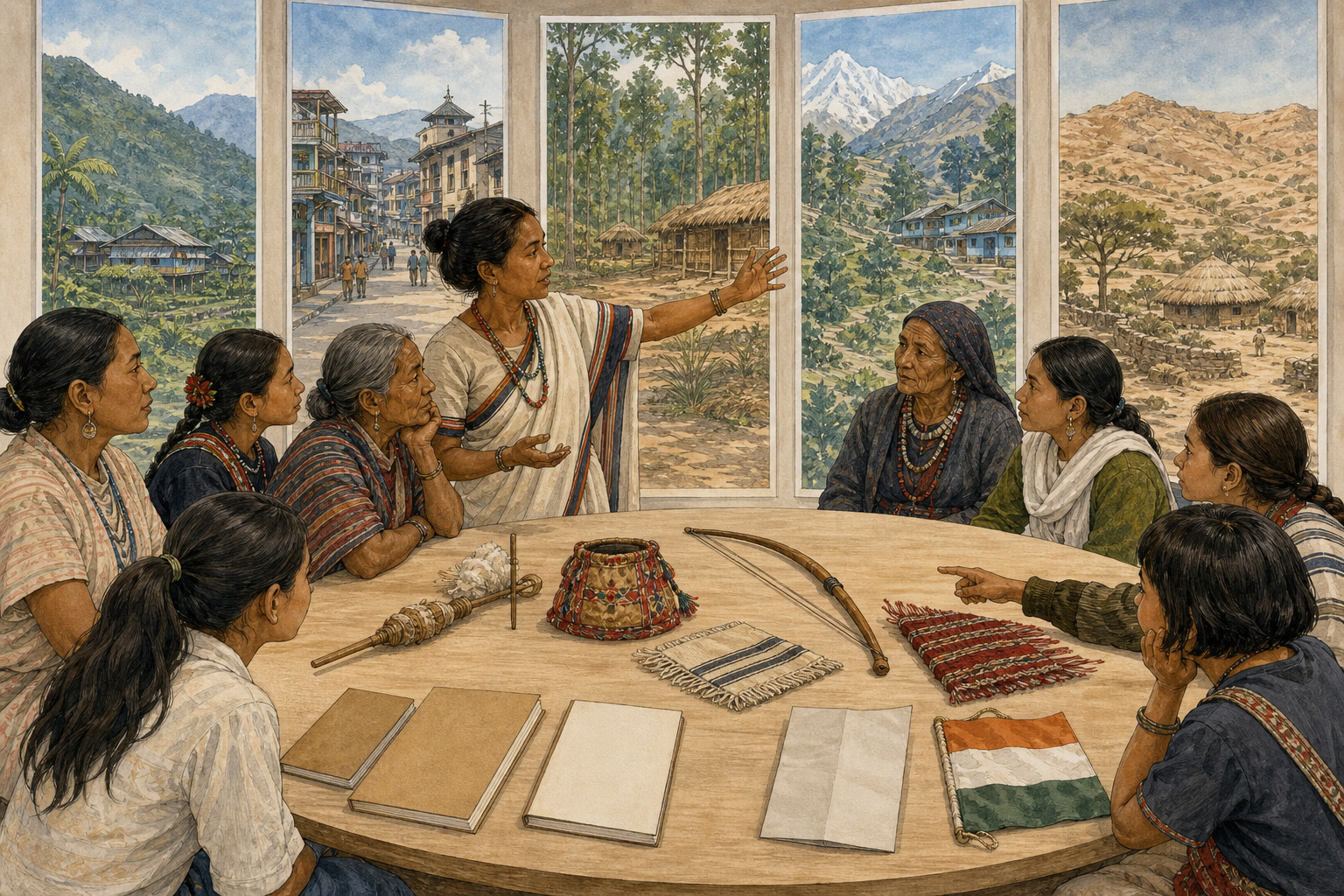
The phrase “forgotten heroines” can attract attention, but it often produces another disposable list. A better account gives every woman a historical location, a method and a purpose. You can use the following five-part frame in a classroom, a family discussion, a commemorative programme or your own reading notes.
- Name the community and place. Write “Sushila Samad, Ho community, West Singhbhum,” not merely “a tribal woman from eastern India.” Specificity is respect, not ornament.
- Use an action verb. Ka Phan Nonglait disarmed; Gaidinliu organized; Helen Lepcha spun, served and mobilized; Sushila Samad published and recruited; Kanaklata carried; Kalibai cut the rope. The verb prevents a person from becoming a passive symbol.
- Identify what was being defended. Depending on the life, it may be sovereignty, spiritual inheritance, labour dignity, political participation, the tricolour, a teacher or access to education.
- Mark the level of certainty. Dates of imprisonment and martyrdom can be stated directly when established in the account. A dramatic battlefield number preserved as part of a remembered episode should remain qualified.
- Follow the legacy beyond the decisive event. Look for prison years, later service, institutions, public honours and local memorials. These reveal what a community or the nation chose to preserve.
A 20-minute remembrance that does more than recite names
Begin with a map and mark Manipur, Meghalaya, Sikkim, Jharkhand, Assam, Odisha, Bastar and Dungarpur. Give each participant one woman and ask for a three-sentence account: where she stood, what she did and what it cost. Then group the actions under four headings: sovereignty, mass mobilization, knowledge and service. A person may belong under more than one heading; that overlap is the point.
End by asking which detail would disappear if the woman were described only as a generic freedom fighter. For Gaidinliu, it would be Heraka and Zeliangrong sovereignty. For Helen Lepcha, it might be the connection between khadi and miners. For Kalibai, it would be the school and the guru for whom she intervened. That single question turns commemoration into historical attention.
If you have only five minutes on the next Independence Day, choose three lives rather than rushing through nine. Place Rani Gaidinliu beside Sushila Samad and Kalibai Bhil: sovereignty, organized participation and education. Give each her community, place, action and cost. Then ask your listeners to explain why Bharat’s freedom story is incomplete without all three.
References
