
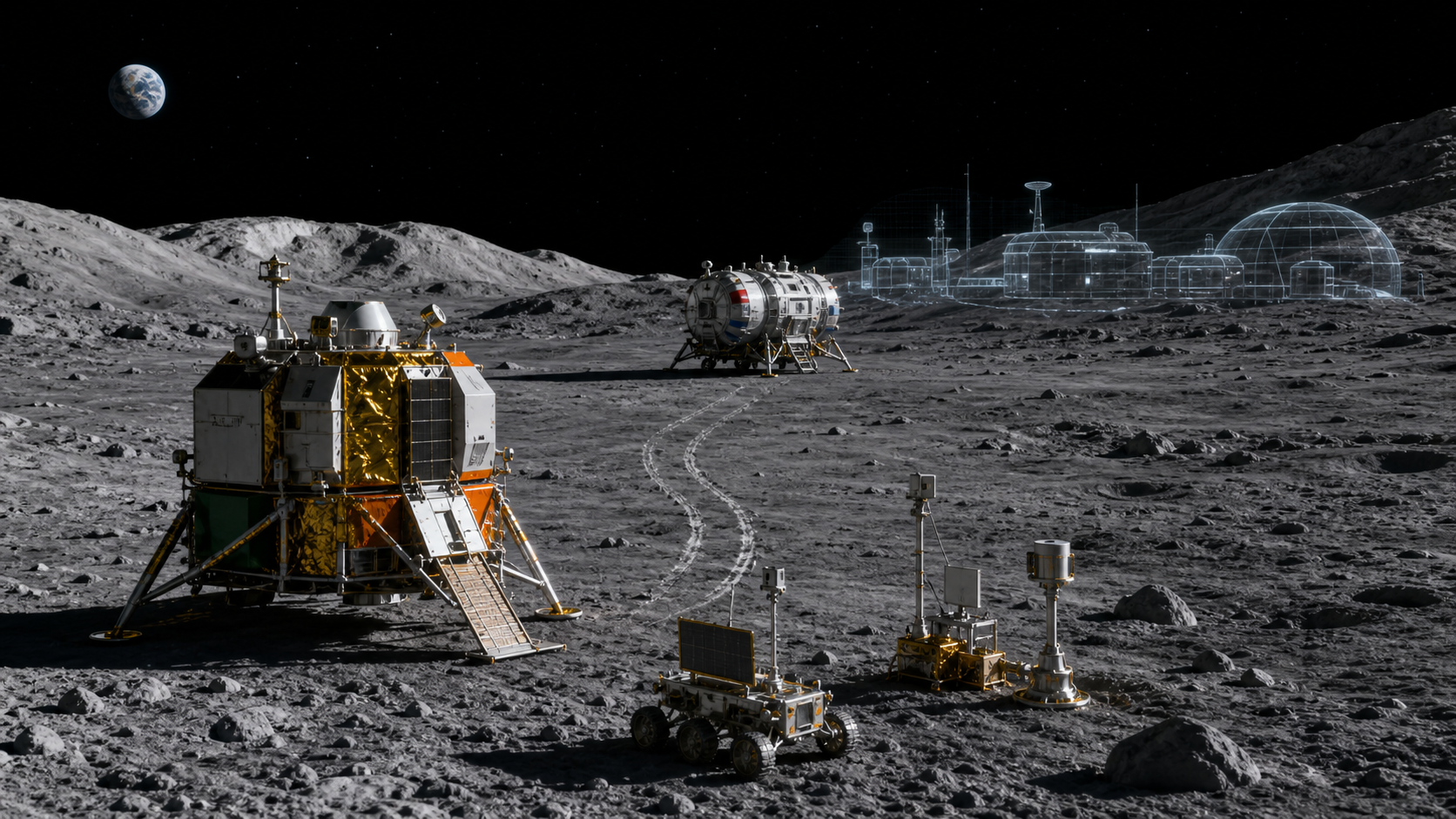
If you are wondering whether Bharat has now secured a place in a future lunar base, the careful answer is: not yet. India has received an important invitation, but the work, rights, costs and responsibilities behind that invitation have not been publicly defined.
The question that matters is therefore not whether India has been admitted to an exclusive space club. It is whether India can turn this opening into technologies it controls, missions it helps direct, scientific knowledge it can use and an industrial base capable of taking on harder lunar work.
What has actually happened – and what has not
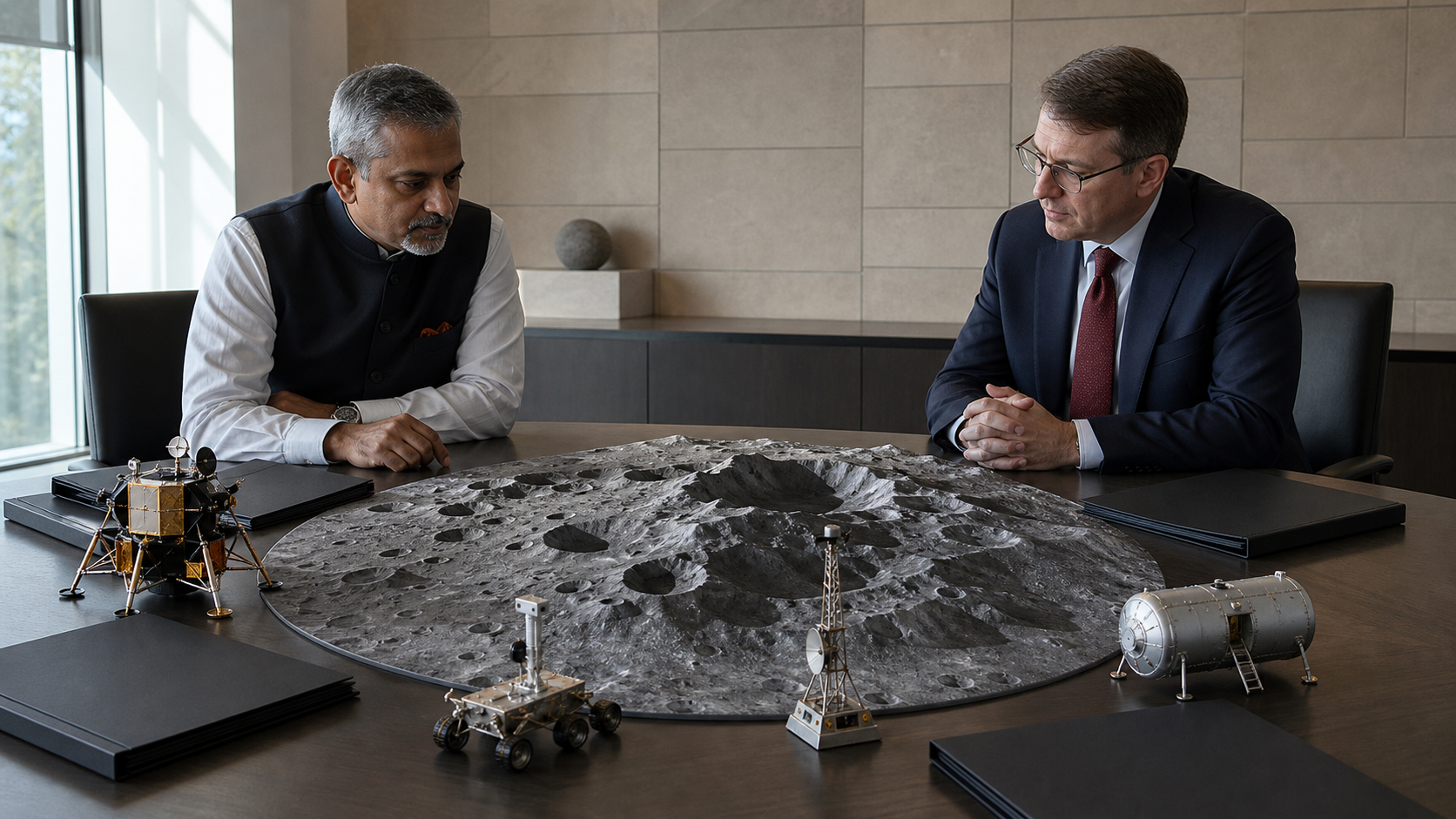
NASA has invited ISRO to join its Moon Base programme. The US Embassy in India confirmed the development following the ninth meeting of the India-US Civil Space Joint Working Group, held at ISRO headquarters in Bengaluru on August 5-6, 2026. US Ambassador Sergio Gor also publicly highlighted the invitation as part of a growing deep-space partnership.
The programme is intended to establish a long-term human presence near the Moon’s South Pole. Its planned progression begins with robotic missions that examine the region and test technologies. Later stages would develop infrastructure supporting astronauts, scientific work and the experience needed for more distant missions, including eventual exploration of Mars.
That sequence is important. A lunar base is not one building delivered by one mission. It is a chain of robotic exploration, technology validation, transport, surface systems, scientific operations and human-support capabilities. Decisions made during the robotic phase can shape which countries own essential technologies and which countries merely use systems designed by others.
The invitation does not, by itself, establish that India has accepted a final participation agreement. It does not reveal a budget, schedule, assigned mission element, astronaut place, Indian-built base module or division of intellectual-property rights. None of those outcomes should be inserted into the announcement by assumption.
You can therefore hold two ideas at once: the diplomatic opening is real, and the operational deal remains undefined. Dismissing the invitation would miss its strategic value. Describing it as a completed lunar-base partnership would go beyond what has been confirmed.
Key takeaways
- The invitation is a negotiating opportunity, not a completed mission assignment. India is being asked to participate, but its precise contribution has not been announced.
- Chandrayaan-3 gives India relevant leverage. ISRO has already demonstrated a soft landing near the same broad lunar region around which the programme is being organised.
- The earliest robotic work may be more consequential than ceremonial participation later. It can allow Indian teams to influence interfaces, operating methods and scientific priorities before the architecture becomes difficult to change.
- Prestige is not an adequate measure of success. Judge the eventual arrangement by Indian responsibility, technology ownership, data access, industrial participation and decision-making authority.
- Watch for commitments rather than celebratory language. A named mission, funded work package, technical milestone and accountable Indian team would show that the partnership has moved from diplomatic intent to execution.
Chandrayaan-3 changes India’s negotiating position
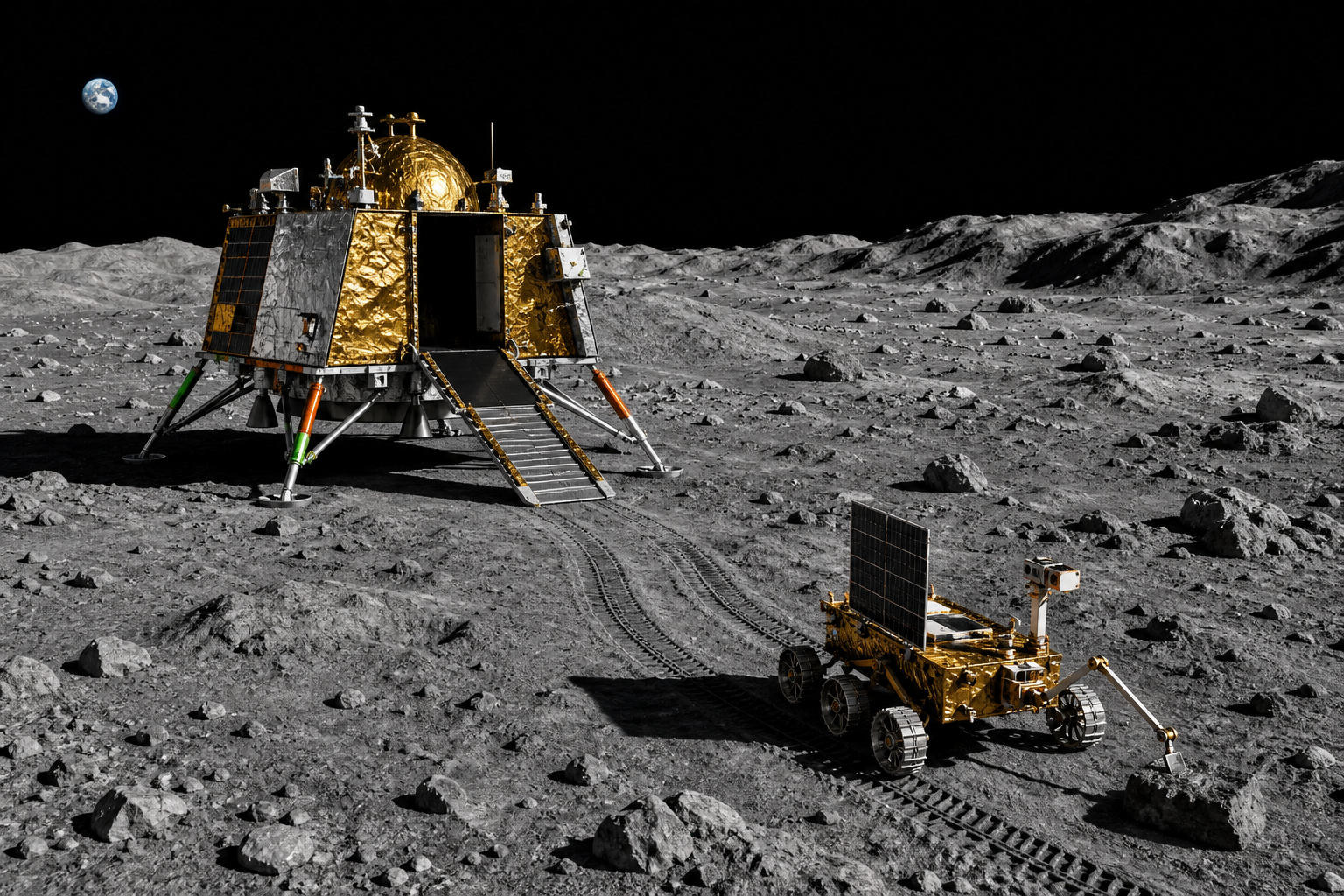
India is not approaching this discussion with only an aspiration to explore the Moon. In 2023, Chandrayaan-3 made India the first country to achieve a soft landing near the lunar south polar region. NASA’s programme is also focused particularly on the Moon’s South Pole.
This geographical alignment gives India demonstrated relevance. ISRO can enter negotiations as an organisation that has already planned, navigated and completed a landing in the programme’s area of interest. That is more valuable than general goodwill because it connects Indian experience to a concrete operational problem.
One successful landing should not be stretched into proof that India already possesses every capability needed for a sustained human presence. Robotic landing, long-duration surface operations and human spaceflight are different technical challenges. Chandrayaan-3 strengthens India’s claim to substantial responsibility; it does not remove the need to build new systems.
The most useful early role would be one that extends India’s demonstrated strength while forcing the next layer of capability to develop at home. When a specific Indian contribution is announced, look for four properties:
- ISRO or an Indian mission team is accountable for a measurable lunar outcome, not merely consulted.
- Indian engineers design and flight-qualify hardware, software or an operational service that the wider programme depends upon.
- Indian scientists help choose the questions being investigated rather than receiving data only after priorities have been set elsewhere.
- The work leaves Indian institutions and companies able to perform a more difficult mission independently or with different partners afterward.
This is the distinction between visibility and capability. A flag, ceremony or passenger place can carry symbolic value. A mission element for which India has continuing responsibility creates knowledge, suppliers, experienced teams and bargaining power that can compound across later missions.
Five tests for an agreement that serves Bharat
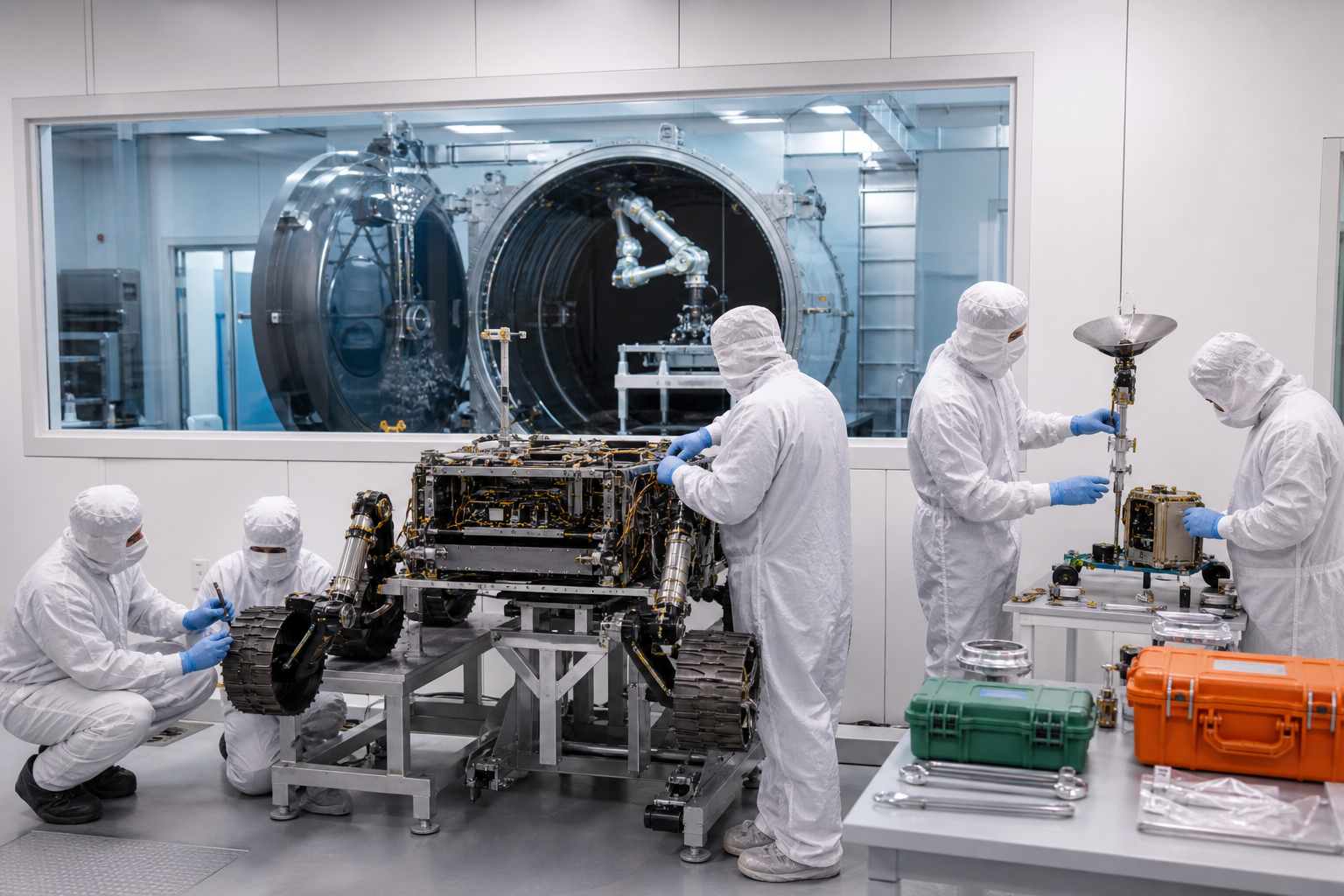
The India-US discussions also covered space science, human-spaceflight technologies and scientific-data sharing under the Artemis Accords, while building on existing civil and commercial cooperation. Those headings are broad. The eventual substance should be tested in five areas.
- A defined mission responsibility. Ask what India will deliver and what result it will own. A named instrument, robotic system, surface service, communications function, scientific package or operations role would be more meaningful than a general promise to cooperate. The strongest work package is one whose absence would matter to the mission.
- Technology ownership and reuse. Participation should help Indian teams master a capability, not confine them indefinitely to an opaque interface. Look for clarity about intellectual property, technical knowledge, critical interfaces and India’s ability to improve or reuse what it develops. Interoperability with partners is useful; dependence that prevents independent follow-on work is not.
- Science leadership and usable data. Data sharing sounds positive, but access alone does not establish equality. Ask who helps set observation priorities, how quickly Indian researchers receive data, who maintains archives and whether Indian teams can lead analyses arising from work they helped perform. These details determine whether India becomes a scientific co-author of lunar exploration or mainly a downstream user.
- A route for Indian industry. Commercial cooperation should produce more than occasional subcontracting. Look for Indian firms receiving transparent opportunities to qualify flight hardware, integrate critical subsystems and become recurring suppliers. The relevant outcome is not simply expenditure in India; it is a domestic supply chain that can meet lunar mission standards again.
- Governance and a human-spaceflight pathway. If the partnership is expected to advance human spaceflight, India should have roles in requirements, safety processes, mission planning, training or operations that build institutional competence. Decision-making authority matters because a country can contribute valuable work while remaining absent when architecture, schedules and priorities are changed.
Not every term will be public immediately, and some sensitive technology will inevitably remain controlled. That does not make scrutiny unreasonable. It means public evaluation should focus on observable outputs: named projects, Indian lead institutions, funded milestones, launches, delivered systems, scientific leadership and repeat orders for Indian suppliers.
How to read the next India-US space announcement
Space diplomacy moves through stages, and headlines often flatten those stages into a single claim of partnership. Use the following evidence ladder when the next announcement appears. The labels may vary, but the underlying level of commitment can still be identified.
- Invitation or statement of intent: political access has opened, but scope and obligations remain negotiable.
- Working group or framework: institutions have agreed on areas for discussion, but no mission task is necessarily guaranteed.
- Implementation arrangement: responsibilities, governance or technical processes begin to become identifiable.
- Funded mission assignment: a team has resources, deliverables and milestones for which it can be held accountable.
- Delivered and operated capability: hardware, software, science or operations have performed in the mission environment and can inform the next undertaking.
Then look for five concrete nouns: mission, deliverable, funding, milestone and authority. An announcement does not need to publish every contractual detail, but it should eventually tell you what is being built, who is paying, when performance will be demonstrated and who can make or change important decisions.
A strong next step would identify an Indian-led contribution to the robotic or technology-testing phase, because that is where the programme is expected to begin. A moderate step might establish structured science, human-spaceflight or data work without yet assigning flight responsibility. A weak outcome would keep repeating the language of strategic partnership while leaving India’s technical role unnamed.
For now, treat NASA’s invitation as a serious opening rather than a finished achievement. When firmer terms emerge, do not ask only whether India is inside the programme. Ask what India is responsible for delivering, what knowledge and systems Bharat will retain, and whether the work makes the next Indian lunar mission easier to lead. That is the practical difference between being present in someone else’s architecture and helping shape the future of lunar exploration.
References
