
You know the moment: a message angers you, a family dispute becomes personal, or a decision must be made before your emotions have settled. Your mind starts composing a reply before it has understood the situation. The immediate problem may be outside you, but agitation is now deciding how you will meet it.
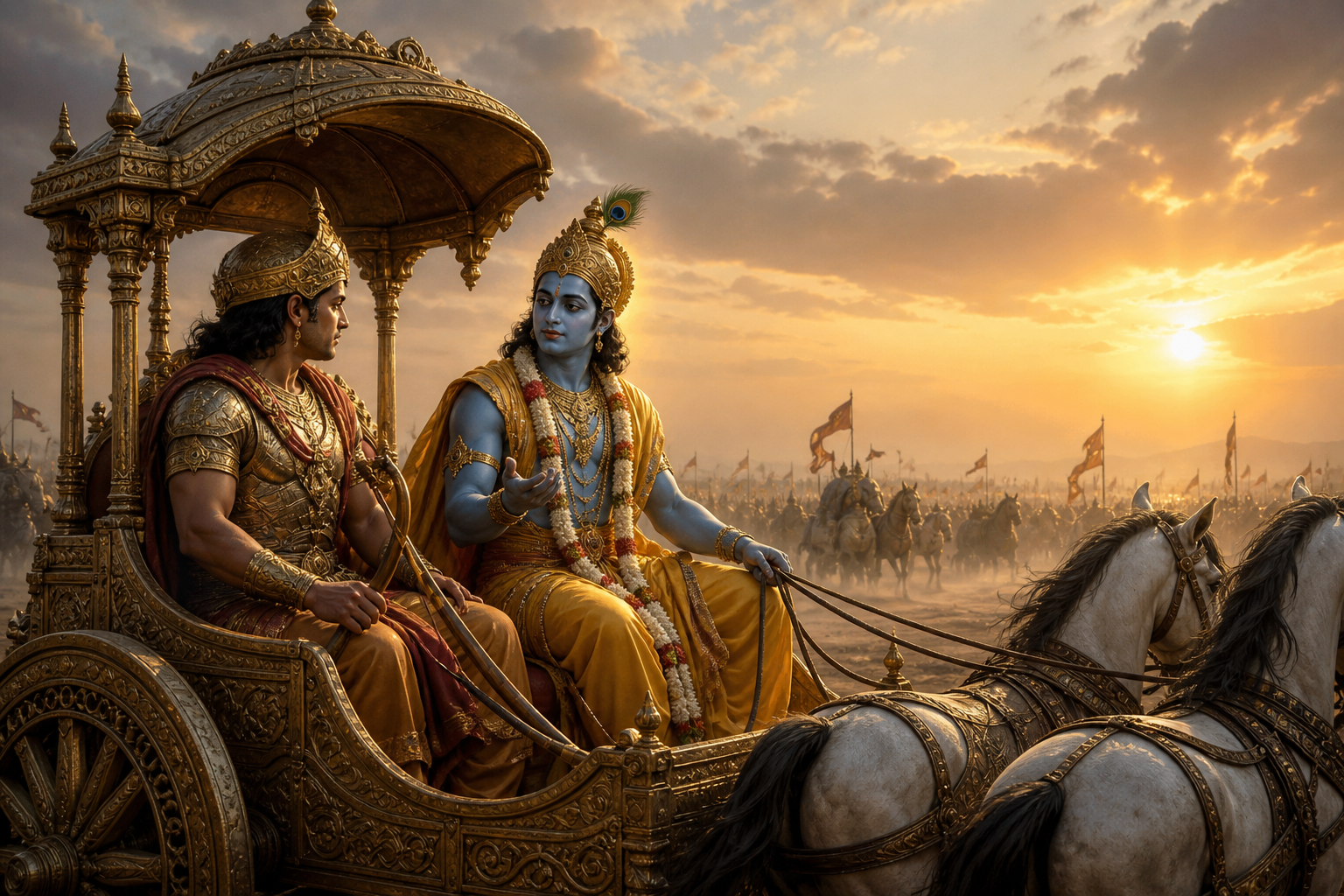
Sri Krishna offers a demanding alternative. Calmness is not withdrawal from difficulty. It is the inner steadiness that lets you see clearly, choose what dharma requires, and act without handing control to fear, pride, or anger.
What Sri Krishna’s calm actually teaches
Intelligence, courage, physical strength, and strategy all matter. Yet none of them can be used well when the mind is being dragged from impulse to impulse. Intelligence becomes rationalisation. Courage becomes recklessness. Strength becomes intimidation. Strategy becomes manipulation. A powerful faculty under an agitated mind can magnify the original mistake.
That is why Sri Krishna’s capacity to remain calm in every circumstance deserves to be understood as a form of strength in its own right. His composure did not replace wisdom or decisive action. It created the inner conditions in which wisdom could guide action.
A calm mind gives you a small but decisive freedom: the event does not automatically dictate your response. You can notice what happened, distinguish it from what you fear it means, and decide what should happen next. That interval is where discernment operates.
Do not confuse this with appearing serene. A quiet voice can conceal resentment, calculation, or avoidance. Genuine calm is visible in the quality of the decision: you can hear an unwelcome fact, revise your view, speak firmly without humiliation, and stop when the necessary action is complete.
The three confusions that agitation creates

Agitation compresses several different questions into one emotional verdict. Someone disagrees with you, so the mind declares that you have been disrespected. A plan fails, so the mind declares that everything is lost. You feel afraid, so the mind declares that retreat is the only safe option. Clear action begins by separating what agitation has fused together.
- Event from interpretation: State only what a neutral observer could verify. “They rejected the proposal” is an event. “They want to destroy my standing” is an interpretation unless you have evidence.
- Feeling from instruction: Anger may tell you that a boundary was crossed, but it does not tell you the right words, timing, or consequence. Fear may reveal risk, but it does not automatically prove that the honourable course is retreat.
- Duty from ego: Ask what protects truth, responsibility, and the legitimate interests of those affected. Then ask what merely protects your image, your need to win, or your desire to make another person feel small.
This separation is practical, not abstract. Suppose a relative makes a cutting remark during a gathering. The event is the remark. The feeling is hurt or anger. Your duty may be to prevent repeated disrespect without turning the gathering into a public contest. Once those are separated, several responses become possible: address it privately, state a boundary immediately in one sentence, or leave the conversation and return when both sides can speak constructively.
The key question is not “How do I stop feeling this?” It is “What authority should this feeling have over my next action?” You do not have to deny anger in order to refuse it command.
A five-step pause for charged moments

The following discipline is a practical application of Sri Krishna’s model of steadiness, not a scriptural formula. Use it before sending a hostile reply, entering a difficult conversation, making an accusation, or taking an action whose consequences will outlast the emotion that prompted it.
- Interrupt the momentum. Stop typing, lower your hands, and take one unforced breath before speaking. If no immediate danger or duty requires action, do not make an irreversible choice while your body is still driving you toward instant release.
- Name the disturbance precisely. Replace “Everything is going wrong” with the narrower truth: “I am angry because my work was dismissed,” “I am afraid of losing this opportunity,” or “I want to answer because silence feels like defeat.” Precision reduces the power of a vague emotional storm.
- Write or say the bare facts. Remove predictions, motives you cannot verify, and words such as “always” or “never.” If your description becomes much shorter, that is useful evidence: part of the crisis was being supplied by interpretation.
- Identify the dharmic responsibility. Ask, “What must be protected here?” The answer may be truth, safety, a promise, a relationship, a fair process, or another person’s dignity. It should name a responsibility, not merely your preferred outcome.
- Choose the smallest sufficient action. Correct the false statement, set the boundary, ask the necessary question, postpone the decision, or leave the harmful setting. Do what the situation requires without adding punishment for the sake of emotional satisfaction.
The final step prevents calmness from turning into endless delay. Once you can state the facts, the duty, and the proportionate response, act. Waiting for every emotion to disappear can become another form of avoidance. The standard is not perfect inner silence. It is enough steadiness to prevent impulse from impersonating dharma.
For written communication, add one simple test before sending: remove every sentence whose only purpose is to sting. A firm reply can still name the conduct, correct the record, state the consequence, and establish the next step. Humiliation contributes nothing to those tasks.
Calm must still serve dharma

The most common misreading of calmness is that a spiritual person should tolerate everything quietly. That confuses self-command with surrender. If a lie must be corrected, calmness should make the correction more exact. If a boundary must be enforced, calmness should remove the threat and theatrics. If someone is at risk, calmness should help you act promptly instead of freezing or escalating blindly.
Use three tests to decide whether your calm response is genuinely dharmic:
- Truth test: Are you responding to what is known, or to a motive and future outcome you have imagined?
- Proportion test: Does the response address the actual wrong, or are you using one incident to release accumulated resentment?
- Aftermath test: When the emotional charge has passed, will you still be able to explain why this action was necessary?
These tests also expose false calm. Silence fails the truth test when it allows a damaging falsehood to stand. Passive compliance fails the proportion test when it invites repeated harm. Avoiding every difficult conversation fails the aftermath test because temporary comfort leaves the underlying duty undone.
Calm action therefore has two boundaries. On one side is impulsive retaliation; on the other is passive avoidance. The middle is not a weak compromise. It is disciplined action: neither more nor less than the situation requires.
You can see whether you are approaching that middle by noticing your aim. If you want the problem corrected, you are becoming ready to act. If you mainly want the other person to suffer, feel defeated, or acknowledge your superiority, pause again. Ahankara has probably entered the decision.
Key takeaways
- Calmness is not the absence of action; it is freedom from automatic reaction.
- Separate the observable event, your emotional response, and your dharmic responsibility before deciding what to do.
- Treat feelings as information, not commands.
- Choose the smallest action sufficient to protect truth, duty, safety, or a legitimate boundary.
- Remove cruelty from a response without removing clarity or consequence.
- Judge composure by the quality of the action, not by how serene a person appears.
Steadiness is built through abhyasa, not discovered suddenly in the middle of conflict. Begin with the next minor provocation. Pause, name the facts, identify the duty, and choose a proportionate response. Each time you do that, you make the mind a little more capable of serving dharma when the stakes are higher.
References
