
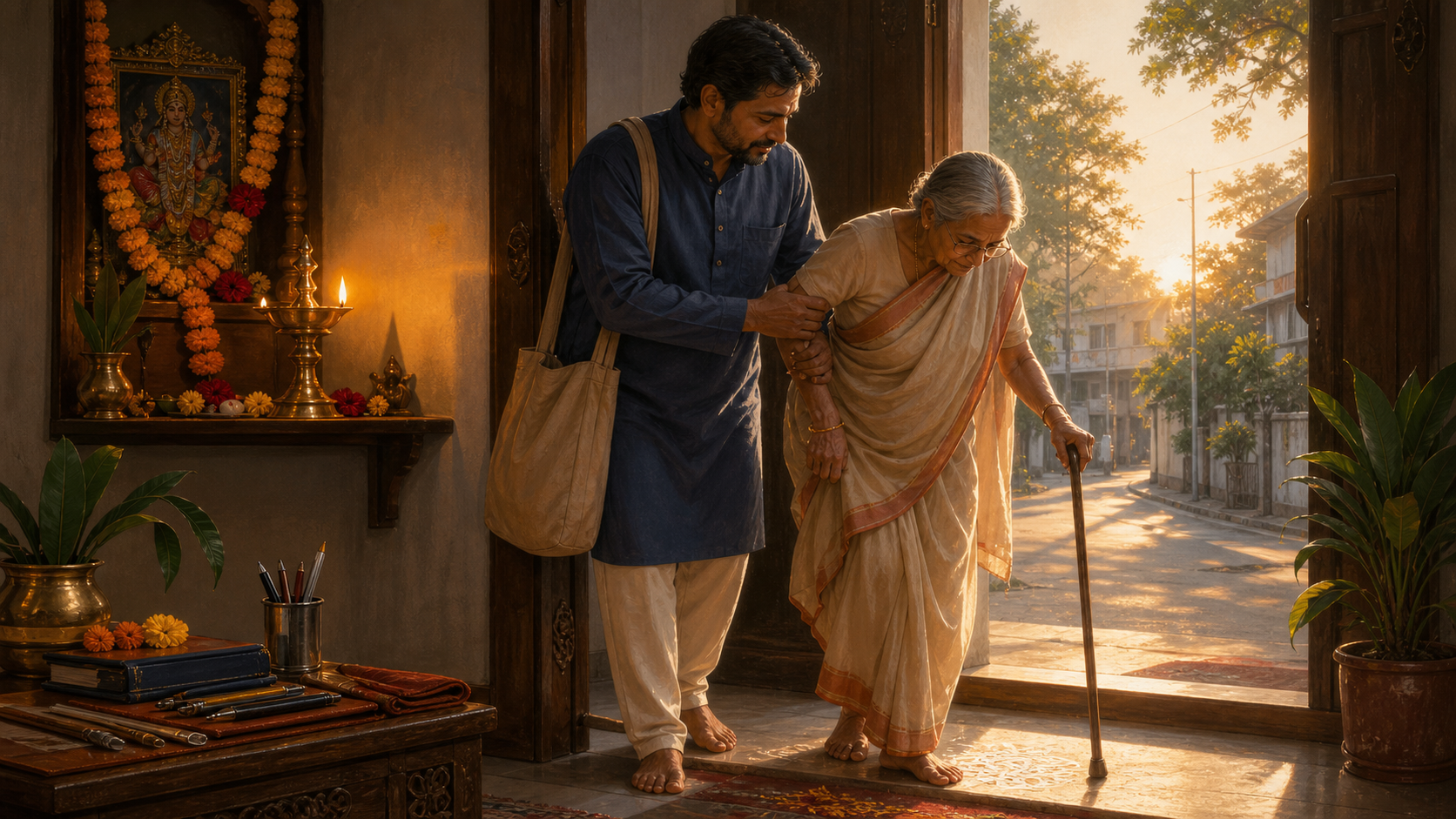
The lamps have dimmed, the prayers of Navaratri have reached their culmination, and you are left with a practical question: what should Vijayadashami change once the celebration is over?
Let the day become a hinge between devotion and conduct. The victory of Dharma over Adharma matters most when it changes how you speak, fulfil a neglected duty, protect a tradition, or correct something within your control. Keep the forms of worship received through your family or sampradaya; the work below begins after worship, when the meaning of victory has to enter ordinary life.
Treat victory as alignment, not applause
It is easy to celebrate Dharma’s victory as an event outside yourself. It is harder to ask where convenience, fear, resentment, or carelessness has displaced Dharma in your own conduct. Vijayadashami does not require you to imagine yourself as the hero of an epic struggle. It asks you to make the next right choice clearly and without evasion.
In this practical sense, victory is alignment. Your words agree with what you know to be true. Your actions agree with the duties you have accepted. Your defence of Dharma agrees with the compassion and restraint Dharma demands. Sanatana Dharma is then more than an identity you affirm; it becomes the standard by which you decide what to do.
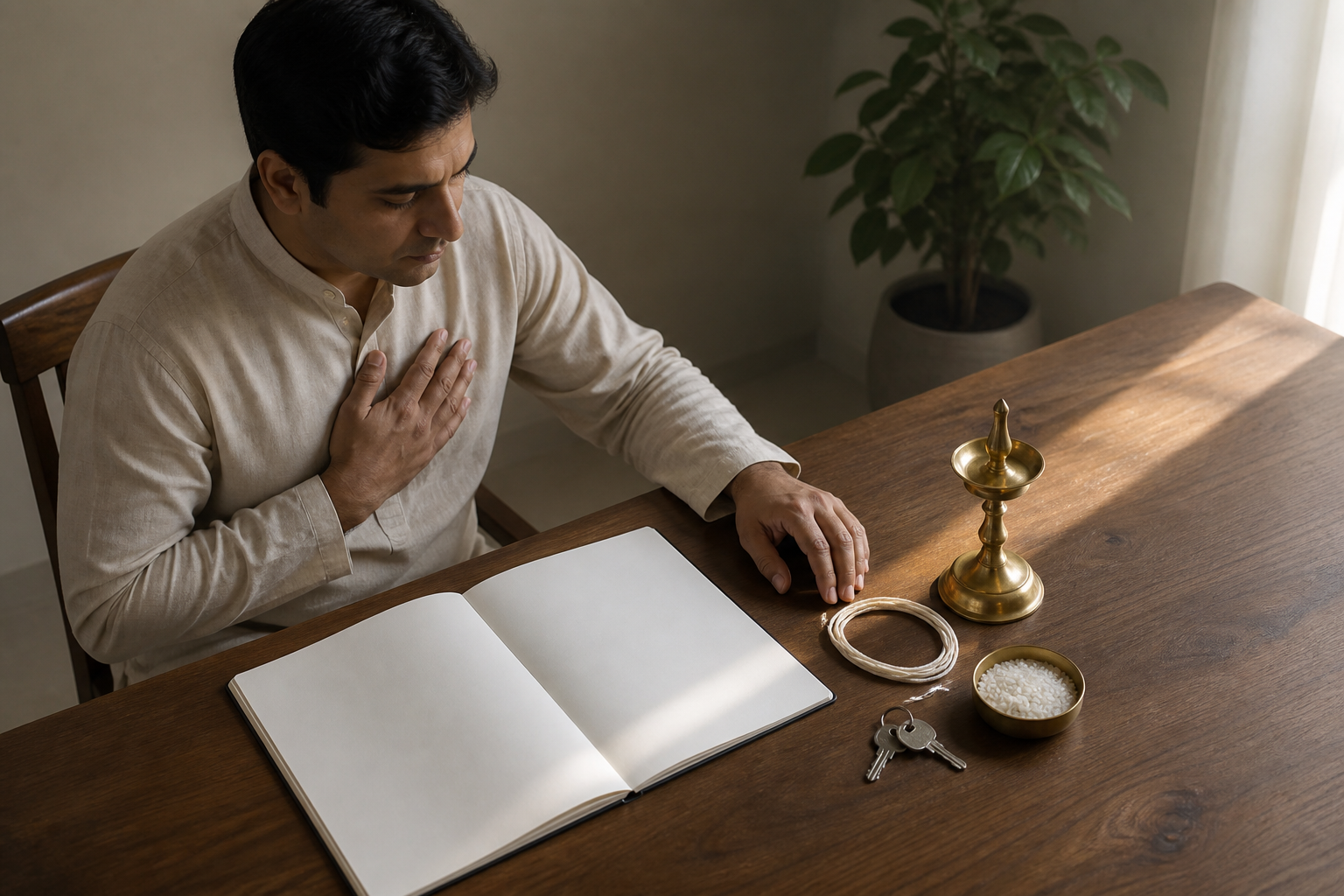
Begin with a short Vijayadashami audit. Write one honest answer to each question:
- What truth am I avoiding because acknowledging it would require action?
- Which duty have I postponed even though it is properly mine?
- Where has my anger begun to imitate moral clarity?
- Which inherited practice, memory, or relationship will weaken if I continue to neglect it?
Do not select the most dramatic answer. Select the one that is specific, within your control, and ready for action. A promise to protect Dharma everywhere is too vague to guide tomorrow morning. A promise to verify a claim before sharing it, resume a neglected prayer, help with a recurring community responsibility, or learn the meaning of a family observance is visible enough to keep.
This distinction matters. Adharma is not confronted only through public declarations. It is also weakened whenever you refuse a convenient falsehood, keep a difficult promise, restrain a cruel response, or give proper care to something entrusted to you.
Pair moral courage with gentleness
Vijayadashami calls for courage, but courage alone is not a complete dharmic test. Courage without gentleness can harden into aggression. Gentleness without courage can become an excuse for silence. You need enough firmness to defend what is true and enough compassion to avoid treating another person’s dignity as expendable.
Before entering a difficult conversation, separate four things that anger tends to mix together: the factual claim, your duty, your tone, and the outcome you seek. Write one sentence for each. If you cannot yet state the factual claim without insulting someone’s motives, you are probably not ready to correct it.
- When correcting misinformation about a Dharmic tradition, verify the claim first and address the error itself. Do not invent motives for the person repeating it.
- When teaching a child, explain what the practice asks them to notice and do. Fear of outsiders is not a substitute for knowledge of one’s own tradition.
- When listening to an elder, ask for context rather than forcing the memory into a conclusion you already prefer. Respect includes preserving uncertainty honestly.
- When a temple or community institution needs correction, identify the specific problem, the responsible person, and the remedy you are requesting. Public escalation should not replace a clear first approach when a direct remedy remains possible.
Compassion does not require you to blur the distinction between Dharma and Adharma. It governs how you uphold that distinction. A person can be corrected without being dehumanised. A boundary can be firm without being theatrical. A defence of tradition can be resolute without letting hostility become its organising principle.
Use a simple test before you speak or publish: if your wording were directed at someone you respect, would you still regard it as truthful and proportionate? If not, revise the wording without weakening the fact. That small discipline keeps moral courage from becoming self-righteous performance.
Choose a resolve small enough to repeat
A festival can generate intensity. Intensity, however, is not continuity. The bridge between an auspicious resolve and a changed life is abhyasa: returning to the practice after the emotion of the day has passed.
Build your Vijayadashami resolve in the following order:
- Name one area of conduct: speech, study, worship, family responsibility, cultural preservation, or service.
- Convert the aspiration into an observable action. Replace “learn more about Dharma” with the text, teaching, language, or practice you will actually study.
- Attach the action to something that already occurs. Study after your regular prayer, call an elder during an established family routine, or complete a community task on its recurring day.
- Define a minimum version for difficult days. The minimum should preserve continuity without pretending that a token gesture is the whole practice.
- Review the resolve at a fixed weekly point. Ask whether the action happened, what obstructed it, and what adjustment would make the next repetition more reliable.
Keep the resolve narrow enough that you can tell whether you kept it. Several grand promises made at once create confusion: when they fail, you cannot see which obstacle mattered. One sustained discipline teaches you more than a cluster of abandoned intentions.
Your minimum version also needs honesty. If your resolve is serious study, merely looking at a book is not study. A short, attentive passage with a note in your own words may be. If your resolve is control of speech, remaining silent in one easy moment does not settle the matter; pausing before forwarding an inflammatory claim is a meaningful repetition because it addresses the actual weakness.
If you miss the practice, do not turn one lapse into a new identity. Identify the broken link and return at the next cue. The dharmic value lies in truthful correction, not in pretending that a vow was effortless.
Turn cultural memory into careful seva
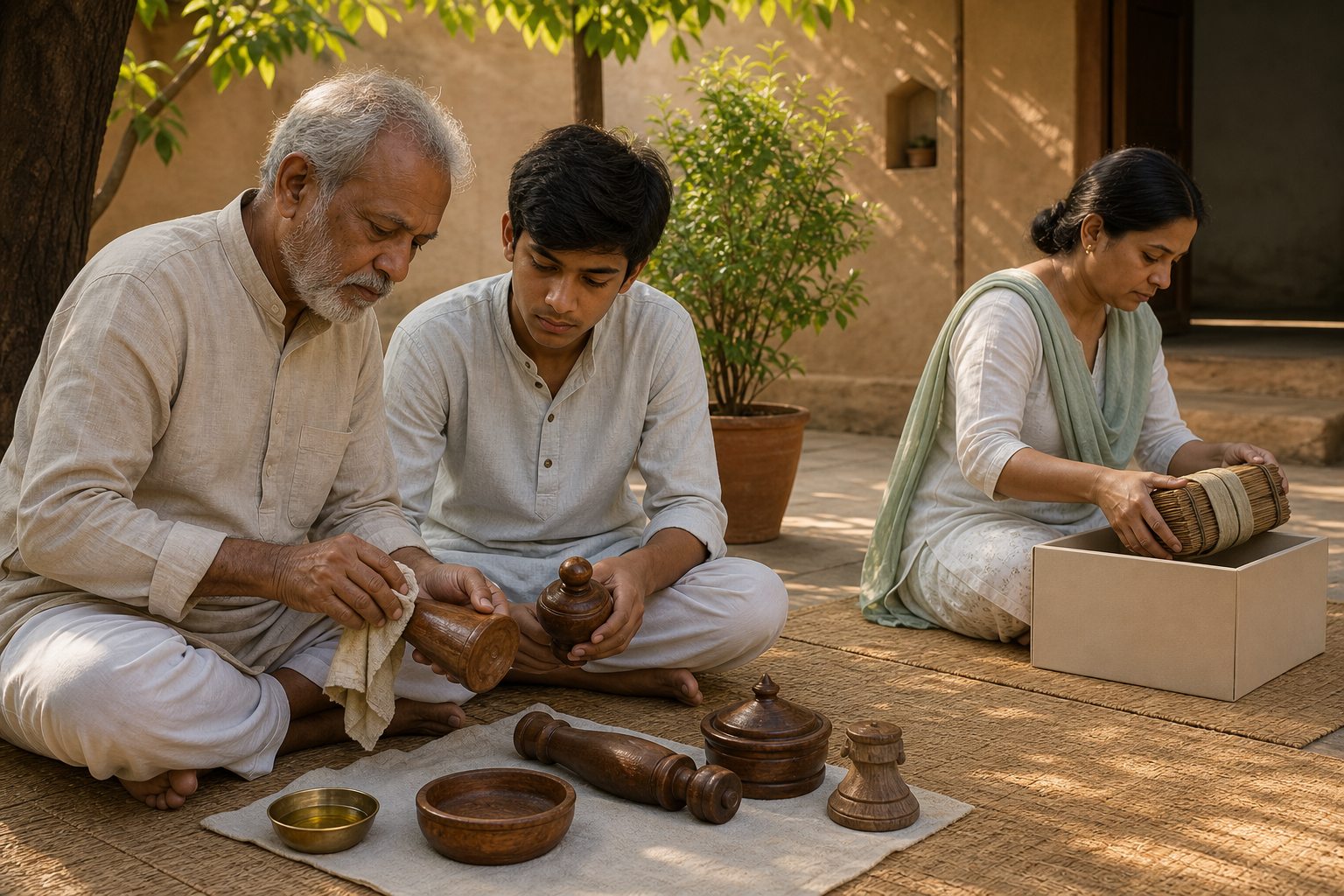
Vijayadashami can also renew a civilisational duty. Sanatana Dharma survives through worship and teaching, but also through the patient preservation of names, meanings, local practices, family memories, and the voices of those who carried them. Admiration is not yet preservation. Something has to be recorded, understood, labelled, and handed forward responsibly.
Choose one bounded item rather than trying to document an entire tradition at once. It might be a family’s Vijayadashami observance, the account of how an elder learned a prayer, the local name of a ritual object, or the way a community responsibility was organised. Then use a careful process:
- Ask what the practice is called in the language of the person who received it.
- Record who taught it, where it was practised, and which details the speaker believes may vary by family, region, or lineage.
- Obtain consent before recording, publishing, or identifying anyone. Ask whether any part should remain within the family or community.
- Preserve the original words alongside any transcription or translation. Label your explanatory additions so they are not mistaken for the speaker’s testimony.
- Distinguish memory from verification. An elder’s recollection is valuable as recollection, but it should not be converted into a dated historical claim without further support.
- Give the file a useful name containing the subject, place, speaker, and recording date, then retain a backup in a separate location.
- When a doctrinal or historical claim exceeds the speaker’s direct memory, consult the relevant texts or a qualified scholar before presenting it as settled.
This discipline protects both truth and diversity. A local practice does not need to be advertised as universal in order to be precious. Preserving its actual context is more respectful than forcing it into a standardised story.
The same rule applies to cultural advocacy. Do not let virality decide what is true. A dramatic claim that cannot be checked does not become dharmic because it appears to defend Hindus. Forwarding it may weaken the very credibility that serious cultural work requires. Verify first, state uncertainty where it remains, and prefer durable knowledge over momentary outrage.
Key takeaways
- Carry Vijayadashami beyond worship by choosing one truthful, observable action within your control.
- Measure victory by alignment between conviction, duty, speech, and conduct rather than by the intensity of celebration.
- Pair courage with gentleness: defend the truth without making humiliation part of the method.
- Turn resolve into abhyasa by linking one narrow practice to a recurring cue and reviewing it honestly.
- Preserve cultural memory with consent, context, accurate labels, and a clear distinction between testimony and verified history.
- Treat unverified claims as a risk to dharmic credibility, even when those claims flatter your existing convictions.
Before Vijayadashami ends, write down the single act that will carry its meaning into your next ordinary day. Put it where you will encounter it at the moment of action, not where it will merely look devotional.
When the festival returns, look for victory in what has become steadier: speech that is more truthful, duty that is more reliable, courage that is better governed, and an inheritance that is better cared for. That is how a sacred day becomes a living commitment to Sanatana Dharma.
References
- DharmaRenaissance Blog — Vijayadashami Reflections: An Essential, Heartfelt Tribute to Sanatana Dharma’s Spirit
