
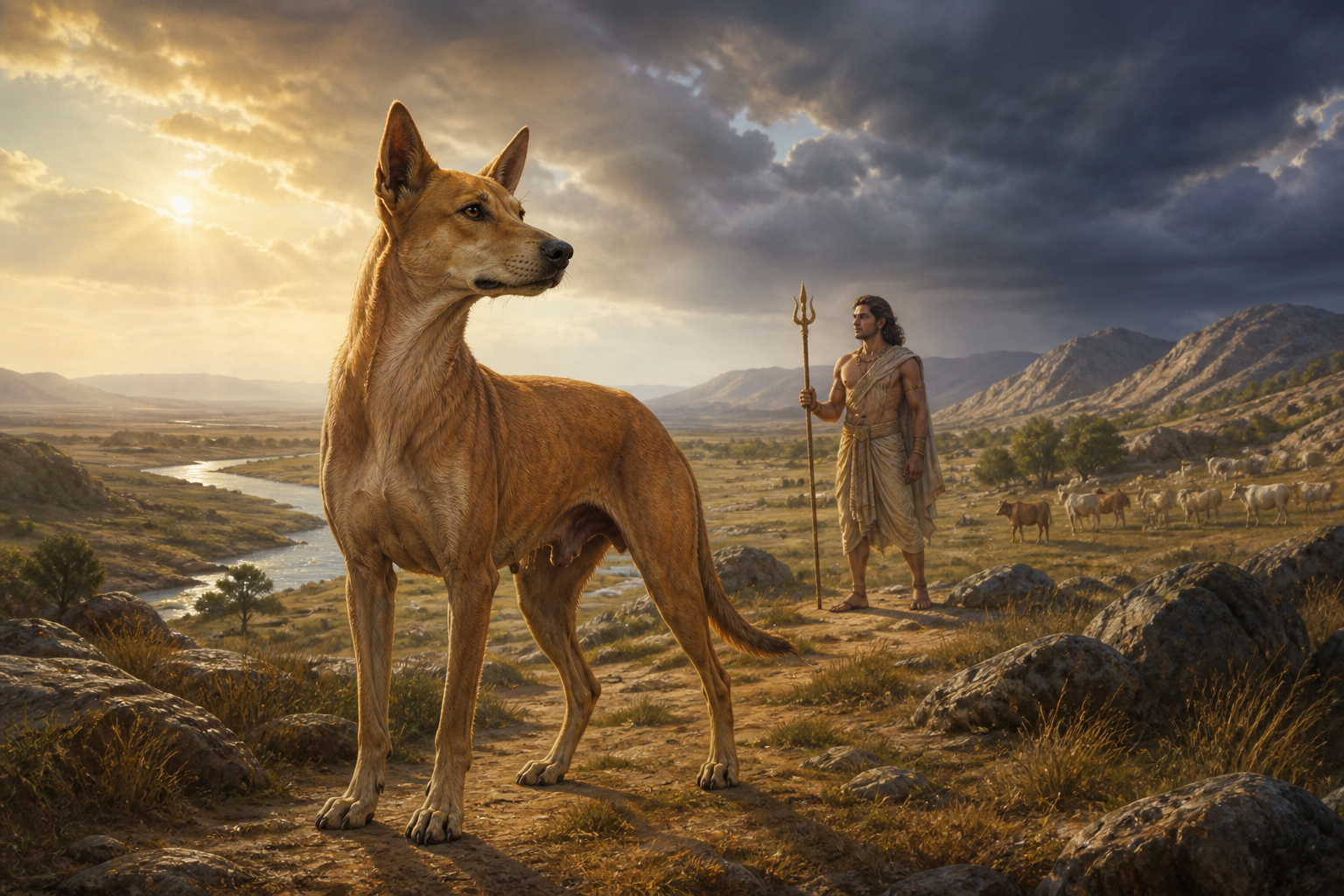
You may have encountered Sarama in a list of Vedic beings and wondered whether she is merely Indra’s dog, an independent deity, or a symbol that later readers have overloaded with meaning. The most reliable answer begins by refusing all three shortcuts.
Read Sarama first as she is presented: a female canine being who belongs to the divine sphere and stands in a devoted relationship with Indra. Once those details are secure, you can consider what her presence means without turning interpretation into supposed scripture.
Begin with Sarama’s actual place in the Vedic world
Three details should govern your reading. Sarama is female, she retains a canine form, and she is celestial rather than an ordinary mortal animal. She is also remembered as a devoted companion of Indra, king of the heavens. None of these details should be discarded as ornamental.
This immediately corrects a common misreading. Calling Sarama a dog does not demote her. Her canine identity is part of the sacred portrayal itself. Nor does her association with Indra make her an incidental household pet. Companion is the more responsible word because it preserves relationship, dignity, and participation in the divine order without inventing a status that has not been established.
The description of Sarama as the first female dog in Hindu sacred tradition should also be handled carefully. It identifies her as an originating or exemplary sacred figure. It should not be converted into a claim about the biological history of dogs. When traditional language and modern categories do not align neatly, keep the religious meaning in view rather than forcing a literalism the description cannot support.
Her animal form is part of the theology, not a disguise
Sarama’s place near Indra shows that animal form does not, by itself, exclude a being from divine honor. She does not have to stop being canine in order to belong in the celestial realm. That point matters whenever you encounter non-human beings in Hindu sacred narratives: outward form is not a dependable measure of spiritual rank.
You should therefore resist two opposite habits. The first is embarrassment, as though an animal-shaped sacred being must be explained away as primitive imagination. The second is overstatement, in which every feature of an animal becomes a fixed mystical code. Sarama can carry symbolic meaning without becoming a cipher in which dog automatically means one thing everywhere.
A sound interpretation begins with placement and relationship. Ask where the being belongs, with whom the being is associated, and how that association shapes the portrayal. In Sarama’s case, celestial belonging and companionship with Indra provide firmer ground than a free-floating catalogue of canine traits.
This distinction also prevents another error: Sarama’s honored position does not prove that every dog mentioned anywhere in Hindu tradition possesses her exact status. Her significance is distinctive. Use her story to notice the spiritual dignity available to non-human life, but do not erase the differences among particular beings, narratives, and forms of worship.
Keep Sarama’s feminine identity visible
Sarama is not simply a gender-neutral dog whose sex can be ignored in retelling. She is specifically female. That identity is carried even in the older English expression celestial bitch, where the word has a precise zoological meaning but now commonly sounds insulting. In most contemporary devotional or educational writing, divine female dog is clearer and less distracting.
Respectful wording matters because careless language can distort the subject before interpretation begins. Use she and her. Retain the canine identity rather than replacing it with a vague phrase such as divine spirit. At the same time, do not build a complete doctrine of sacred femininity from her sex alone. The disciplined position is simple: her femaleness belongs to the portrayal, so it should neither be erased nor made to carry claims that have not been demonstrated.
This gives you a useful test for images, captions, and popular retellings. If Sarama is presented merely as an unnamed dog beside Indra, something important has been lost. If she is presented as an all-encompassing goddess of every canine quality, more may have been added than the inherited description warrants. A faithful presentation preserves her name, sex, form, celestial standing, and relationship with Indra.
Use three layers when interpreting Sarama’s symbolism
The safest way to discuss Sarama’s meaning is to separate description, implication, and spiritual application. Problems arise when a personal meditation from the third layer is presented as a fact from the first.
- State the inherited description. Sarama is a divine female canine and a devoted companion of Indra. These are the anchors. If an interpretation contradicts them or makes them irrelevant, it has moved away from Sarama rather than deeper into her meaning.
- Draw only the nearest implication. Her honored celestial place shows that non-human form is compatible with sacred dignity. Her companionship with Indra also makes relationship and devoted service relevant to the way she is remembered.
- Label meditation as meditation. You may contemplate loyalty, alertness, steadfast companionship, or willingness to serve when reflecting on Sarama. These can be spiritually fruitful associations, but they should be offered as devotional readings rather than exclusive definitions imposed on the tradition.
- Run a limit check. Do not use Sarama alone to prove a universal doctrine about dogs, a particular ritual practice, or a fixed symbolic system for every animal in Hindu literature. A meaningful inference still needs boundaries.
This layered method is especially useful if you teach children, prepare a temple handout, write a social-media caption, or discuss Vedic symbolism with someone unfamiliar with Hindu traditions. Begin with who Sarama is. Explain what her divine placement allows us to notice. Only then offer the moral or contemplative meaning you draw from her.
The order is important. Starting with a modern moral and searching backward for a sacred figure to illustrate it turns Sarama into a prop. Starting with her identity and relationship allows the reflection to remain accountable to the tradition.
Key takeaways
- Sarama is presented as a celestial female dog, not merely an ordinary animal later given sentimental importance.
- Her canine form does not diminish her sacred standing; it is integral to the way she appears in the Vedic world.
- Her devoted relationship with Indra is a firmer interpretive anchor than generalized assumptions about what dogs symbolize.
- Her feminine identity should be retained without turning it into unsupported claims about all forms of sacred femininity.
- Loyalty, vigilance, companionship, and service may enrich personal reflection, but they should be identified as interpretations rather than quoted as fixed definitions.
- Sarama’s distinctive status should not be generalized to every canine figure, animal narrative, or ritual in Hindu tradition.
The next time you read, teach, or write about Sarama, make two short columns. Put only the inherited details in the first and your spiritual interpretations in the second. If the second column starts replacing the first, trim it. That small discipline will let you honor Sarama as she is while still allowing her presence to speak meaningfully to you.

References
