
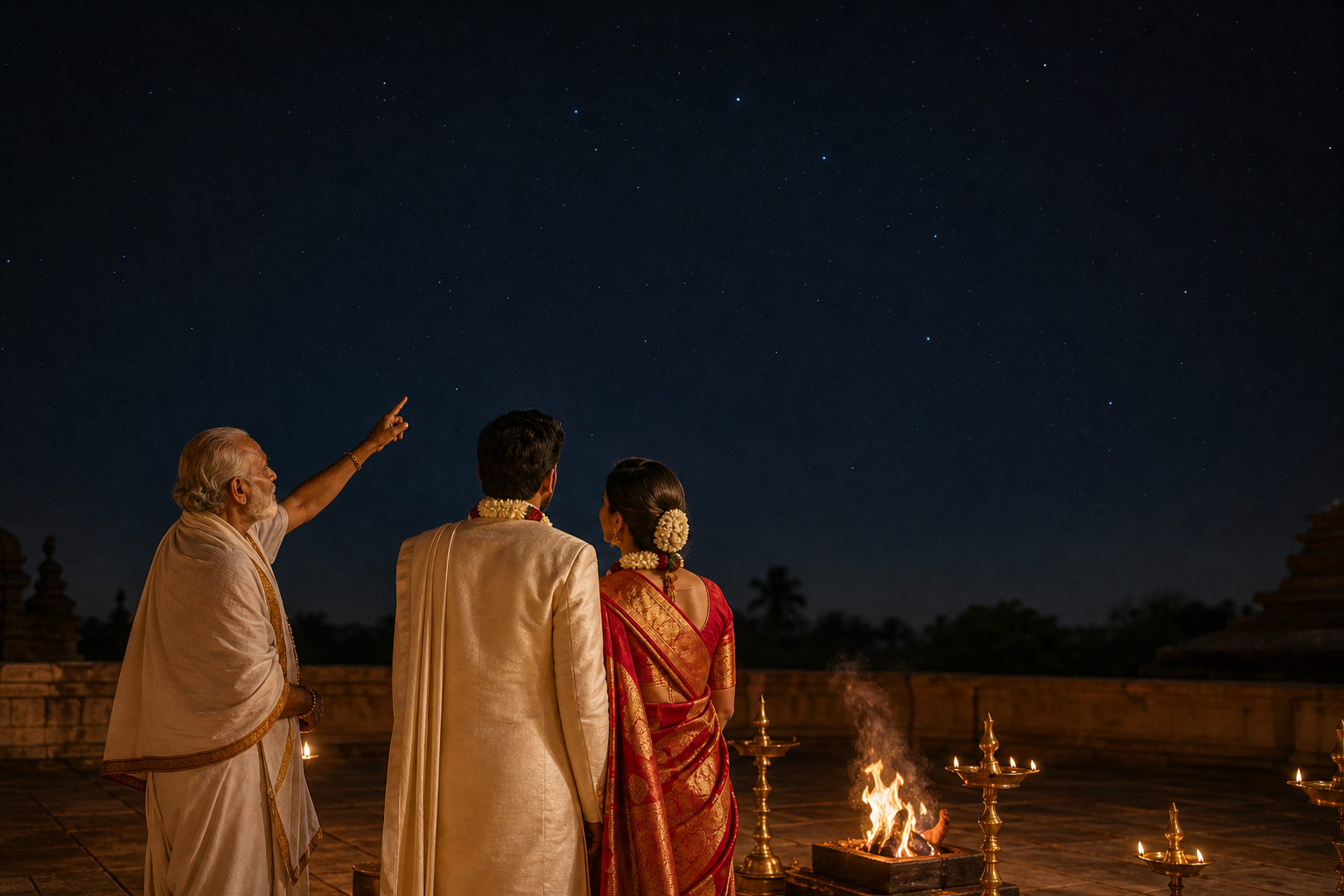
If your priest has said that you and your spouse will be shown Arundhati after the wedding ceremony, you may be wondering what you are expected to see and why that brief act matters. It is not merely ceremonial stargazing, and it should not be treated as a test of eyesight.
The ritual gives you a compact lesson in married dharma. A priest guides both spouses from an easily recognized point in the sky toward a subtler companion. In that movement are three linked ideas: husband and wife stand together, household virtues must be practiced by both, and deeper truths often become visible only through patient attention.
What the couple is being asked to see
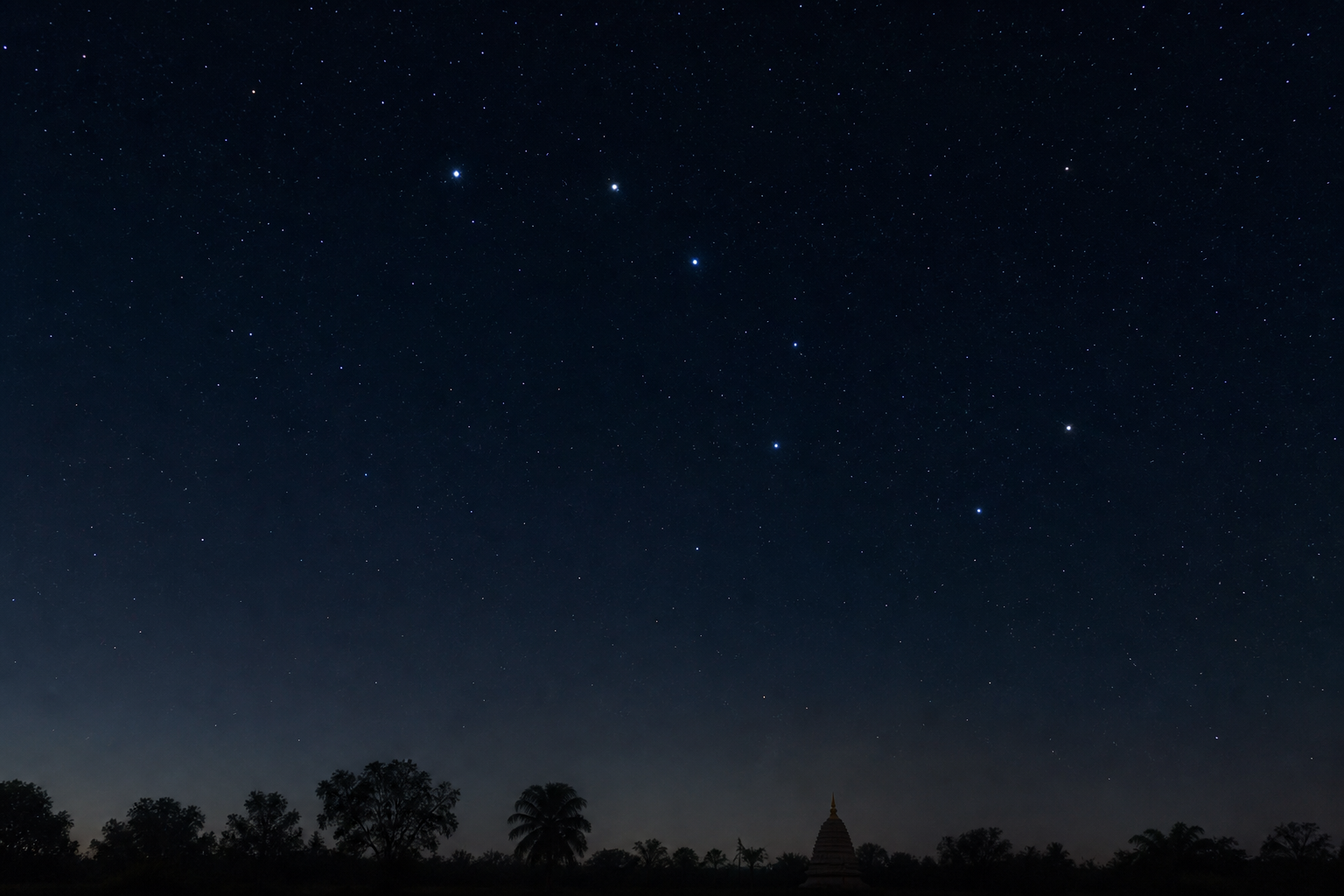
In the customary form of Arundhati Darshana, the priest leads the newly married couple outside after the central wedding ceremony and directs their attention toward the Saptarishi asterism. This familiar celestial pattern is often associated with the Big Dipper in Ursa Major.
Arundhati is traditionally paired with the rishi Vashistha. In observational astronomy, the pair is identified with the naked-eye double of Mizar and Alcor. The priest first establishes the clearer reference point and then helps the couple discern the fainter companion beside it.
That order is essential. The couple is not simply told that a small point of light exists somewhere in the sky. They are taught how to find it. The visible becomes a doorway to the subtle, and guidance turns an indistinct sky into an intelligible map.
Poor visibility does not turn the ritual into a bad omen. Clouds, surrounding lights, the position of Ursa Major and the time available after the ceremony can all affect what you can see. If Arundhati cannot be discerned, the honest response is to preserve the teaching with a sky map or another suitable aid, not to pretend that the star was visible. The integrity of the observance lies in disciplined attention and shared intention, not in performing certainty for the gathering.
Why Arundhati and Vashistha represent married dharma

Arundhati is remembered in sacred lore for steadfastness and wisdom. Her place beside Vashistha presents marriage as companionship grounded in character. The symbolism includes fidelity, but it is larger than fidelity alone: it also asks for mutual respect, cooperation, truthfulness and compassion within the household.
This matters because the symbolism is sometimes narrowed into a demand placed only upon the bride. The structure of the rite points in another direction. Both spouses are led outside. Both look toward the pair. Both are being asked to uphold the dharma of married life. A reading that celebrates constancy in the wife while excusing the husband from the same moral discipline misses the reciprocity visible in the ritual itself.
From an admired ideal to a household practice
Grihastha dharma is lived through ordinary decisions after the wedding decorations have been removed. Truthfulness means not concealing a difficult fact because disclosure is inconvenient. Cooperation means treating the household as shared work rather than assigning one spouse permanent responsibility for every burden. Compassion means remembering that winning an argument can still damage the partnership in which both people must continue to live.
You can make the ritual concrete by agreeing in advance on how its central virtues will govern your home. When a hard decision arises, ask what fidelity, truth and mutual respect require from each of you. When duties become uneven, ask how cooperation can be restored. The celestial pair then remains more than a wedding-day image; it becomes a practical standard against which the couple can examine conduct.
Why the priest points from the obvious to the subtle
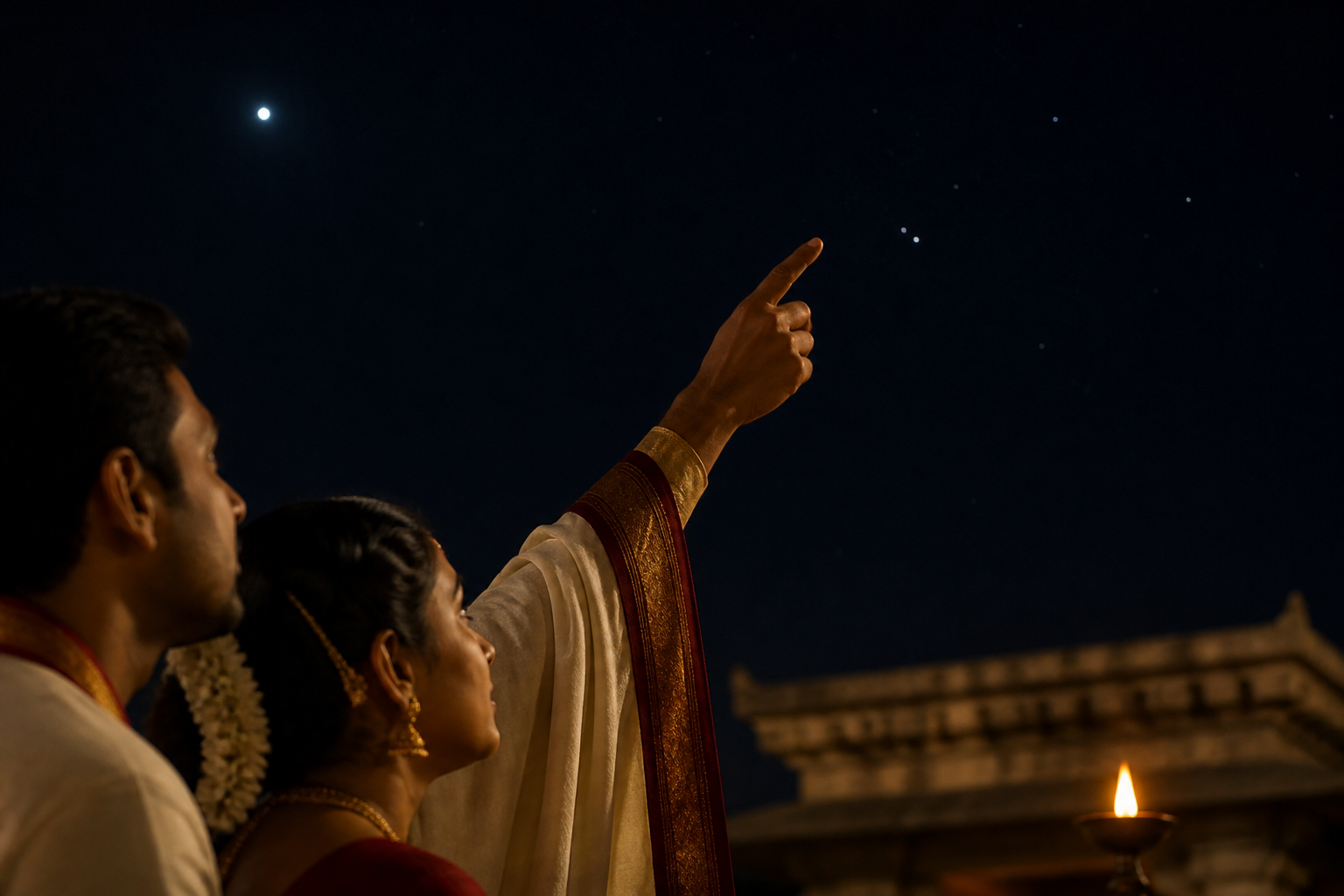
The expression Arundhati-darshana-nyaya names the teaching method embodied by the observance. Here, nyaya refers to a method or guiding principle: begin with what the learner can recognize, establish orientation, and then direct attention toward what is harder to perceive.
This is not a trick for producing instant understanding. It respects how understanding actually develops. A subtle object shown without context may be missed. Once the mind has a clear reference, however, it can notice a distinction that was present all along. The priest therefore does more than identify a star; the priest demonstrates patient instruction.
The same movement applies to married life. The wedding vows, garments and sacred fire are visible. The finer disciplines of marriage are less conspicuous: listening before reacting, recognizing the other person’s moral agency, telling the truth when it costs something, and noticing when shared responsibility has quietly become one-sided. The outer samskara gives the couple a clear point of orientation. Daily conduct reveals whether its subtler meaning has been seen.
The method also has a wider Dharmic resonance. Buddhist upaya emphasizes guidance suited to the learner; Jain anekantavada trains attention toward dimensions of truth that a single viewpoint can miss; Sikh tradition emphasizes the Guru’s guidance toward wisdom that must be lived. These are not interchangeable doctrines, but they share a useful family resemblance: instruction proceeds with patience, and insight is verified through ethical life rather than verbal display alone.
If you are explaining Arundhati Darshana to younger relatives or guests unfamiliar with the rite, follow its own method. First show them the recognizable celestial pattern. Then point out the paired lights. Only after they are oriented should you explain what the pair asks of the newlyweds. Beginning with a long abstract lecture reverses the ritual’s pedagogy.
How to prepare the ritual under modern skies
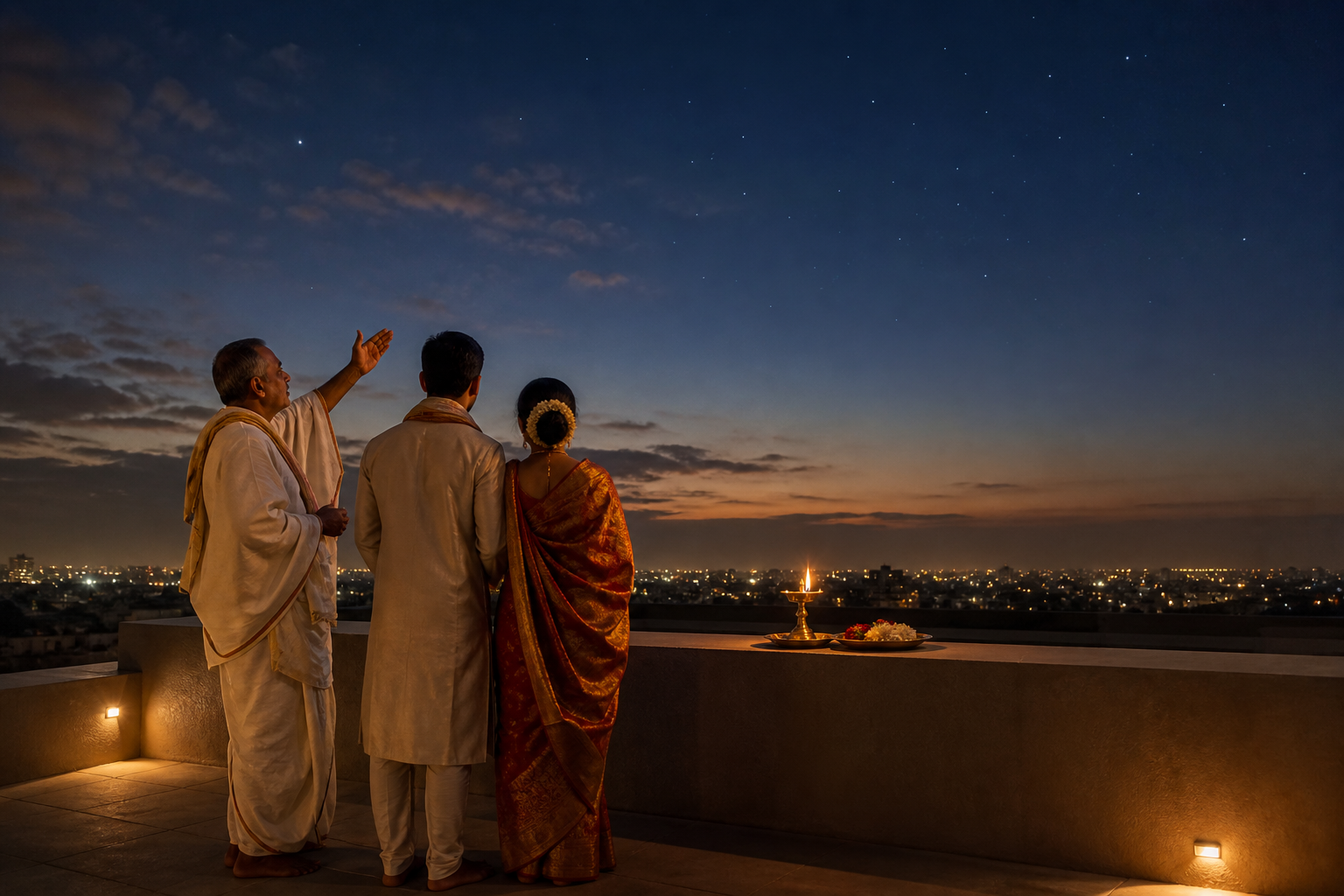
Urban lighting, an obstructed venue or a cloudy night can make the subtler point difficult to see. Preparation helps, but adaptation should preserve the sequence and meaning of the observance rather than turning it into a generic slideshow.
- Confirm the local form with the priest. Ask when Arundhati Darshana will occur, how the priest identifies the pair, and whether the family or sampradaya follows a particular narration or liturgical order. This prevents a logistical decision from accidentally displacing a living custom.
- Inspect the viewing place before the ceremony. Look for an open section of sky rather than assuming that a courtyard, hotel entrance or terrace will provide a clear view. Buildings, decorative lighting and trees may matter as much as the weather.
- Check the sky for the wedding’s location and date. A current sky map or astronomy application can show where Ursa Major will appear. Visibility improves when the asterism is higher above the horizon and surrounding light is limited.
- Allow quiet time for observation. Reduce nearby lights where practical and let the couple’s eyes adjust. The priest should establish the clearer reference before asking them to search for the subtler companion. Rushing directly to the faint point defeats the instructional design of the rite.
- Choose a fallback before it is needed. If the sky is obscured, use a sky map or astronomy application to demonstrate the same progression from the obvious pattern to the subtle pair. A later viewing on a clear night or a planetarium visit can extend the observance without pretending that conditions were favorable during the wedding.
A plain-language explanation for guests can be brief: first find the familiar group of stars; then look carefully beside the clearer point for its subtler companion; finally remember that marriage asks two people to remain constant, attentive and truthful beside one another. This is an explanation of the symbolism, not a substitute for any mantra or procedure maintained by the officiating tradition.
If an application or printed map is used, it should assist attention rather than become the entire event. Show the orientation, put the screen aside when the real sky is available, and give the couple enough stillness to look. The observance loses something when camera instructions, crowd movement or an emcee’s commentary occupy the very moment intended to teach concentration.
Key takeaways
- Arundhati Darshana guides both newlyweds toward the celestial pair traditionally associated with Arundhati and Vashistha.
- The pair represents steadfastness, wisdom, mutual respect, cooperation and shared grihastha dharma; its ethical demand belongs to both spouses.
- Arundhati-darshana-nyaya is the method of moving from an obvious reference to a subtle truth, not merely another name for looking at a star.
- Clouds or light pollution do not make the marriage inauspicious. A sky map, astronomy application, later clear-night viewing or planetarium visit can preserve the teaching honestly.
- A successful observance joins accurate guidance with a concrete commitment to live the virtues being shown.
Before your wedding, speak with the priest about the viewing sequence, the likely sky conditions, the fallback and the meaning that will be explained. Then decide with your spouse how truthfulness, cooperation and mutual respect will govern the home you are about to establish. That decision is where Arundhati Darshana begins to move from the sky into daily life.
References
