

A harsh message arrives. A family conflict flares again. Work becomes uncertain, or someone you trusted acts without integrity. You know that anger can worsen the situation, but remaining silent can feel like surrender. The immediate problem is not how to appear calm. It is how to act without letting pain choose your conduct.
Dharmic resilience gives you a demanding but workable aim: preserve your capacity to choose what is right while circumstances press you toward impulse, fear or bitterness. Patience, forbearance and evenness of mind are valuable because they protect clear action. They are not instructions to endure every wrong.
Key takeaways
- Dharmic patience restrains reaction so that you can choose a truthful and proportionate response.
- Ask for your nearest duty, not a complete explanation of why adversity happened.
- A single conscious breath can interrupt an impulsive reply, but a pause must eventually lead to a decision.
- Forgiveness does not require renewed access, immediate trust or continued exposure to harm.
- Breath awareness, japa, svadhyaya, seva and satsang train resilience before a crisis tests it.
Resilience begins by refusing two false choices
Adversity often presents a false choice: retaliate or tolerate. Retaliation hands control to anger. Indefinite toleration hands control to whoever caused the harm. Both leave your conduct governed by another person’s action.
Kshama offers another possibility. It is patient strength with moral direction. You may wait until your mind clears, speak firmly, refuse an improper demand, leave a destructive exchange, seek support or forgive without resuming the relationship. The defining question is not whether the action looks gentle. It is whether the action remains truthful, proportionate and aligned with dharma.
This is why equanimity cannot be measured by appearance. A quiet person may be paralysed by fear. A person who states a firm boundary may be acting from remarkable composure. Virtue concerns the quality of the choice, not the volume of the voice.
When you cannot tell patience from avoidance, ask:
- What actually happened? Describe observable conduct before assigning motives.
- What is my nearest duty? It may be to tell the truth, prevent harm, fulfil a promise, make amends or decline responsibility that is not yours.
- What response is proportionate? Do not use a passing insult to justify lasting revenge, and do not treat recurring harm as a minor misunderstanding.
- What boundary protects dignity? A boundary identifies what you will do if conduct continues; it is not an attempt to control another person’s mind.
- What result is outside my control? You can govern your speech and action. You cannot force recognition, remorse or agreement.
Sita’s moral power is useful here when understood as an archetype of integrity under trial, not as a demand that women silently absorb suffering. Sita-like virtue transcends gender: it joins steadfastness to dignity, truth to courage, and grace to moral agency. Maryada cannot be separated from consent, equality and compassionate boundaries.
If you are in immediate danger, move toward safety and contact appropriate local emergency or professional support. Do not delay protective action in order to prove spiritual composure. We should not call exposure to abuse patience, and we should not call silence in the face of preventable harm peace.
Forgiveness also needs a boundary. You can relinquish the wish to retaliate without pretending that nothing happened. Reconciliation requires participation from more than one side. Trust must be supported by conduct. Kshama can free you from revenge while viveka, discernment, determines whether renewed access would be wise.
Use the pause to separate pain from duty

A pause is not an escape from decision. It is a small interval in which feeling can be acknowledged without being placed in command. The Bhagavad Gita’s language of titiksha, forbearance amid changing conditions, and samatva, evenness of mind, points toward this disciplined interval. Heat and cold, pleasure and pain, praise and blame all influence you; they need not dictate you.
Use the following sequence when a situation is emotionally charged:
- Stop transmission. Do not send the message, repeat the accusation or make the irreversible declaration while the first surge is governing you. If safety requires immediate action, act for safety instead.
- Take one conscious breath. Let it mark the difference between receiving an event and choosing a response. You are not trying to erase anger or grief; you are creating room around it.
- Separate fact, feeling and urge. State them distinctly: what happened, what you feel, and what you currently want to do. The urge is information, not an order.
- Name the nearest dharmic duty. Avoid trying to solve your whole life at once. Decide what truth must be spoken, what commitment must be kept, what harm must stop or what uncertainty must simply be carried for now.
- Take the smallest complete action. Send a factual reply, request a conversation, decline the demand, document the incident, apologise for your part, seek counsel or consciously wait for information that would change the decision.
Suppose someone criticises you unfairly. The reactive mind often combines several tasks: defend your reputation, punish the speaker, prove their motive and settle every past grievance. The dharmic pause narrows the field. Correct the material falsehood if correction matters. Ask for a concrete example if the criticism is vague. Admit the part that is true. Decline the insult. You do not need to win a trial about your entire character.
Uncertainty needs a different response. During a job transition, health concern or personal loss, there may be no immediate answer to force. Patience then means giving emotion a humane tempo while continuing the duties that remain possible. Identify what information would genuinely change your next choice. Until it appears, do not let repeated speculation masquerade as problem-solving.
Watch for false equanimity. If you say that nothing affects you while resentment silently accumulates, you are suppressing rather than steadying the mind. Name the hurt truthfully. Discuss it with a trustworthy person when needed. Then decide which action serves dharma. Samatva is freedom from domination by changing experience, not the absence of human feeling.
Choose the virtue that answers the actual danger

The Dharmic traditions converge on non-reactive strength, but their distinctive vocabularies help diagnose different problems. Treating every difficulty as a generic need to calm down misses the moral work in front of you.
Hindu Dharma: Kshama restrains anger and opens the possibility of forgiveness. Titiksha helps you bear unavoidable opposites without losing direction. Samatva guards evenness of judgement. Together they move you from impulse toward viveka and dhriti, discernment and steady resolve.
Buddhism: Kshanti is a perfection of patience joined to compassionate wisdom. Its practical challenge is to meet frustration without manufacturing another cycle of hostility. When your pain produces an urge to make someone else suffer, kshanti asks whether that action will end harm or merely transmit it.
Jain Dharma: Kshama comes into living focus through Kshamavani, where forgiveness and ahimsa refine conduct as well as intention. This lens is especially useful when you are rehearsing an injury long after the immediate event. It asks what violence is still being sustained in thought, speech or planned action, while leaving room for prudent boundaries.
Sikh Dharma: Chardi Kala is resilient optimism grounded in courage, compassion and seva. It is not denial that circumstances are painful. It refuses to let adversity cancel service, dignity or constructive effort. When discouragement tempts you to withdraw from every useful duty, Chardi Kala asks what good can still be done.
These are not interchangeable labels pasted over one technique. They are distinct Dharmic approaches to patient and courageous conduct. Use the distinction practically:
- When anger is about to speak for you, invoke Kshama.
- When an unavoidable discomfort is distorting judgement, practise titiksha and samatva.
- When you want to pass your suffering onward, bring in kshanti and ahimsa.
- When adversity has become demoralisation, express Chardi Kala through one useful act of seva.
- When you are excusing harmful conduct, return to satya, viveka and maryada.
The shared ethic is neither passive nor sentimental. Patience prevents anger from choosing the method. Truth prevents patience from becoming complicity. Compassion prevents truth from becoming cruelty. Courage prevents compassion from becoming helplessness.
Build the habit before adversity demands it

You cannot reliably invent a composed mind at the height of conflict. Resilience grows through abhyasa, repeated practice in ordinary moments. A delayed queue, an irritating interruption or a minor disagreement can become training: notice the first impulse, pause, and choose a cleaner response before the stakes are high.
| Practice | What it trains | What to notice |
|---|---|---|
| Breath awareness or pranayama | A deliberate space before speech and action | You notice agitation before it becomes a message, accusation or decision |
| Japa or mantra remembrance | Return of attention to a chosen spiritual anchor | You can interrupt repetitive mental argument without pretending the issue is solved |
| Svadhyaya | Perspective and moral vocabulary | You can name the virtue or duty a situation requires |
| Seva | Constructive action beyond self-absorption | Distress no longer prevents every act of contribution |
| Satsang or sangat | Accountability and companionship in practice | You seek honest correction rather than an audience that only confirms resentment |
A workable personal rhythm does not need to be elaborate. Before a demanding part of the day, choose the virtue you expect to need: patience, truthfulness, courage, compassion or restraint. At the first sign of friction, pair a conscious breath with a remembered mantra or principle. After a difficult exchange, examine what happened without self-flattery: Where did impulse take over? Where did fear hide behind politeness? Is an apology, correction or boundary now required?
Svadhyaya keeps this examination from collapsing into mood. Reflective engagement with the Bhagavad Gita, the Ramayana and allied teachings supplies language for experiences that otherwise feel shapeless. Do not read only to admire an ideal. Carry a question into the text: What would truth require in this conflict? What belongs to me, and what does not? Where am I calling avoidance forgiveness?
Japa helps when the mind keeps retrying the same imaginary confrontation. The point is not to use mantra as a lid over a real problem. First determine whether action is needed. If it is, take or schedule that action. Then let remembrance release the mental repetition that adds no wisdom.
Seva changes the direction of energy. Adversity can make the self feel like the whole field of reality. A useful act restores proportion without denying pain. Help with a household duty, support someone carrying a heavier burden, contribute to your community or fulfil a neglected responsibility. Service is not proof that you are unaffected; it is evidence that suffering has not taken possession of all your agency.
Satya, ahimsa, seva, simplicity, svadhyaya and spiritual community work as an interconnected discipline. Truth without non-violence can become a weapon. Non-violence without truth can conceal disorder. Study without practice becomes admiration at a distance. Service without boundaries can turn into exhaustion or resentment. Satsang keeps these virtues answerable to lived conduct.
Audit the practice by its fruit. If it makes you more truthful, less reactive, more capable of repair and clearer about boundaries, it is strengthening resilience. If it makes you proud of tolerating mistreatment, indifferent to injustice, unwilling to admit pain or dependent on appearing serene, correct the practice. Spiritual vocabulary should sharpen discernment, not hide its absence.
Turn private resilience into a shared moral culture
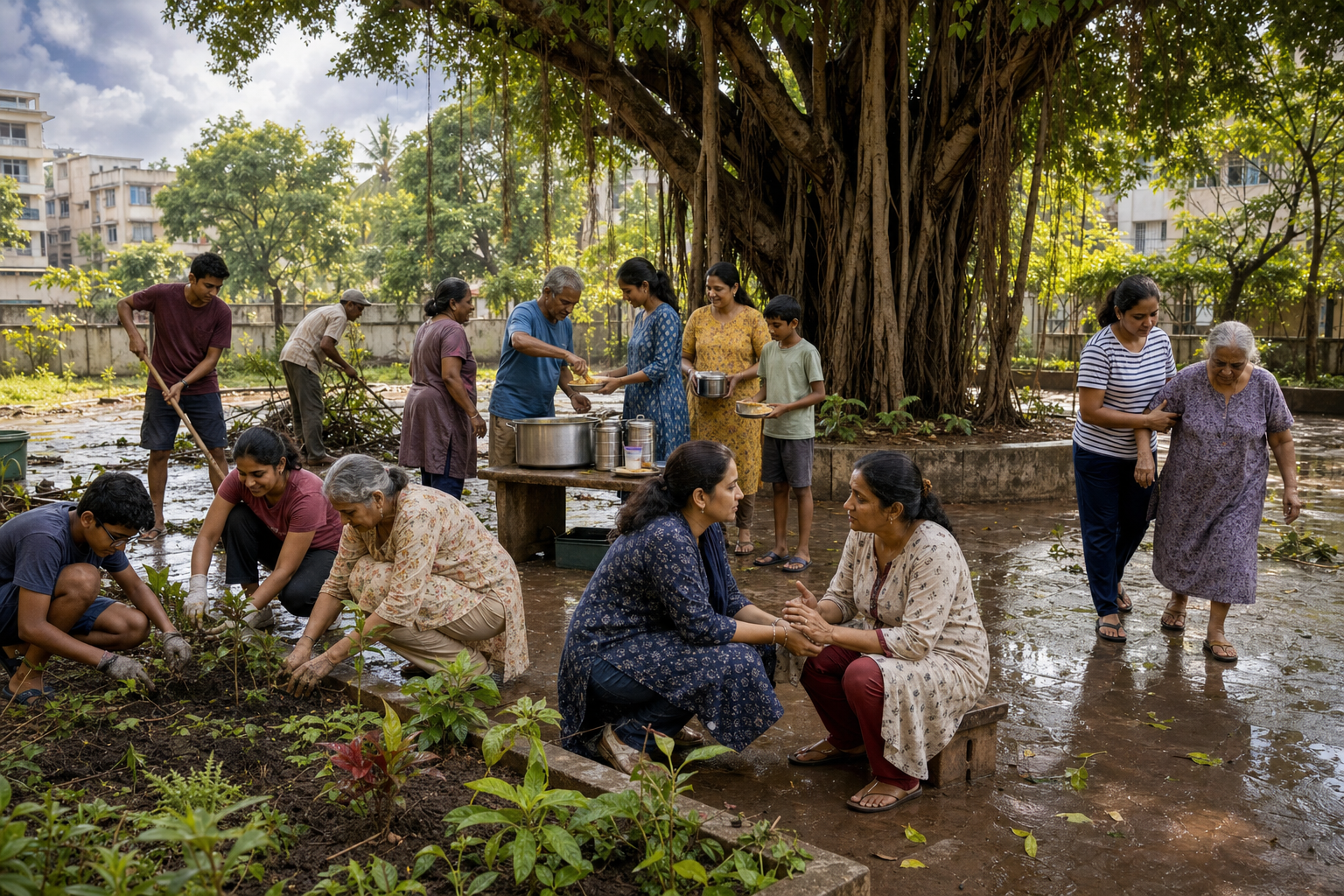
Virtue is harder to sustain in an environment that rewards humiliation, instant retaliation and permanent suspicion. Your surroundings train your reflexes. This makes resilience more than a private temperament; families, workplaces and communities can either protect the pause required for discernment or punish anyone who takes it.
A simple conflict covenant can make Dharmic values operational:
- State the disputed conduct before claiming to know another person’s motive.
- Do not use humiliation as a method of correction.
- Allow a pause without permitting endless evasion.
- Make room for acknowledgement, apology, restitution and changed conduct.
- Protect anyone who raises a credible concern from retaliation.
- Do not demand reconciliation where safety, accountability or trust has not been restored.
- Return attention to the shared duty after the immediate conflict has been addressed.
This approach supports unity without confusing unity with silence. Ahimsa lowers needless aggression. Satya keeps the group in contact with reality. Kshama makes repair possible. Maryada protects dignity. Seva returns the community to constructive work. Accountability prevents noble language from becoming cover for repeated misconduct.
The same principle applies to the fear that virtue has become impossible in Kali Yuga. Cynicism often begins as disappointment and ends as permission: if everyone is selfish, why maintain restraint; if loyalty has vanished, why remain trustworthy? A Dharmic answer is practical. Character is cultivated through repeated choices and sustaining community. The moral climate may make virtue costly, but it does not make your next truthful action unavailable.
Choose your company accordingly. Seek people who can challenge anger without trivialising harm, encourage forgiveness without forcing access, and value service without exploiting the generous. Good satsang does not merely praise virtue. It helps you practise it with accuracy.
At the next difficult moment, do not ask whether you can bear everything indefinitely. Take the conscious breath. Name the nearest duty. Set the boundary that dignity requires, and make the cleanest available next move. Repeated under pressure, that choice becomes character; shared with others, it becomes culture.
References
- DharmaRenaissance Blog – Master Patience in Adversity: The Essential Dharmic Guide to Resilience and Inner Strength
- DharmaRenaissance Blog – Essential Truth of Finding Sita in Kali Yuga: Discover a Proven Path to Living Virtue
