

When life narrows to three questions – Will there be enough? Are we safe? Can I endure what must change? – Hindu Goddess traditions do not answer with one undifferentiated image. Annapurna, Vasoorimala, and Kali meet different pressures: sustaining life, guarding the community, and cutting through fear and attachment.
If you are deciding how to approach these traditions, do not begin by asking which Goddess is strongest. Ask what kind of care the moment requires. Then choose a practice whose outward result can be seen in the kitchen, in your response to illness, or in your conduct under pressure.
Key takeaways
- Annapurna teaches that nourishment becomes sacred when gratitude, responsible use, and dignified sharing accompany it.
- Vasoorimala preserves a regional memory of protection during contagious disease. Prayer can strengthen courage and solidarity, but it must accompany medical care and responsible public-health conduct.
- Kali represents transformation through the removal of ignorance, egoic grasping, and fear. The proper measure of this transformation is ethical steadiness, not dramatic experience.
- You do not need to adopt every practice. Name the need before you, pair devotion with its corresponding duty, and deepen specialized sadhana only within competent guidance.
Three needs reveal three dimensions of divine care
Nourishment, protection, and transformation overlap, but they are not interchangeable. A family facing scarcity needs more than language about inner transformation. A community responding to contagious illness needs more than a private feeling of abundance. A person trapped by fear may be physically safe and well fed yet still need the courage to release an identity, habit, or attachment.
Approaching the Goddess through the actual need prevents spiritual vagueness. It also reveals a demanding truth: divine care usually places a human duty in your hands.
Annapurna: nourishment must circulate
Annapurna is revered as a compassionate manifestation of Parvati and is closely associated with Kashi. Her ladle and food-filled pot unite abundance with ethical distribution. The pot answers the fear that life cannot be sustained; the ladle asks whether what has been received will reach another person.
This makes the kitchen a place of dharma rather than mere consumption. Food offered with devotion becomes prasada, but the sanctity of a meal cannot end with a prayer. It must affect how food is prepared, received, wasted, withheld, and shared. Anna-dana is therefore not an ornamental act added to worship. It is worship taking social form.
At your next meal, make the pause before eating do three things. Acknowledge what has been received. Remember the visible and invisible labour that brought it to the table. Decide what your household can share without neglecting its own genuine needs. That last qualification matters: a family struggling to eat does not have to give beyond its capacity. The wider community has the corresponding duty to make nourishment available without humiliation.
You can test an Annapurna practice with a plain question: does food create more gratitude and belonging around you, or merely reinforce possession? A full shrine beside a wasteful or exclusionary kitchen has separated the symbol from its teaching.
Vasoorimala: protection is a communal discipline
Vasoorimala belongs to the living sacred geography of Kerala and the Kodagu region of Karnataka. Her very name carries the memory of smallpox: vasoori is the Malayalam word for the disease. She is associated with protection from contagious illnesses including smallpox, chickenpox, and measles, and she may appear as a sub-deity in Bhadrakali or Shiva temples.
Regional narratives vary, including accounts that connect her with Manodari, the wife of the Asura Darikan. In North Kerala, Vasoorimala Theyyam carries the tradition through consecrated performance. Drumming, dance, lamps, vows, and the sacred setting of the kavu transmit a community’s memory of affliction, fear, protection, and renewal.
This local character should be respected. If you visit a shrine or Theyyam, learn the community’s expectations before making an offering, taking photographs, or treating the rite as spectacle. A living protective tradition is not a collection of dramatic images detached from the people who preserve it.
The central practical lesson is collective responsibility. During illness, prayer, a lamp, or a locally appropriate vow may give coherence and courage. None of these is a substitute for medical attention, vaccination where medically appropriate, or current public-health guidance. If you or someone in your care is ill, seek suitable professional care rather than delaying it for a ritual. Devotion becomes protective when it also moves you to support the vulnerable, reduce avoidable risk, and help a household obtain food or care.
Ask a concrete question after the prayer: who might be left alone, uninformed, hungry, or unable to obtain help? The answer identifies the seva that belongs beside the ritual.
Kali: transformation must cut through self-deception
Kali, the first of the Dasa Mahavidyas, embodies the force of time and the fierce compassion that removes ignorance. Her dark form and sword of discernment are not invitations to cruelty. They direct the seeker toward the ending of fear, false identity, attachment, and egoic control. In this sense, Kali’s fierceness serves liberation and the protection of dharma.
Her forms emphasize different aspects of that work. Mahakali points toward cosmic time and transcendence. Dakshina Kali brings compassionate transformation into daily life. Smashana Kali confronts dissolution and impermanence. Bhadrakali expresses protective and righteous strength. Kalaratri, venerated during Navaratri, removes darkness on the movement toward inner light. These names should not be treated as interchangeable labels; they help a practitioner discern which dimension of the Mother’s presence is being invoked.
Kali mantra sadhana traditionally begins with sankalpa, ethical discipline, posture, regulated breathing, japa, and meditation. Some lineages use a bija mantra and a mala, with practice at sunrise or after sunset. If you have received a practice from a competent tradition, consistency matters more than forcing intensity. If you have not received such guidance, there is no need to improvise an esoteric mantra from fragments encountered online. Prayer, study, ethical reflection, and seva provide a sound place to begin while you seek trustworthy instruction.
The useful question here is not whether the practice felt powerful. Ask what it made you capable of relinquishing. A mature Kali practice should produce clearer judgement, steadiness amid change, fearlessness without aggression, and compassion without sentimentality. Siddhi understood as integration is visible in conduct; fascination with extraordinary powers can become another form of the ego the practice is meant to expose.
Choose the practice by naming the need first
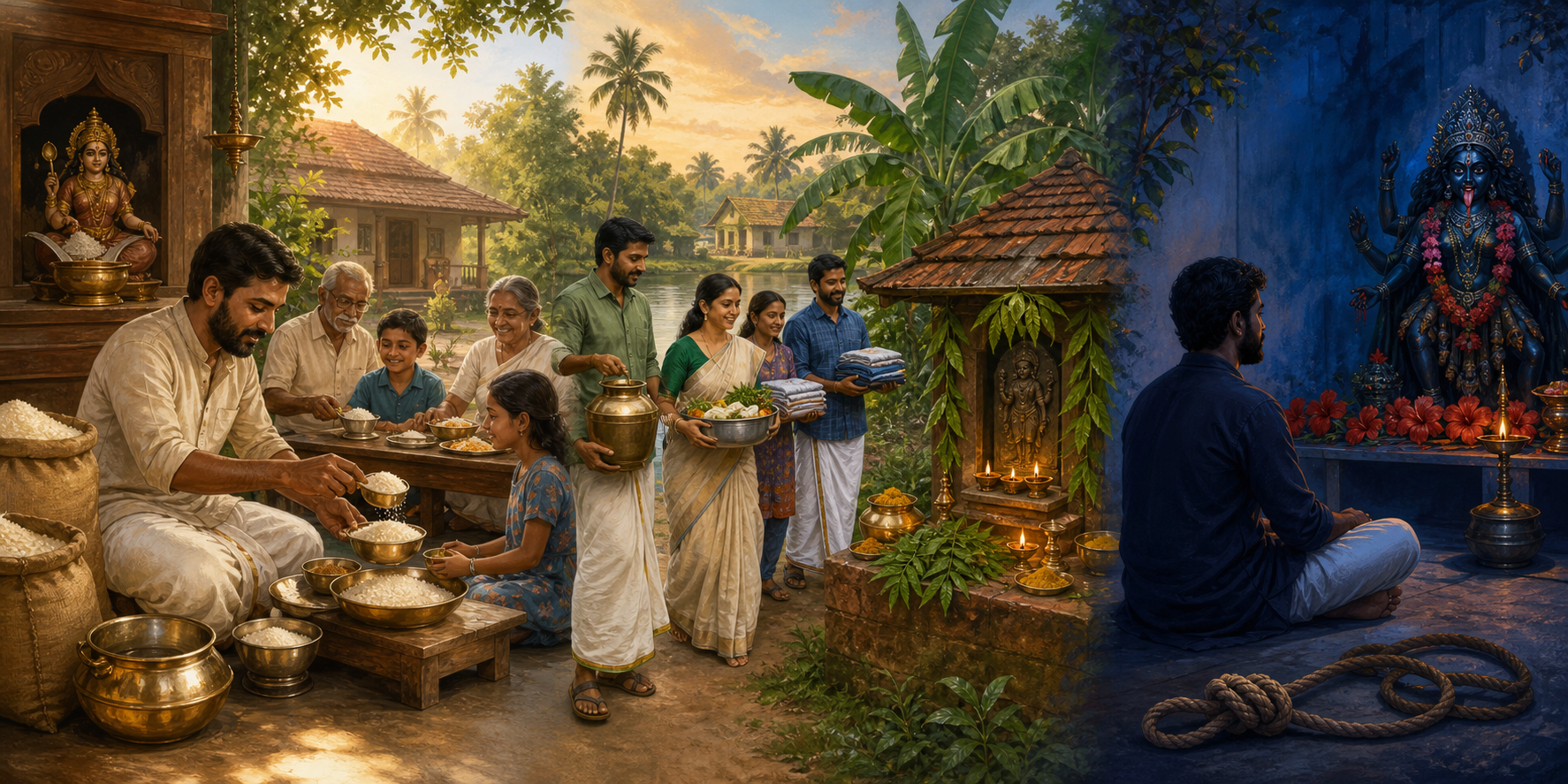
A devotional life can become scattered when every difficult feeling sends you toward a new deity, mantra, or ritual. Use the following map to identify the centre of the problem before adding another practice.
| Situation before you | Devotional orientation | Immediate outward duty | Fruit to look for |
|---|---|---|---|
| Food, household sufficiency, hospitality, or unequal access to nourishment | Annapurna | Receive food gratefully, reduce waste, and share according to capacity without humiliating the recipient | Greater generosity, sufficiency, and dignity around the meal |
| Illness, fear of contagion, or concern for communal wellbeing | Vasoorimala | Pray within local custom while obtaining proper care, following health guidance, and checking on vulnerable people | Courage joined to responsibility rather than denial or panic |
| Fear of change, destructive attachment, confused judgement, or egoic resistance | Kali | Undertake guided sadhana, ethical reflection, meditation, and the relinquishment of one clearly named harmful pattern | Fearlessness, clarity, humility, and compassionate action |
Turn that map into a disciplined choice with five steps.
- Write the need in one sentence without devotional language: Our household is wasting food; someone is ill and isolated; I am refusing a necessary change.
- Name the human duty before selecting the ritual. The duty might be sharing a meal, arranging care, following health guidance, apologizing, or ending a harmful habit.
- Choose one devotional anchor that fits the need: a prayer before eating, a locally appropriate protective observance, or an established meditation and japa practice.
- At the end of each week, examine the fruit. Look for an observable change in generosity, responsibility, clarity, or compassion.
- Deepen the practice only when its ethical foundation is becoming stronger. Specialized mantra and regional ritual require more respect, not more improvisation.
This sequence prevents devotion from becoming a way to avoid the duty already visible in front of you. It also gives you a reliable basis for deciding whether a practice is helping.
Three distortions can empty the traditions of their force

Abundance without distribution
Annapurna is sometimes reduced to the wish for a well-stocked home. Her ladle corrects that reading. Abundance is a trust that must circulate. If a ritual for prosperity makes you more anxious about possession or less attentive to hunger around you, return to the ethics of anna-dana, gratitude, and hospitality.
Protection without practical responsibility
A protective Goddess is not permission to deny danger. Vasoorimala’s connection with epidemic memory makes communal care central, not optional. Prayer may steady the mind, but refusing appropriate healthcare or ignoring the vulnerable contradicts the protective duty being invoked.
Fierceness without self-discipline
Kali’s imagery can attract people seeking intensity, identity, or power. Yet the sword points inward as discernment. Anger, theatrical transgression, and claims of spiritual superiority are not evidence of transformation. Yama-niyama, ahimsa, humility, emotional balance, and service provide more credible tests.
These distortions share one mechanism: the symbol is retained while its demand is removed. Restore the demand, and the practice becomes concrete again. Annapurna asks what you will share. Vasoorimala asks whom you will help protect. Kali asks what falsehood you are willing to surrender.
A shared dharmic grammar need not erase real differences

The ethos of sacred nourishment has clear resonances across the dharmic family. Hindu anna-dana and prasada make giving and receiving food devotional. Sikh langar joins nourishment with egalitarian service. Buddhist dana trains generosity. Jain food ethics place eating under the discipline of ahimsa. Protection and transformation likewise find echoes in karuna, daya, seva, non-attachment, fearlessness, and responsibility for living beings.
These resonances establish kinship without proving that every theology or ritual is identical. You can honour shared values more honestly by cooperating through action than by blending distinct traditions into a vague universalism. At a community gathering, for example, organize a shared meal, food distribution, or care for people affected by illness, while allowing each tradition to express the motive in its own language and form.
Begin with one threshold this week. At the next meal, connect gratitude to sharing. When illness touches your circle, place responsible care beside prayer. Before a necessary change, name the attachment that must be cut. Let one outward duty accompany one devotional act, and judge the practice by the life it helps you sustain, protect, or transform.
References
- DharmaRenaissance Blog – Annapurna Mahatmyam: Discover the Complete Guide to the Goddess of Sacred Nourishment
- DharmaRenaissance Blog – Vasoorimala: Complete Guide to the Goddess Protecting from Pox – Discover Kerala’s Living Tradition
- DharmaRenaissance Blog – Ultimate Kali Mahavidya Guide: Discover Mantra Sadhana, Siddhi, Forms, and Rahasya
