
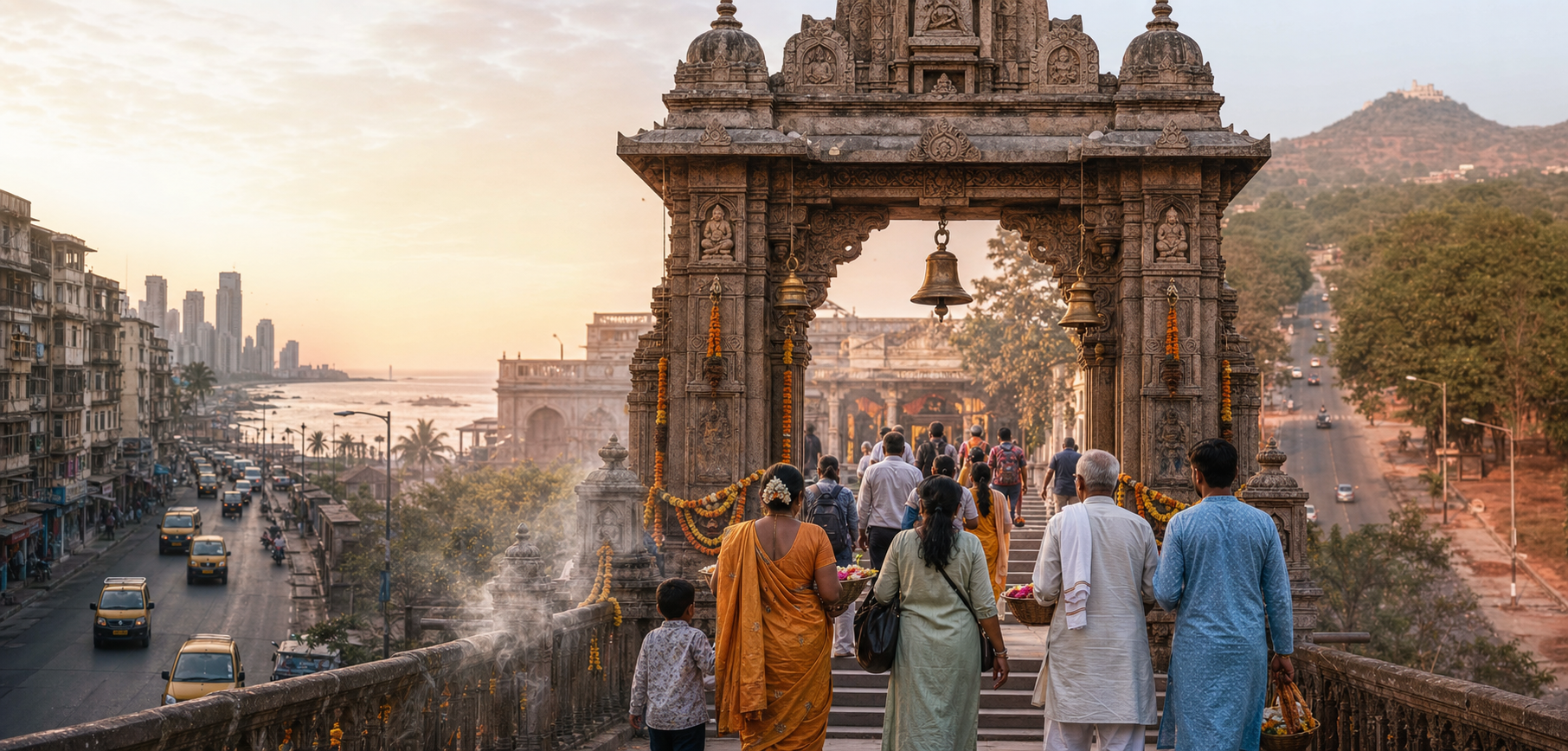
You have one day in Mumbai or Nagpur, several temples saved, and no honest sense of which ones belong in the same yatra. The useful question is not, “How many can I cover?” It is, “Which sequence will let me arrive attentive, complete my darshan, and understand the sacred character of this city?”
A workable urban pilgrimage needs a devotional purpose, a compact route, and room for the unexpected. The circuits below give you four starting plans: two within Mumbai, one within Nagpur, and one for Nagpur’s outer shrines. Use them as frameworks, then confirm current temple timings, aarti schedules, access arrangements, and festival restrictions directly before travelling.
Begin with one sankalpa and one anchor shrine
A temple list becomes a pilgrimage when its stops belong to a shared intention. Decide what you are seeking before you decide how many places to visit. You may be praying for Ganesha’s guidance, following a Shakti circuit, studying sacred architecture, or introducing your family to the many forms of Hindu worship. Each purpose produces a different route.
Build your day from three kinds of stops:
- The anchor: the shrine you would still visit if every other plan failed. Give it your best arrival window rather than leaving it for the end.
- The companion: a nearby temple that develops the same devotional or historical theme without simply repeating the anchor.
- The completion: a quieter shrine, sacred landscape, kirtan, or aarti where you can stop moving and absorb the day.
The core routes below contain four stops, with optional extensions clearly separated. That limit is a planning choice: it protects prayer time and makes it easier to absorb a delayed queue without turning the rest of the yatra into a race. If one temple is the reason for your journey, reduce the circuit rather than reducing your attention at that temple.
Four circuits that give each city a coherent devotional shape
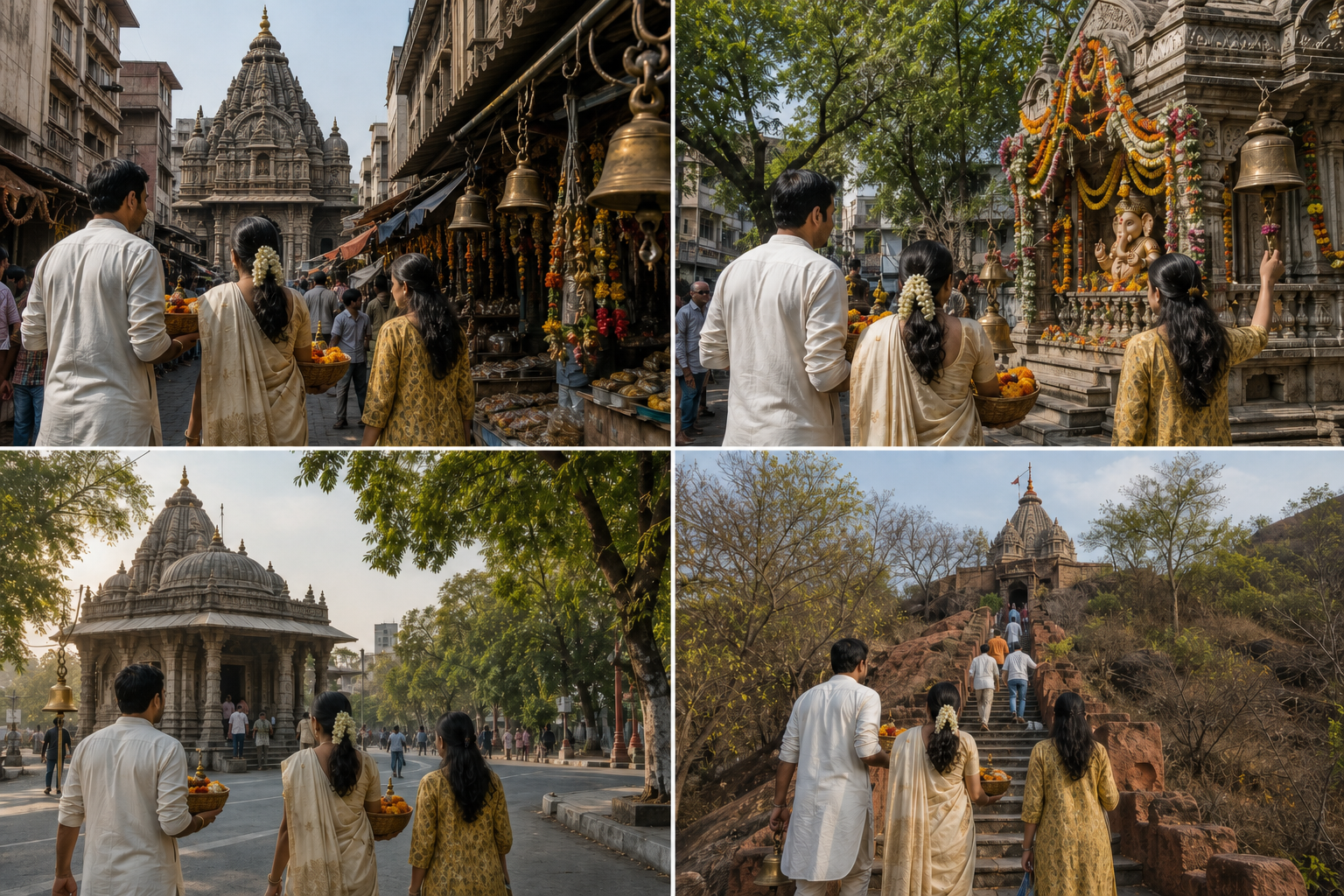
Mumbai old-city Shakti, Shaiva, and heritage circuit
Choose this route if: you want to understand how deity, neighbourhood, commerce, water, and historical memory coexist in Mumbai’s older sacred landscape.
- Mumba Devi Temple, Mumba Devi Marg, Zaveri Bazaar, Bhuleshwar. Begin with the goddess whose name is bound to Mumbai’s identity. The shrine’s busy commercial setting immediately shows that urban dharma does not require withdrawal from ordinary life.
- Shri Swaminarayan Mandir, 196 Kalbadevi Road, Bhuleshwar. Its disciplined worship and distinctive Sampradaya iconography offer a useful contrast with the surrounding market precinct.
- Babulnath Temple, Babulnath Road, Charni Road East. The ascent to this Shiva shrine gives the journey a physical pause. Its present form reflects a nineteenth-century reconstruction layered upon an older sacred tradition.
- Walkeshwar Temple and Banganga Tank, Malabar Hill. Finish the core circuit among shrines, stone steps, ghats, and the tank associated with the memory of Lord Rama. The setting rewards slower observation after the density of Bhuleshwar and Girgaum.
These sites form a devotional progression from the city’s presiding goddess through Sampradaya worship, Shaiva ascent, and the sacred landscape of Banganga. Add Mahalaxmi Temple on Bhulabhai Desai Road only if Shakti worship is central to your sankalpa or you have protected enough time for an unhurried visit. During Navaratri, treat Mahalaxmi as an anchor rather than an extension.
Mumbai Ganesha, neighbourhood devotion, and rock-cut heritage circuit
Choose this route if: Siddhivinayak is your principal destination and you want to connect everyday neighbourhood worship with Vaishnava bhakti and early Shaiva architecture.
- Shree Siddhivinayak Ganapati Mandir, SK Bole Marg, Prabhadevi. Established in 1801, this is the natural anchor for a Ganesha-focused yatra. Its reputation as a place where devotees fulfil vows also means that darshan should not be treated as a quick preliminary stop.
- Prabhadevi Temple, Keluskar Road N, Prabhadevi. This smaller shrine to Goddess Prabhadevi, from whom the locality takes its name, lets you encounter the steady rhythm of a neighbourhood temple after the larger Siddhivinayak congregation.
- ISKCON Sri Sri Radha Rasabihari Temple, Hare Krishna Land, Juhu. Make this your participatory bhakti stop if you want kirtan, scriptural discourse, or time within a temple community rather than another brief darshan.
- Jogeshwari Caves, Caves Road, Jogeshwari East. Complete the route at a Shaiva rock-cut site dating to around the sixth century. Look at how the sacred space is formed from the rock itself; the encounter is architectural and historical as well as devotional.
This south-to-north circuit joins living Ganesha worship, a locality’s goddess, congregational Vaishnava practice, and one of the region’s early rock-cut Hindu temples. If scriptural study and a meditative Vaishnava atmosphere matter more than the northern route, substitute ISKCON Sri Sri Radha Gopinath Mandir near Girgaum Chowpatty for the Juhu stop. Do not include both ISKCON temples merely to increase the count; choose the one that fits the geography and purpose of your day.
Nagpur city circuit from central darshan to Seminary Hills
Choose this route if: you want a city-based yatra that begins with established central shrines and ends in a more contemplative setting.
- Shree Ganesh Mandir Tekdi, near Nagpur Railway Station. Begin with Ganesha and set the intention for the route before the day becomes fragmented by movement.
- Shri Poddareshwar Ram Mandir, Central Avenue. Its serene sanctum, structured rituals, and devotional music shift the circuit from invocation toward Rama bhakti.
- Telankhedi Hanuman Temple. The lakeside setting provides a natural place to slow down rather than moving immediately to the next queue.
- Balaji Temple, Seminary Hills. Finish amid green surroundings and South Indian architectural elements. Its disciplined ritual rhythm suits a quieter final darshan.
The sequence brings together Ganesha, Rama, Hanuman, and Balaji worship within Nagpur’s urban devotional landscape. If congregational singing is the desired completion, replace the final stop with ISKCON Nagpur, where kirtan, discourse, and prasadam shape the visit. If architecture and a modern community mandir are your priority, choose BAPS Shri Swaminarayan Mandir at Wathoda Layout instead. Make either one a deliberate substitution, not an automatic fifth stop.
Nagpur outer-shrine circuit for a separate pilgrimage day
Choose this route if: you have dedicated transport and want the physical movement out of the urban core to become part of the yatra.
- Adasa Ganpati Temple is the Ganesha anchor, known for its distinctive idol and an ancient-feeling sanctum that invites slow darshan.
- Koradi Mata Temple is the Shakti anchor. During Navratri, the lamps, aarti, and collective chanting become the central experience, so the rest of the itinerary should contract around it.
- Ramtek Temple is the hill and Rama anchor. The ascent and panoramic setting make the journey itself part of the visit.
These are substantial pilgrimage destinations around Nagpur, not casual additions after completing the city circuit. Decide their order only after checking your starting point, current access, temple hours, and transport. If Ramtek is your vow or primary destination, place it first in your planning even if another order appears more convenient on a map.
Plan for the temple clock, the city clock, and the pilgrim’s body
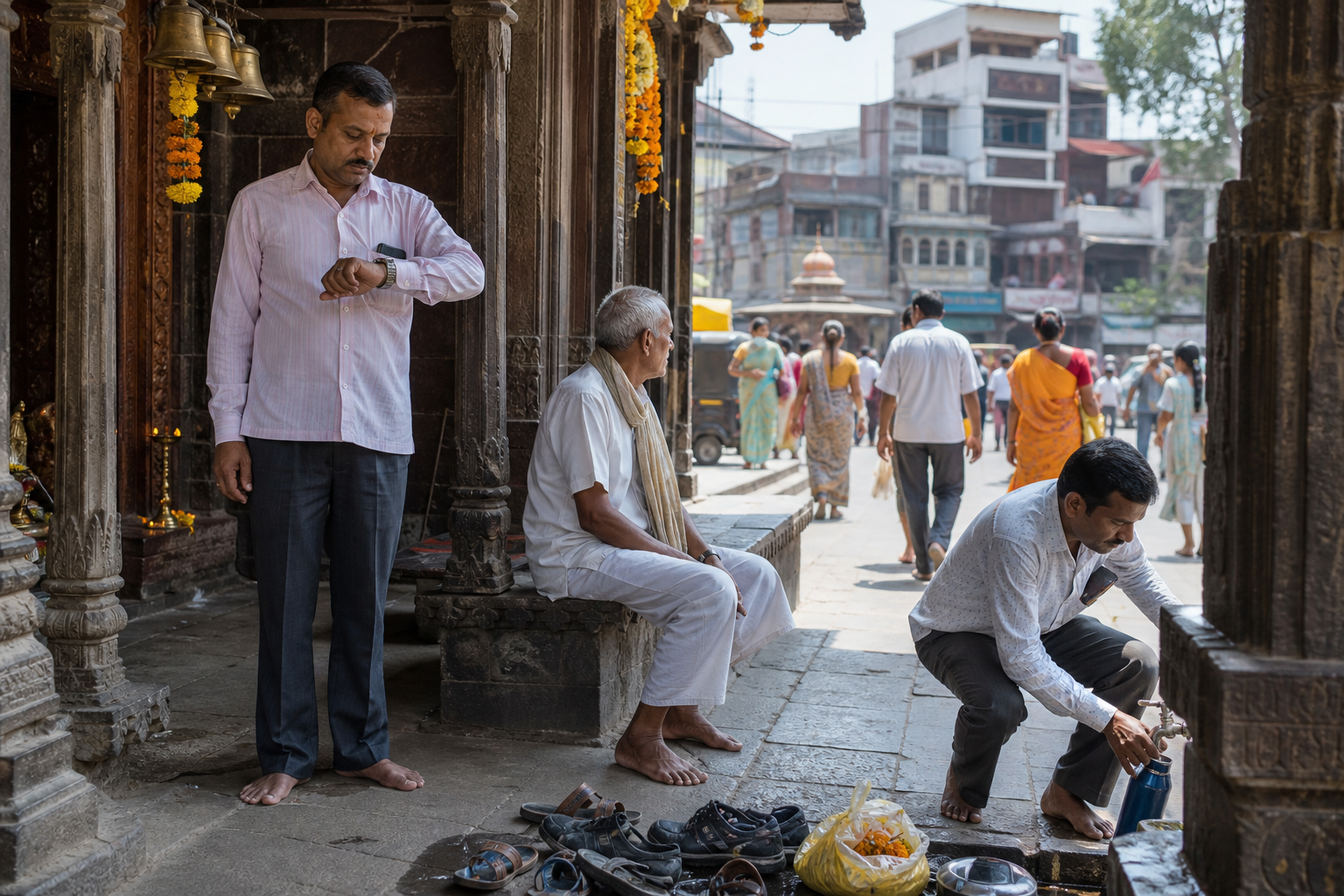
An urban yatra runs on three clocks. The temple has opening periods, pujas, aartis, queues, and festival arrangements. The city determines how reliably you can move between precincts. Your own group has a pace, a hunger threshold, and perhaps limits around steps or standing. A route fails when it plans for only one of the three.
Make a small route card the night before. For every stop, record:
- the full temple name and locality, so a similarly named shrine does not send you elsewhere;
- the opening period and any interval when darshan pauses, verified through a current temple channel;
- the aarti or puja you actually intend to attend;
- whether a festival, weekday observance, or special queue changes the visit;
- the site’s footwear, photography, bag, and prasad rules;
- the access plan for children, elders, or anyone who cannot comfortably manage steps or long periods of standing;
- the one optional stop you will remove first if the day slips.
Festival intensity must change the structure of the day. Ganesh Chaturthi can make Siddhivinayak the whole purpose of a Mumbai pilgrimage. Navaratri transforms both Mahalaxmi and Koradi into major Shakti destinations. Ram Navami brings special importance and celebration to Poddareshwar Ram Mandir. Thursdays draw particular devotion at Nagpur’s Sai Baba Temple. If you want the festival experience, accept a shorter circuit. If you want quiet architectural observation, choose another date and favour an early arrival; weekday mornings can allow smoother darshan in Mumbai, while early mornings and evenings suit many Nagpur temple visits.
Three locations deserve an explicit mobility check: the ascent at Babulnath, the steps and ghats around Banganga, and the hill approach at Ramtek. Do not assume that every historic entrance is accessible in the same way. Confirm the current entrance arrangement before committing a companion with limited mobility, and give that confirmation more weight than the visual elegance of the route.
Move as a pilgrim and learn to read what changes between shrines
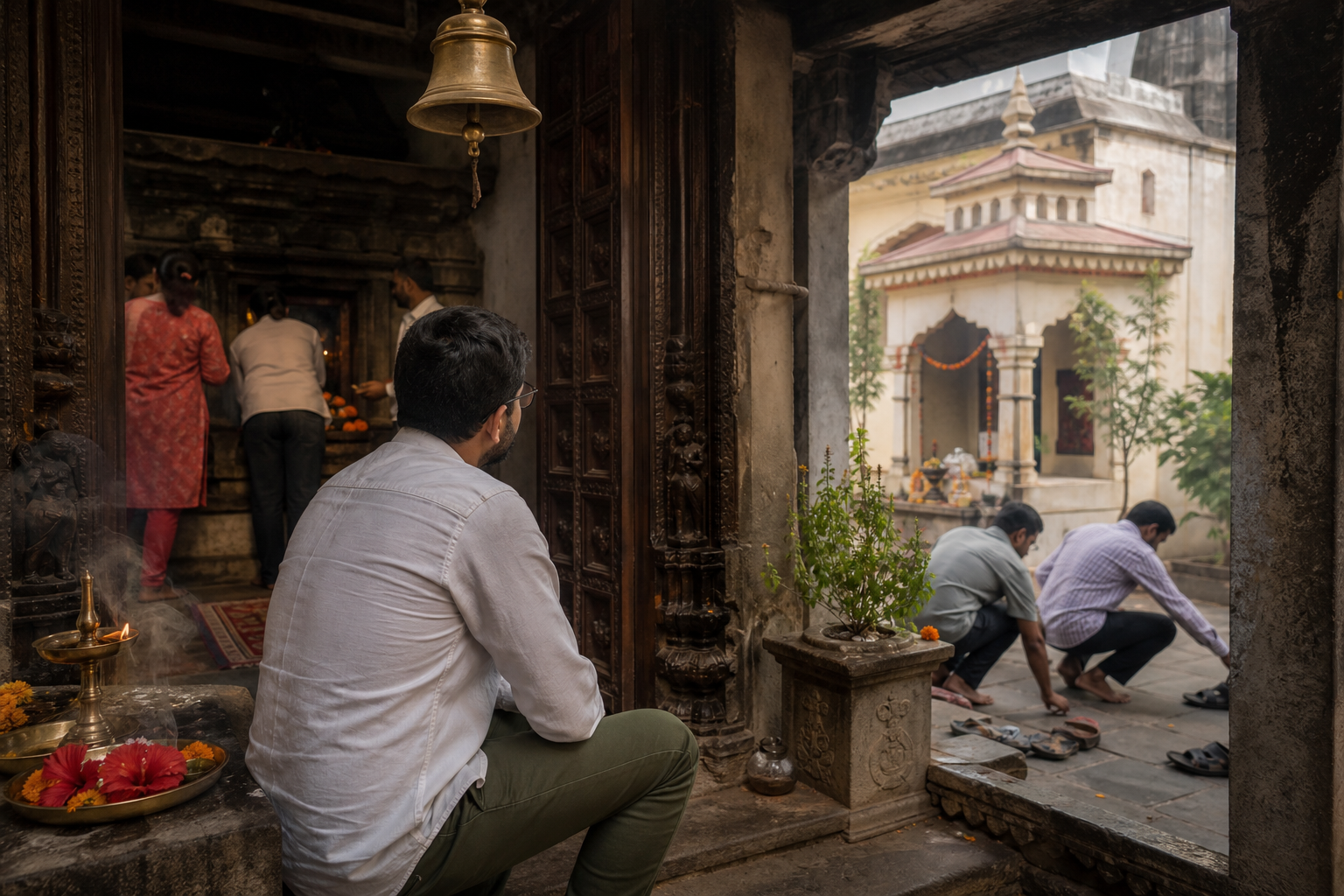
Correct etiquette begins before the sanctum. Wear modest clothing, keep the queue intact, remove footwear where directed, and silence your phone. Ask before photographing any deity, ritual, ascetic, or devotee; some temple areas prohibit photography. Receive prasad with respect, and step aside before eating or reorganising your belongings so that others can approach.
Do not impose one ritual grammar on every temple. A disciplined Swaminarayan service, an ISKCON kirtan, a neighbourhood goddess shrine, a crowded Ganesha darshan, and a rock-cut Shaiva cave ask different things of the visitor. Watch first. Follow the local sequence. If you do not know what to do, a quiet namaskar is better than copying a complex action without understanding it.
You can also turn the circuit into a study of living Hindu civilisation. At each stop, notice one concrete feature:
- Relationship to place: Mumba Devi and Prabhadevi preserve the bond between a deity and the name of a city or neighbourhood.
- Sacred landscape: Banganga joins water, steps, shrines, legend, and historical restoration in one precinct.
- Architecture as theology: Jogeshwari’s rock-cut form, Babulnath’s elevated approach, Balaji Temple’s South Indian elements, and BAPS Nagpur’s red-stone architecture produce different bodily experiences of worship.
- Sound and participation: compare silent darshan with bhajan, aarti, discourse, and congregational kirtan. Ask what each practice trains in you.
- Continuity: Mumbai’s circuit can move from a cave associated with the sixth century to a Ganesha temple founded in 1801 and onward to modern bhakti institutions. The city is not preserving one frozen period; it is carrying several layers of dharma at once.
This attention prevents a common failure of temple tourism: collecting photographs while missing the form of life that keeps a shrine sacred. The aim is not to make every tradition look identical. The deeper unity lies in disciplined practice, hospitality, reverence, learning, service, and the ability of distinct sampradayas to inhabit the same civic world.
Key takeaways
- Choose one anchor shrine before arranging transport or adding optional temples.
- Use the old-city Mumbai circuit for Shakti, Shaiva worship, and sacred urban heritage; use the Siddhivinayak-to-Jogeshwari circuit for Ganesha, neighbourhood devotion, bhakti, and rock-cut history.
- Keep Nagpur’s central circuit separate from Adasa, Koradi, and Ramtek unless you have deliberately reserved a larger outer-city pilgrimage block.
- On Ganesh Chaturthi, Navaratri, Ram Navami, or a major weekly observance, reduce the number of stops and let participation be the day’s main purpose.
- Verify current timings, aarti schedules, access, queue arrangements, and photography rules directly; do not build the day around an old screenshot or an assumed routine.
- At every shrine, identify one feature of place, architecture, ritual, or community life before moving on.
Choose your city, name your anchor, and write the four-stop version of the yatra first. Then remove anything that competes with the anchor’s darshan. A shorter circuit completed with attention will carry more meaning than a longer list remembered mainly through roads and queues.
References
- DharmaRenaissance Blog – Discover Mumbai’s 10 Essential Temples: A Complete Guide to History, Devotion, and Heritage
- DharmaRenaissance Blog – Discover Nagpur’s Top 10 Temples: The Ultimate Guide to Iconic Sacred Shrines
