

You can keep a quiet room quiet and still lose yourself in one difficult conversation. That gap is exactly where Shanti has to become a discipline. If your peace survives only when notifications stop, people cooperate, and plans work, you have arranged calm; you have not yet cultivated steadiness.
Dharmic practice gives you a more useful aim. Do not wait to feel untroubled. Train yourself to meet trouble without handing it control of your attention, speech, or conduct. The result is not permanent pleasantness, but enough inner space to choose a Dharmic response.
Stop asking whether you feel peaceful
A mood depends heavily on conditions. Shanti, as a discipline, is the capacity to remain inwardly ordered while conditions change. You may still feel anger, fear, disappointment, or urgency. The practical question is whether that movement immediately becomes your master.
Within the Hindu frame, this stability comes from alignment with Dharma and recognition of one’s deeper nature, or Atman. The passing disturbance is real as an experience, but it does not have to define the whole person or dictate the next action. Dharma supplies direction when emotion supplies only momentum.
This distinction corrects several common misreadings. Shanti is not the absence of disagreement. It is not compulsory silence, an agreeable personality, withdrawal from responsibility, or a meditation session in which no thought appears. A necessary boundary may be expressed peacefully. A difficult duty may be performed without hatred. A restless sitting practice may still be fruitful if you notice the restlessness without feeding it.
Use a three-part test when pressure arrives:
- Notice: Can you recognize agitation before it becomes speech or action?
- Restrain: Can you keep the first impulse from deciding for you?
- Choose: Can you act in a way that remains consistent with Dharma and Ahimsa?
If you can do those three things more reliably, Shanti is growing even when the surface of the mind is not perfectly calm. That is a sturdier measure than asking whether meditation felt pleasant.
Build a daily practice that joins conduct, breath, and attention
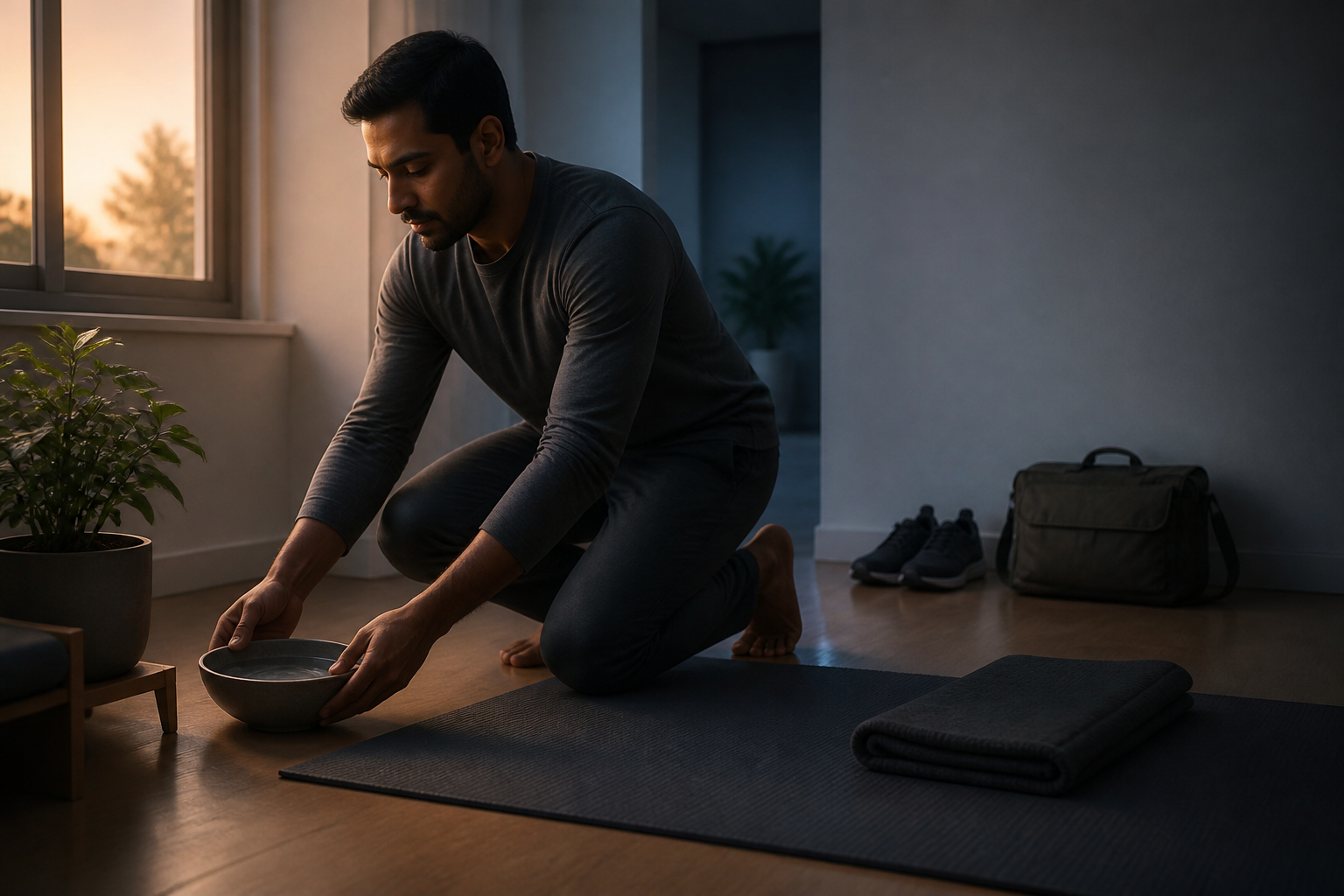
Meditation cannot carry the entire burden of peace if the rest of the day continually produces fresh agitation. Yoga therefore begins with the ordering of conduct and intention through yama and niyama. Dhyana refines attention, Pranayama steadies it, and svadhyaya exposes the assumptions behind habitual reactions. Japa gives the mind a sacred centre to which it can return.
The disciplines reinforce one another. Ahimsa reduces the conflict created by harmful thought, speech, and action. Breath awareness interrupts scattered momentum. Meditation teaches you to observe without immediately reacting. Self-study helps you distinguish a passing justification from a principle worth following. Practised together and continuously, these disciplines turn occasional calm into a more dependable inner orientation.
Use the following sequence for a sustainable 10–15 minute daily practice:
- Begin with conduct. Recall one situation in which you are likely to become reactive. Set a clear intention to practise Ahimsa in thought, word, and deed when it arrives.
- Sit without creating a performance. Choose a stable, comfortable posture. Let the body settle and allow the breath to become natural before trying to direct it.
- Use sama-vritti Pranayama. Inhale for a comfortable count and exhale for the same count. Keep the breathing slow and easy. If deliberate breathing feels uncomfortable, return to a natural breath; steadiness, not endurance, is the purpose.
- Observe the mind. Notice thoughts, sensations, and emotional movements without arguing with them. When attention wanders, return it gently to the breath.
- Add japa if it belongs to your practice. Repeat the mantra with attention rather than speed. Let the repetition gather the mind instead of becoming background noise.
- Close with direction. Carry one principle from the sitting practice into the next action of the day. Peace becomes a discipline when it crosses the boundary between the seat and ordinary life.
Svadhyaya can follow the sitting practice or occupy another consistent place in your day. Read the Bhagavad Gita, an Upanishad, or a teaching from your own lineage with one practical question: what does this ask you to notice or do differently? Reading becomes self-study when the teaching examines the reader, not merely when the reader accumulates information.
Do not rely only on the formal session. At natural transitions, take three mindful breaths before moving on. A one-minute pause before a meeting, commute, or difficult conversation can gather attention before habit takes over. These brief returns are especially useful when digital interruptions have divided the mind into unfinished fragments.
The decisive element is continuity, or nairantarya abhyasa. An elaborate practice performed occasionally is less formative than a modest discipline you actually maintain. Repetition converts a technique you remember into a response that becomes available under pressure.
Recognize the shared discipline without erasing each tradition
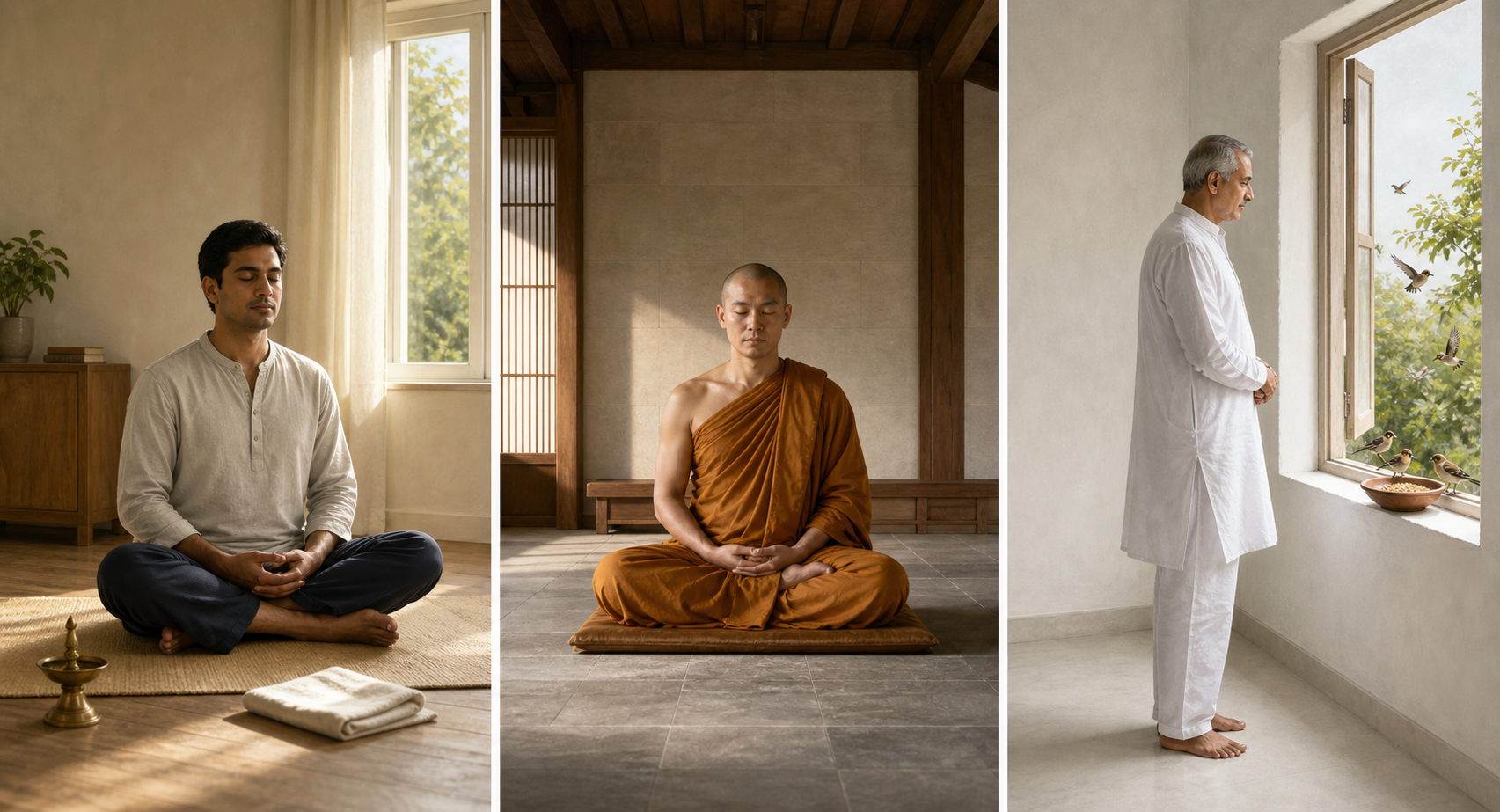
Hinduism, Buddhism, Jainism, and Sikhism do not offer interchangeable theologies. Their accounts of self, liberation, authority, and ultimate reality retain important distinctions. Yet their disciplines reveal a recognizable Dharmic grammar: ethical restraint, trained attention, contemplative depth, non-harm, remembrance, and compassionate action.
- Hindu practice joins yama and niyama with Pranayama, dhyana, svadhyaya, and japa. Shanti grows through alignment with Dharma rather than dependence on a convenient outcome.
- Buddhist practice develops calm and insight so that experience can be met with greater equanimity and clarity. The practitioner learns to see mental movement without automatically becoming entangled in it.
- Jain practice gives particular force to Ahimsa and Samayik. Non-harm extends through thought, word, and deed, while disciplined periods of steadiness interrupt the ordinary pull of reaction and attachment.
- Sikh practice joins simran with seva. Remembrance gathers the inner life, while service prevents peace from becoming private self-absorption.
This common structure should deepen commitment, not encourage spiritual sampling without roots. Begin with the discipline of your own tradition. If you are Hindu, let japa, Yoga, and scriptural study acquire continuity. If you are Buddhist, follow the contemplative training transmitted within your path. If you are Jain, give Samayik and Ahimsa their full ethical seriousness. If you are Sikh, do not separate simran from seva.
You can still learn from the family resemblance. Each path refuses the idea that peace is merely a feeling delivered by favourable circumstances. Each asks whether inner order is changing how you perceive, speak, and serve. Unity in spiritual diversity lies in that shared discipline, not in pretending that every doctrine says the same thing.
Measure Shanti by recovery, speech, and action

The clearest evidence of practice appears when something goes wrong. A peaceful self-image formed in solitude tells you little. A delayed plan, an insulting remark, a domestic disagreement, or a tense workplace exchange reveals whether attention and conduct have actually been trained.
Look for four changes:
- Less automatic reactivity: You notice the impulse to retaliate, interrupt, or withdraw before acting on it.
- Quicker recovery: A setback may still disturb you, but you return to balance instead of repeatedly renewing the disturbance.
- Clearer perception: You become better able to separate what happened from the story that wounded pride, fear, or attachment immediately added to it.
- A more spontaneous preference for Ahimsa: Non-harm begins to shape speech and action before it has to be imposed as an afterthought.
A short evening review can make these changes visible. Ask where you reacted automatically, how you recovered, whether your speech reduced or increased agitation, and what a more Dharmic response would have looked like. Do not use the review to prosecute yourself. Use it to identify the precise point at which tomorrow’s practice must enter.
Watch for counterfeit peace as well. Suppression says nothing is wrong while resentment accumulates. Passivity avoids a necessary duty. Spiritual pride uses composure to feel superior to someone who is distressed. Shanti does something more demanding: it allows you to see clearly, remain non-hostile, and perform the action that Dharma requires.
This is also how individual discipline becomes a public good. Calmer speech changes the atmosphere of a household. A pause before retaliation changes a workplace exchange. Seva turns remembrance toward the needs of others. Ahimsa keeps personal agitation from being exported into the community. Shanti scales outward through conduct, not through slogans.
Key takeaways
- Judge Shanti by your freedom to choose under pressure, not by the absence of uncomfortable emotion.
- Begin with ethical discipline. Meditation cannot reliably settle agitation that harmful conduct continually recreates.
- Use a consistent 10–15 minute practice combining quiet sitting, comfortable equal-count breathing, observation, and japa where appropriate.
- Take three mindful breaths at natural transitions so that formal practice reaches meetings, commutes, conversations, and digital life.
- Respect the distinct paths of Hinduism, Buddhism, Jainism, and Sikhism while recognizing their shared commitment to ethical and contemplative training.
- Track reduced reactivity, quicker recovery, clearer perception, and more natural Ahimsa rather than chasing a special meditative feeling.
Choose your anchor before the next day begins. Sit for 10–15 minutes at a time you can keep, take three breaths before the first difficult transition, and review your conduct that evening. Do not ask whether the day remained peaceful. Ask whether your practice helped you bring peace into the part that was not.
References
