

You may long to undertake parikrama in Sri Mayapur but be unable to travel or walk the full route. Or perhaps you already attend kirtan and distribute books, yet those activities feel like separate parts of your devotional life. The practical question is not which one counts more. It is how to make pilgrimage, sacred sound and outward service form one coherent practice.
Contemporary tools can bring sacred geography within reach, but they cannot supply attention, humility or intention. You still have to turn access into pilgrimage. The clearest way is to approach the dhama attentively, receive the holy name through hearing and chanting, and then carry that remembrance toward another person through seva.
Choose the form of parikrama your circumstances can sustain
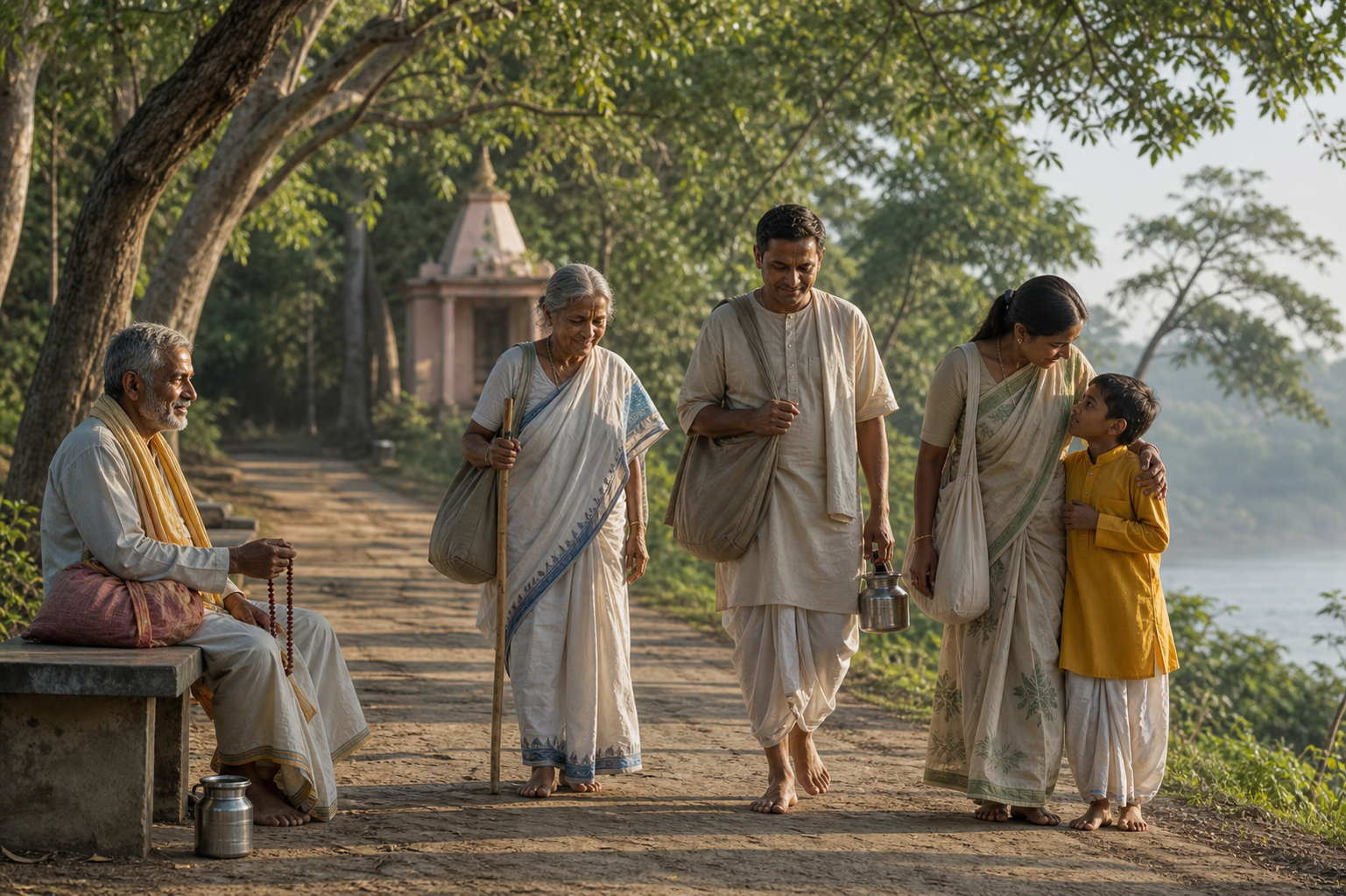
Parikrama is not simply a long walk with religious stops. You circumambulate sacred geography while allowing place, remembrance and bodily effort to direct consciousness toward the Divine. In the Gaudiya tradition, Sri Mayapur-dhama is inseparable from the remembrance of Sri Caitanya Mahaprabhu and the devotional movement associated with him.
The Sri Mayapur Pañca-krośa circuit is a traditionally walked route of about 16 kilometres. A contemporary virtual form combines an interactive Google-based map, a guided video tour and multilingual access. That gives you several legitimate ways to engage, depending on your health, location, time zone and access to a devotional community.
- Choose the physical route when you can travel, walk it safely and participate with appropriate local direction. Its bodily scale, changing surroundings and encounters with actual places cannot be reproduced on a screen.
- Choose a live virtual gathering when travel is impossible but you need the discipline and warmth of shared participation. A household, temple group or online satsanga can move through the route together.
- Choose a solo virtual parikrama when mobility, privacy, caregiving, geography or scheduling prevents group participation. Solitude can support careful attention if you protect the session from ordinary browsing.
- Choose a hybrid approach when you are preparing for a future visit or consolidating a pilgrimage already completed. Learn the geography before travelling, then revisit particular locations afterward.
A virtual parikrama is not identical to walking in Mayapur, and it should not be advertised to yourself as though nothing is lost. You will not experience the road, the physical proximity of temples or the demands of the full circuit. Yet difference does not make the virtual form empty. When travel is unavailable, a carefully structured digital journey can become serious devotional participation rather than passive viewing.
Choose by capacity, not spiritual status. If walking 16 kilometres would be unsafe for you, bodily strain is not a useful test of devotion. If you can travel but are not yet prepared, beginning virtually may help you arrive with a clearer sense of the sacred geography. State your actual constraint, select the form that answers it, and commit to that form without embarrassment or exaggeration.
Give the route a devotional shape instead of consuming content
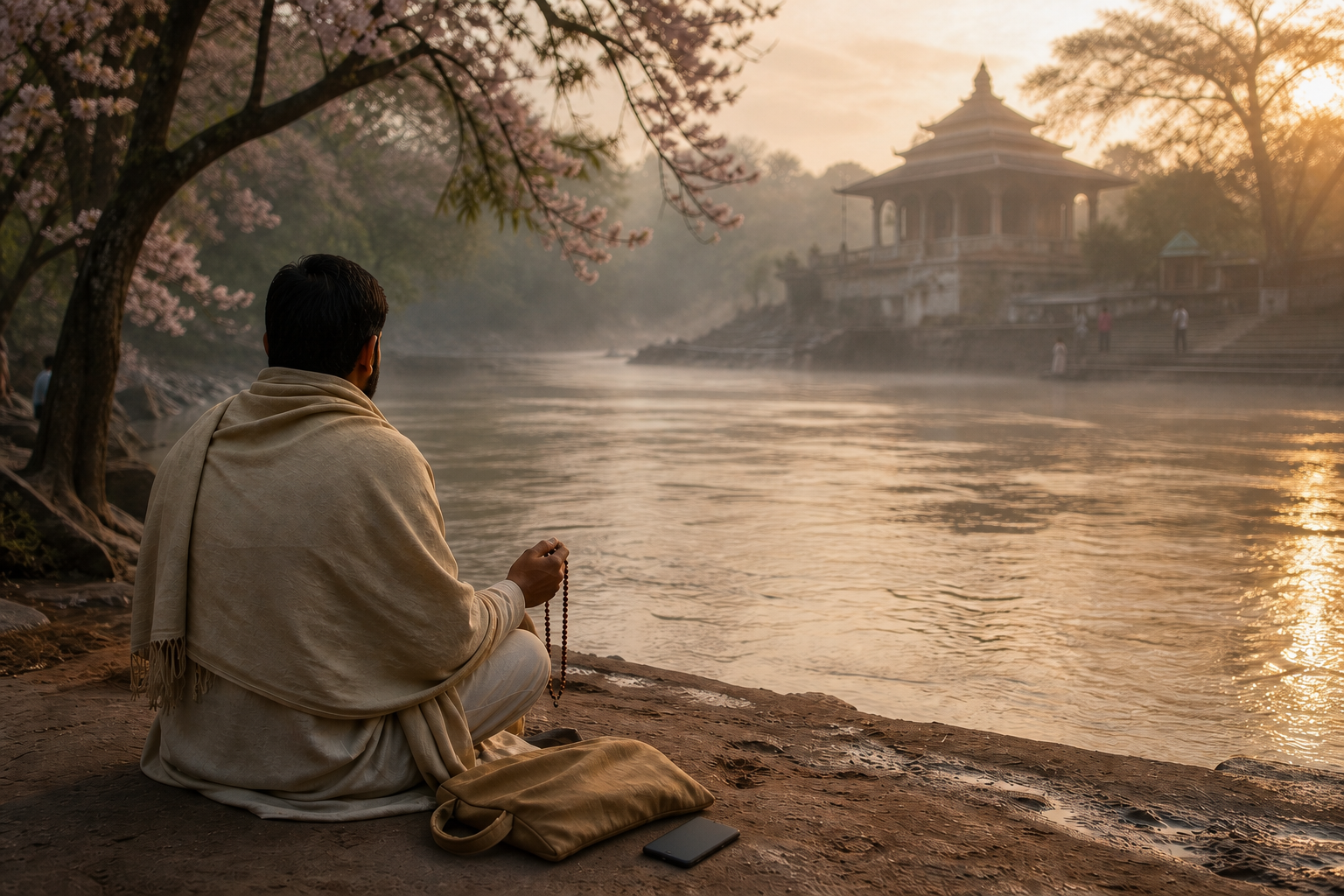
A map can tell you where to move next. A video can tell you what happened at a place. Neither can decide how attentively you will receive it. Without a deliberate rhythm, a virtual pilgrimage becomes a queue of clips completed at the same distracted pace as ordinary media.
A simple sequence for individual parikrama
- Choose a bounded portion of the route. You do not have to finish the entire circuit in one sitting. Stop while you can still offer real attention rather than continuing merely to register completion.
- Prepare a clean, quiet place. You may light a lamp safely, place sacred texts nearby or begin with a few verses. These aids establish intention; they are not admission requirements.
- Silence notifications and close unrelated tabs. If the same device holds the map and the distractions, decide before beginning that it will serve only the parikrama until the session ends.
- Offer pranama and state your purpose in one sentence. Ask to remember Sri Caitanya Mahaprabhu, understand the dhama more deeply or become more fit for service. A precise intention makes it easier to notice when the mind wanders.
- At each waypoint, first locate the place, then hear or read its context. Afterward, pause. Chant, sit quietly or repeat the central remembrance in your own words before moving on.
- Record one line about what deserves further study or practice. Do not attempt to produce a travel diary. One honest observation is more useful than a page copied from narration.
- Close with gratitude and select one outward act of seva. This prevents the experience from ending as private spiritual consumption.
The pauses matter. They distinguish pilgrimage from digital sightseeing. If you remember the interface more clearly than the sacred places, reduce the number of waypoints in your next session. A slower portion of the route can do more devotional work than a hurried completion of all of it.
A group format that keeps everyone involved
Families and community groups need enough structure to prevent one person from turning the gathering into a lecture. Assign simple roles: one participant manages the map, another reads or summarizes the context, and another leads the chanting. Rotate those roles at the next gathering.
- Select the language before beginning so that children, elders and less fluent participants can follow. Multilingual access is most useful when the group chooses for inclusion rather than prestige.
- Use the same rhythm at each location: orientation, context, chanting, silence and one short response from the group.
- Let younger participants locate the next waypoint or identify recurring names and places. Give elders room to add remembered teachings without requiring them to manage the technology.
- End at the agreed time even if the route is unfinished. Continuity is easier to build when participants trust that the gathering has a clear boundary.
Digital convenience does not create spiritual authority. Explanations of Mayapur’s sacred places should remain grounded in scriptural references and the guidance of the Acharyas, as the virtual Pañca-krośa presentation is designed to do. Treat the map as an index into the tradition, not as a replacement for siddhanta, qualified teachers or sustained study. When a social-media retelling conflicts with established lineage teaching, pause before repeating it.
Carry remembrance outward through respectful sankirtan

Pilgrimage gathers attention around sacred place. Sankirtan carries that attention outward through the sacred names and the sharing of Krishna-centred wisdom. Congregational chanting is the most recognizable form, while book distribution extends the same movement into personal encounters.
This connection matters because book distribution can otherwise become a campaign driven by counts, social pressure or the desire to appear successful. In Gaudiya practice, it is seva before it is a result. The first verse of the Siksastakam places purification, illumination and spiritual joy within the work of sacred sound, and long-term engagement in book distribution can become a stabilizing devotional discipline. That discipline begins with your own hearing and chanting, not with a target imposed on a stranger.
A respectful encounter can follow a simple sequence:
- Set your intention before approaching anyone. Your task is to offer an opening, not to win control of the person’s response.
- Ask permission. A direct question such as Would you like to see a book about bhakti and the practice of chanting? gives the other person a real choice.
- Listen for context. Someone already following a spiritual path may need a different introduction from someone who has never encountered Krishna bhakti.
- Present one clear doorway. Explain the book, chanting practice or invitation to kirtan without unloading every doctrine at once.
- Do not manufacture urgency or promise worldly outcomes. Sacred literature does not need claims that chanting will automatically remove illness, financial hardship or family conflict.
- Accept refusal cleanly. Thank the person and move on. A free invitation ceases to be an invitation when declining it brings argument, guilt or contempt.
- Respect the rules of the place where you are serving. Devotional purpose does not cancel the responsibilities attached to a public venue, campus, business or private property.
Respect for other dharmic paths should be equally precise. Hindu, Buddhist, Jain and Sikh traditions all honour the transmission of wisdom, compassion and community responsibility in their own ways. That shared ground can support courtesy and dialogue, but it does not make their teachings interchangeable. You do not have to hide Gaudiya siddhanta to be respectful, and you do not have to belittle another path to speak clearly about Krishna bhakti.
After a parikrama session, choose one proportionate form of sankirtan. Invite someone to a kirtan, give or lend an appropriate book, help an elder access the multilingual route, share the virtual experience with a housebound devotee, or volunteer in a community programme. Send a personal invitation with context rather than scattering an unexplained link. The purpose is to extend relationship, not merely distribution.
Protect the practice from performance, fatigue and transaction
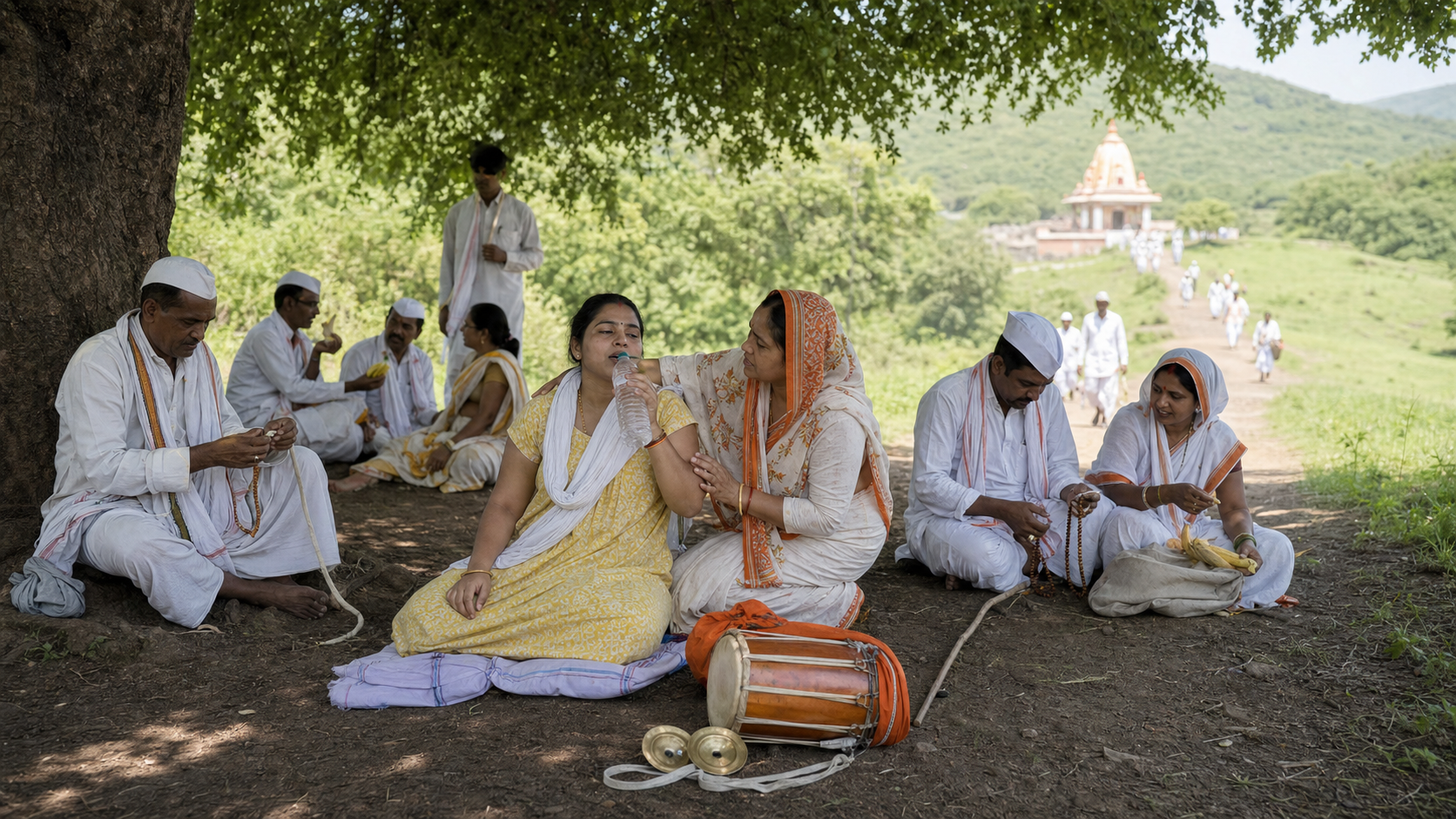
Devotional joy is not the same as a pleasant mood after every outing. Some parikrama sessions will feel concentrated; others will expose distraction. Some sankirtan encounters will be warm; others will end quickly. A sustainable practice is measured by faithful return and the refinement of intention, not by uninterrupted emotional intensity.
Srila Prabhupada’s own path included prolonged austerity and uncertainty before disciples, recognition and institutional support appeared. His life is therefore not a formula promising that visible success will follow every difficult period. Krishna’s reciprocation is not a transaction in which a fixed amount of distribution purchases recognition. Grace may appear as resilience, clearer purpose, unexpected assistance or another opportunity to serve.
Use five review questions after a cycle of pilgrimage and sankirtan:
- Attention: Did I actually hear, chant and remember, or did I mainly move through waypoints and screens?
- Accuracy: Did I repeat teachings grounded in the Gaudiya lineage, or did I pass along an attractive claim without checking it?
- Respect: Did the person receiving an invitation remain free to ask questions, disagree or decline?
- Sustainability: Did this service strengthen my regular sadhana, or did I neglect chanting and study in order to maintain an outward appearance?
- Follow-through: Is there one person, question or teaching that now deserves a thoughtful response?
Watch for predictable distortions. Virtual pilgrimage becomes performative when documenting completion matters more than contemplation. Book distribution becomes coercive when a low count makes you pressure people. Inclusive language becomes vague when it erases Gaudiya commitments, while doctrinal confidence becomes adharma when it licenses discourtesy.
When one of those signs appears, reduce the scale and restore the sequence: hear, chant, remember, serve. Complete fewer digital waypoints. Hold a shorter kirtan. Have one honest conversation instead of many hurried approaches. A smaller act performed in the right consciousness is a sounder foundation for the next act.
You can also use a simple recurring rhythm without turning it into another scorecard. Protect a regular personal anchor of japa or study. Set aside a recurring time for one portion of parikrama or a community kirtan. Follow it with one modest outward act. Then review what changed in your attention, understanding and conduct before expanding the commitment.
Key takeaways
- Select physical, group-virtual, solo-virtual or hybrid parikrama according to real capacity, not perceived spiritual rank.
- Use the 16-kilometre Mayapur route as sacred geography, not a completion challenge. Divide it across sessions when that protects attention.
- At every virtual waypoint, alternate information with chanting, silence or reflection so that the experience does not collapse into media consumption.
- Let sankirtan begin with your own hearing and continue through an invitation that the other person can freely accept or decline.
- Honour shared dharmic values without pretending that Gaudiya Vaishnavism, Buddhism, Jainism and Sikhism have identical doctrines.
- Evaluate the practice by attention, accuracy, respect, sustainability and follow-through rather than distance covered, views received or books handed out.
Set your next step while the decision is still concrete. Choose a date, decide whether you will walk or participate virtually, select a manageable portion of the route, and name one act of sankirtan that will follow. When that day arrives, give the dhama, the holy name and the person before you your undivided attention. That is how contemporary access becomes living Gaudiya practice.
References
- Dandavats – Discover the Ultimate Sri Mayapur Pañca-krośa Parikrama: A Complete Virtual Pilgrimage Experience
- Dandavats – Discover the Proven Joy of Sankirtan: How Book Distribution Sustains a Lifelong Practice
