
You may have found Narak Chaturdashi and the main Diwali observance assigned to the same civil date in 2025. That is not necessarily a mistake. A lunar tithi can change during a calendar day, so the pre-sunrise Chaturdashi bath and a later Diwali observance can fall on different ritual portions of 20 October.
The practical answer is to build your day around separate anchors: Abhyanga Snana before sunrise while Chaturdashi prevails, household preparation during the day, Yama Deep Daan at dusk, and the Diwali or regional puja indicated by your family’s parampara and local panchang.
Key takeaways for the 2025 observance
- In India and several Asia-Pacific and Gulf locations, Narak Chaturdashi was observed on 20 October 2025. The applicable civil date could differ in the United States, Canada, and the United Kingdom.
- Perform Abhyanga Snana before local sunrise while Chaturdashi tithi is active. A date alone is not a complete muhurta.
- Use sesame oil, an optional familiar ubtan, bathing water, clean clothes, and a short prayer. You do not need an elaborate collection of ritual items.
- Light a dedicated Yama Deep at dusk for protection, ethical restraint, gratitude, and family well-being.
- Hanuman Puja, Kali Chaudas practices, and Roop Chaudas customs are regional options, not duties that every Hindu household must combine.
- Confirm the main Diwali or Amavasya puja separately. Do not assume that its timing is identical to the pre-dawn Chaturdashi window.
Fix the local date before arranging the rituals
Narak Chaturdashi is the fourteenth lunar day of Krishna Paksha. In the 2025 Indian calendar, its central observance fell on 20 October. The preferred Abhyanga Snana window depended on Chaturdashi prevailing before the sunrise of the devotee’s own location.
This distinction matters most in the diaspora. The 2025 date was also 20 October in Australia, New Zealand, the UAE, Singapore, and Malaysia, while communities in the United States, Canada, and the United Kingdom could encounter a different local date because the tithi and sunrise occurred at different clock times. Use a city-specific panchang or a calendar issued by a trusted local temple. An India-based time converted into your time zone is not necessarily the local muhurta.
The overlap on 20 October also explains why TTD temples could hold Deepavali Asthanam on the same civil date associated with Narak Chaturdashi Snana. The ritual day is governed by the active tithi and prescribed part of the day, not merely by the midnight-to-midnight label on a phone calendar.
| Part of the observance | When to place it | What you need to confirm |
|---|---|---|
| Abhyanga Snana | Before local sunrise | Chaturdashi must be active during the preferred local window |
| Cleaning, altar preparation, and rangoli | During the day | No separate complex muhurta is needed for ordinary preparation |
| Yama Deep Daan | At dusk or in the evening | Follow the lamp placement preserved in your household custom |
| Hanuman or Kali Chaudas worship | During the locally applicable Chaturdashi period | Check the regional or temple convention you actually follow |
| Main Diwali or Amavasya worship | In its separately prescribed local period | Use the Diwali entry in the local panchang rather than the Snana time |
Hanuman Puja associated with Kali Chaudas was described across the 19-20 October span in 2025. That span should not be read as a forty-eight-hour universal muhurta. It reflects the way the tithi crossed civil dates and the fact that regional practices assign different portions of Chaturdashi to worship. Your local panchang resolves which portion applies to you.
Perform Abhyanga Snana as a deliberate morning sadhana
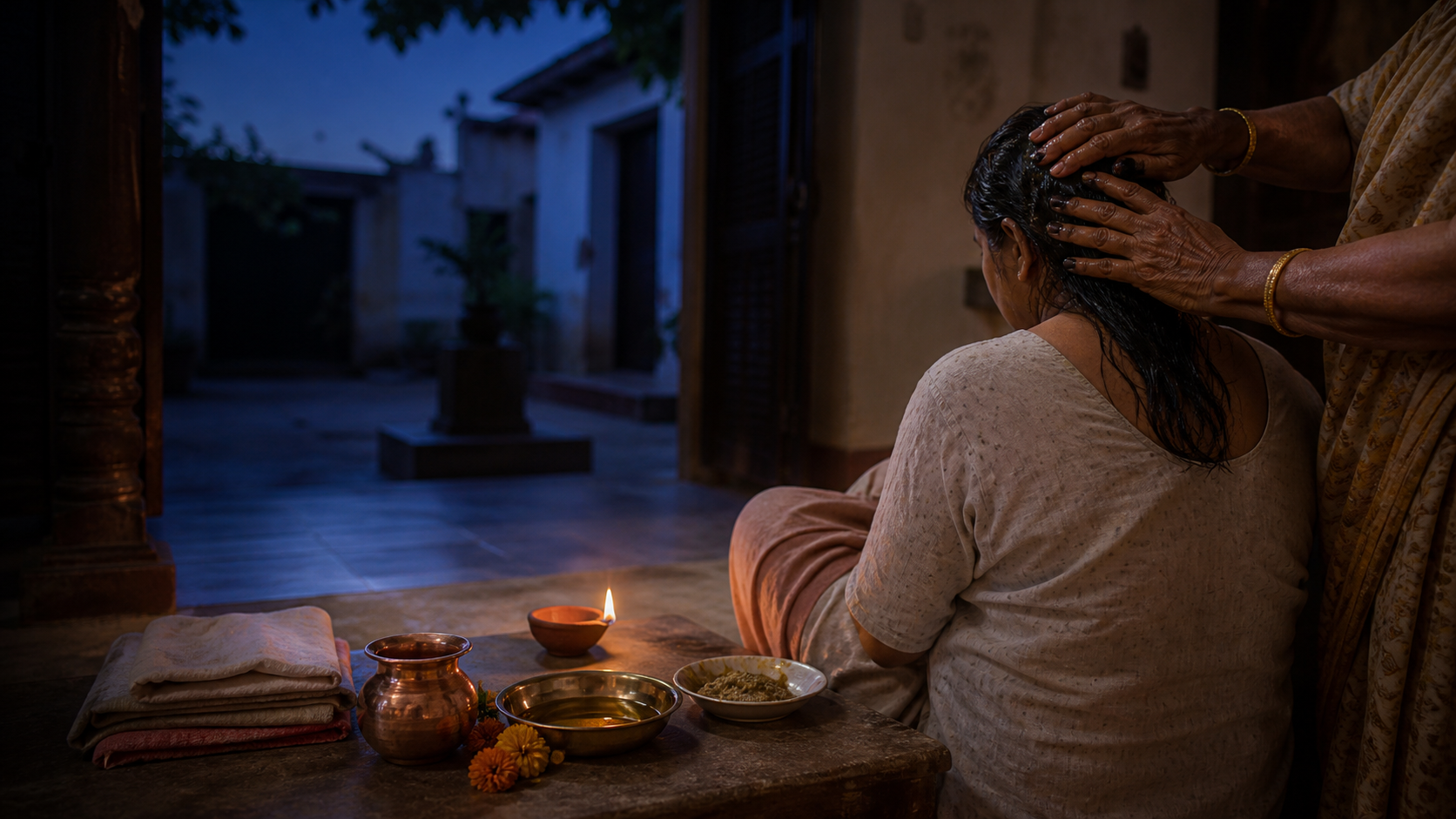
The oil bath is the defining household practice of Narak Chaturdashi. Its sequence is simple: make a sankalpa, apply oil, bathe before sunrise, pray, and begin the festival in clean clothes. Preparing the items the previous evening prevents the ritual from becoming a rushed search through cupboards before dawn.
- Set out sesame oil, your usual bathing supplies, an optional familiar ubtan, a towel, and clean clothes. Place a non-slip mat where oil could reach the floor.
- Begin with a short sankalpa. State that you are undertaking Narak Chaturdashi Snana for purification of conduct and mind, protection, clarity, and readiness for Deepavali.
- Apply comfortably warm tila taila, or sesame oil, gently from head to toe. The act should remain calm and respectful; using more oil does not make it more sacred.
- If Roop Chaudas is part of your family custom, apply an ubtan that your skin already tolerates. Gram flour, turmeric, and rose water appear in common Roop Chaudas practice, but the paste is optional rather than a test of ritual completeness.
- Invoke the sacred rivers over the bathing water, then bathe thoroughly. Keep the physical space safe, especially when children or elders are participating, because an oil-coated floor can become slippery.
- Recite one or more prayers appropriate to your sampradaya. A short mantra repeated with attention is better than racing through a long, unfamiliar collection.
- Close with a prayer for peace, dress in clean clothes, and, where customary, light one of the first diyas of the festival season.
A widely used invocation for the bathing water is:
Gange cha Yamune chaiva Godāvari Sarasvati | Narmade Sindhu Kāveri jalesmin sannidhim kuru.
This prayer invites the sanctifying presence of Ganga, Yamuna, Godavari, Sarasvati, Narmada, Sindhu, and Kaveri into the water available in your home. It allows a devotee far from a tirtha, including someone living outside Bharat, to approach an ordinary bath with sacred remembrance.
You can then select a mantra according to the intention and deity central to your practice:
- For remembrance of Vishnu and Sri Krishna: Om Namo Bhagavate Vāsudevāya.
- For protection and freedom from fear: Tryambakaṁ yajāmahe sugandhiṁ puṣṭi-vardhanam | urvārukam iva bandhanān mṛtyor mukṣīya mā’mṛtāt.
- Where Kali Chaudas worship is customary: Om Krīm Kālikāyai Namaḥ.
- For respectful remembrance of Yama and the discipline of dharma: Om Yamāya Namaḥ.
- To close by turning the mind toward truth and light: Asato mā sadgamaya | Tamaso mā jyotir gamaya | Mṛtyor mā amṛtaṁ gamaya | Om śāntiḥ śāntiḥ śāntiḥ.
These are alternatives, not a compulsory package. If your family has one inherited mantra, retain it. If pronunciation is unfamiliar, choose the short Vasudeva or Yama mantra and recite it steadily. The purpose of the Snana is attentive purification, not performance.
A demanding work schedule does not require abandoning the observance. The simplified form is a brief oil anointment, a mindful bath within the proper local window, and a short prayer. Preserve the order and intention before adding decorative complexity.
Build the evening around Yama Deep Daan and your regional custom
The evening has a different mood from the morning. Abhyanga Snana removes what should be left behind; Yama Deep Daan asks you to carry light, restraint, and care into the household. The dedicated lamp is commonly placed near the entrance or in the home’s sacred space, accompanied by a prayer for protection and family well-being.
- Choose a clay or metal lamp that can stand securely on a heat-resistant surface.
- Place it at the threshold or in the puja area according to your family custom. Keep it away from curtains, rangoli materials that can ignite, and places where people will step over it.
- Light it at dusk or during the locally observed evening period.
- Offer the salutation Om Yamāya Namaḥ, followed by a simple prayer for right conduct, protection, and the well-being of the family.
- Keep the flame supervised. Devotion does not require placing an open lamp where wind, children, animals, or foot traffic make it unsafe.
Do not add an unsupported rule about the exact direction, number of wicks, or number of lamps merely because it appears in a generic festival checklist. Those details vary by region and parampara. Retain the practice known in your household, or ask the temple or priest whose calendar you are already following.
When Hanuman Puja belongs to your Kali Chaudas tradition
Hanuman Puja is especially prominent in Gujarat, Maharashtra, and parts of North India. It places courage, protection, steadfast devotion, and seva at the center of Kali Chaudas. A manageable home observance can include a lamp, oil and sindoor offered in the manner customary to your shrine, jasmine or marigold flowers, betel leaves, and recitation of the Hanuman Chalisa.
- Clean the shrine and arrange the offering before the puja window begins.
- Invoke Sri Hanuman and offer flowers, oil, sindoor, or betel leaves only in the way your family or temple custom permits.
- Recite the Hanuman Chalisa without rushing.
- Ask for kshama, bala, and raksha: forgiveness, strength, and protection.
- Close with a lamp or harati and carry the prayer into a concrete act of service.
Kali Puja, Kali Yantra Puja, and Narak Chaturdashi Tarpana also appear in some regional traditions. Their presence under the wider name Kali Chaudas does not make every practice obligatory for every home. If a ritual has not been transmitted in your family or sampradaya, do not assemble it casually from fragments. A simple lamp and familiar prayer are preferable to imitating a lineage-specific procedure without guidance.
Where Roop Chaudas and Choti Diwali fit
Roop Chaudas emphasizes radiance joined to purification. The familiar ubtan and oil bath can become an intergenerational practice in which elders pass on family methods without turning appearance into vanity. The deeper question is whether outer cleanliness is being accompanied by clearer speech, restraint, and conduct.
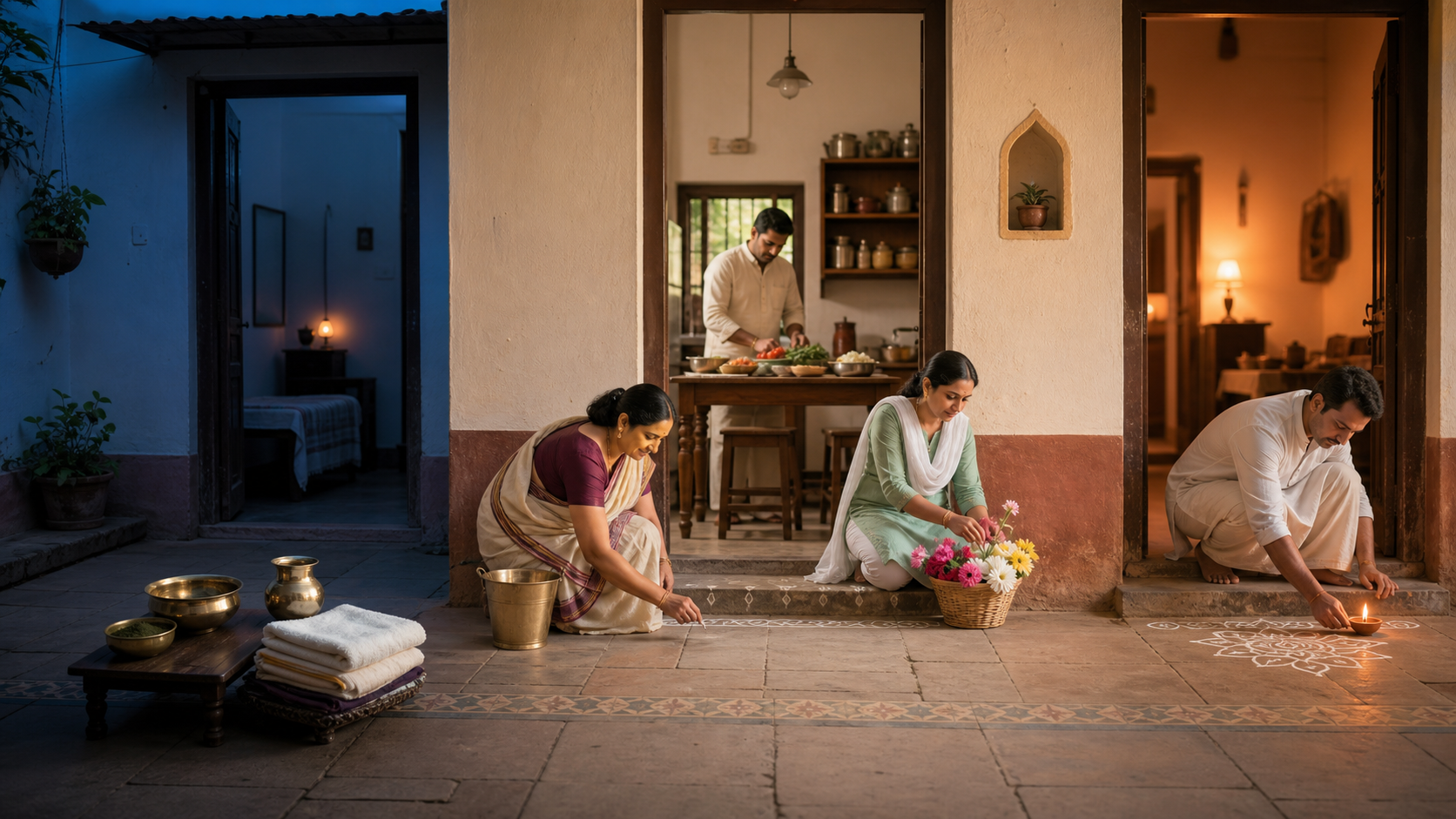
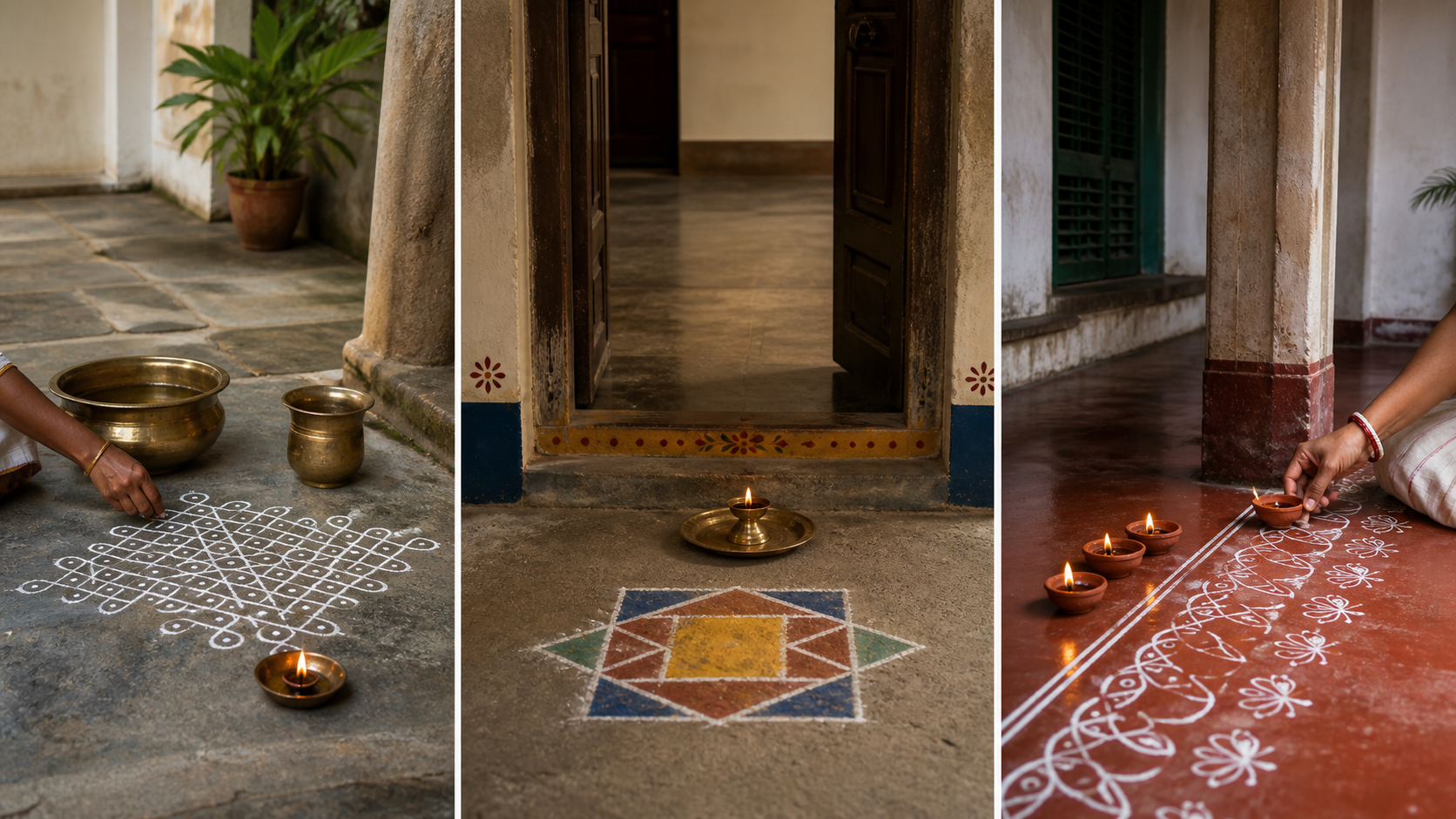
Choti Diwali also serves as the practical bridge into the larger celebration. Complete the remaining cleaning, arrange the altar, draw an eco-conscious rangoli, prepare diyas, and organize naivedya during the day. The evening may include modest, safety-conscious fireworks, but noise and smoke need not become the measure of celebration. Clay lamps, natural rangoli materials, low-noise choices, and minimal packaging preserve the festive atmosphere while respecting neighbours, animals, elders, and anyone affected by heavy smoke.
Keep home worship and temple Asthanam distinct
A household puja does not need to reproduce a temple’s ceremonial scale. At home, complete the altar preparation, light the diyas, offer the naivedya your family has prepared, perform the archana or recitation known to you, and close with harati. The coherence of the sequence matters more than the number of decorations.
In Tirupati, the 2025 TTD observance included Deepavali Asthanam on 20 October at Sri Govindaraja Swamy Temple and Sri Kodanda Rama Swamy Temple. Asthanam means a ceremonial royal court and commonly includes special alankaram, archana, naivedyam, deepa-alankarana, Vedic recitation, and mangala harati.
If your plan includes temple darshan, treat the temple schedule as its own timetable. Arrive early, wear modest clothing, follow the queue arrangements, and allow extra time for increased attendance. Individual temple timings can vary even when the observance has a common date, so verify the shrine’s program rather than assuming that one TTD temple’s sequence applies to another.
The discipline of the queue is also part of the observance. Crowding past another devotee to gain a few minutes undermines the very self-restraint invoked during the morning Snana and evening lamp. Let orderly darshan, quiet attention, and consideration for families around you become practical forms of dharma.
Share the light without erasing distinct Dharmic memories
Within Hindu practice, Narak Chaturdashi recalls Sri Krishna’s victory over Narakasura. The story gives the morning cleansing a moral direction: the darkness to be removed is not merely dirt or disorder but fear, arrogance, harmful habit, and confused conduct. Make the sankalpa specific. Name one tendency you intend to restrain and one dharmic action that will replace it.
Regional names illuminate different parts of the same day. Narak Chaturdashi remembers the defeat of Narakasura. Kali Chaudas foregrounds protection and the removal of darkness. Roop Chaudas joins radiance with purification. Hanuman Puja develops courage through devotion and service. You can honour the name preserved in your home without presenting it as the only authentic form of the festival.
Deepavali also carries distinct memories across the wider Dharmic family. Jains associate the day with the nirvana of Bhagavan Mahavira. Sikhs remember liberation through Bandi Chhor Divas. Lamps in several Buddhist and Hindu communities can express wisdom and compassion. These observances need not be blended into a single ritual to demonstrate kinship. Shared reverence for illumination, ethical discipline, compassion, and seva is strongest when each tradition’s own historical memory is named accurately.
Before the family disperses into sweets, visits, and photographs, give the day one quiet moment of application. Ask each person to name a darkness they will stop feeding and a form of light they will practice: truthful speech, restraint, study, forgiveness, dana, or service. That turns the diya from decoration into a vow that can survive the festival night.
For a reliable family record, write down the city, the local panchang used, the pre-sunrise Snana window, the dusk lamp practice, and the regional puja actually followed in 2025. Preserve that ritual order for the future, but recalculate the dates and muhurtas every year. The tithi moves; the discipline of purification, courage, and illumination remains yours to renew.

References
- DharmaRenaissance Blog — Discover Deepavali Asthanam 2025 in TTD Temples: A Complete Guide to Rituals and Unity
- DharmaRenaissance Blog — Ultimate Naraka Chaturdashi Mantras: Master Stotras for a Transformative Snan Ritual
- DharmaRenaissance Blog — Hanuman Puja on Kali Chaudas 2025: The Complete Guide to Rituals, Timing, and Meaning
- DharmaRenaissance Blog — Complete Guide to Choti Diwali 2025: Discover Narak Chaturdashi Rituals, Meaning, Preparation
- DharmaRenaissance Blog — Complete 2025 Abhyanga Snana Muhurat: Master Narak Chaturdashi Rituals for a Transformative Diwali
- DharmaRenaissance Blog — Essential Guide to Narak Chaturdashi 2025: Discover Kali Chaudas, Roop Chaudas, Hanuman Puja
