
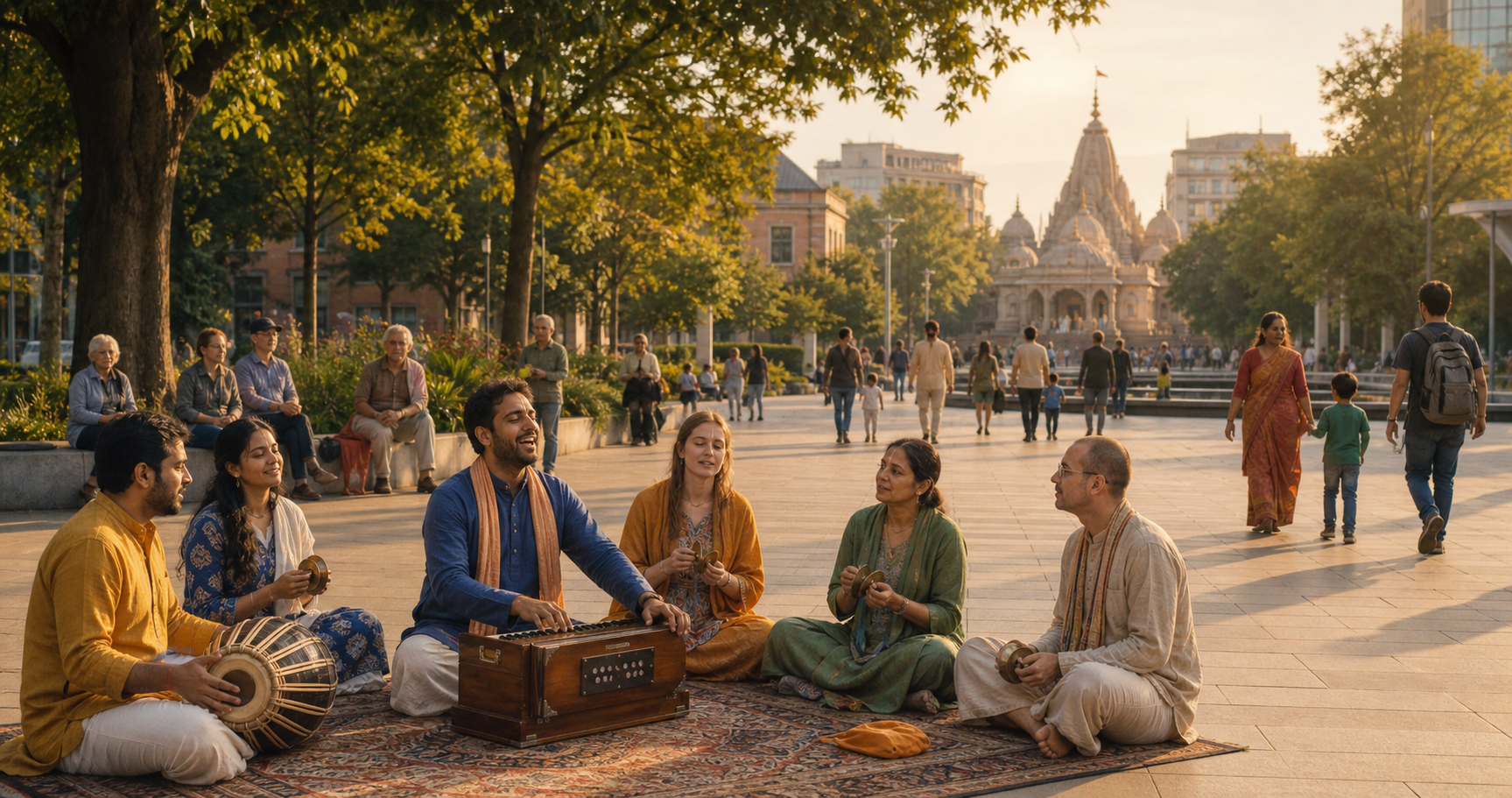
You have been asked to bring mantra into a city hall, campus, interfaith programme, parade route, or street festival. The difficult question is not whether sacred sound belongs there. It is how to keep worship from becoming background entertainment while ensuring that no stranger is pressured to perform belief.
A clear framework lets you decide what may adapt, what must remain intact, and how to explain the practice without shrinking it into generic wellness or claiming that every dharmic tradition is the same.
Name the public act before you plan it
Sacred sound can enter public life as worship, civic invocation, or cultural education. These forms may overlap, but they are not interchangeable. Naming the form first determines who leads, how participation works, what the host should advertise, and what the audience needs to know.
Devotional kirtan
Public kirtan, or sankirtana, is collective devotional singing. In Gaudiya Vaishnavism, the Hare Krishna mantra is commonly sung in call and response, often supported by the mridanga drum and karatals. Sri Chaitanya popularised communal sankirtana in the 16th century, and migration and new religious movements carried the practice into Western cities during the mid-20th century.
This history matters when someone treats street kirtan as an Indian music act, political demonstration, or piece of performance art. Its public visibility does not cancel its devotional identity. If worship is the primary purpose, call it kirtan in the programme and identify the tradition. A sacred practice can be musically beautiful without being reduced to a spectacle.
Civic invocation
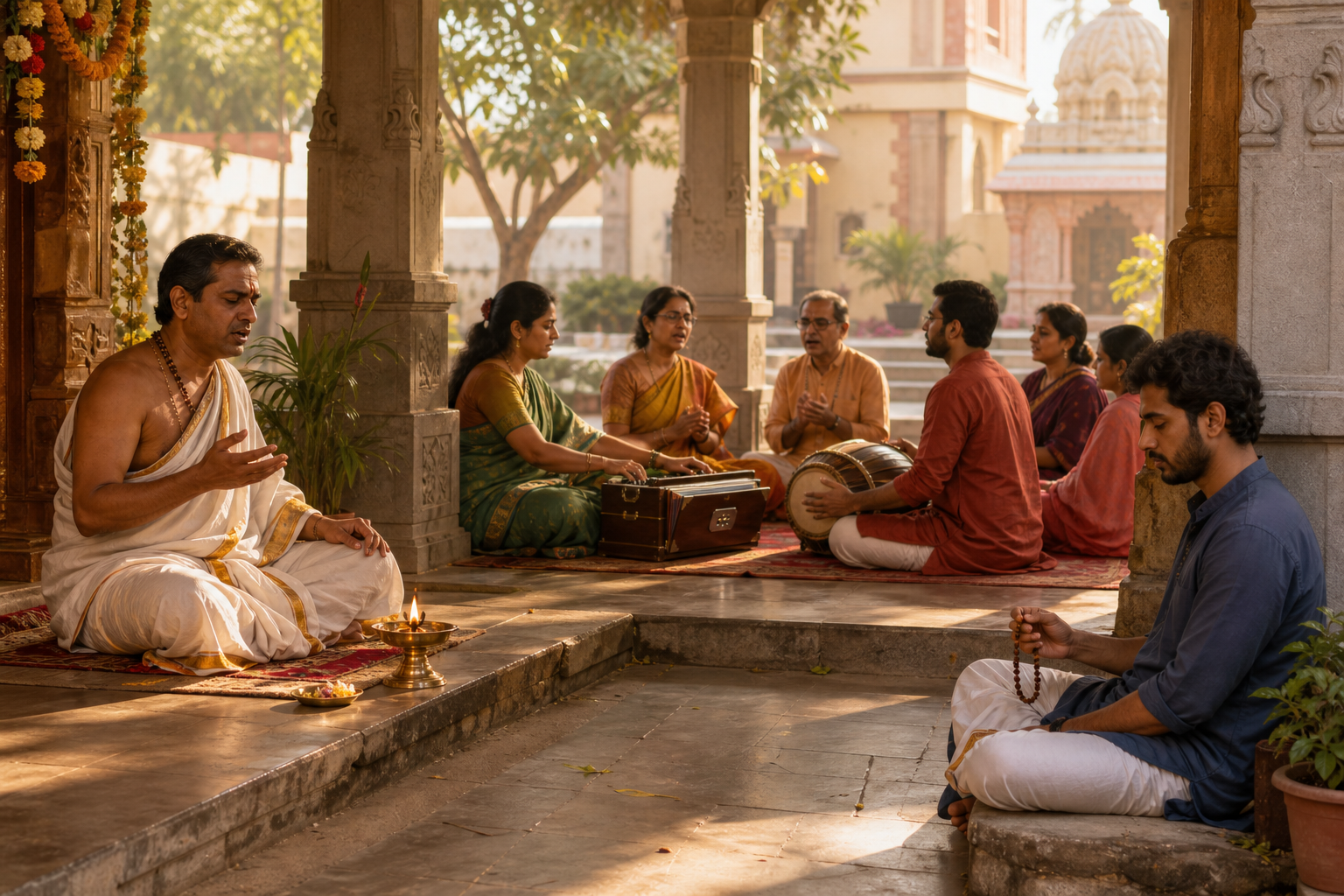
A civic invocation serves a different setting. It opens a shared public task rather than assembling a temporary congregation. Sanskrit and Vedic verses can be selected around peace, truthfulness, compassion, mutual respect, collective welfare, and the responsibilities of public service. The audience should be able to receive the offering without being expected to repeat it.
The Legislature of the United States Virgin Islands provided a concrete model when it arranged for Hindu Sanskrit mantras to open a Senate session in Charlotte Amalie, reportedly the first such invocation since the legislature was established in 1954. The setting did not require Hindu identity to disappear. It required the offering to be intelligible within the chamber’s common civic purpose.
If you are arranging an invocation, ask a qualified practitioner to choose and recite the verses. Give the leader a precise brief about the occasion, but do not ask an event planner to splice attractive Sanskrit lines together. A useful opening sentence is: “These verses are offered for peace, truthful service, and the welfare of all; no spoken response is expected.”
Cultural or educational presentation
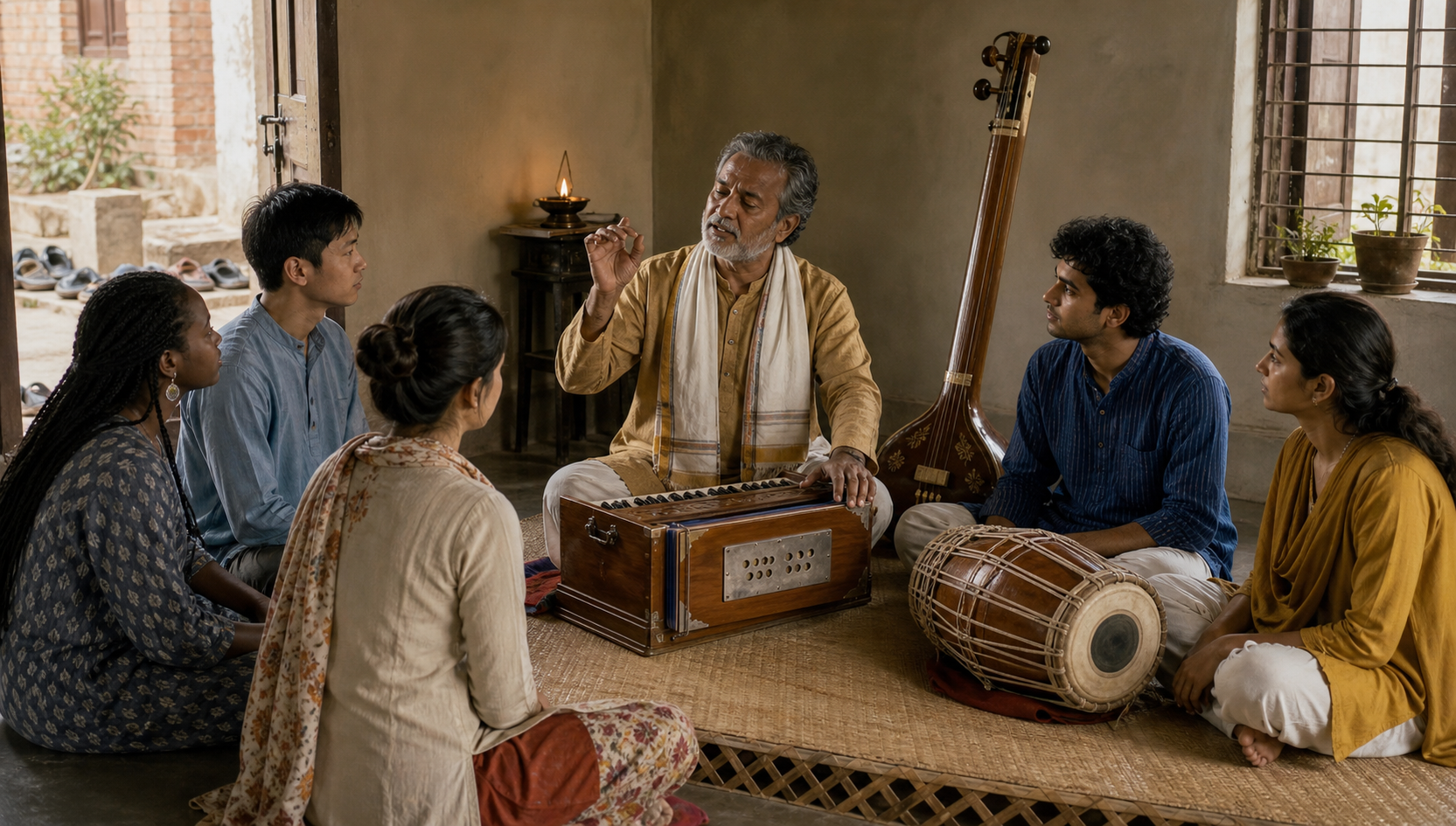
An educational presentation explains a practice to people who may never have encountered it. Introduce the lineage, name the mantra or form of kirtan, and say whether the demonstration remains a devotional offering. Do not perform worship and then deny that it is worship merely to make an institution comfortable. “A Vaishnava devotional practice presented in an educational setting” is both accurate and accessible.
Adapt the setting without rewriting the sacred centre
The spoken introduction, printed translation, amplification, procession route, length, and audience instructions can all respond to the venue. The wording of a received mantra, its lineage, and its devotional purpose should not be casually altered. Our rule is simple: explain more; dilute less.
That distinction protects sacred sound from two opposite mistakes. One is exoticisation: Sanskrit becomes mysterious ambience detached from meaning. The other is sanitisation: mantra is presented only as a relaxation technique because devotion might make the host uneasy. Both approaches hide the very thing the public has been invited to encounter.
Collective chanting can steady breath and rhythm, support emotional regulation, and foster social connection. Those human effects can help an unfamiliar audience understand why group sound is accessible. They do not define the practice, and they should not be used to promise a guaranteed psychological or spiritual result. Describe what people will do and what the tradition understands it to mean; do not advertise “higher consciousness” as a measurable outcome.
Within Gaudiya Vaishnava theology, the Holy Name is understood to possess intrinsic spiritual potency. Yet transmission still depends on the person carrying it. A.C. Bhaktivedanta Swami Prabhupada’s global work illustrates a both-and principle: the Holy Name is the spiritual power, while a disciplined and faithful teacher makes that power audible across unfamiliar languages and cultures.
That principle gives an organiser a practical test. The lead practitioner should be able to identify the mantra and lineage, explain the devotional purpose in plain language, distinguish shared ethical ground from specific doctrine, and honour the venue’s legitimate conditions. Charisma is not a substitute for those qualifications. If the proposed leader cannot explain what is being offered without either grand claims or embarrassed evasions, pause the event and find someone who can.
Make freedom of participation visible
Public sacred sound works by invitation. A passer-by or seated guest must be free to listen, join, observe silently, ask a question later, or continue on their way. That freedom should not remain an unspoken assumption; make it explicit before the first refrain.
For a participatory kirtan, one sentence is enough: “This is a Vaishnava call-and-response practice; you are welcome to sing the response, listen quietly, or simply pass through.” For a non-participatory invocation, say that no response is required. These introductions remove uncertainty without delivering a lecture.
The physical arrangement should carry the same message. Keep a street procession from closing the only path through a space. Let the singing circle remain permeable. Do not single out people who decline to sing or dance, and do not treat their silence as hostility. If literature or conversation is available, let people approach it separately rather than making it the price of participation.
Public space is shared space, so confirm the venue’s rules, sound conditions, procession requirements, and accessibility arrangements before the event. Requirements differ by place. Devotional purpose does not exempt an organiser from them. The gentle effect of public kirtan depends on this non-coercive character: some people pause, some join for part of the refrain, and others simply witness it while moving through the city.
If someone asks whether the gathering is a protest, recruitment drive, or concert, answer directly: “It is a public Vaishnava devotional practice. Listening and participation are voluntary.” That answer is clearer than insisting that the event is “just cultural,” and less confrontational than treating an ordinary question as an attack on Dharma.
Show dharmic kinship without flattening real differences
Sacred sound forms a recognisable thread through Hindu, Buddhist, Jain, and Sikh life, but each tradition gives that sound its own theological content. Gaudiya Vaishnavas chant the names of Krishna in bhakti. Buddhist communities maintain forms of mantra recitation connected with mindfulness and compassion. Jains revere the Navkar Mantra in the work of inner purification. Sikh practice gives a central place to kirtan and naam simran as remembrance of the Divine.
The family resemblance lies in disciplined remembrance and the shaping of consciousness through sacred sound, not in an assertion that the mantras are interchangeable. A Jain mantra should not be described as another form of Hare Krishna kirtan, and Sikh naam simran should not be absorbed into a generic category of “Indian chanting.” Unity becomes more credible when difference is named accurately.
At an interfaith event, introduce every offering in the same order: name the tradition, name the practice, state its purpose in that tradition’s own vocabulary, and only then identify the civic value it can share with others. This sequence prevents a broad claim about universal harmony from swallowing the practice itself.
A confident dharmic public presence neither hides its identity nor demands conformity. It can offer a Sanskrit prayer for collective welfare, a Vaishnava kirtan in a busy street, or a Sikh rendering of sacred remembrance while recognising that neighbours may receive the sound from another standpoint. Public pluralism is strongest when hospitality replaces both erasure and compulsion.
Key takeaways
- Decide whether you are arranging devotional kirtan, a civic invocation, or an educational presentation before settling the programme.
- Adapt the introduction, translation, length, route, and amplification to the setting without casually rewriting a received mantra or concealing its lineage.
- Choose a practitioner who can carry the sound with discipline, explain its purpose plainly, and work responsibly within venue conditions.
- Tell people that they may listen, participate, remain silent, or move on; then design the physical space so those choices are real.
- Present Hindu, Buddhist, Jain, and Sikh sacred-sound practices as related but distinct, using each tradition’s own name and purpose.
- In civic institutions, connect the offering to common welfare and public responsibility while confirming the host’s applicable rules.
Before you accept the next public invitation, write two sentences: one stating what the sacred sound is in its own tradition, and one stating what the audience is free to do. If the host can welcome both sentences, you have a sound foundation. If it wants anonymous “Eastern ambience” or compelled participation, renegotiate before anyone steps up to the microphone.

References
- Dandavats — The Ultimate Cultural History of Mantra Chanting: Discover a Proven Path to Higher Consciousness
- Dandavats — Essential Insight: Discover the Power of the Holy Name in Srila Prabhupada’s Global Breakthrough
- Hindu Pad — Historic Breakthrough: Sanskrit Mantras to Open US Virgin Islands Senate for the First Time
