
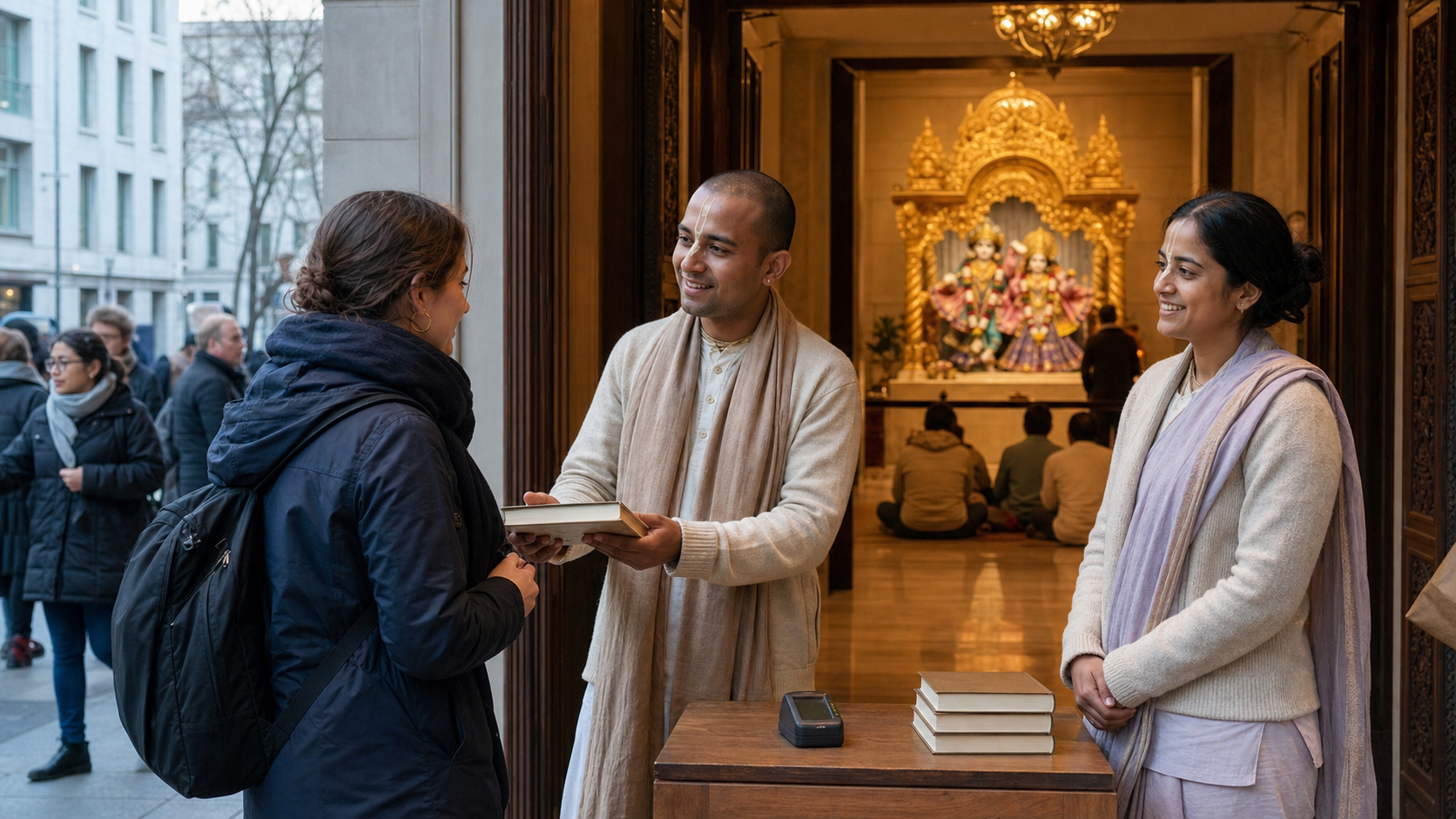
If you help with an ISKCON temple or book-distribution team, the tension is familiar. People move through crowded schedules, card payments, short conversations, and digital invitations, while bhakti asks for attention, discipline, and enduring relationship. You do not have to choose between fidelity and accessibility.
The practical task is to keep the spiritual centre firm while making the doorway easier to enter. That distinction can guide everything from the words a volunteer uses to the way a temple handles payments, follow-up, teaching, and accountability.
Keep the teaching fixed and the doorway flexible

Modern outreach can fail in opposite directions. One team may resist every new method because it looks unfamiliar. Another may adopt whatever attracts attention, even when the method weakens the message. Both mistakes come from treating content and delivery as if they were the same thing.
The content is the devotional centre: Krsna-bhakti, scripture, disciplined practice, ethical conduct, and service. The delivery is the doorway: language, location, payment method, event format, printed or digital information, and the first invitation offered to someone unfamiliar with the tradition. Delivery can change when circumstances change. The centre should not be quietly rewritten to make that change easier.
Guru Prasad Swami’s service moved from administration and BBT publication distribution in the United States in 1975 to Central America from 1976 to 1978, followed by responsibility as temple president in Costa Rica in 1978. The sequence matters because it joins several kinds of seva that are sometimes separated: distributing teachings, maintaining an institution, taking responsibility for a local community, and continuing scriptural instruction.
His later work across Latin America included opening temples and worship centres, working with communities, and fitting devotional practice to local cultural settings; his Srimad Bhagavatam katha in Chandigarh kept scriptural teaching visible within that wider life of service. Cultural adaptation did not have to mean spiritual dilution. It meant giving rooted practice a form through which a particular community could approach it.
Before adopting a new outreach method, ask questions that separate the centre from the doorway:
- Are we changing how people reach the teaching, or are we changing what the teaching means?
- Can a volunteer describe the book, programme, or practice accurately without exaggerating its benefits?
- Does the invitation lead towards study, devotional practice, service, or a trustworthy community?
- Will a newcomer understand what is being offered, what it costs, and what happens next?
- Would we use the same method if no photograph, public praise, or distribution total were attached to it?
A modern method passes the test when it removes an unnecessary obstacle without hiding the identity or purpose of the tradition.
Remove friction without turning outreach into a sales funnel

People do not always encounter spiritual literature in a quiet temple foyer. An opening may appear beside a road, during travel, or in the few moments between other obligations. Readiness for a spiritual conversation and readiness for a long conversation are not the same thing.
In one curbside encounter, a driver who was already on a call noticed a visible stack of books and asked for one; the volunteer stated the $25 price, and when the driver said there was no cash, EFTPOS allowed the exchange to be completed immediately. A devotee may recognise Krsna’s grace in the timing. The operational lesson is equally valuable: the books were visible, the answer about price was clear, and a usable payment method was ready.
Grace and preparation are not opposites. The volunteer could respond to the opportunity because the practical side of the service had been prepared. A payment terminal does not make outreach spiritual, but its absence can create a needless barrier for a willing reader.
Prepare the point of contact so that a sincere interest can become a clean, respectful exchange:
- Keep the available books visible and in suitable condition.
- Give each volunteer a plain, accurate description of what each book contains and who may find it useful.
- State a price or requested donation clearly. Do not allow ambiguity to create pressure after the person has shown interest.
- Use only payment methods the team is authorised and equipped to handle. Never write down card information or improvise with sensitive financial details.
- Carry a simple printed or digital route to the temple, a public programme, or further teaching.
- Ask permission before collecting contact details. A purchase is not automatic consent to receive messages.
- Let a refusal end the exchange gracefully. Persistence is not a substitute for respect.
The distinction between outreach and a sales funnel is important. A funnel treats attention as something to capture and move towards conversion. Seva treats the person as a conscious being whose freedom, questions, and circumstances matter. Modern tools should shorten administrative friction, not replace listening or manufacture urgency.
Design the path from a book to a living sangha

A book can carry teaching well beyond the moment of distribution. It may be read later, shared with someone else, or kept until a question becomes urgent. The volunteer does not need to control that journey. The community should nevertheless be ready when a reader wants to take the next step.
This is where one-time distribution and sustained outreach diverge. Distribution places a text in someone’s hands. Community building creates a reliable place in which the resulting questions can be heard, practice can be learned, and service can mature. The temple, worship centre, study gathering, and qualified teacher therefore belong to the same outreach ecology as the book table.
Build that ecology as a sequence with clear boundaries:
- Encounter: Offer a respectful opening and allow the person to decide whether to engage.
- Orientation: Explain what the book or programme is, rather than assuming that an unfamiliar person recognises its context.
- Invitation: Provide a specific next step that actually exists, such as a public temple programme, a study opportunity, or a reliable contact for questions.
- Consent: Follow up only through a channel the person has knowingly accepted.
- Continuity: Direct substantial scriptural or pastoral questions to someone qualified to answer them. A volunteer should be free to say, “We will connect you with someone who can address that carefully.”
- Participation: When interest deepens, make room for the person to learn, practise, and serve rather than remaining a permanent audience member.
If the team has no reliable follow-up, do not gather names merely to make the outreach appear productive. First create a channel that someone owns, ensure its information is current, and decide how questions will reach an appropriate teacher. A neglected contact list weakens trust more quickly than having no list at all.
Local adaptation belongs here as well. Listen for the questions that actually recur in the community. Adjust the language of the invitation, the accessibility of the setting, and the route into participation. Do not disguise the tradition to gain an initial response. Cultural familiarity should act as a bridge to honest teaching, not as a substitute for it.
Make administration and dharmic ethics part of the seva

Administration can look secondary beside katha, worship, or book distribution. In practice, poor administration can undo all three. Unclear prices create suspicion. Unreconciled funds burden trust. Outdated programme information wastes a newcomer’s effort. Volunteers who do not know their limits may give confident but inaccurate answers.
The remedy is not bureaucracy for its own sake. It is enough structure to protect the person being served, the volunteer doing the work, and the institution carrying the responsibility. Administrative discipline becomes seva when it makes truthfulness, reliability, and proper stewardship easier.
For each outreach effort, assign responsibility for the practical essentials:
- Who holds and counts the books or other materials?
- Who is authorised to handle payments and reconcile them afterwards?
- How will the team distinguish a fixed price, a voluntary donation, and free distribution?
- Which programme details have been verified before volunteers share them?
- Who answers scriptural questions beyond a volunteer’s training?
- Who receives a concern about conduct, pressure, money, or inaccurate information?
- What will the team review after the outreach, apart from the number of books distributed?
Distribution totals can help with inventory and planning, but they are not a spiritual rank. A smaller effort with truthful communication, clean accounting, and useful follow-through may serve people better than a larger effort driven by pressure. Use numbers as operational evidence, not as a measure of a devotee’s worth.
Shared dharmic values make this ethical standard clearer. Seva asks whether the action serves rather than enlarges the worker’s ego. Dana keeps giving voluntary and transparent. Karuna requires listening to the person in front of you. Satya rules out inflated claims. Ahimsa rejects humiliation and coercion. Aparigraha warns against treating people as possessions, targets, or additions to a personal score.
Hindu, Buddhist, Jain, and Sikh traditions do not become interchangeable because they share some of this moral vocabulary. Their teachings and disciplines retain real distinctions. The common ground is most useful when it sharpens conduct: mindful attention, non-harm, truthfulness, generosity, and service should be visible in how outreach is performed, not merely named in a speech about unity.
Use this field plan for your next outreach effort
A dependable plan leaves room for human conversation while preventing avoidable confusion. Before the next temple event, book table, travelling distribution effort, or community programme, work through this sequence with the people who will actually be present.
- Choose the primary invitation. Decide whether you are principally offering a book, a conversation, a temple visit, or participation in a programme. Do not make a stranger decode several competing requests at once.
- Prepare an accurate explanation. Give volunteers a short description of the offering, along with a clear way to acknowledge questions they cannot answer.
- Remove access friction. Check the materials, price or donation language, approved payment method, location details, and public contact route before anyone goes into the field.
- Prepare the next step. Verify that the programme or contact being offered is active and that someone is responsible for receiving newcomers.
- Agree on ethical boundaries. No coercion, no inflated spiritual promises, no hidden financial expectations, and no collection of personal information without consent.
- Review what happened. Reconcile materials and funds, note recurring questions without recording unnecessary personal data, identify points of confusion, and route unresolved matters to the right person.
The purpose is not to make every encounter mechanical. It is to make the fundamentals dependable enough that a volunteer can give full attention to the human being present. Good systems carry the routine burden so that warmth, discernment, and sincere conversation do not have to compete with preventable disorder.
Key takeaways
- Keep scripture and devotional purpose fixed while adapting the practical doorway.
- Use modern tools to remove genuine friction, not to create urgency or pressure.
- Connect book distribution to a trustworthy route into teaching, practice, and sangha.
- Treat clear prices, consent, clean accounting, and qualified answers as parts of seva.
- Judge outreach by truthfulness, dignity, and continuity as well as visible activity.
For your next outreach effort, improve one point of access and one point of follow-through. Keep the teaching intact, make the encounter easier, and examine whether the person was treated with dignity. When all three remain aligned, modernisation is serving bhakti rather than competing with it.
References
- Dandavats – Discover HH Guru Prasad Swami’s Srimad Bhagavatam Katha: A Complete ISKCON Legacy of Service
- Dandavats – Everyday Grace on the Frontlines: A Proven Moment of Krsna’s Magic in Modern Outreach
