
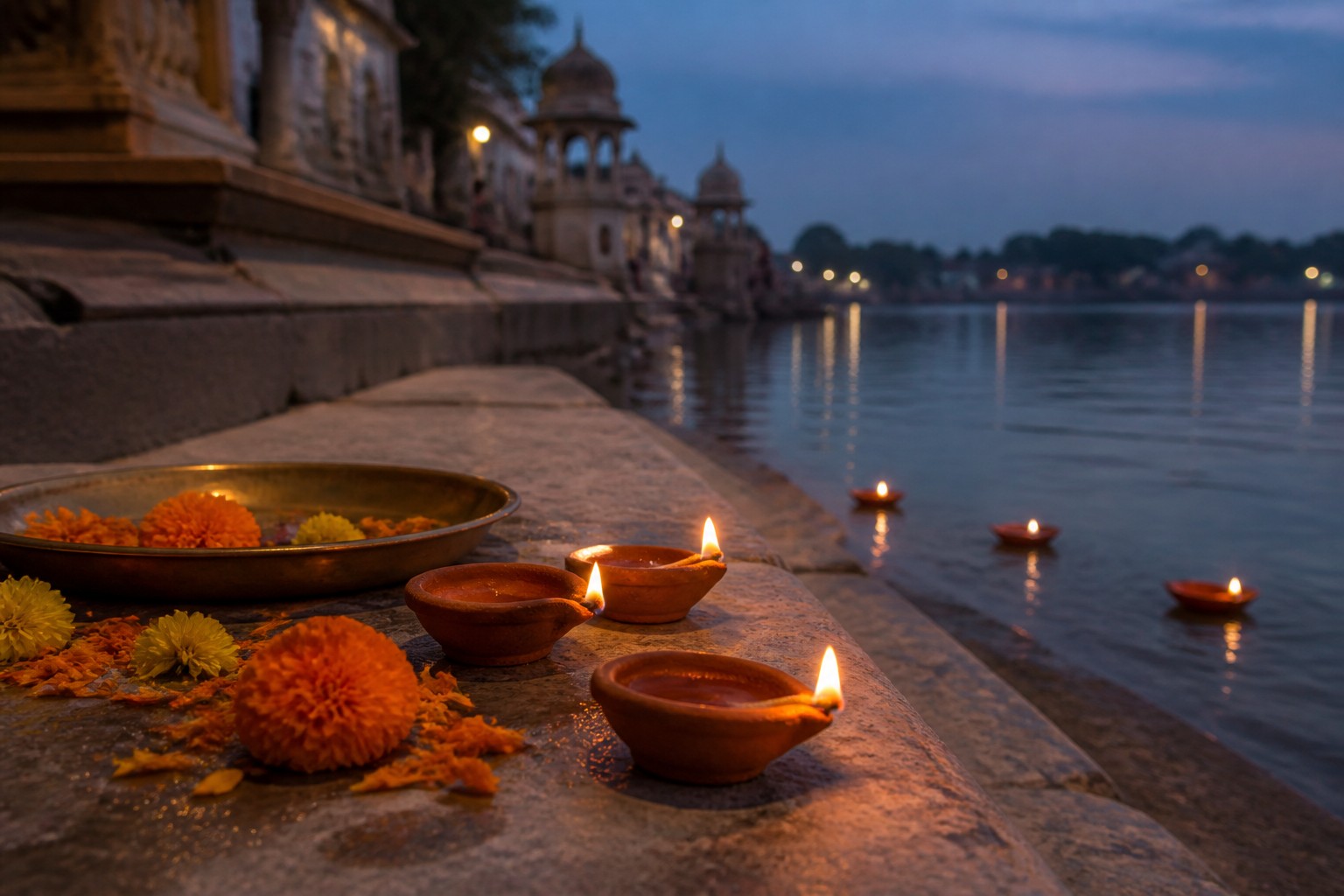
You want to light the lamps properly, but the calendar seems to give you more than one answer. One relative treats Naraka Chaturdashi morning as Deepavali, another plans Lakshmi Puja for Amavasya evening, and the temple continues Deep Daan throughout Kartik. None of those practices has to cancel the others.
The practical solution is to identify the observance before choosing the date. Diwali is a sequence of related festival days, while Kartik Deep Daan is a recurring devotional offering within the sacred month. Once you separate those two layers, you can choose the right time, intention, and setting without flattening regional or family traditions.
Identify the observance before looking for a date
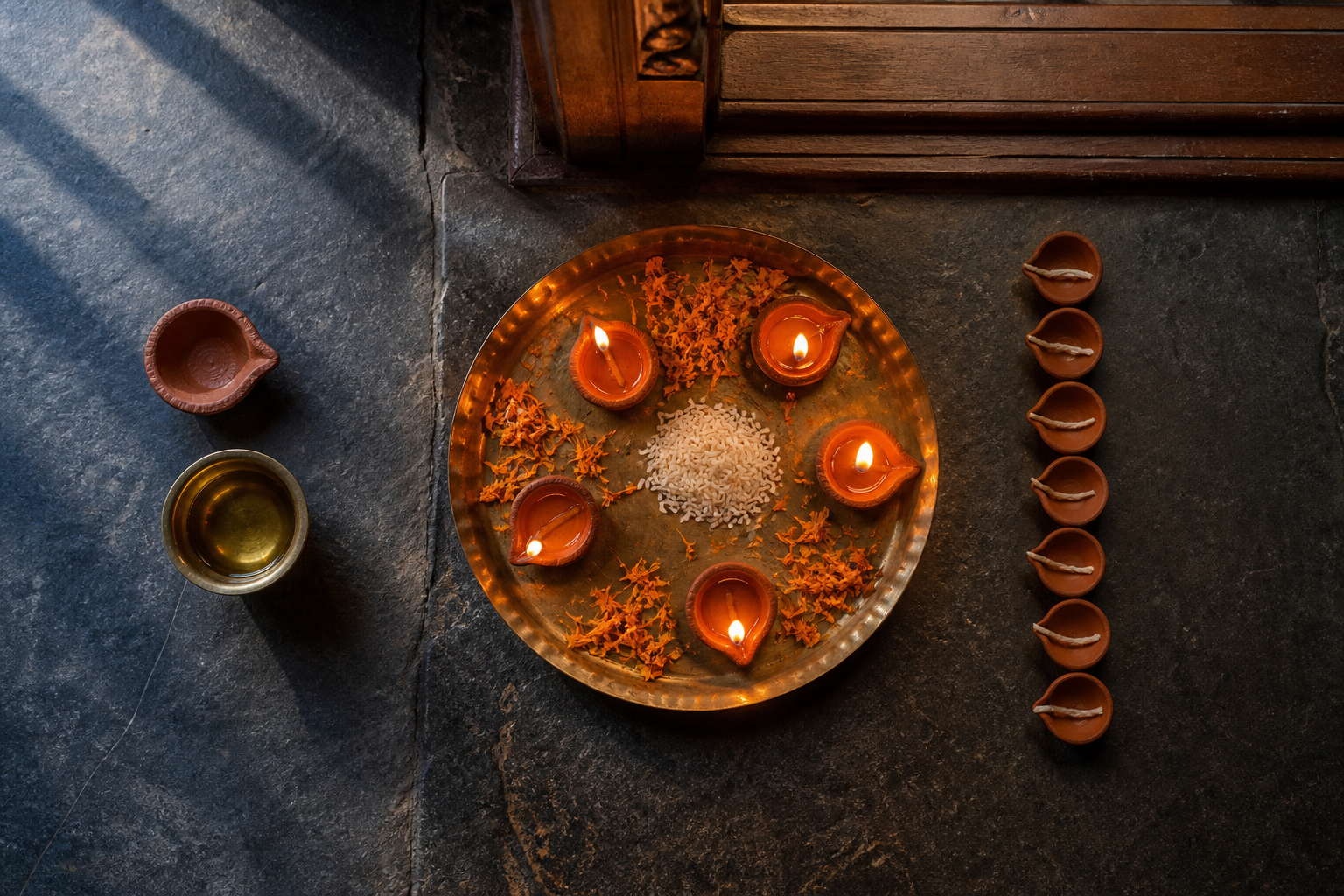
Diwali is often spoken of as one festival night, but household practice commonly unfolds through five core observances. Each has its own emphasis. Kartik Deep Daan belongs beside this sequence, but it should not be reduced to another name for Lakshmi Puja.
| Observance | Usual ritual setting | What you are marking |
|---|---|---|
| Dhanteras | The opening part of the Diwali sequence | Health and auspicious beginnings |
| Naraka Chaturdashi | Pre-dawn abhyanga snan and early lamp lighting | Purification and the overcoming of darkness |
| Lakshmi Puja | Pradosh kaal on the Amavasya evening | Reverence for Lakshmi and the responsible welcome of abundance |
| Govardhan Puja or Annakut | The part of the sequence following the principal Diwali night | Gratitude, nourishment, and sacred relationship with the sustaining world |
| Bhai Dooj | The concluding part of the five-observance sequence | The sibling bond |
| Kartik Deep Daan | Lamp offering during Kartik, often at dusk and sometimes with kirtan | Bhakti, reflection, ethical clarity, and seva |
The calendar difference is not merely a disagreement about arithmetic. Regional traditions may give ritual priority to different parts of the sequence. In Tamil Nadu and much of South India, for example, the Naraka Chaturdashi morning can carry the principal Deepavali emphasis. In Maharashtra, the Amavasya-evening Lakshmi Puja may determine the main celebration. The 2025 observance illustrated the consequence: the principal date was October 20 in much of South India but October 21 in Maharashtra.
That past example is a warning against copying an isolated date into another year, region, or time zone. For the year you are observing, ask a trusted regional panchang, temple, or family authority three precise questions: Which observance are we timing? Which regional tradition are we following? What is the local muhurat where the ritual will actually be performed? A date without those qualifiers is incomplete.
Do not make every diya perform the same ritual function
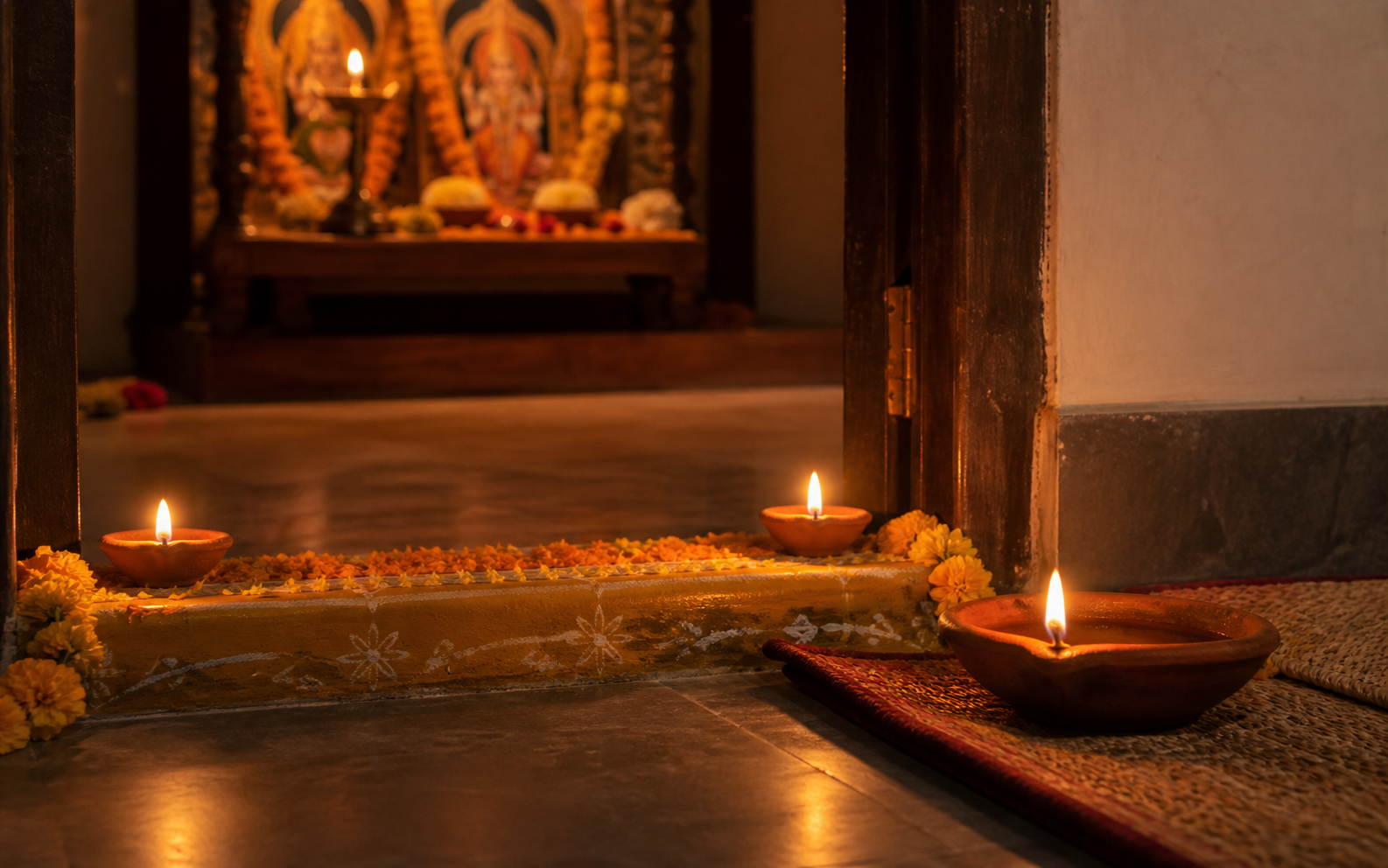
A diya can illuminate the same doorway while carrying a different ritual intention. During Lakshmi Puja, lamps belong to the preparation of a clean, welcoming home and to worship during the locally verified Amavasya-evening window. Some households add Kuber Puja, but that is a family or lineage choice rather than a requirement to impose on everyone.
Yam Deep Daan has a more specific protective meaning. A lamp is commonly placed at or near the threshold in honour of well-being and protection. If this is part of your inherited practice, preserve its intention while making the placement safe. A doorway lamp should not obstruct the path, sit against a flammable decoration, or be left where clothing can brush the flame.
Kartik Deep Daan turns the lamp into a repeated discipline. At ISKCON Vrindavan’s Kartik observance, devotees offered ghee lamps at dusk and joined kirtan in a temple setting. The important pattern for you is the union of outer light and sustained attention: the offering is accompanied by prayer, remembrance, song, introspection, or service rather than treated as illumination alone.
You also do not need to erase distinctions among Dharmic paths in order to recognise a shared reverence for light. Hindus celebrate Deepavali through diverse regional narratives and rites. Jains associate the occasion with Mahavira’s nirvana. Sikhs commemorate Bandi Chhor Divas, and Newar Buddhists light lamps in a setting of prosperity and inner awakening. These are related expressions of illumination, compassion, and freedom, but they are not interchangeable ceremonies. When you welcome neighbours or explain the festival to children, name each tradition accurately. Unity becomes more credible when it does not demand sameness.
Build a home observance you can perform attentively
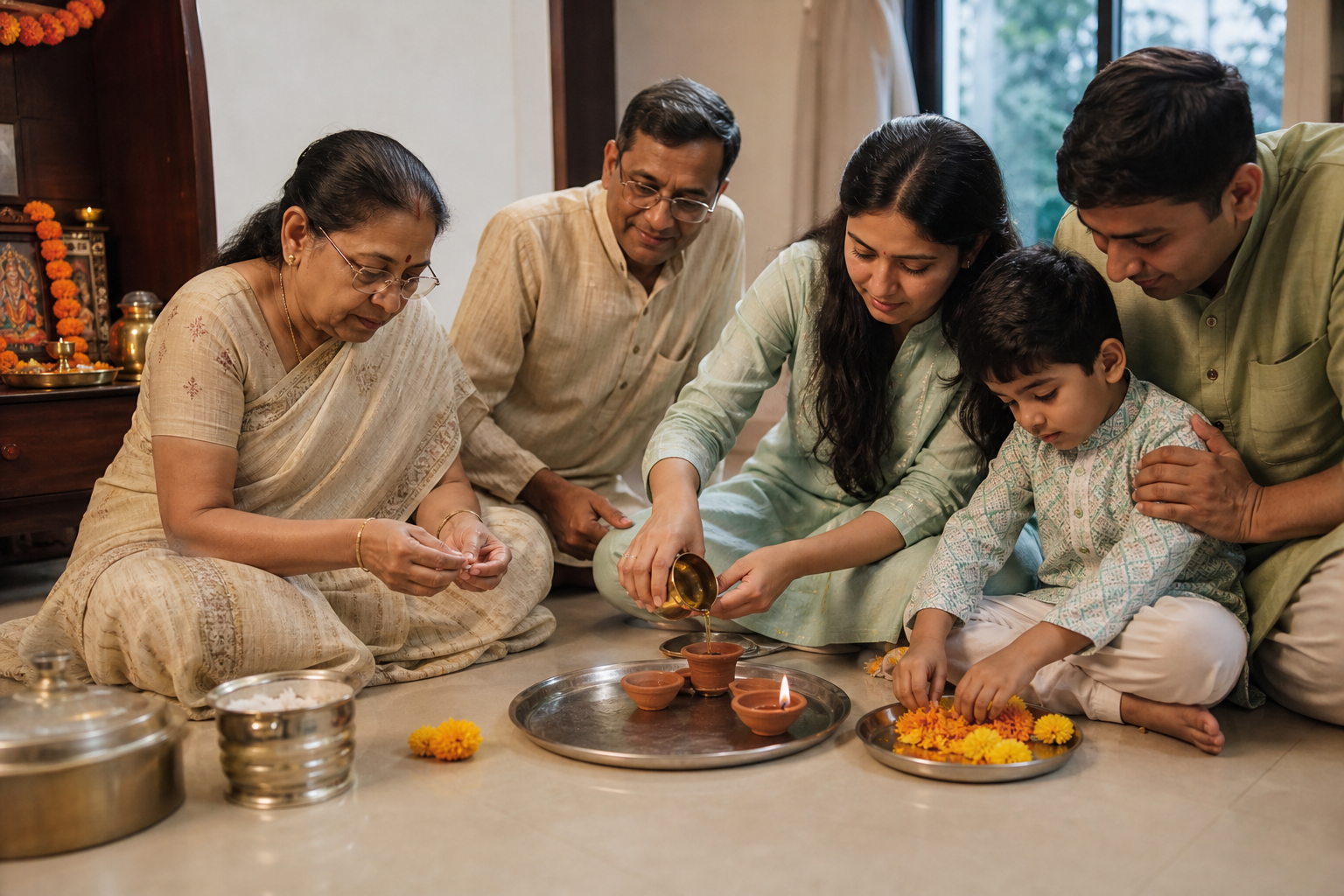
An elaborate arrangement is not automatically a more serious one. A small observance with a verified time, an understood purpose, and undivided attention is better than a crowded schedule assembled from unrelated customs. Use this sequence to plan what your household can genuinely sustain.
- Choose the ritual layer. Write down whether you are planning Naraka Chaturdashi, Lakshmi Puja, Yam Deep Daan, a Kartik evening offering, or more than one of them. Do not use the word Diwali as the only calendar instruction.
- Verify the local timing. Use a regional panchang, a temple notice, or the established calendar followed by your family. Confirm that the timing applies to the place where you will perform the rite.
- Prepare the space before the muhurat. Clean the worship area, arrange the lamps, set out the required offerings, and finish the rangoli early enough that preparation does not consume the worship window.
- Match placement to purpose. Keep the main worship lamps in the puja space. Place a threshold lamp only if you are observing Yam Deep Daan, and keep it clear of foot traffic and flammable material.
- State the intention. Follow your family’s mantra or puja method when you have one. If you do not, offer a simple prayer for clarity, gratitude, right livelihood, compassion, and the welfare of others. Avoid inventing ritual precision merely to make the observance look formal.
- Give the lamp your attention. Sit for prayer, quiet reflection, or kirtan instead of lighting the wick and immediately returning to errands. Even a brief offering becomes coherent when the action and intention remain together.
- Connect worship with conduct. Let the observance lead to dana, hospitality, reconciliation, or seva. Kartik’s ethical emphasis on ahimsa, satya, and service asks what the light changes after the flame is lit.
- Close safely. Keep every open flame on a stable, heat-resistant base and away from curtains, paper decorations, children, pets, and crowded walking routes. Never leave it unattended. If your custom calls for a lamp to burn for an extended period, assign an adult to watch it until it has gone out safely.
If work, travel, age, or housing rules limit what you can do, preserve the essential structure instead of abandoning the observance. For Lakshmi Puja, use the locally verified window, light one safely placed lamp, offer your prayer, and make one deliberate act of generosity. For Kartik Deep Daan, choose a sustainable rhythm at dusk and keep it. Where an open flame is prohibited, a flameless lamp can preserve the visual reminder, while prayer and seva preserve the devotional purpose.
Plan communal Deep Daan as both worship and stewardship
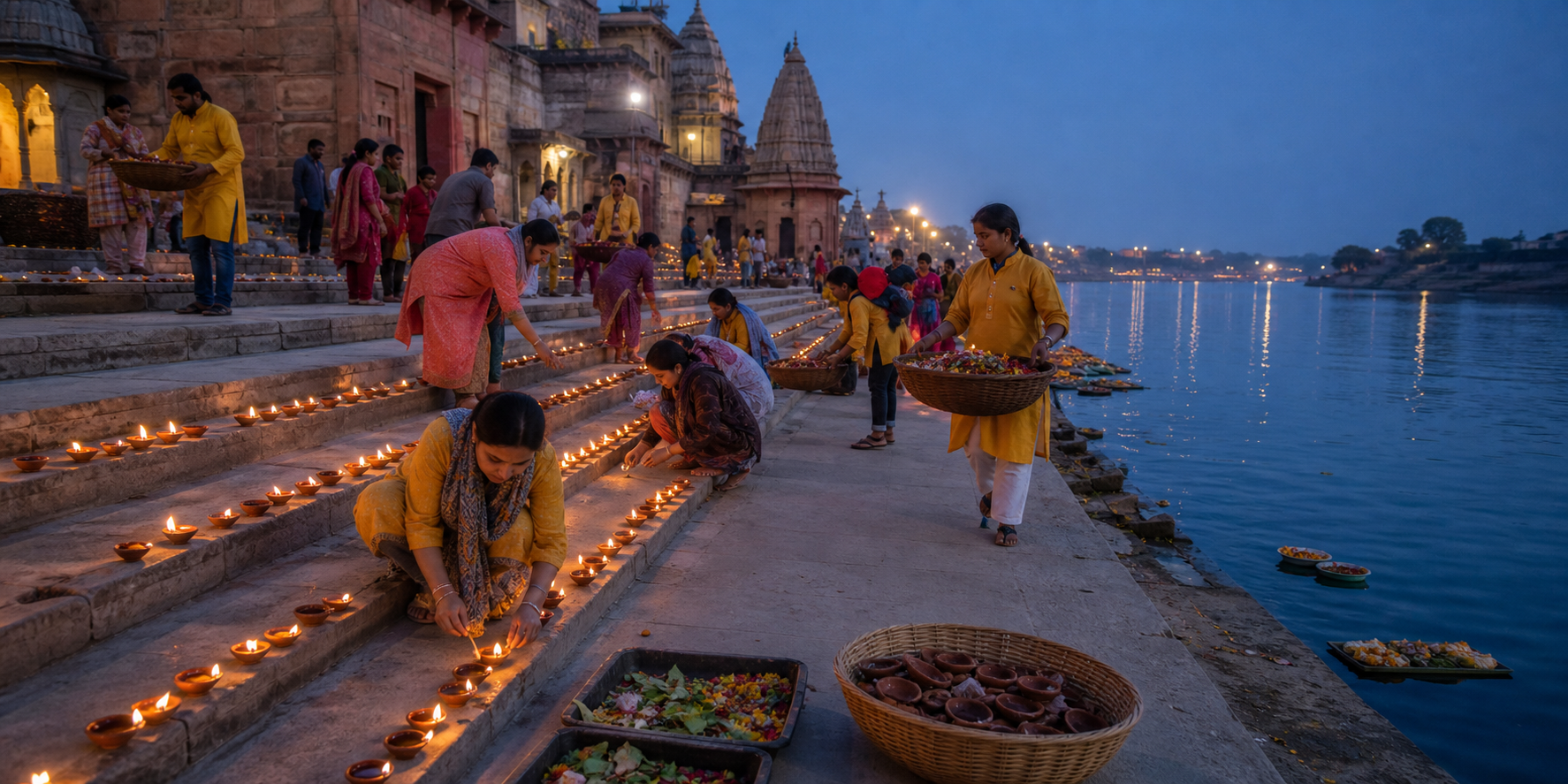
A temple courtyard filled with lamps can create a powerful shared atmosphere, but devotion does not remove the need for orderly movement. The Kartik gathering at ISKCON Vrindavan used volunteer coordination, marked lamp stations, and guided circumambulation. Those practical choices allowed the congregation to focus on the offering rather than negotiate a confusing or unsafe space.
If you are helping a temple, cultural association, apartment community, or campus group organise Deep Daan, settle the movement plan before discussing decoration.
- Create separate areas for unlit lamps, active lighting, completed offerings, and spent materials.
- Keep the lighting station away from the main entrance, exit routes, loose fabric, and the densest part of the congregation.
- Use stable, heat-resistant trays and leave enough room between lamps for volunteers to reach them without leaning over another flame.
- Give volunteers defined duties: distributing lamps, supervising the flame, guiding the queue, assisting children and elders, and handling cleanup.
- Use a clear route for circumambulation rather than allowing people to cross against the flow while carrying lit lamps.
- Provide an accessible participation point for anyone who cannot bend to the ground, climb steps, or enter a crowded lamp area.
- Keep fireworks, if permitted and used at all, physically separate from the lamp-offering zone. Minimal, community-safe celebration better serves the festival than smoke, panic, or injury.
- Assign someone to remain until every flame and ember is safely out. The event is not finished when the kirtan ends.
This is cultural stewardship in its most concrete form. Good organisation does not dilute bhakti; it protects the conditions in which people can participate with reverence. It also makes room for elders, children, first-time visitors, and Dharmic neighbours whose commemorations of light may differ from the host tradition.
Key takeaways for your lamp observance
- Ask which observance you are timing before asking for the Diwali date.
- Use a local panchang, temple schedule, or established family calendar; do not copy another region’s date or muhurat without checking.
- Keep Naraka Chaturdashi, Lakshmi Puja, Yam Deep Daan, and Kartik Deep Daan distinct, even when your household observes several of them.
- Treat regional differences as living expressions of Dharma, not as evidence that one community must be wrong.
- Join the outer lamp to an inner and ethical practice: prayer, kirtan, dana, ahimsa, truthfulness, or seva.
- For a public observance, design the lamp stations, walking route, volunteer roles, accessibility, and fire supervision before adding decoration.
Before you buy more lamps, make one call to the temple or family elder whose calendar you follow. Confirm the named observance, local date, and worship window. Then choose one act of dana or seva to accompany it. That small preparation will do more for a faithful Diwali or Kartik observance than an impressive display whose timing and purpose remain unclear.
References
- DharmaRenaissance Blog – Essential Diwali 2025 Guide: Discover Regional Dates and Master Puja Planning
- Dandavats – Discover Kartik’s Deep Daan: A Complete, Heartfelt Celebration at ISKCON Vrindavan
