

If you are asking whether King Parikshit deserved to die, whether Takshaka merely fulfilled a curse, or whether the serpent king acted from revenge, a one-word answer will mislead you. Karma, fate, and vengeance overlap in this episode, but they are not the same thing.
The distinction matters beyond scripture. When an old injury enters a present conflict, you need to know who caused the original harm, who chose to escalate it, and who is being asked to pay. The Parikshit-Takshaka cycle gives you a precise way to make those distinctions without denying wrongdoing or excusing retaliation.
Key takeaways
- Parikshit’s insult to Sage Sameeka was a real misuse of royal power, but it did not automatically make every later response proportionate.
- Shringi’s curse was another morally significant act, not a neutral announcement detached from anger.
- Takshaka became the instrument of the curse, yet his planning and older grievance also make him an agent responsible for how he acted.
- The destruction at Khandava helps explain hostility toward Arjuna’s lineage, but explanation is not inherited guilt.
- Janamejaya’s Sarpa Satra reveals where vengeance leads: responsibility expands from one offender to an entire people until wise restraint interrupts it.
One death contains several separate choices
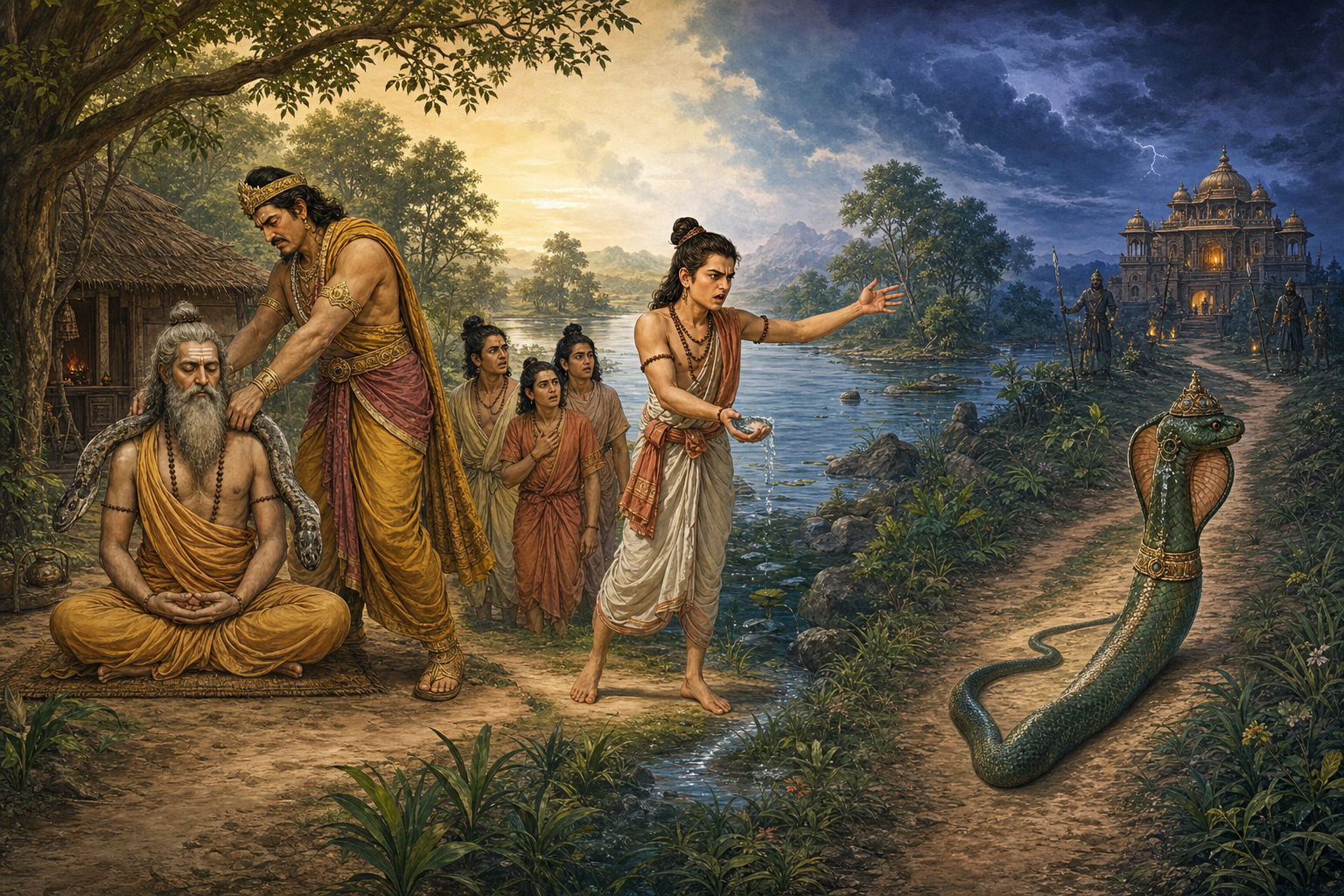
The fatal chain begins with a lapse that can look small beside its consequences. Parikshit, the grandson of Arjuna and a capable ruler, returned from a hunt exhausted and irritated. When the meditating Sage Sameeka did not respond to him, the king placed a dead snake around the sage’s neck.
Fatigue explains why Parikshit’s self-command may have weakened; it does not excuse the act. His rank made the insult more serious, not less. A ruler can turn a passing irritation into public humiliation because power gives weight to gestures that would already be wrong between equals.
That is the first practical warning. Do not issue a rebuke, verdict, punishment, or public accusation when hunger, fatigue, humiliation, or anger is controlling the tempo. Delay the irreversible response. Parikshit’s error took only a moment, but royal authority amplified it into a breach whose consequences he could not contain.
Shringi changes an insult into a death sentence
The offended sage and the person who pronounced the curse were not the same individual. Sameeka was meditating; his son Shringi responded by declaring that Parikshit would die within seven days from the bite of Takshaka.
This distinction prevents a common moral shortcut. Parikshit committed the first wrong, but Shringi still chose the scale of the answer. Condemning the king’s disrespect does not require treating a death curse as morally invisible. The episode places anger on more than one side of the conflict.
When you assess a dispute, separate four things: the original harm, the judgment imposed for that harm, the person who executes the judgment, and the retaliation that follows. If you compress them into a single label such as karma, you erase the choices through which the conflict grows.
Takshaka is an instrument, but not a mindless weapon
The curse identifies Takshaka as the means of Parikshit’s death. That gives him a role in an already pronounced outcome, but it does not remove his intention from the scene. Parikshit attempted to protect himself in a secure, elevated residence from which serpents were excluded. Takshaka did not simply appear by accident.
He dissuaded the venom-healing sage Kashyapa from intervening and then penetrated the king’s precautions through guile. The familiar form of the stratagem places a worm inside a fruit; the worm reaches Parikshit and becomes Takshaka before delivering the fatal bite.
Those details matter ethically. Preventing a healer from helping and circumventing the king’s defences show purposeful participation. Takshaka may fulfil the curse, but fulfilment is not the same as moral automatism. An outcome can be karmically conditioned while the people who bring it about remain responsible for their conduct.
Parikshit’s precautions expose a second practical mistake. He treats the crisis mainly as an access problem: keep every serpent out and the danger will pass. Physical security can block an attacker, but it cannot by itself repair an insult, calm an aggrieved party, or answer a legitimate demand for accountability. When a conflict begins in a damaged relationship, fortification without ethical repair addresses only the final link in the chain.
Why ancestral injury explains hostility but does not transfer guilt

Takshaka’s connection to Parikshit is older than the seven-day curse. During the burning of the Khandava forest, Krishna and Arjuna aided Agni while many Nagas were destroyed. Takshaka’s family losses are associated with that conflagration, and his son Ashvasena later attempted to kill Arjuna during the Kurukshetra war. The enmity therefore had a memory before Parikshit offended Sameeka.
That history explains why Takshaka could view Arjuna’s grandson through the lens of an older wound. It does not mean Parikshit personally burned Khandava, nor does it make lineage a substitute for individual responsibility. He inherited the consequences of a damaged relationship between communities and families. He did not inherit authorship of every act committed before his birth.
| Question | What the episode supports | What it does not support |
|---|---|---|
| Did the past shape the danger? | Yes. Khandava and the grievance against Arjuna’s line formed part of the conflict surrounding Parikshit. | No. Historical connection does not prove that Parikshit performed the ancestral act. |
| Does an old wound help explain Takshaka? | Yes. Family loss and continuing hostility help explain why he was not a neutral participant. | No. A comprehensible motive does not make every method or degree of retaliation righteous. |
| Can descendants be affected by earlier actions? | Yes. They can inherit distrust, danger, institutions, memories, and unresolved relationships. | No. Being affected by a legacy is not the same as bearing personal guilt merely by blood or identity. |
| Where does present responsibility begin? | With the choices each person makes inside the conditions received from the past. | It does not disappear because another person began the cycle. |
This is the most useful way to understand karma here: earlier actions shape the field in which later people must act, but those later people add fresh causes through their own decisions. Parikshit did not choose the history of Khandava, but he chose how to treat Sameeka. Takshaka did not choose the original losses, but he chose how to pursue Parikshit. Janamejaya could not undo his father’s death, but he would choose whether grief justified the destruction of others.
So inherited pain must be acknowledged without converting it into hereditary culpability. In a family dispute, community conflict, or political argument, replace a sweeping claim such as they harmed us with four particulars: the actor, the act, the people directly harmed, and the remedy now sought. If you cannot name those separately, identity has probably begun to replace responsibility.
This distinction also carries a wider Dharmic resonance without making different traditions identical. Hindu reflection on dharma and atonement, Jain commitment to ahimsa, Buddhist concern with ending the production of suffering, and Sikh ideals of daya and sarbat da bhala all turn attention toward restraint and the welfare of more than one’s own side. Their philosophies differ, but none requires you to call suffering righteous merely because it answers an earlier suffering.
The Sarpa Satra exposes the endpoint of vengeance
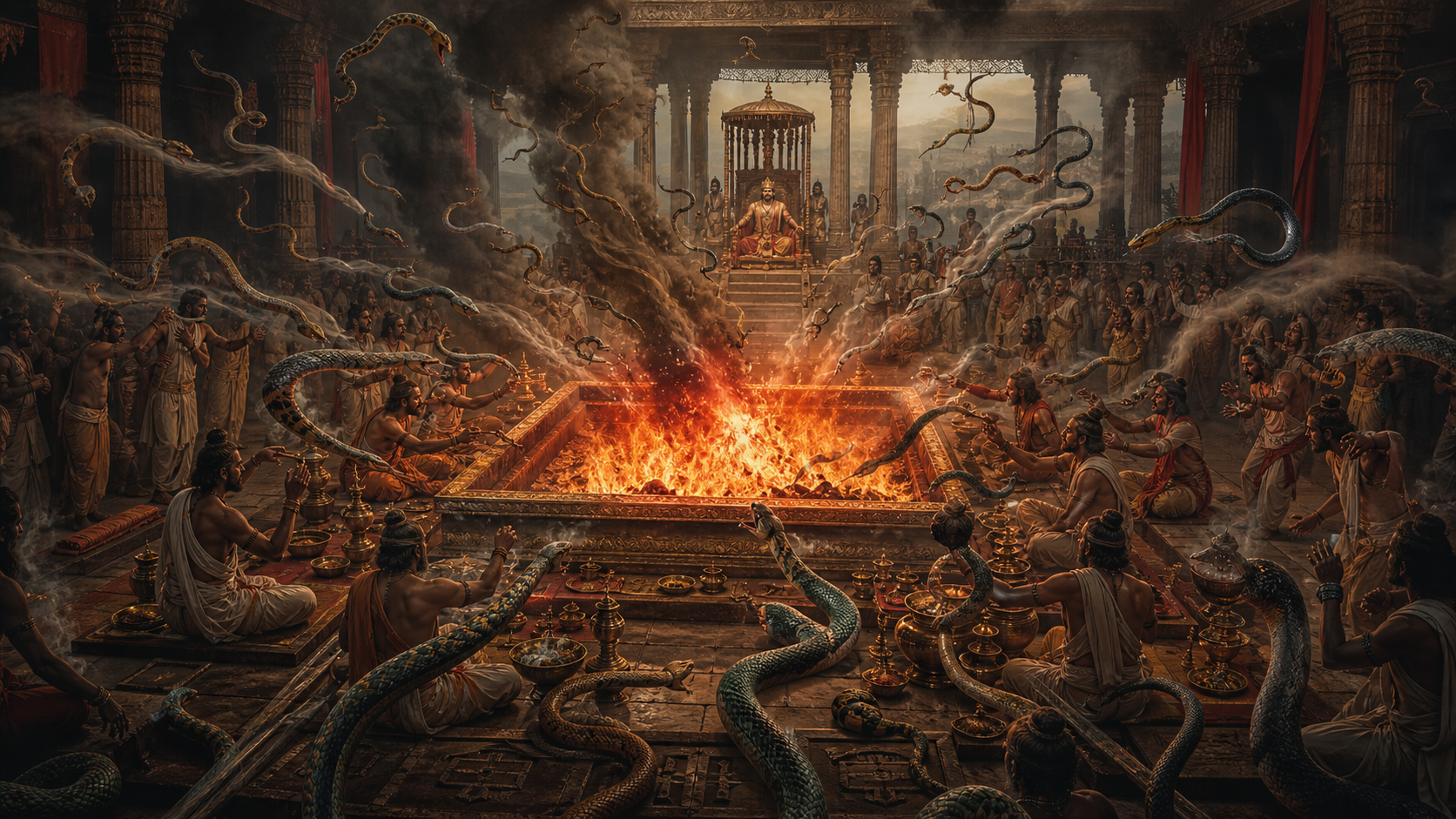
Parikshit’s death is not the moral endpoint. His son Janamejaya answers it by commencing the Sarpa Satra, a great snake sacrifice intended to annihilate the Naga race. What began with one king insulting one sage has now expanded into a project aimed at an entire people.
Janamejaya’s reasoning contains the defining move of collective punishment: Takshaka killed my father, therefore all who share Takshaka’s identity may be made to pay. The individual offender and the wider category become interchangeable. Once that substitution occurs, innocence within the targeted group no longer restrains the avenger.
The sacrificial mechanism draws serpents toward the fire and eventually threatens Takshaka despite Indra’s protection. Yet a solemn or sacred procedure cannot make an unlimited objective dharmic merely by giving it formal shape. A process may be orderly while its aim remains disproportionate.
The wise Brahmin Astika finally halts the sacrifice before the Naga race is destroyed. Stopping the rite does not deny that Parikshit was killed. It refuses to multiply that wrong by manufacturing countless new victims who did not kill him.
This is where justice and vengeance part company. Justice tries to keep the wrongdoer, the wrong, and the remedy connected. Vengeance loosens those connections. Its target expands from the responsible person to relatives, descendants, allies, or an entire community. Its stopping condition also disappears: suffering itself becomes proof that the response is working.
You can usually notice the change before the worst act occurs. Listen for collective nouns replacing names. Watch for punishment reaching people who could not have committed the original wrong. Ask whether anyone can state what would count as enough. Notice whether a call for restraint is treated as betrayal rather than counsel. Those are signs that accountability is being displaced by karmic vengeance.
Use Astika’s test before answering an inherited wrong
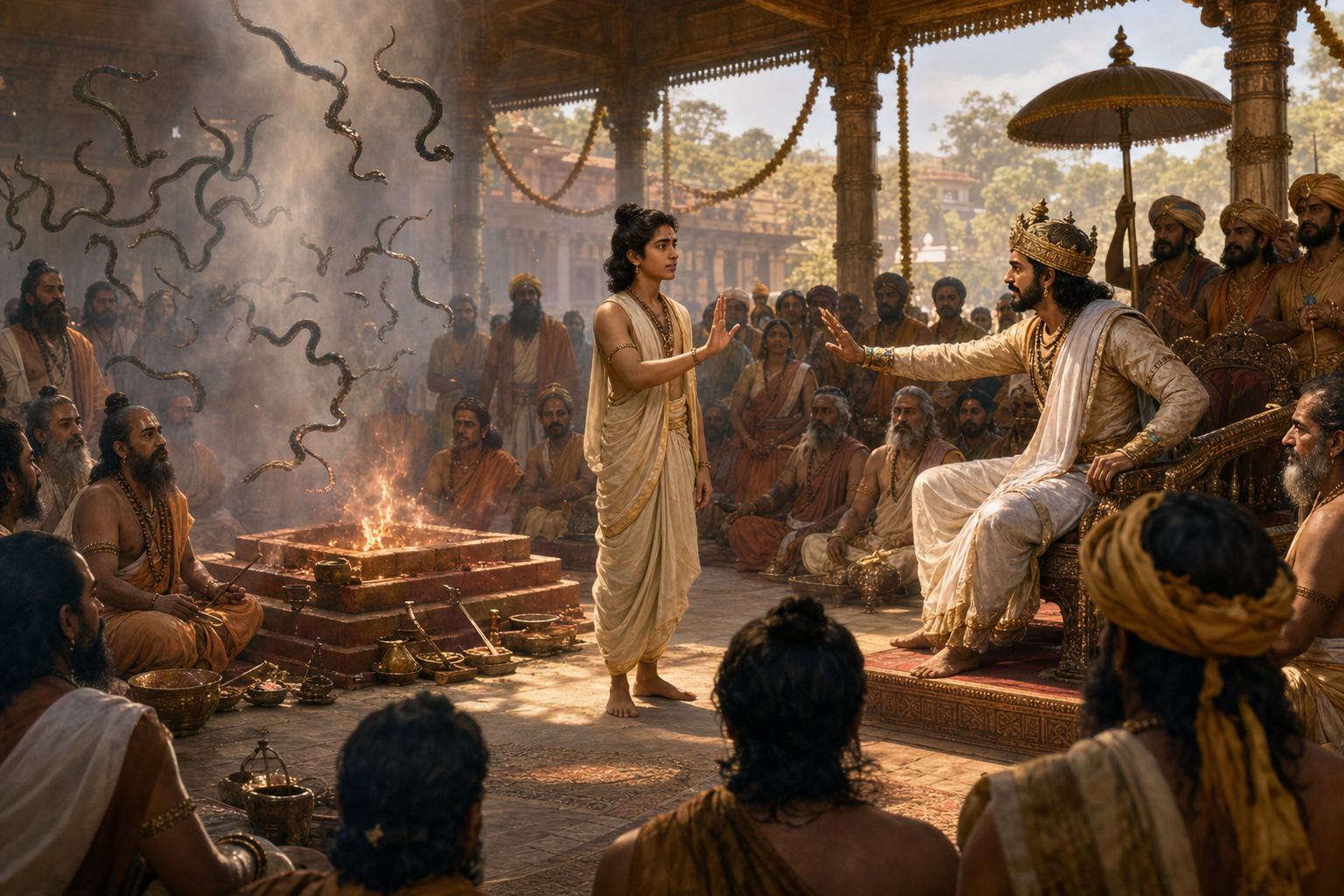
You do not need to ignore harm or abandon consequences to break a cycle of retaliation. You need to make responsibility more precise than anger wants it to be. Before you act, use this five-part test.
- Pause when your condition is governing your judgment. If you are exhausted, humiliated, or enraged, postpone any response that cannot easily be reversed. Parikshit’s lapse shows how a brief loss of discipline can become much larger when authority gives it force.
- Map the whole chain. Name the initial injury, the person who judged it, the person who carried out the response, and the next retaliation. Do not hide distinct decisions under fate, karma, or history.
- Separate inherited conditions from personal guilt. A descendant may live with the consequences of an old act without having committed it. Address inherited distrust and injury, but do not use ancestry as proof of culpability.
- Define the target and stopping condition in advance. A defensible consequence is directed at responsible conduct and ends when its stated purpose is met. If the response reaches uninvolved people or has no answer to what would be enough, it has crossed toward vengeance.
- Give someone the authority to interrupt you. Astika’s function is not decorative wisdom after the crisis. He stops the machinery while it is operating. Choose a trusted counsellor, elder, mediator, or institutional check before escalation, and agree that this voice can require a pause.
Accountability can include admission of harm, a proportionate consequence, restoration where possible, and a changed pattern of conduct. What it cannot include is the conversion of an offender’s identity into a warrant against everyone who resembles or descends from that offender.
The next time an inherited conflict enters your family, institution, or community, write the proposed response in one sentence. If that sentence names an entire people where it should name an act and an actor, rewrite it before you proceed. That small discipline is how you make room for Astika before the fire has gathered everyone into it.
References
