
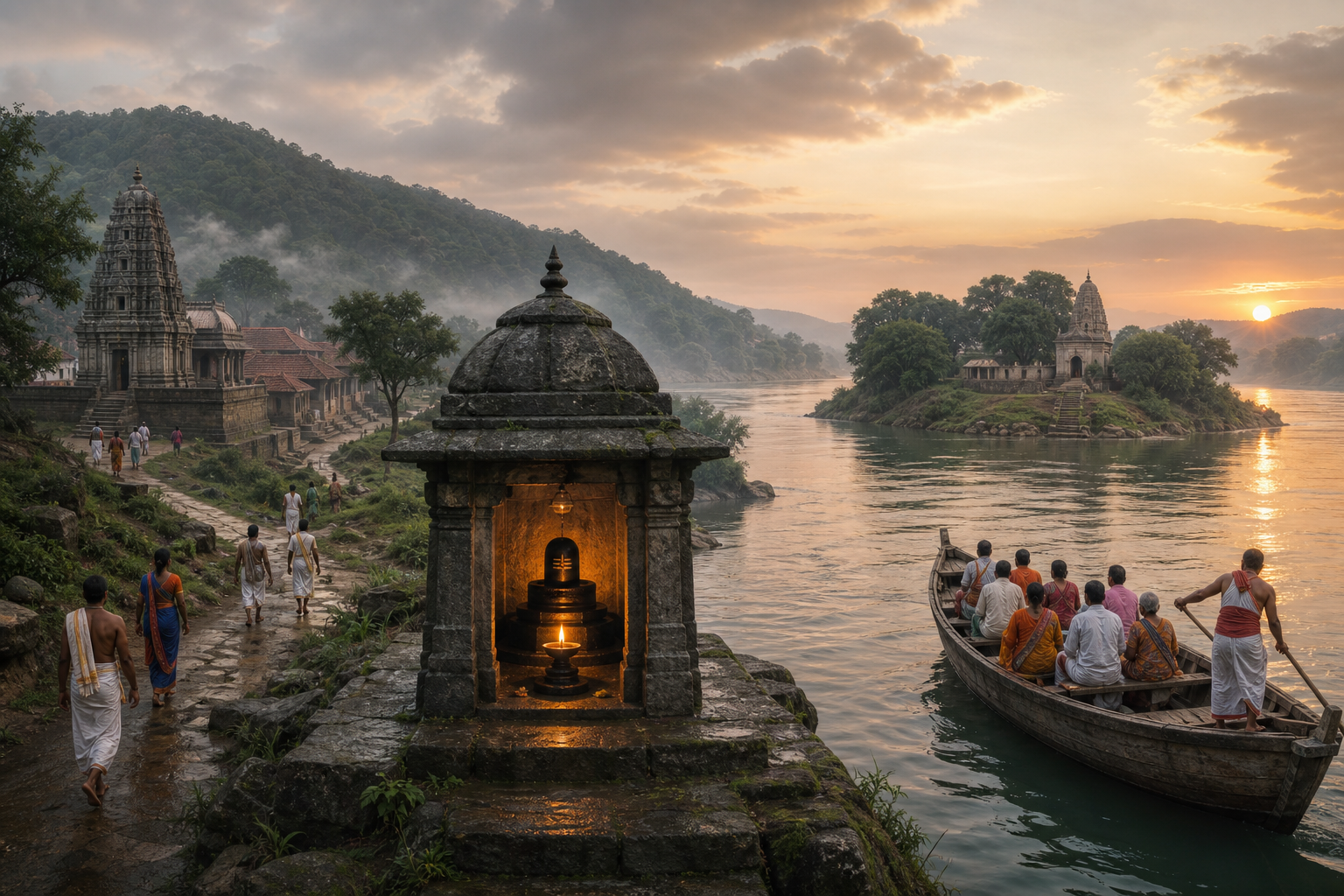
You may have only one open day, a family group with different energy levels, or a wish for darshan without the pressure of a famous, crowded circuit. The useful question is not which regional Shiva temple is greatest. It is what kind of pilgrimage you can undertake with full attention.
These three kshetras offer three distinct forms of yatra: village stillness near forested hills, concentrated worship around an unusual Lingam, and a river crossing to an island shrine. Choose the form first. Your route, timing and preparation will then become much clearer.
Choose the shrine by the pilgrimage you actually need
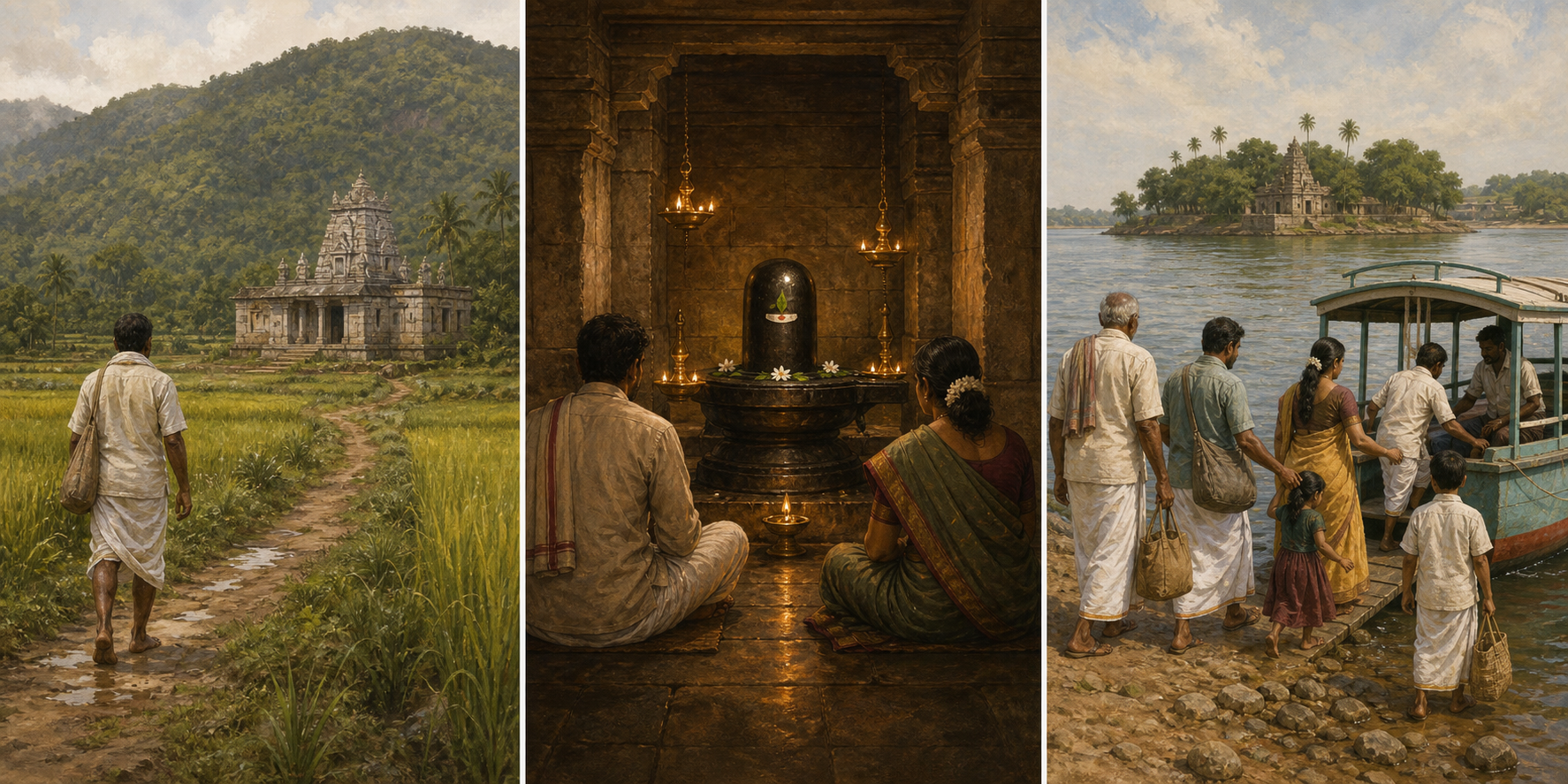
A regional temple should not be treated as a smaller substitute for a nationally famous shrine. Its value lies in the relationship between local tradition, landscape and continuing worship. Use the distinctions below to decide where your attention belongs.
| Temple | Choose it when you want | Defining character | Main planning constraint |
|---|---|---|---|
| Sri Bugga Ramalingeshwara Swamy Temple | Quiet darshan that can be paired with a hill-and-grove setting | A locally revered Shiva shrine whose Ramalingeshwara name recalls Sri Rama’s devotion to Shiva | The temple is about 6 km from Vikarabad and 7 km from Ananthagiri Hills, so the order of temple and nature visit matters |
| Bhiknoor Sri Siddharameshwara Swamy Temple | Focused sanctum worship and inward contemplation | A rare reverse-positioned Shiva Lingam within a living regional tradition associated with saintly lineages | Early morning and Pradosham suit quiet worship; Mahashivaratri brings much larger gatherings |
| Pattiseema Veerabhadra Swamy Temple | A river-centered yatra in which the journey is part of the worship | A hillock shrine in the Godavari, dedicated to Veerabhadra and honored in regional tradition as a Pancha Kashi Kshetram | Boat access depends on water levels and safety conditions, so fixed assumptions about access can fail |
If you are mentally tired and need uncluttered space, begin with Bugga Ramalingeshwara. If your purpose is mantra, dhyana or disciplined inward attention, Bhiknoor gives that intention a clear center. If you want sacred geography to shape the entire day, choose Pattiseema and accept that the river, not your timetable, has the final word.
Key takeaways for planning
- Plan these as separate regional modules, not as stops to be hurried through on one tightly packed day.
- For quiet darshan, favor early hours at Bugga Ramalingeshwara or Bhiknoor; use festival days only when collective worship is part of your purpose.
- Make the Vikarabad temple and Ananthagiri Hills one natural pairing, but place darshan first if pilgrimage is the reason for the journey.
- At Bhiknoor, treat the unusual Lingam as an invitation to inward attention, not merely as a rare object to photograph.
- For Pattiseema, confirm boat operations locally and close to departure. Never replace a suspended service with an improvised crossing.
- Carry one clear sankalpa into the shrine. A short, deliberate yatra is more coherent than a longer itinerary built around collecting temple names.
Build the journey as three self-contained modules

Vikarabad and Ananthagiri: let darshan set the pace
Sri Bugga Ramalingeshwara Swamy Temple stands in Bugga Rameshwaram village, within easy regional reach of Vikarabad. Local signs and directions from the community generally provide the final wayfinding. The nearby Ananthagiri Hills make this the simplest choice when members of your group want both a sacred visit and time in a natural setting.
Visit the temple before turning the day into a nature excursion. That one decision prevents darshan from becoming the activity everyone rushes through after sightseeing. Early morning and twilight are associated with a calmer atmosphere, while avoiding peak heat makes the village and hill setting easier to appreciate. Monsoon and post-monsoon conditions bring greater greenery, but current local conditions should still govern the journey.
The shrine’s public documentary history is limited, so distinguish responsible heritage appreciation from confident historical storytelling. What can be approached directly is its continuing devotional life, its local standing as an older regional temple, and the association of the Ramalingeshwara name with Rama’s reverence for Shiva. Listen to local tradition respectfully without converting every devotional account into a dated historical claim.
Bhiknoor: make the unusual Lingam a discipline, not a spectacle
Bhiknoor Sri Siddharameshwara Swamy Temple in Kamareddy district is the strongest choice when your yatra centers on the sanctum itself. Its reverse-positioned Shiva Lingam is unusual, but rarity should sharpen attention rather than encourage a hurried photograph-and-exit visit. Local devotional interpretation treats the orientation as a reminder to turn awareness inward. You can act on that meaning by reducing conversation before darshan, keeping your mantra simple and allowing silence to continue after you leave the sanctum.
Temple tradition places the shrine’s beginnings in the 15th century and associates it with the lineages of Siddagiri and Ramagiri. Its arrangement includes the functional elements expected of a traditional Shiva shrine, including the garbhagriha and a path supporting pradakshina. Follow the sequence used by local worshippers rather than imposing a routine learned elsewhere; living temples can share broad forms while differing in local practice.
Early morning is suitable when you want stillness. Pradosham, observed twice each month, offers a more explicitly focused Shiva-worship setting. Mahashivaratri is the choice for a night vigil and collective chanting, not for an uncrowded first visit. Decide which experience you want before choosing the date.
Pattiseema: give the Godavari its place in the yatra
Pattiseema, near Rajahmundry in the West Godavari region, should be planned as a river pilgrimage rather than an ordinary road stop. The Veerabhadra shrine occupies a hillock rising within the Godavari, and the usual boat approach makes water, movement and waiting part of the experience. That is precisely why the visit should not be squeezed between appointments with fixed arrival times.
Confirm the operating ghat, boat timing and safety status locally. Water levels and official safety decisions can change whether a crossing is available. If service is suspended, do not bargain for an informal alternative; a missed visit is reversible, while an unsafe river crossing is not. Carry drinking water and sun protection, wear clothing appropriate for a temple, and keep your hands free enough to board safely.
Veerabhadra represents Shiva’s fierce and protective aspect. Let that form give the visit a specific contemplative question: where does courage serve dharma, and where does force become undisciplined reaction? The regional Pancha Kashi identification adds sacred significance, but the most immediate lesson comes from the meeting of shrine, stone and river. You do not need to rush past that setting in search of another attraction.
Match your date to worship, weather and access
The same shrine can offer a very different pilgrimage on a quiet morning and during a major observance. Neither is automatically better. A festival is appropriate when you want collective chanting, lamps and the intensity of shared devotion. An ordinary day is better when your priority is attentive darshan, architectural observation or silent practice.
- For the quietest available experience: Favor early morning or twilight at Bugga Ramalingeshwara and early morning at Bhiknoor. At Pattiseema, the cooler months make the exposed river journey more comfortable, subject to current access conditions.
- For Mahashivaratri: Expect a stronger gathering at Bhiknoor, including collective worship and night vigil. Bugga Ramalingeshwara also observes the festival. Arrive early and accept that unhurried solitary contemplation may not be possible.
- For Karthika masam: All three settings gain a particular devotional resonance. Lamps and extended prayer characterize the season at the Telangana shrines, while Karthika is also a favored period for Pattiseema and the wider Andhra Shiva tradition.
- For Pradosham: Bhiknoor is the clearest fit when you want a recurring, focused Shiva observance without choosing the scale of Mahashivaratri.
- For monsoon or post-monsoon scenery: Bugga Ramalingeshwara and the Ananthagiri landscape can be especially green. Treat the landscape as an aid to recollection, not a reason to ignore current travel conditions.
Do not rely on a general description of the season as a substitute for day-of-travel confirmation. This matters most at Pattiseema because boat operations are conditional, but it is also wise at village temples during major festivals. Verify access and worship timing locally, then leave enough flexibility for the actual rhythm of the shrine.
Carry a practice into the temple, not just a checklist
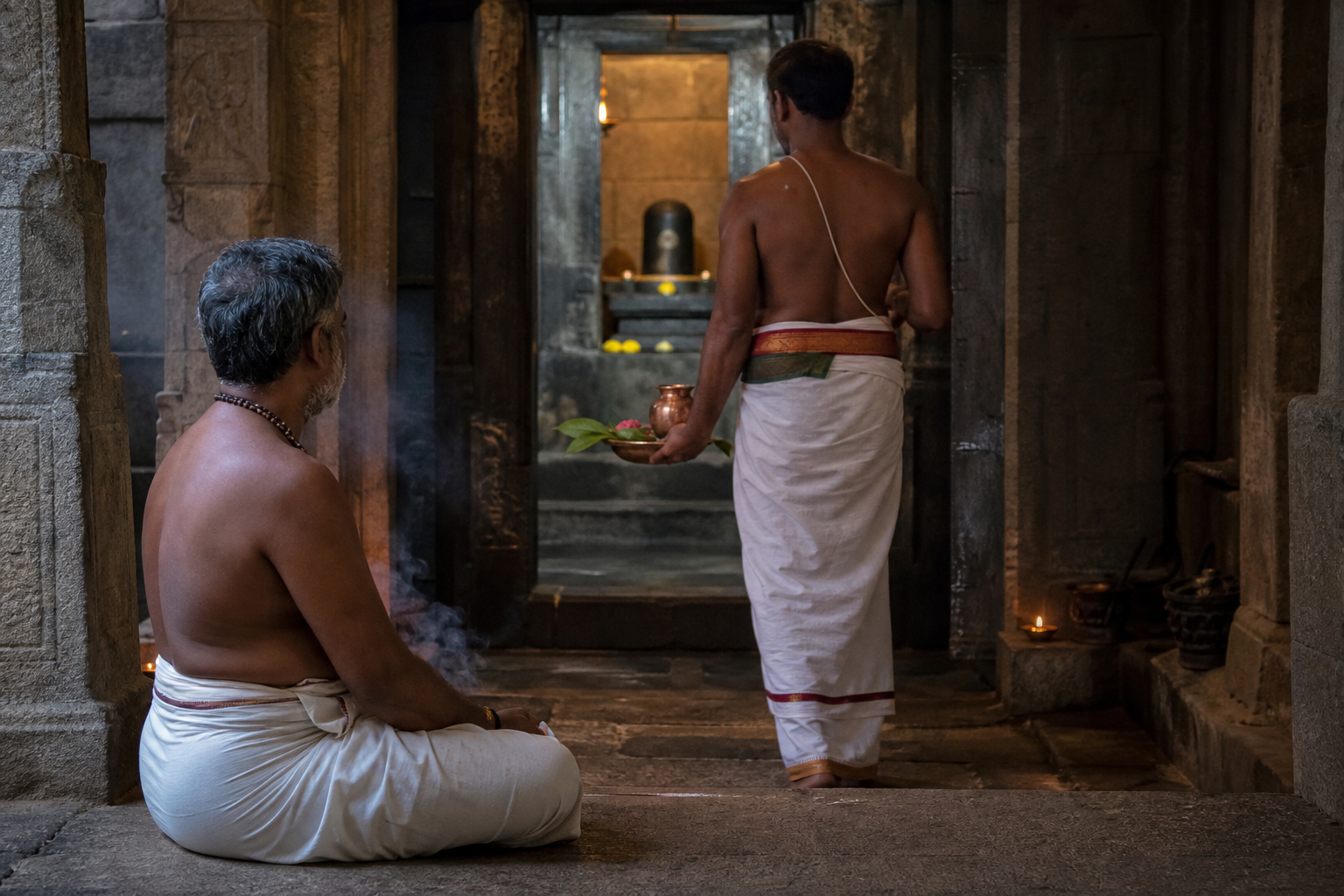
A pilgrimage becomes coherent when your conduct supports your intention. You do not need an elaborate personal ritual. Use a short sequence that can adapt to local rules.
- Name the purpose before you leave. Choose one intention such as gratitude, steadiness, courage, self-discipline or remembrance of Shiva. Do not wait until you are standing in the queue to decide why you came.
- Verify rather than assume. Ask locally about opening times, acceptable offerings, photography and the order of worship. Customs at a living regional shrine should take precedence over a generic itinerary found elsewhere.
- Lower your voice before the sanctum. Silence is not only etiquette; it protects the attention of worshippers around you. Keep calls and group coordination outside the immediate worship area.
- Follow the local flow. Join the queue without pushing, observe how pradakshina is being performed and do not enter restricted spaces merely to obtain a closer view.
- Let each shrine supply one contemplation. At Bugga, attend to stillness and gratitude. At Bhiknoor, turn attention inward. At Pattiseema, reflect on disciplined courage and the power of sacred geography.
- Pause after darshan where permitted. Resist the reflex to check a photograph or begin planning the next stop immediately. Carry the chosen intention back into speech and conduct.
Modest clothing, soft speech and mindful photography are practical forms of reverence at all three temples. At the river shrine, care for safety and the surrounding water is part of that same discipline. At the village and hill setting, leaving the landscape undisturbed matters as much as behaving properly inside the precinct.
A family or group drawn from different Dharmic paths does not need to pretend that every tradition is identical. Shared conduct offers firmer common ground: disciplined attention, compassion, truthfulness, seva and respect for sacred space. Let each person hold an appropriate prayer while the group shares silence and responsible behavior.
Choose one module, confirm its access close to the day of travel, and write down one sentence explaining why you are going. Let the schedule serve darshan. That is how a regional temple visit becomes a yatra rather than another stop on a crowded route.
References
- DharmaRenaissance Blog — Ultimate Guide to Sri Bugga Ramalingeshwara Swamy Temple: Discover Vikarabad’s Sacred Gem
- DharmaRenaissance Blog — Discover the Bhiknoor Siddharameshwara Swamy Temple: A Complete Guide to a 15th-Century Shiva Marvel
- DharmaRenaissance Blog — Discover Pattiseema Veerabhadra Swamy Temple: Complete Pancha Kashi Kshetram Guide
