
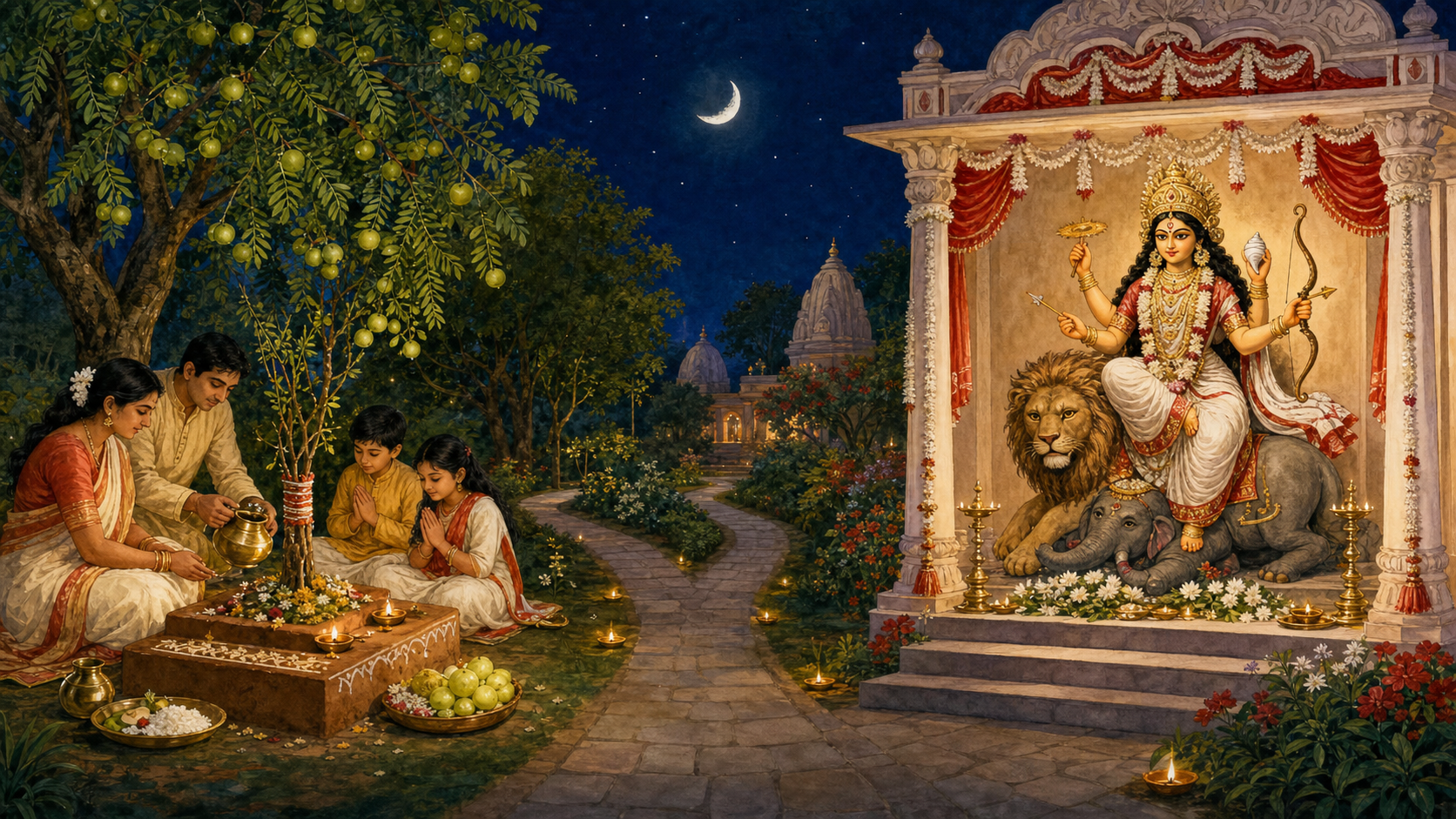
Your calendar may place Akshaya Navami, Amla Navami, and Jagadhatri Puja on Kartik Shukla Navami. That does not give you three compulsory pujas. Akshaya Navami and Amla Navami are names for the same Amla-centered observance, while Jagadhatri Puja is a distinct Bengali Shakta celebration kept on the same lunar day.
Your first task is therefore not to collect every ritual attached to Navami. It is to identify the tradition that actually belongs to your family, sampradaya, temple, or regional community. Once that is clear, you can confirm the local tithi, prepare the essential offerings, and keep one coherent observance with attention rather than several disconnected rites in haste.
One tithi carries two distinct devotional paths
Kartik Shukla Navami is the ninth lunar day of the bright fortnight of Kartik, also written Kartika. It is the tithi, rather than the midnight-to-midnight civil date, that anchors the observance. Purnimanta and amanta month-reckoning systems can produce different regional descriptions of the surrounding fortnight, but the relevant lunar tithi remains Kartik Shukla Navami.
On the Akshaya/Amla path, the word akshaya expresses the belief that punya, daan, and virtuous conduct undertaken on this day bear enduring or inexhaustible fruit. The Amla, or Indian gooseberry, tree gives the observance its other familiar name. Worship of Sri Vishnu and Lakshmi, reverence for the Amla tree, pradakshina, simple food, and charity form its practical center.
Jagadhatri Puja centers on a ten-armed manifestation of Maha Shakti worshiped as Goddess Durga. It is especially prominent in Bengal, including Chandannagar and Krishnanagar, and carries the current of Shakti worship from Ashwin into Kartik. Its characteristic forms include alankara of the murti, shodashopachara, Chandipath, pushpanjali, and deepa arati.
| Practical question | Akshaya or Amla Navami | Jagadhatri Puja |
|---|---|---|
| What is the devotional center? | Sri Vishnu and Lakshmi, the sacred Amla tree, punya, daan, and gratitude | Jagadhatri as Maha Shakti, the sustaining and disciplined power of the Divine Mother |
| What are the characteristic acts? | Amla worship, pradakshina, sattvic food, anna-daan, and optional Tulasi worship | Sankalpa, murti alankara, shodashopachara, Chandipath, pushpanjali, and deepa arati |
| Where is it commonly kept? | At home, in a temple, near an Amla tree, or through a pilgrimage parikrama | In Bengali homes, temples, community pujas, and pandals |
| What should guide your choice? | Your family’s Amla Navami practice or the custom of a Vishnu-Lakshmi temple you follow | Your Bengali Shakta inheritance or participation in an established Jagadhatri Puja |
If your family already observes one form, begin there. If you have no inherited custom, an established local temple or community is the best place to learn because it can show you the regional sequence, pronunciation, and boundaries of the rite. If neither is available, keep the smallest complete home observance appropriate to the path you have chosen. Do not treat a mixture of ritual objects as more authentic merely because it is more elaborate.
A family that genuinely inherits both traditions does not have to deny either. It should, however, keep their devotional centers intelligible. Follow the sequence given by family elders or the officiating priest rather than silently combining two full puja systems and assuming that the same timing or offerings govern both.
Set the date by local tithi, not by a copied clock time
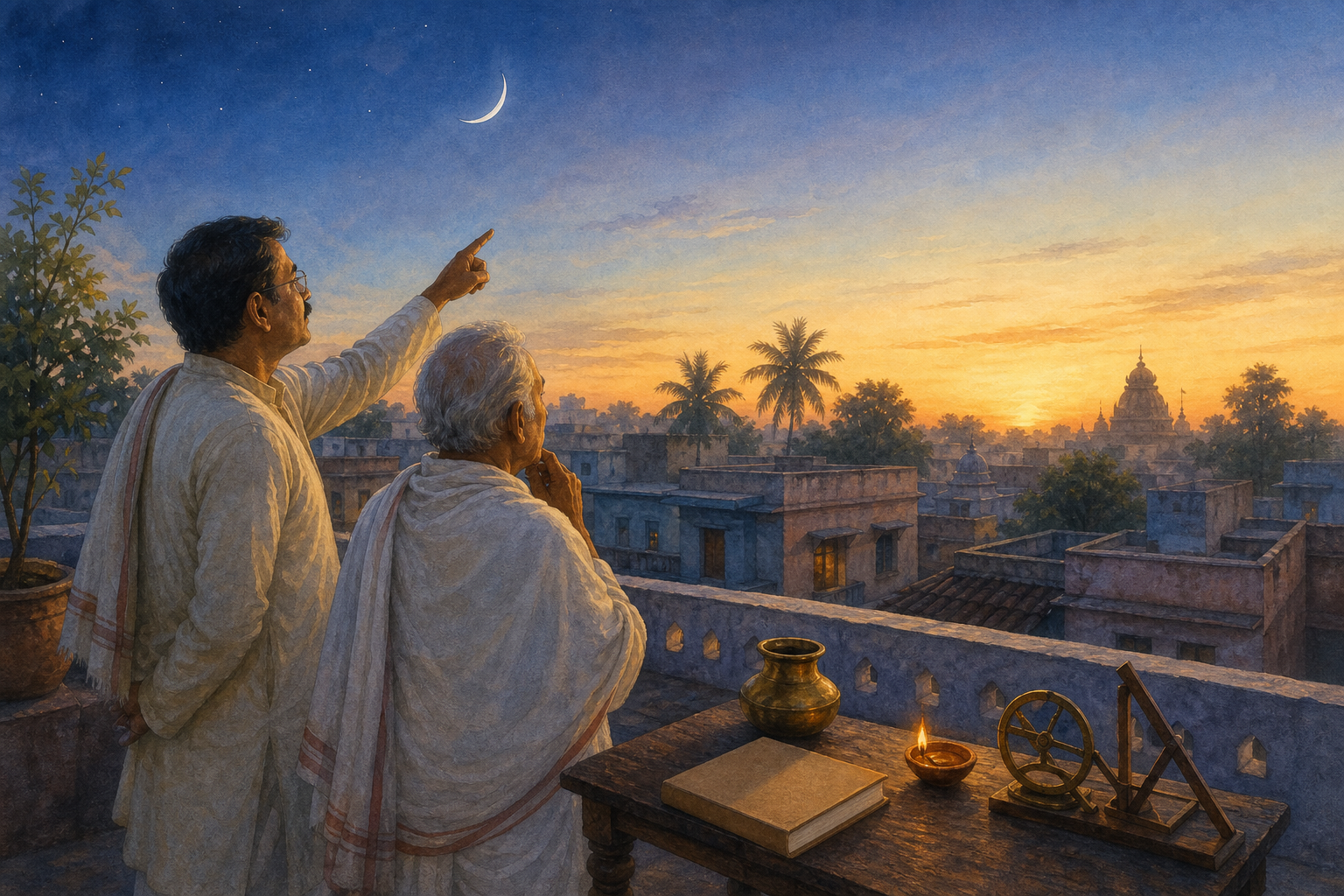
Navami can begin on one civil date and end on the next. A muhurat published for Kolkata, Ayodhya, Toronto, or another city cannot automatically be carried to your location because sunrise and the tithi’s local span matter. This is why two calendars can appear to disagree even when both are using a recognizable panchang method.
Before buying offerings or announcing a community schedule, ask a trusted regional panchang to answer five precise questions:
- When does Navami tithi begin and end in your city?
- Which tithi prevails at local sunrise?
- Which civil date does your tradition assign to the observance?
- What puja window applies to the specific vrata or deity you are observing?
- Does your family, temple, or regional tradition apply an additional rule when Navami overlaps an adjacent tithi?
For Jagadhatri Puja, preference is traditionally given to Navami prevailing at sunrise, known as Udaya Vyapini. The principal worship is commonly placed in Madhyahna or Aparahna while avoiding Rahu Kalam and Yamaganda. Because each of those periods depends on local sunrise, the applicable Jagadhatri muhurat must be calculated for the place of worship.
For Akshaya or Amla Navami, confirm the local Navami tithi and follow the convention used by your household or temple. Do not automatically import Jagadhatri Puja’s regional scheduling rules into Amla worship simply because the observances share a tithi. The exact clock time is a local calculation; the devotional identity of the rite comes from its own tradition.
Keep Amla Navami as a complete, manageable home vrata
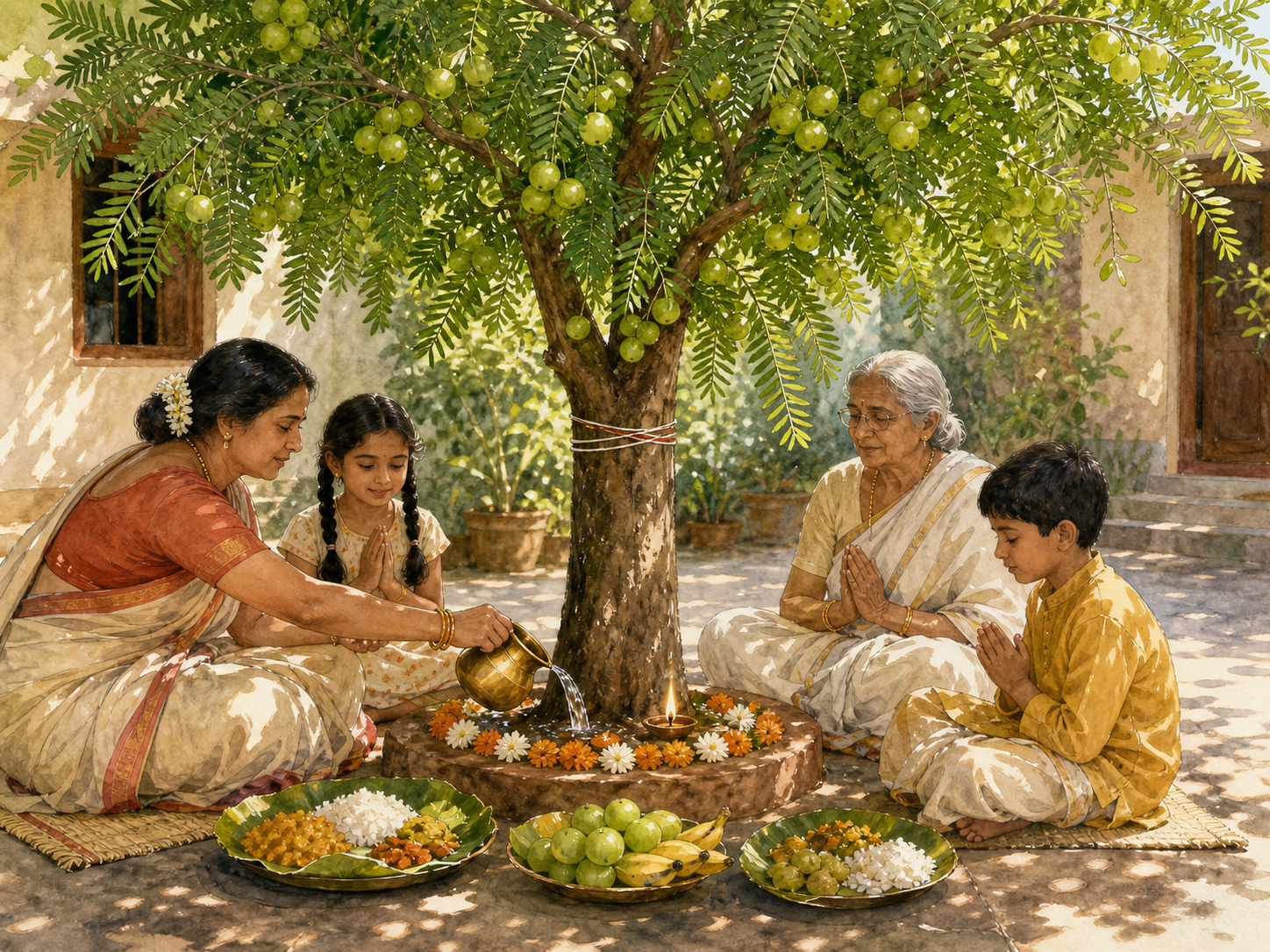
Amla Navami is particularly suited to a modest home observance because its main disciplines are clear: purification, worship, reverence for a living tree, charity, and restrained food. You do not need to manufacture complexity around those elements. Prepare the day so that each one receives real attention.
- Begin with an early bath and a clean worship space. Arrange the altar before the puja window so that searching for items does not consume the time set aside for worship.
- Offer worship to Sri Vishnu and Lakshmi. Use the mantras, stotras, and customary offerings already followed by your household or temple. If you do not know a formal sequence, keep the worship simple and reverent rather than improvising claims of scriptural authority.
- Honor an Amla tree where one is genuinely available. Offer your respects without cutting, piercing, or otherwise harming the tree. Treat the living tree as the center of the act, not as a support for decorations.
- Perform pradakshina mindfully. If your family or temple prescribes a customary number of circumambulations, follow it. Otherwise, do not turn an improvised count into a supposed universal requirement. Walk without crowding the roots or leaving ritual litter behind.
- Make daan concrete. Anna-daan is especially fitting. Decide in advance who will receive food and how it will reach them; a vague intention to give later easily disappears once the puja is over.
- Prepare a simple sattvic meal. Keep excessive oil and spice out of the meal. Where access, weather, permission, and cleanliness allow, the family may receive prasad under or near an Amla tree.
- Add Tulasi worship only where it belongs naturally. Tulasi reverence accords with the wider sacred rhythm of Kartik, but it need not displace the Amla-centered character of this Navami.
If you have no access to an Amla tree, do not label an arbitrary plant as its ritual equivalent. Keep the elements you can perform honestly: worship Sri Vishnu and Lakshmi, offer food in charity, prepare sattvic prasad, and express care for plant life without pretending that symbolism and the traditional Amla rite are identical. Where climate, space, permission, and long-term care make it realistic, planting an Amla sapling can extend the day’s ecological commitment beyond the puja.
Parikrama at Ayodhya or in the Braj region, including Vrindavan and Mathura, belongs to the public pilgrimage expression of the day. If you cannot travel, you have not failed to observe Navami. A local pradakshina or a sincere home vrata is a different scale of practice, not a counterfeit pilgrimage. If you do join a large parikrama, follow the host community’s route and discipline rather than treating the gathering as an unsupervised excursion.
Scale Jagadhatri Puja to the tradition you can sustain
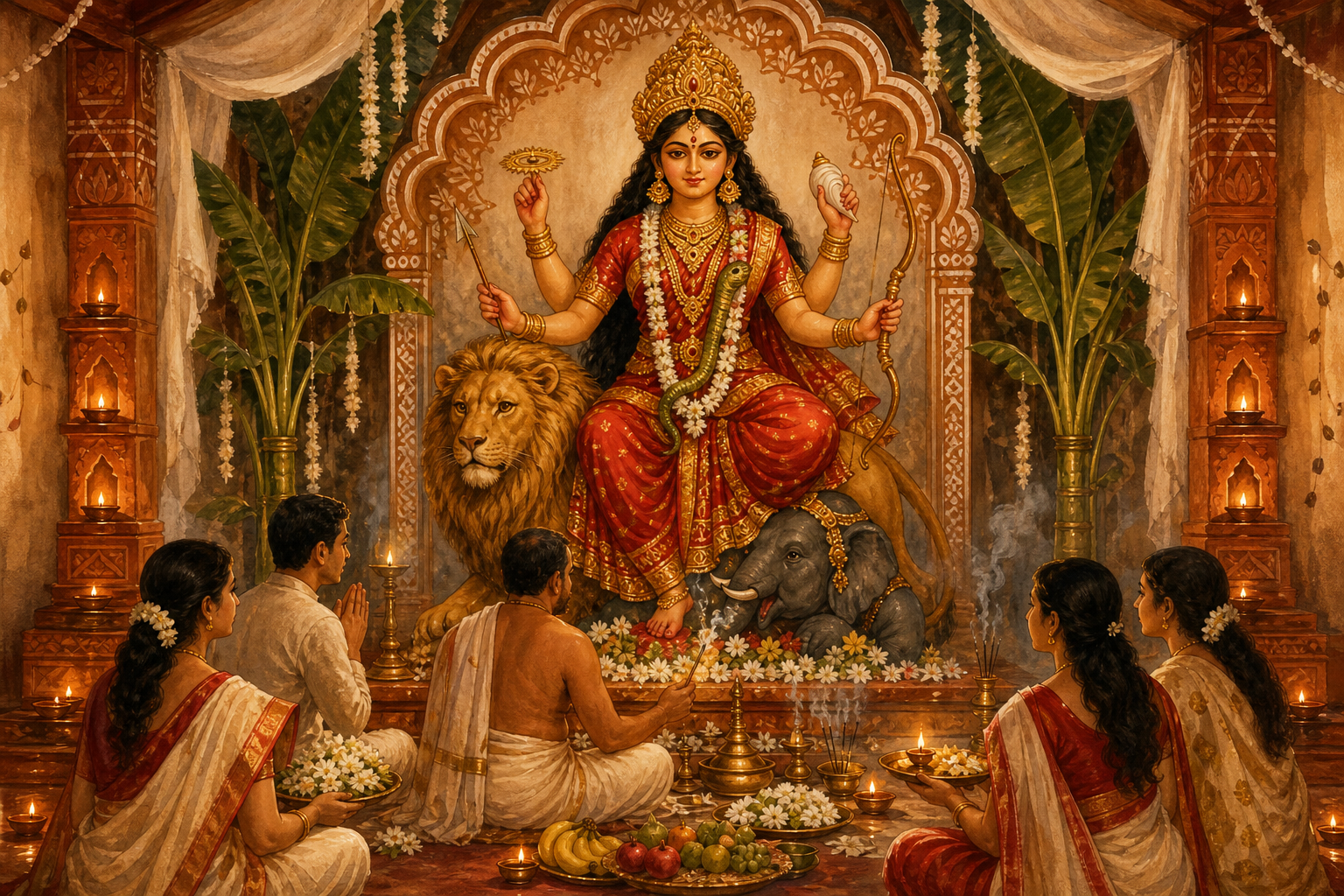
Jagadhatri Puja can involve a richly decorated dashabhuja murti, Chandipath, dhak, conch-blowing, ululation, lighting, collective pushpanjali, and bhog distribution. Those elements create a powerful communal setting, but a household does not need to reproduce a Chandannagar pandal in miniature. Scale and devotional completeness are not the same thing.
For a household already grounded in the practice, prepare a clean, well-lit altar; confirm the Navami puja window; arrange the murti or image and alankara; and decide who will conduct each part. A traditional sequence may include sankalpa, shodashopachara, Chandipath, pushpanjali, and deepa arati. If your household has not been taught the full sequence, seek guidance for the formal portions rather than rushing through unfamiliar procedures from a checklist.
Offerings associated with the puja include hibiscus, lotus, seasonal fruits, and sattvic sweets such as sandesh and narkel naru. Use what your established tradition accepts and what can be obtained responsibly. The purpose of a named offering is not to create last-minute waste or turn the altar into a display of expense.
Some devotees keep a vrata or light fast to support restraint and clarity. Treat fasting as a discipline, not as a contest or a substitute for necessary care. A person who cannot fast can still participate through worship, pushpanjali, attentive recitation, preparation of bhog, or seva. Do not pressure another member of the household to adopt a restriction that is not part of their capacity or commitment.
For community organizers, assign the devotional work before the decorative work. Confirm the officiating team and muhurat, then plan the altar, recitation, crowd movement, pushpanjali, arati, and food distribution. Only after those essentials are secure should lighting and visual design claim the remaining attention. Jagadhatri represents the sustaining force of Shakti; a puja whose volunteers are exhausted by decoration but unprepared for worship has reversed its priorities.
Bhog distribution is not an afterthought. Estimate portions conservatively, establish an orderly serving area, and identify how any usable remainder will be handled. Where an idol is immersed, clay, natural dyes, and responsible immersion practices keep public devotion aligned with ecological responsibility. Conch, dhak, and ululation enrich the collective atmosphere, but they should not be treated as barriers that prevent a smaller diaspora community from worshiping sincerely.
Keep the shared ethic without flattening the traditions
Kartik Shukla Navami brings several Dharmic virtues into practical view: restraint, gratitude, care for living beings, daan, and seva. Amla reverence can deepen awareness of sacred ecology. Jagadhatri worship can train attention toward disciplined strength, courage, and compassionate sustenance. In both forms, food offered and shared turns devotion outward toward other people.
These values resonate beyond a single Hindu observance. Care for life speaks to Jain and Buddhist emphases on ahimsa, while service and shared food find a clear echo in Sikh seva and langar. The useful connection is ethical, not a claim that every Dharmic community performs the same Navami ritual. Unity becomes more credible when it respects distinct deities, liturgies, histories, and community ownership.
Key takeaways
- Akshaya Navami and Amla Navami refer to the Amla-centered observance; Jagadhatri Puja is a distinct Bengali Shakta observance on the same tithi.
- Choose according to living family, sampradaya, temple, or regional practice before choosing according to an online label.
- Confirm Navami for your location. Do not copy another city’s civil date or clock time without checking local sunrise and tithi.
- For Amla Navami, protect the core sequence: Vishnu-Lakshmi worship, Amla reverence, pradakshina, daan, and simple sattvic food.
- For Jagadhatri Puja, protect the liturgical center before expanding decoration: sankalpa, alankara, formal worship, Chandipath where practiced, pushpanjali, arati, and bhog.
- Make ecological care visible by avoiding plastic waste, protecting living trees, choosing responsible puja materials, and planning the handling of offerings and immersion materials.
Write your plan in five lines: the tradition you are keeping, the local Navami window, the worship place, the food or prasad, and the act of seva. Then ask a family elder, priest, or community organizer about the one point you still cannot resolve. That small act of preparation will do more for the integrity of your observance than adding another unexamined ritual at the last minute.
References
- DharmaRenaissance Blog — Akshaya Navami 2025 (Amla Navami): Discover the Complete Guide to Rituals, Parikrama, and Meaning
- DharmaRenaissance Blog — Jagadhatri Puja 2025 Muhurat Guide: Discover Auspicious Timings, Rituals, and Significance
