
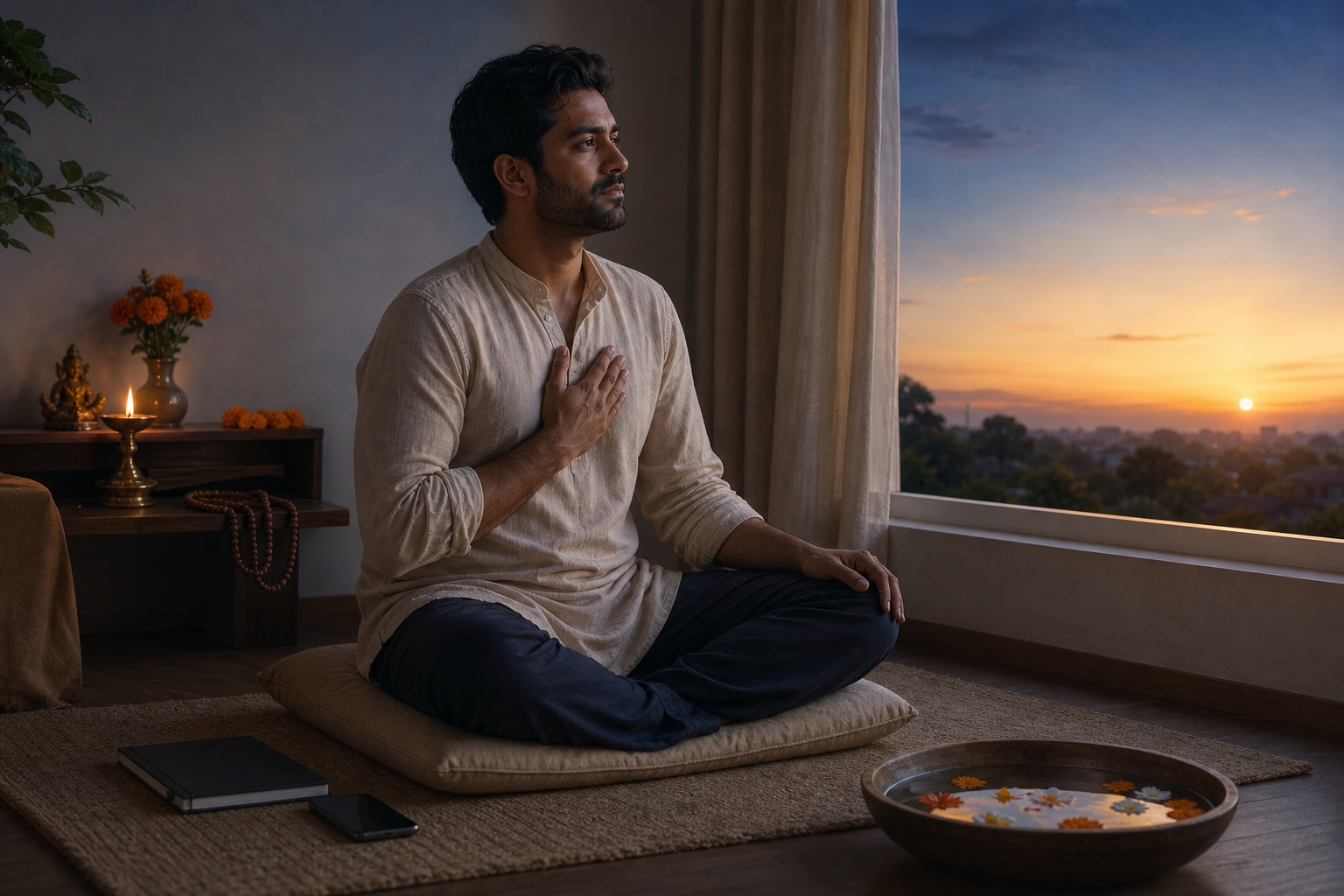
If you are awake at 2 AM composing one more message, checking for one more update or replaying a decision you have already made, the mind is probably trying to obtain certainty through repetition. It feels like preparation, but nothing new is being prepared.
Hindu practice offers a more disciplined response: settle the body, distinguish your duty from the result, complete the action that is actually yours and release the rest. Non-attachment does not ask you to care less. It stops care from becoming an attempt to control what no person can guarantee.
Non-attachment removes the demand, not the care

Anxiety often fuses three different things: duty, preference and guarantee. You may have a duty to prepare carefully. You may strongly prefer a particular result. You do not, however, possess a guarantee that other people, circumstances or timing will cooperate.
Viveka, or discernment, separates these categories. Vairagya, or non-attachment, loosens the mind’s insistence that the preferred result must occur. Used together, they give you a practical division of responsibility:
- Within your sphere are your intention, preparation, words, conduct, effort and response.
- Outside your command are another person’s choices, the timing of events, changing external conditions and the final result.
This distinction must be made honestly. Do not label an uncomfortable duty uncontrollable merely because you would rather avoid it. You may not control how someone receives a difficult conversation, but you still control whether you speak clearly, respectfully and at an appropriate time.
Ask one precise question: What part of this situation can I begin or complete through my own choice? Write that part as an action. If the answer depends on another person’s cooperation, rewrite it as your contribution. Replace make them understand with explain my position once, listen carefully and state the boundary clearly.
Concern is useful while it is revealing a neglected responsibility. Once you have identified and completed that responsibility, repeating the same thought without new information is no longer preparation. That is the moment for vairagya.
Turn a worry loop into a Karma Yoga sequence

The Bhagavad Gita’s Karma Yoga trains you to give full attention to right action without claiming control over its fruit. This is not permission for careless effort. It demands that you act well while refusing to make inner balance conditional on success.
Use the following sequence when you notice yourself checking, rehearsing or forecasting the same outcome:
- State the dharmic intention. Name the value or responsibility that should govern you: honesty, care, courage, patience, fairness or competent work.
- Name the desired fruit. Say plainly what you want. Hidden attachment is harder to release than acknowledged preference.
- Choose one complete action. Make the call, prepare the document, send the respectful message, ask the necessary question or decide that no further action is currently warranted.
- Dedicate the effort. Mentally offer the action to a higher ideal rather than using it only to defend your ego or force reassurance.
- Close the loop. Tell yourself: The action was mine; the result is not mine alone. Then stop checking until new information or a genuine responsibility appears.
Consider a parent worried about a child who has not replied. Responsible action might include agreeing on check-in expectations beforehand and sending one clear, respectful message. Repeated messages sent only to relieve the parent’s uncertainty do not create control. After the appropriate action, returning to rest is part of the discipline.
The same rule applies at work. You can prepare, verify, communicate and follow up when a follow-up is due. You cannot command a colleague’s judgment, an institution’s timing or the final decision. Act again when circumstances change or duty requires it, not merely because uncertainty feels uncomfortable.
Use breath and attention before asking the mind to let go

When worry is loud, an abstract instruction to detach may be nearly useless. Begin by reducing stimulation and giving attention somewhere stable. Pratyahara withdraws attention from inputs that keep feeding the loop, pranayama steadies breathing and dhyana gathers a scattered mind.
A brief reset can be simple:
- Interrupt the input. Put the phone face down, close the unnecessary tab or step away from the conversation long enough to stop reacting automatically.
- Take three slow breaths. Let each exhalation be unhurried. Do not force the breath or turn the exercise into a test of endurance.
- Watch natural breathing for one minute. When attention runs toward the feared result, notice that movement and return to the breath.
- Re-enter through duty. Ask what action is yours now. If there is one, perform it. If there is none, redirect attention to the next proper activity.
The purpose of this pause is not to manufacture a mystical feeling. It is to create enough space between impulse and action for discernment to operate. A slow exhalation before a difficult message can prevent an anxious reaction from becoming an unnecessary conflict.
If focusing on the breath makes you dizzy or more distressed, stop rather than forcing the practice. Spiritual discipline is not measured by how much discomfort you can override.
Make steadiness a daily practice, not an emergency ritual
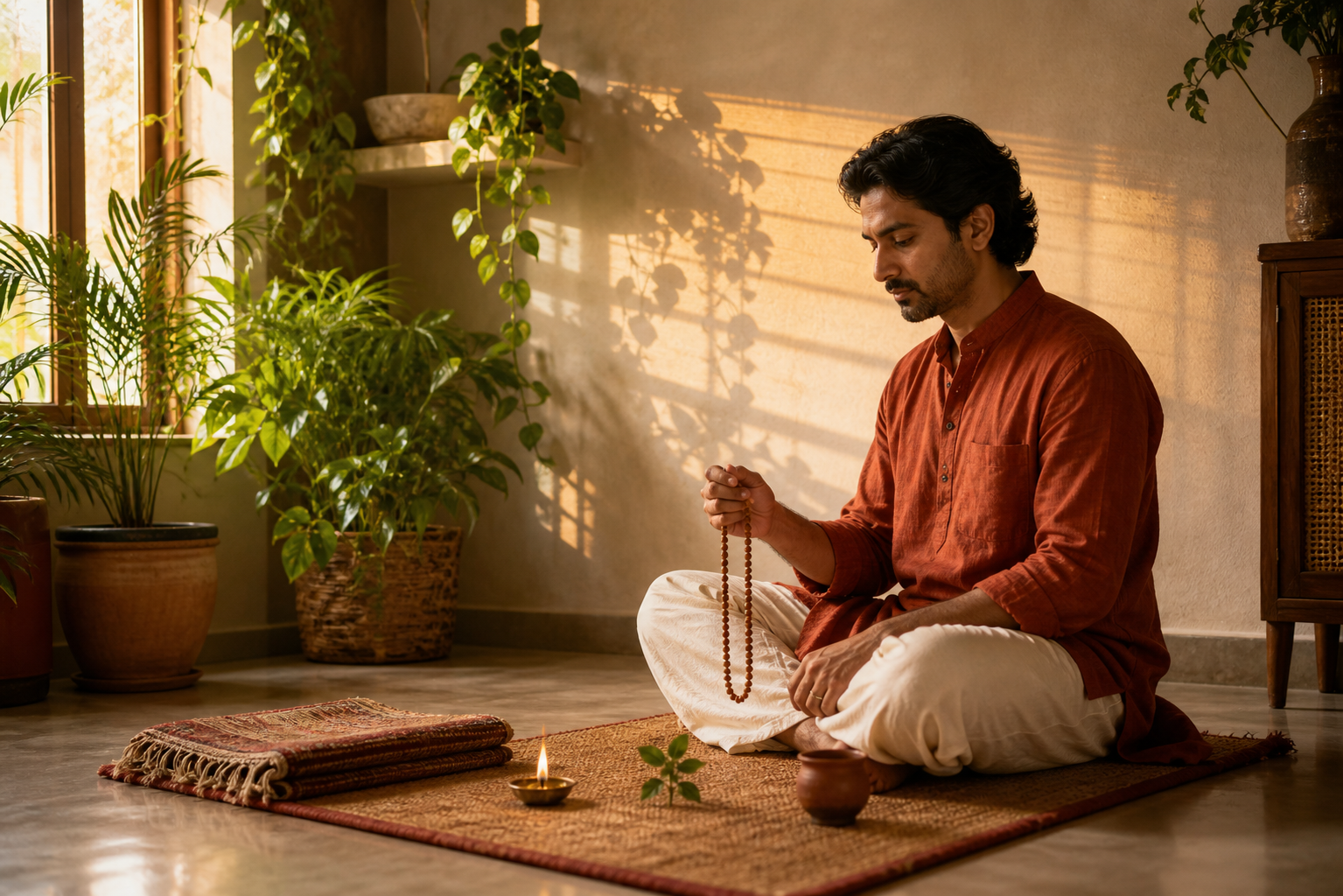
Abhyasa, repeated practice, matters because anxiety usually captures attention before you remember a philosophical teaching. A small routine gives you familiar steps to use when judgment is under pressure.
Build the routine around three natural points in the day:
- Morning intention: Choose one sentence that describes how you will act, such as Today I will be clear, diligent and kind without trying to control every response.
- Midday or trigger pause: Use three slow breaths before sending a charged message, entering a meeting or checking for a result again.
- Evening reflection: Review your conduct without putting yourself on trial. Identify one correction for tomorrow, then release the day.
Four evening questions keep reflection practical:
- What was genuinely mine to do today?
- Did I do it with reasonable care?
- Where did attachment turn into checking, controlling or replaying?
- Is there one repair to make tomorrow, or can this result now be left alone?
Stop after the answer is clear. Reflection becomes another form of worry when you keep reviewing the same event in the hope that certainty will emerge. One honest correction is useful; prolonged self-accusation is not.
This pattern also has recognisable echoes across the wider Dharmic family. Buddhist mindfulness notices worry without clinging to it. Jain aparigraha loosens possessiveness, while pratikraman supports reflective correction without endless self-reproach. Sikh remembrance through simran and alignment with hukam place responsible effort within a larger order. These traditions are not interchangeable, but each refuses the idea that peace must wait until the world satisfies every demand.
These practices can support steadiness, but they are not substitutes for mental-health assessment or treatment. If anxiety is persistent or severe, repeatedly disrupts sleep, work or relationships, or involves panic or thoughts of self-harm, contact a qualified mental-health professional or physician. If you might act on thoughts of self-harm, seek local emergency or crisis support now.
Key takeaways
- Non-attachment releases the demand for a guaranteed result; it does not remove care, ambition or responsibility.
- Use viveka to divide intention, preparation, conduct and response from other people’s choices, external timing and final outcomes.
- Apply Karma Yoga in sequence: set a dharmic intention, name the desired fruit, perform the action, dedicate the effort and close the loop.
- When worry is too loud for reflection, withdraw from the stimulus, take three slow breaths and watch natural breathing for one minute.
- Reopen the problem when new information arrives or duty calls, not simply because uncertainty remains.
- Use spiritual practice alongside, not instead of, appropriate professional care when anxiety is severe or disruptive.
Tonight, choose one real worry. Write the outcome you want, circle the part that is yours, take one appropriate action and put the list away. Let new information arrive before you reopen the case.
References
