
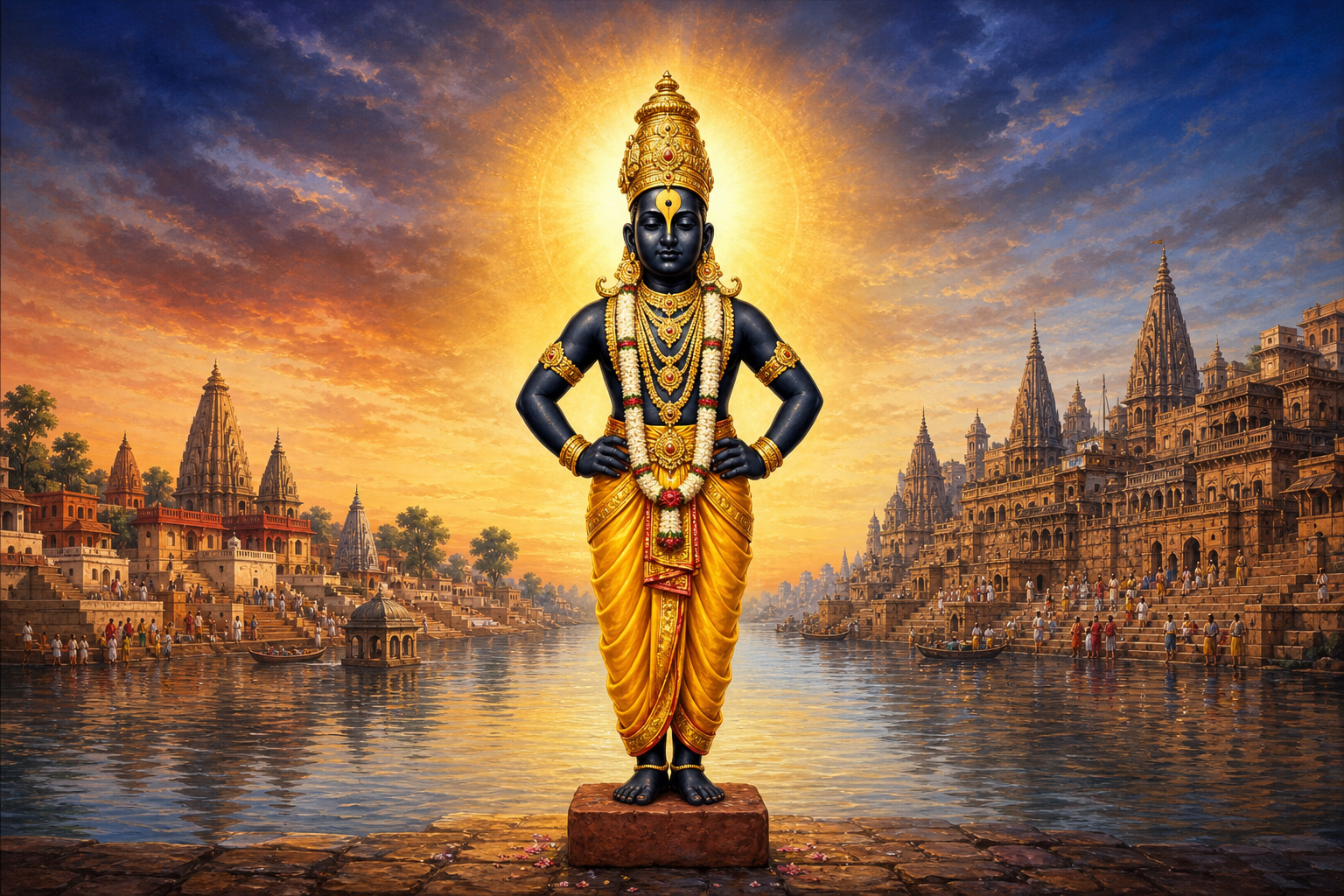
If you have encountered the name Bindu Madhava for Bhagavan Vitthal, you may be wondering what exactly is being claimed. Is Bindu Madhava merely another name for Vitthal? Does it connect Pandharpur with Kashi? Or is a deity belonging to one sacred place being transferred to another?
The careful answer is that the name expresses divine continuity across distinct sacred places. It identifies Vitthal with Vishnu-Krishna while allowing Pandharpur and Kashi to retain their own rivers, temples, narratives and devotional practices. Once you keep identity and location separate, the Puranic logic becomes much easier to understand.
The claim concerns divine identity, not a shared address
Within the Kashi material of the Uttara Khanda of the Padma Purana, Bindu Madhava denotes Vishnu at a sanctifying tirtha. Pandharpur, meanwhile, is the kshetra where Vitthal stands on the banks of the Bhimarathi and receives the devotion of the Varkari sampradaya. These geographical settings should not be collapsed into one another.
The connection becomes intelligible at the level of the deity. Varkari devotion consistently recognizes Vitthal as Krishna, while Madhava is a well-established name of Vishnu and Krishna. Bindu Madhava and Vitthal therefore meet in the same Vishnu-Krishna identity even though their kshetras remain distinct.
This is a form of abheda, or non-difference, between manifestations of the Lord. Non-difference does not mean that every image, temple history or local custom is identical. It means that the divine presence encountered through those forms is not divided into competing gods.
That distinction gives you a reliable way to state the tradition. The precise formulation is: Vitthal is revered as Bindu Madhava because both names reveal the same Vishnu-Krishna through different sacred settings. A less careful formulation would insist that every Puranic occurrence of Bindu Madhava must refer specifically to the murti at Pandharpur. The tradition does not need that stronger claim in order to affirm Vitthal’s divinity.
What Bindu and Madhava contribute to the name

The two parts of the name perform different theological work. Bindu can mean a point or a drop: something small in extent yet concentrated in significance. Madhava identifies the Lord as Vishnu-Krishna. Put together, Bindu Madhava presents the immeasurable Lord as intensely and accessibly present at a particular sacred locus.
Madhava carries the principal identification. It tells you whom the devotee approaches. Bindu describes how sacred presence can be concentrated at a tirtha without being confined by it. The Lord is not reduced to a physical point; rather, the point becomes a place where the devotee can meet what cannot be bounded.
- Lexical level: Bindu means a point or drop, while Madhava is a name of Vishnu-Krishna.
- Theological level: the unlimited Divine becomes approachable through a definite name, image and place.
- Geographical-symbolic level: a local river or tirtha can echo the meaning of the name without creating that meaning by itself.
This three-level distinction prevents an attractive symbol from being mistaken for a textual proof. The crescent-like bend of the Bhimarathi at Pandharpur is revered as the Chandrabhaga. Its form can evoke a drop held within the river’s curve and thus harmonize with the bindu motif. That is meaningful devotional resonance, but it is not the sole basis for calling Vitthal Bindu Madhava. The more substantial basis is the shared identity of Vitthal, Madhava, Vishnu and Krishna.
Pandharpur and Kashi remain distinct within one sacred geography

Puranic sacred geography does not work like a modern directory in which a name must have one exclusive address. A divine epithet may disclose the same Lord at more than one kshetra. The name can travel because divine identity is continuous, even while each place retains its own character.
In Kashi, Bindu Madhava belongs to a Vishnu tirtha within that city’s sacred landscape. In Pandharpur, Vitthal belongs to the Bhimarathi-Chandrabhaga, the Varkari path and the devotional world centred on Krishna. Recognizing the same Lord in both places does not make the rivers interchangeable or turn one temple’s customs into the customs of the other.
This distinction matters whenever you encounter claims that Hinduism either has countless unrelated gods or, at the other extreme, treats every form as contextually identical. The Puranic model is subtler. Unity belongs to the divine essence; variety belongs to the ways that essence becomes present to communities of devotees. Continuity need not erase particularity.
If you visit Pandharpur and Kashi, you can make that theology practical without inventing a new ritual:
- Name the local form before you. In Pandharpur, approach Vitthal within the sacred world of the Chandrabhaga and the Varkari tradition; in Kashi, approach Bindu Madhava within Kashi’s own tirtha geography.
- Recognize the common identity. Remember that Vitthal and Madhava are encountered as Vishnu-Krishna, not as divine rivals competing for your loyalty.
- Carry devotion forward rather than treating each darshan as an isolated item on a pilgrimage list. Let the second kshetra deepen your recognition of the Lord already worshipped at the first.
The discipline is simple: first honour where you stand, then recognize whom you are meeting. That preserves both the integrity of the kshetra and the unity of Bhagavan.
A practical test for reading Puranic divine names
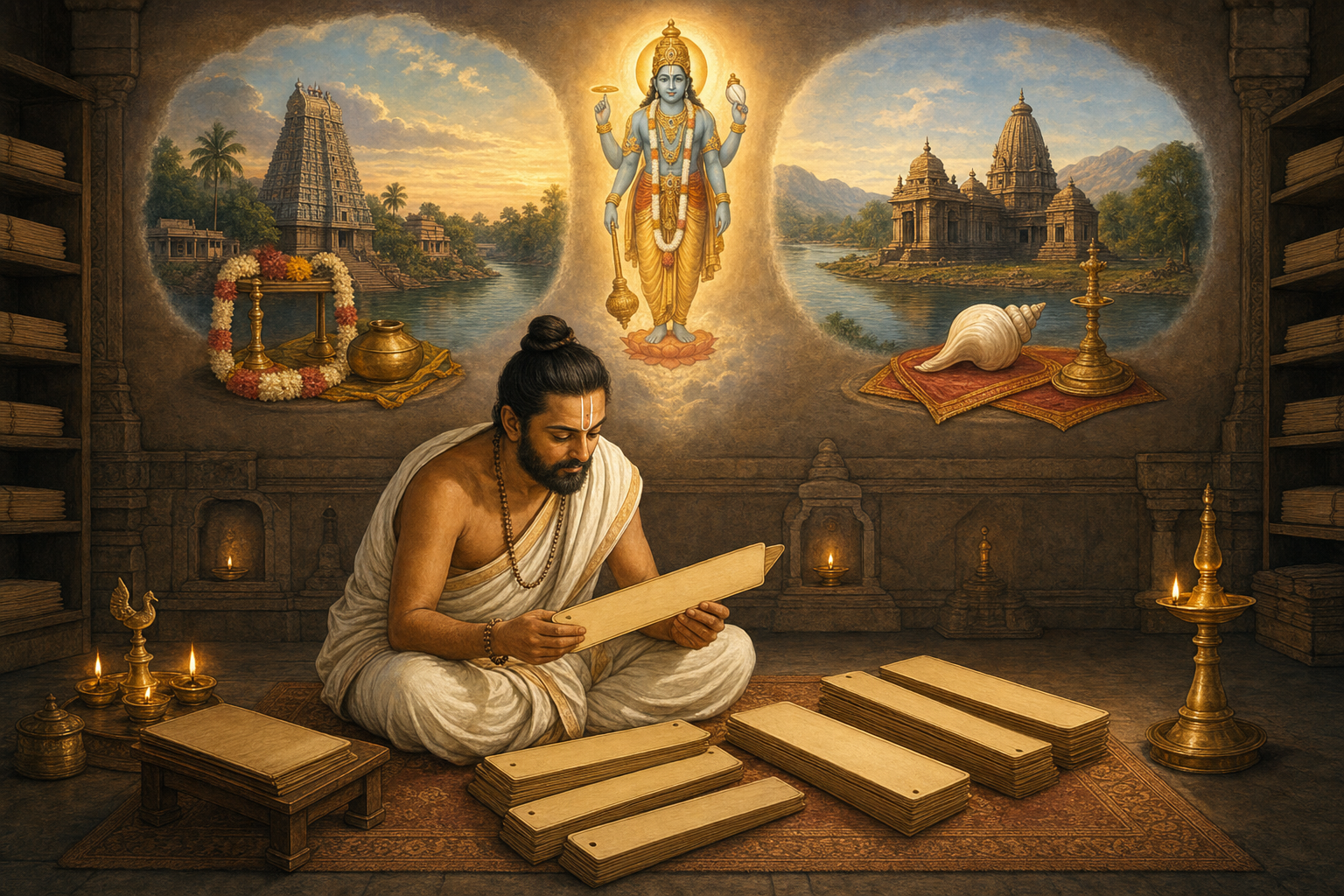
The same interpretive problem appears whenever one divine name is associated with several temples or regions. You can evaluate such a claim by asking five questions in order.
- Where is the name situated? Keep the immediate kshetra and narrative setting visible. For Bindu Madhava, the direct Puranic setting under discussion is Kashi.
- Whom does the name identify? Madhava identifies Vishnu-Krishna. This establishes the theological centre of the epithet.
- How is the other manifestation understood? Vitthal is recognized as Krishna in Varkari devotion, supplying the bridge between the names.
- Is the connection direct naming or theological extension? Distinguish a name used in a particular passage from its devotional application to a non-different manifestation elsewhere.
- Does local symbolism support or replace the identification? The Chandrabhaga’s shape supports reflection on bindu, but the Vishnu-Krishna identity does the decisive work.
Applied carefully, this test produces a layered conclusion. The textual attestation locates Bindu Madhava in Kashi. The divine name identifies Vishnu. Varkari tradition identifies Vitthal with Krishna. The theology of non-difference permits the epithet to illuminate Vitthal, while Pandharpur’s river geography adds a fitting symbolic resonance.
This order of reasoning avoids two opposite mistakes. One mistake rejects the connection merely because Kashi and Pandharpur are different places. The other erases their differences by treating every use of the name as a literal reference to the same local shrine. The stronger reading keeps the textual setting narrow and the theological meaning expansive.
It also gives you better language for discussion. Instead of saying that one regional deity has been borrowed and relabelled, say that one Vishnu-Krishna is recognized through locally rooted manifestations. Instead of treating Bindu Madhava as a rival to Vitthal, understand the epithet as another disclosure of the Lord whom the Varkari already addresses as Vitthal.
Key takeaways
- Bindu signifies a point or drop and suggests concentrated sacred presence; Madhava identifies that presence as Vishnu-Krishna.
- The direct Puranic setting of Bindu Madhava is a Vishnu tirtha in Kashi.
- Vitthal can be revered as Bindu Madhava because Varkari devotion recognizes Vitthal as Krishna and Vaishnava theology affirms continuity among the Lord’s manifestations.
- The Chandrabhaga’s crescent-like bend enriches the bindu symbolism, but it should be treated as resonance rather than the sole proof of the identification.
- Pandharpur and Kashi do not lose their distinct identities when devotees recognize the same Lord at both kshetras.
The next time you hear Vitthal addressed as Bindu Madhava, listen for both parts of the claim. Bindu directs attention to the Lord’s concentrated presence; Madhava tells you that the one standing before the devotee is Vishnu-Krishna. Honour the local form fully, and let the shared name widen rather than flatten your darshan.
References
