

You may love Sri Krishna’s names and sacred stories yet still wonder why devotion feels separate from your difficult choices, household duties, or restless mind. The missing element is often not another teaching. It is a way to connect what you hear, sing, decide, and physically do.
Krishna bhakti becomes a whole path when four practices reinforce one another. Surrender changes what you seek. Sacred narrative trains your judgment. Kirtan gathers your attention. Pilgrimage places your body inside remembrance. You do not need to abandon ordinary responsibilities to begin; you need to turn those responsibilities toward Krishna.
Key takeaways
- Surrender does not erase agency. It releases the demand to possess, control, or receive a particular result.
- Sacred narrative becomes practical when you examine the pressure a devotee faced, the principle that guided the response, and the action that followed.
- Kirtan is first an offering of attention, not a performance or a search for an impressive emotional state.
- Pilgrimage joins place, sacred memory, chanting, service, and disciplined movement.
- The four practices should affect one another: what you sing should shape what you choose, and what you learn on pilgrimage should survive the return home.
Surrender changes what you ask Krishna to give you
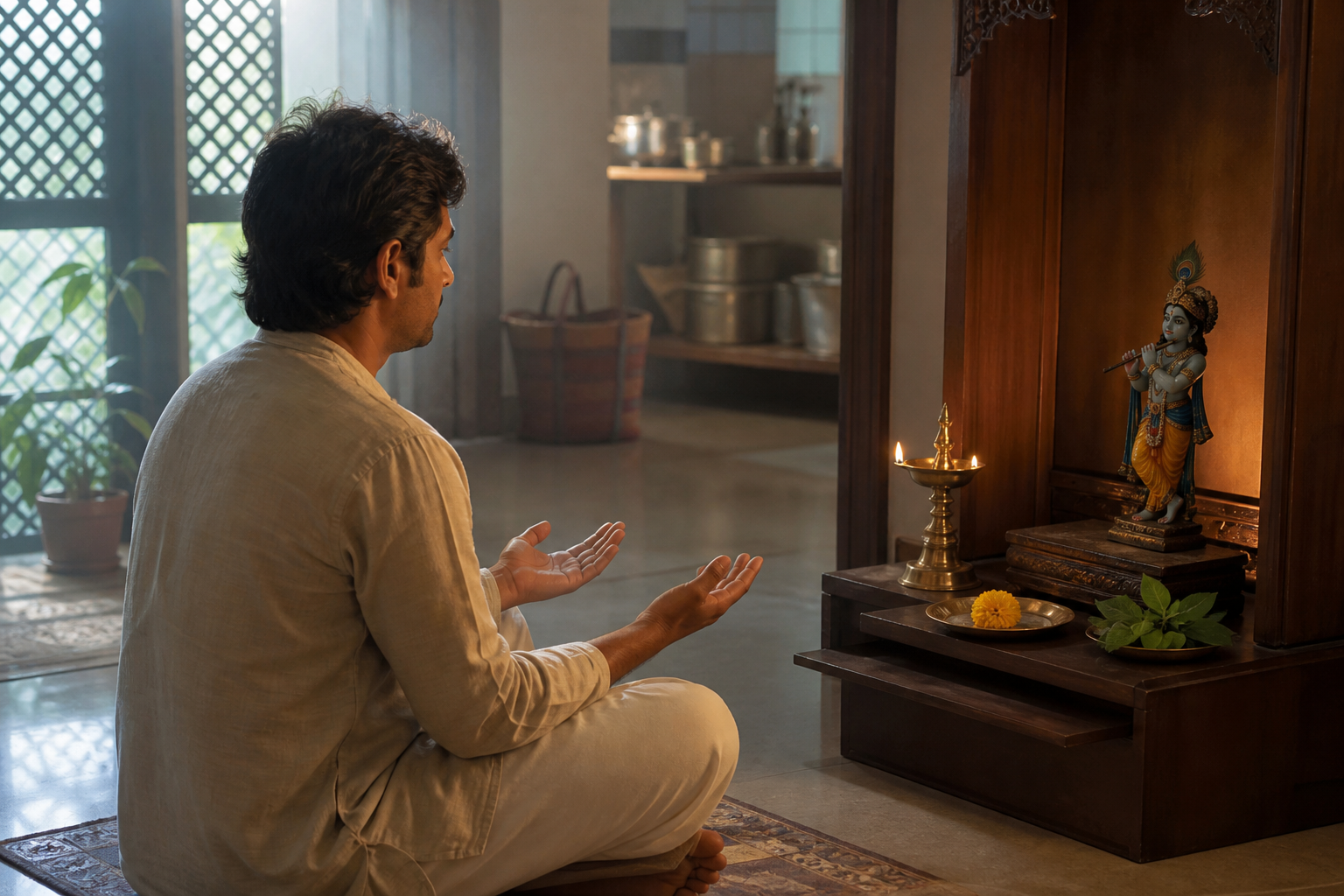
Surrender is easily misunderstood as passivity, helplessness, or indifference to consequences. Bhakti asks for something more demanding: act according to dharma while relinquishing the belief that security depends on controlling every result.
Mahabali shows this reversal with unusual clarity. When Krishna invited him to request a benediction, Bali did not seek restored dominion or greater prosperity. In Srimad-Bhagavatam 10.85.45, he sought freedom from material entanglement and refuge at the Lord’s lotus feet. The boon was not another possession. It was release from the need to build identity around possessions.
This does not require you to imitate Bali’s outward wish to wander. A householder can practise the same inner movement while earning, caring for family, keeping commitments, and participating in society. The practical question is not whether you own anything. It is whether ownership, status, praise, or a preferred outcome has acquired the power to overrule dharma.
When a decision is making you anxious or possessive, use this surrender test:
- Name the result you are trying to control. Be precise: approval, victory, comfort, recognition, money, or another person’s response.
- Name the duty that remains even if you do not receive that result. This may be honesty, care, restraint, courage, service, or keeping a promise.
- Offer the result to Krishna in your own words. Ask for attachment to His shelter and enough clarity to perform the duty in front of you.
- Take the next dharmic action without waiting to feel completely detached. Surrender matures through action; it is not a mood you must manufacture beforehand.
This distinction protects bhakti from two errors. The first is spiritualized avoidance: abandoning a responsibility and calling the retreat renunciation. The second is spiritualized control: praying intensely while insisting that Krishna validate the outcome you already selected. If a choice neglects dependants, conceals the truth, or transfers the cost of your detachment to someone else, a devotional label does not make it dharmic.
You can recognize genuine surrender by its ordinary fruits. You become less defensive about status, more truthful about motive, and more capable of doing an unwelcome duty without treating the result as your possession. Refuge at Krishna’s lotus feet then becomes a criterion for living, not merely an image used during prayer.
Use sacred narrative to rehearse dharmic choices
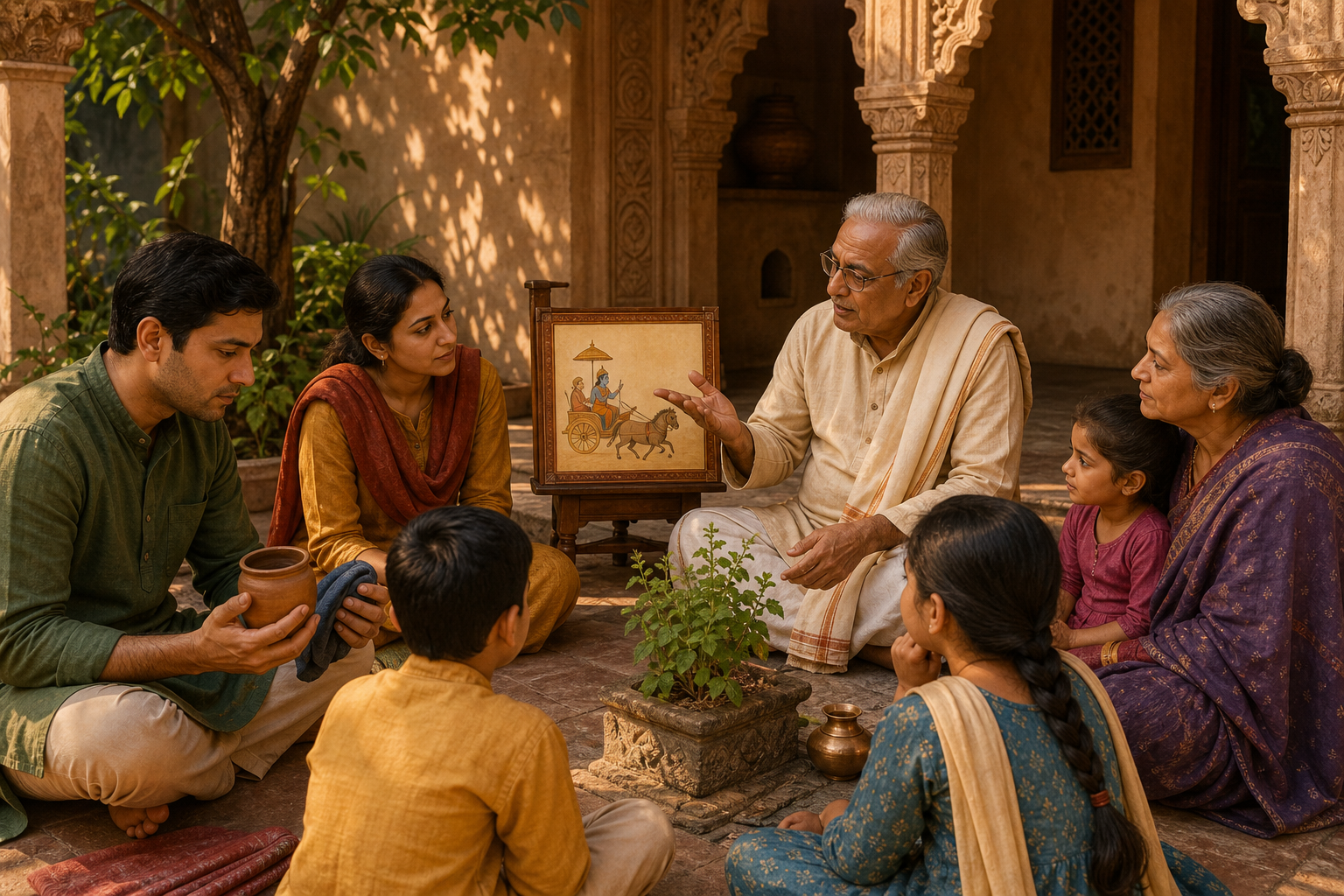
A Krishna-lila can move the heart and still leave conduct untouched. That happens when you remember the spectacle but do not study the decision inside it. Sacred narrative becomes sadhana when you enter the moral pressure of the scene and ask how devotion directed action.
Rukmini did not begin with a dramatic rescue. She heard accounts of Krishna from saintly visitors, formed a settled devotion, and then acted when a political marriage to Shishupala threatened that commitment. She sent Krishna a clear appeal and a practical plan connected with her visit to the Ambika temple. Krishna came for her, and Balarama helped secure their passage. Her devotion included trust, consent, discernment, communication, and decisive action.
Read that beside Bali’s prayer and an important correction appears. Bali relinquishes his claim upon worldly security; Rukmini refuses to surrender her dharmic agency to political pressure. One devotee asks to be freed from possession. Another asks Krishna to intervene and then makes herself ready to act. Surrender can therefore look quiet or forceful. Its defining feature is not outward passivity but alignment with the Divine.
Use the following method with a single episode from Krishna-lila rather than rushing through a large amount of text:
- Reconstruct the pressure. What fear, attachment, social demand, or conflict made the choice difficult?
- Identify the devotional orientation. What did the devotee trust about Krishna, and what worldly support became secondary?
- Identify the action. Did the devotee pray, speak, wait, refuse, travel, serve, seek help, or accept a loss?
- Translate the principle, not the costume. Ask what honesty, courage, restraint, or reliance on Krishna looks like within your actual role and obligations.
- Carry one sentence into practice. Form a short intention you can remember when the corresponding pressure appears in your day.
The fourth step matters because sacred narratives are not permission to reproduce every external act without context. Rukmini’s royal circumstances, Bali’s unusual history, and your present duties are not interchangeable. The enduring instruction lies in the relationship among pressure, devotion, dharma, and response.
If you study with family or a community, resist the urge to announce the moral before everyone has understood the choice. First ask each person to describe what the devotee risked and what alternatives were available. This turns katha from passive admiration into shared moral reasoning. The story remains sacred, but it also becomes usable.
Make kirtan an offering of undivided attention
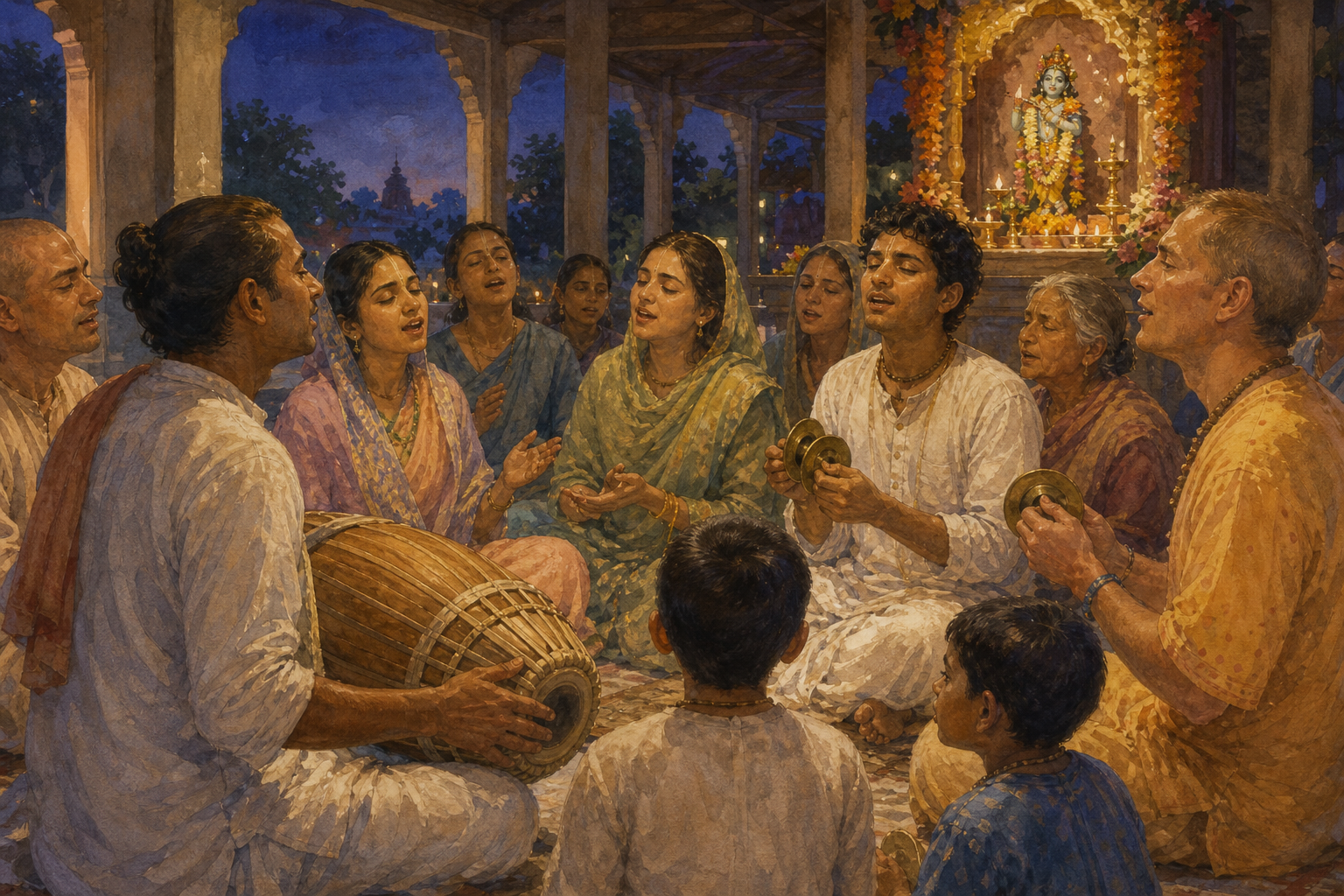
Many practitioners do not lack affection for Krishna. They lack an interval in which that affection is allowed to become the center of attention. Plans, recognition, money, unfinished conversations, and imagined futures continue glowing like competing lamps. Kirtan gives you a deliberate way to stop following them for a while.
A grounded practice is to sit as though you are before Sri Krishna, chant gently, let the natural breath steady the mind, and return without self-reproach whenever attention wanders. The setting does not need a stage or an audience. Devotional integrity remains intact when only the natural world seems to hear you.
Use this sequence for personal kirtan or japa:
- Choose a place where foreseeable interruptions can be set aside for a definite period. Consistency matters more than making the setting elaborate.
- Name the worldly claims you are suspending. You are not denying your responsibilities; you are refusing to let them occupy the devotional interval.
- Bring Sri Krishna before the mind. You may use the form, name, or lila through which your established tradition directs your remembrance.
- Chant steadily and without forcing the breath. Let the mantra carry attention rather than turning the session into a test of concentration.
- When the mind leaves, notice where it went and return. Do not conduct an argument with every thought; that merely gives the distraction another form of attention.
- Close with gratitude and name one duty you will now perform in a devotional spirit. This creates a bridge between chanting and conduct.
Public kirtan and solitary chanting serve different conditions. Collective singing can support participation, shared rhythm, and community. Quiet practice exposes whether you can offer the Name without applause, novelty, or social momentum. Neither setting should be used to disparage the other. Use both, where available, and notice what each one reveals about your attention.
Do not measure every session by emotional intensity. A quieter set of signs is more useful: you return to the mantra sooner, the need to be seen loosens, material preoccupations lose some urgency, and the next ethical choice becomes easier to recognize. Those changes may be less dramatic than a powerful mood, but they show that remembrance is beginning to enter the rest of life.
Kirtan also prepares you to read sacred narrative differently. Once a lila has supplied the mind with a form of Krishna and a devotee’s orientation, chanting gives that remembrance somewhere to settle. Conversely, the Name prevents narrative study from remaining purely analytical. Story gives attention direction; kirtan gives it continuity.
Let pilgrimage train the body, then bring it home

At home, distraction often belongs to the environment itself. The same rooms cue the same tasks, worries, and habits. Tirtha-yatra temporarily reorganizes space and movement around sacred remembrance. Walking, hearing, chanting, serving, and encountering a place associated with lila can teach the body what the mind has been trying to affirm.
Nabadwip Mandal Parikrama offers a clear example of this integration. Its route through the nine islands joins places associated with Sri Chaitanya Mahaprabhu to kirtan, katha, seva, and attentive walking. The pilgrim does not merely arrive at a site, take in a view, and move on. Sacred geography becomes a living classroom in which narrative, song, community, discipline, and service share the same ground.
Before you leave
- Use announcements from the responsible organizer for routes, schedules, and practical guidance. Do not build travel plans around an unverified forwarded message.
- Choose a sankalpa connected to your actual practice. You might seek freedom from one attachment, steadiness in the Divine Name, or clearer performance of a neglected duty.
- Prepare for the physical and communal conditions without romanticizing discomfort. Pilgrimage requires humility toward your bodily limits as well as respect for the needs of other participants.
- Learn the central sacred associations of the places you expect to visit. A location becomes spiritually legible when you know what is being remembered there.
While you walk
- Join kirtan and katha attentively instead of treating them as background to movement.
- After hearing a narrative at a sacred place, ask what attachment was relinquished, what dharmic agency was exercised, and what form of service followed.
- Accept simple opportunities for seva. Service prevents pilgrimage from becoming spiritual consumption centered only on what you hope to feel.
- Respect local customs and practise ecological care. Leaving disorder behind contradicts the reverence that brought you to the tirtha.
- Notice the impulse to collect sites, images, or recognition. Return to your sankalpa when counting experiences begins to replace remembrance.
After you return
The decisive stage of pilgrimage begins when familiar surroundings regain their claims. Write down the clearest instruction you received from the journey, then attach it to a repeatable home practice: a prayer of surrender before a difficult duty, close reading of one lila, regular chanting, or a concrete form of seva. If nothing changes at home, the journey risks becoming a cherished memory rather than a continuing discipline.
If distant travel is not possible, do not pretend that a local practice is identical to a traditional tirtha-yatra. You can still use the same devotional grammar. Walk attentively to a temple or community gathering, hear the lila associated with the place or deity, chant, offer service, and return with one commitment. The scale is smaller, but attention, embodiment, and accountability are still real.
For your next practice, choose the missing link rather than automatically repeating the easiest one. If you sing but your decisions remain possessive, begin with Bali’s surrender test. If you read lila but never let it shape action, work through Rukmini’s choice. If your devotion depends on an audience, chant quietly. If home practice has become abstract, prepare a verified pilgrimage or a deliberate local temple walk. Let attention, agency, body, and duty face Krishna in the same direction.
References
- Dandavats – Essential Insight into Bali’s Prayer (SB 10.85.45): Discover Krishna’s Proven Path to Liberation
- Dandavats – The Complete Kartik 2025 Practice: Discover a Proven Kirtan Focus for Inner Peace
- Dandavats – Discover Rukmini’s Secret Letter: A Complete, Insightful Retelling of Krishna’s Daring Rescue
- Dandavats – Complete Guide to Kartik Nabadwip Mandal Parikrama 2025: Discover a Transformative Tirtha-Yatra
