
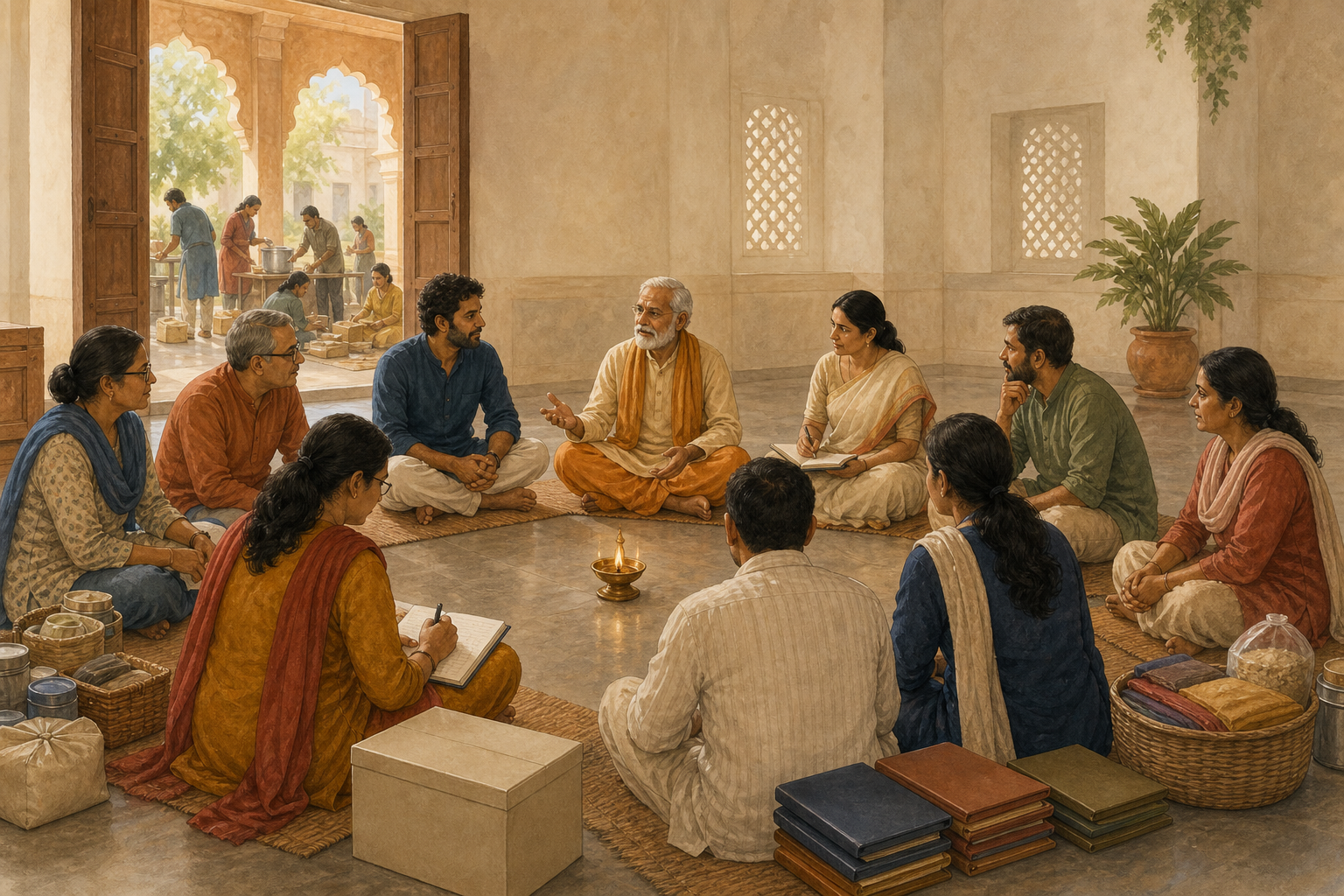
You have been asked to lead a temple committee, cultural initiative, advocacy effort or service project. A respected spiritual figure supports the work. Volunteers are ready. Yet an uncomfortable question remains: when should spiritual authority guide the decision, and when should the community insist on ordinary accountability?
You do not have to choose between leadership cut off from Dharma and leadership that treats a sacred title as an answer to every objection. The sounder path is to distinguish kinds of authority, test how power is used and turn every blessing into a duty of service.
Separate spiritual authority from organisational power

Confusion begins when a person is trusted in one role and therefore assumed to be authoritative in every role. A teacher may be qualified to guide sadhana without being the right person to approve accounts. A capable administrator may organise volunteers without being qualified to settle a doctrinal dispute. A generous donor may deserve gratitude without acquiring spiritual or institutional control.
Before an important discussion, identify the kind of authority each participant is exercising. One person may hold more than one role, but the roles should still be named separately.
| Kind of authority | Its proper contribution | Boundary to protect |
|---|---|---|
| Spiritual teacher or acharya | Formation, sadhana and ethical counsel | Spiritual standing does not automatically settle budgets, appointments or every operational dispute |
| Interpreter of a tradition | Explaining a teaching within a text, lineage or sampradaya | A lineage-specific position should not be presented as the uncontested voice of every Dharmic tradition |
| Organisational leader | Assigning work, managing resources and delivering an agreed mission | Operational control remains subject to records, review and a way to raise concerns |
| Community representative | Bringing the needs and consent of affected people into the decision | Popularity does not confer spiritual mastery or remove minority protections |
| Civic or public authority | Protecting welfare, fairness and public order | Official power must not turn spiritual counsel into compulsory devotion |
This separation does not diminish religious institutions. It helps them serve without being made responsible for work outside their proper scope. Akhadas have carried responsibilities connected with spiritual discipline, service and social guidance; an organisation receiving such guidance still has to govern its programme responsibly.
Use a simple meeting rule: anyone making a decisive recommendation should state the role from which it comes. Is this scriptural counsel, a practical judgement, an organisational instruction or a personal preference? That one distinction prevents reverence from being used to close questions that still require evidence and deliberation.
Test authority by the purpose and restraint of power
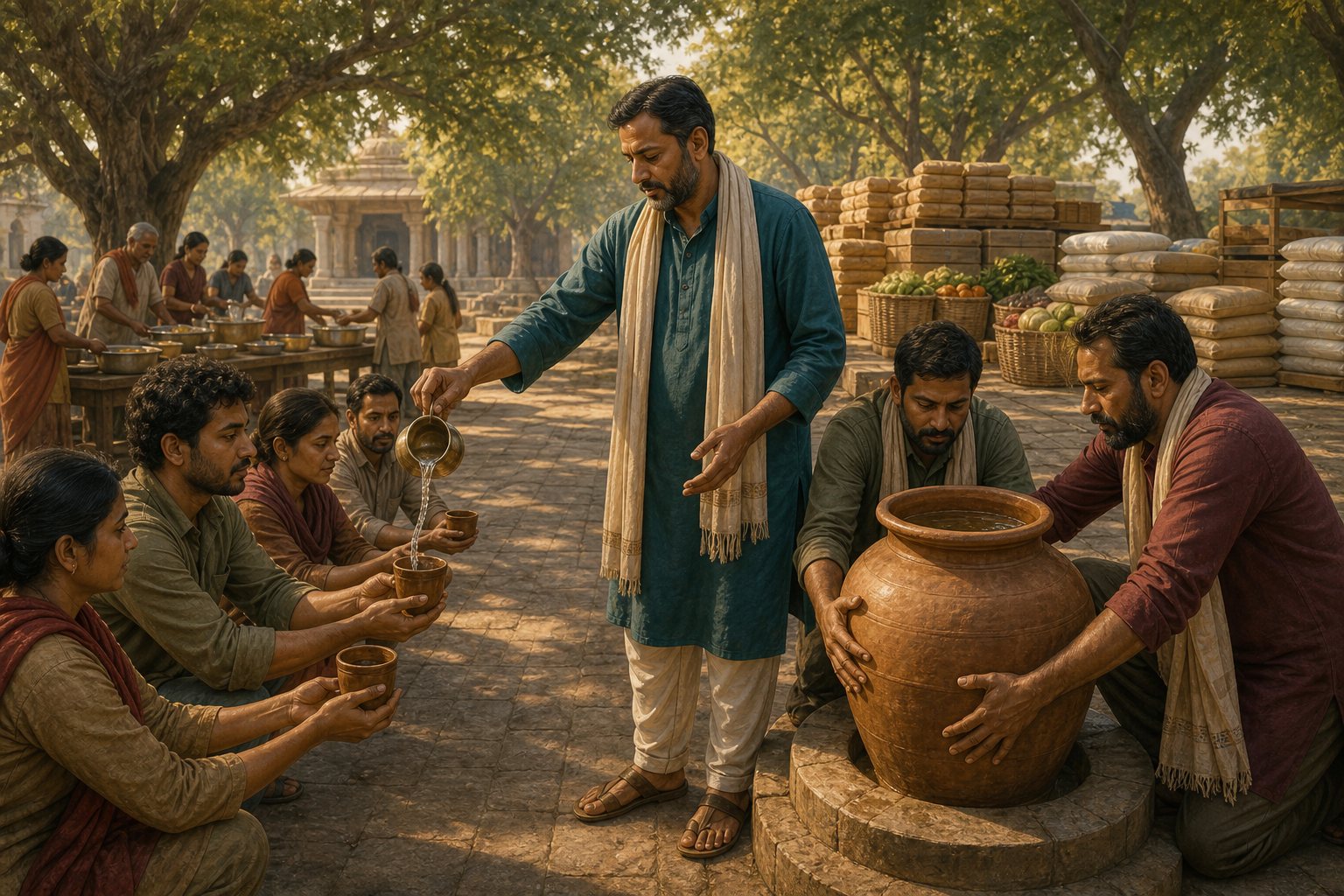
The narrative of Sri Parashurama confronts a recurring danger: rulers become proud of strength, reject ethical counsel and cease to place the welfare of the people above their own dominance. Its enduring principle is that power remains answerable to Dharma, wise counsel and the protection of society.
That principle is more demanding than loyalty to a religious identity. A leader does not become Dharmic merely by invoking Dharma, receiving public honour or opposing a group described as adharmic. You have to examine what the leader protects, what limits the leader accepts and whether the same ethical standard is applied to friends and critics.
- Name the good being protected. Replace broad claims about defending Dharma with a concrete purpose: safeguarding worship, serving people in need, preserving a tradition, teaching accurately or correcting a defined injustice.
- State the limit before acting. Ask what the leader or organisation will not do, even for a desirable goal. Truthfulness, non-injury, proportionality and respect for innocent people cannot appear only after harm has occurred.
- Apply the rule to allies. If misconduct is condemned only when an opponent commits it, the rule is serving a faction rather than Dharma.
- Look at who bears the cost. A decision is suspect when powerful people gain status while volunteers, vulnerable families or dissenting members absorb all the risk.
- Provide a route for correction. A trustworthy leader can explain who reviews a decision, how an error will be acknowledged and what remedy is available to someone treated unfairly.
The rajarshi ideal is useful here because it unites statecraft with self-restraint. The point is not that a ruler becomes sacred and therefore unquestionable. The ruler is expected to submit power to a discipline higher than appetite, pride or political convenience.
The same discipline matters whenever protection is invoked. Ahimsa does not require indifference to aggression, but the duty to protect does not erase restraint. Ask four questions before supporting a forceful response: What specific harm is occurring? What is the least harmful effective response? Who protects innocent people from foreseeable consequences? What condition ends the intervention? If no one can supply those limits, moral language is being used to widen power rather than govern it.
Make blessings create obligations, not immunity

A blessing can encourage service, connect an initiative to a living tradition and remind workers that outward action must rest on inward discipline. Its social value is clearest when it strengthens sadhana, compassion, seva and integrity in public life.
A blessing cannot by itself verify every factual claim, prove administrative competence, approve every future action or exempt an organisation from scrutiny. Treating it that way burdens the spiritual teacher and gives the organisation borrowed authority without corresponding responsibility.
After receiving counsel or blessings, record four lines before publishing photographs or announcements:
- Counsel received: Write the actual principle or direction, without enlarging it into a broader endorsement.
- Decision owner: Name the person or body responsible for the resulting organisational choice.
- Obligation created: Specify what will change in practice, such as stronger volunteer discipline, transparent use of resources or a defined seva commitment.
- Review point: State who will check whether the commitment was honoured and how concerns can be raised.
This record protects everyone. The elder’s words are less likely to be exaggerated. Organisers cannot hide operational choices behind a sacred name. Volunteers know where responsibility lies. The public can distinguish spiritual encouragement from a guarantee of every claim made by the organisation.
Use an additional safeguard when money, appointments, personal data or physical safety are involved: the person offering spiritual counsel should not be treated as the sole operational approver merely because of spiritual rank. Require the ordinary controls appropriate to the decision, including a written record, a second responsible reviewer and a clear remedy for misuse. Accountability does not show a lack of shraddha. It keeps reverence from being exploited.
Build Dharmic unity without erasing real differences

Hindu, Buddhist, Jain and Sikh communities can cooperate around compassion, responsibility, non-injury, justice, seva and social welfare. They do not interpret every principle in precisely the same way, and they do not share a single institution of religious authority. Good social leadership starts with that honesty.
Unity should mean coordinated action where genuine agreement exists, not a demand that every tradition surrender its vocabulary, discipline or internal authority. A Hindu leader cannot declare a Jain position on behalf of Jains. A shared platform should not use a Sikh presence as ceremonial proof of inclusion while excluding Sikh participants from decisions that affect them. Nor should disagreement over doctrine prevent cooperation on a clearly bounded work of public service.
For a joint initiative, prepare a one-page Dharmic compact with these elements:
- One defined mission. State the work in a sentence that every participating community can accept.
- Shared rules of conduct. Include truthful communication, non-denigration, protection of vulnerable people and honest stewardship of resources.
- Tradition-specific boundaries. Record practices that cannot be made compulsory, including worship, food, dress, doctrinal language or representation by another community.
- A decision rule. Specify which matters require consensus, which can be delegated and who may speak publicly for the initiative.
- A grievance route. Give participants a named contact and a process for reporting coercion, misrepresentation or unfair treatment.
- A review date. Revisit the compact after the first substantial phase of work, before temporary habits become an unchallengeable hierarchy.
You can detect false unity by its response to questions. If a request for accurate representation is condemned as disloyalty, or if a respected name is used to silence those affected by a decision, the initiative has confused harmony with obedience. Real Dharmic cooperation can survive clarification because its unity rests on service and principle rather than ambiguity.
Key takeaways
- Ask which kind of authority is being exercised before accepting a decision.
- Judge Dharmic leadership by its purpose, restraint, fairness and willingness to correct error.
- Do not turn a spiritual blessing into proof of operational competence or unlimited endorsement.
- Record the counsel received, the person responsible, the obligation created and the review process.
- Build cooperation across Dharmic traditions through a bounded mission and explicit safeguards, not by pretending that every tradition is institutionally or doctrinally identical.
At your next leadership meeting, ask each decision-maker to name both the authority being exercised and the constraint that comes with it. Then record who decides, who may be harmed, who can object and when the choice will be reviewed. That small discipline turns Dharma from a claim of status into a standard of service.
References
- Dandavats — Discover Parashurama’s Proven Revolution: How Dharma Transformed Kingship and Society
- Hindu Jagruti Samiti — Essential Milestone: HJS Receives Blessings from Mahamandaleshwar Swami Avdheshanand Giri
