
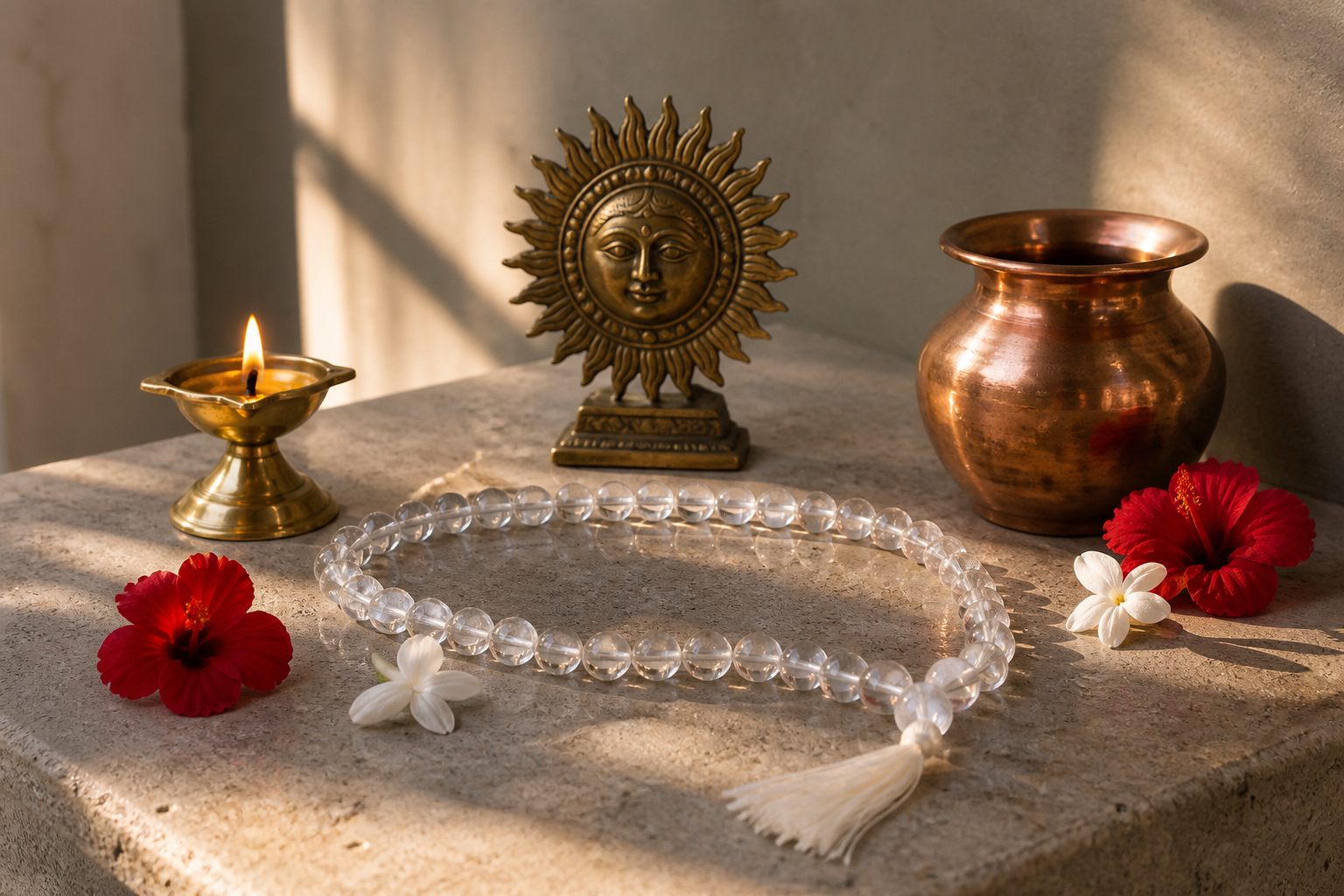
You may have a sphatika crystal or mālā on your Surya altar and still wonder what it is meant to do. Is it an object of worship, a support for japa, a symbol of purity, or simply a beautiful way to catch the morning light?
Its most useful role is surprisingly disciplined: sphatika gives you a visible image of the clear mind with which Surya should be approached. Used carefully, it can connect the outer ritual of dawn worship with the inner work of attention, discernment, and steadiness.
Why a clear crystal belongs beside Surya
Surya illuminates. Sphatika receives and transmits light. Their relationship is therefore not based on visual resemblance: the crystal does not look like the sun. It expresses what illumination reveals. When light passes through a clear crystal, concealed surfaces, reflections, and subtle changes become visible. In worship, this gives physical form to the movement from confusion toward discernment.
Sphatika is traditionally associated with sattva: clarity, composure, transparency, and truthfulness. This does not mean that possessing a crystal automatically makes the mind sattvic. It means that the crystal can remind you what to cultivate. If resentment, haste, or distraction accompanies you to the altar, its clarity places a quiet question before you: what is colouring the mind through which you are seeing this day?
A familiar philosophical analogy deepens the point. A clear crystal placed near a coloured object can appear to assume that colour while remaining unchanged in itself. In the same way, pure awareness appears entangled in changing thoughts, emotions, and circumstances without being reducible to them. Surya represents the light by which those changes are known; sphatika represents the clarified medium through which that light is recognised.
There is also a traditional balance of qualities. Surya carries tejas, the force of heat, brilliance, courage, and vigorous action. Sphatika is associated with śīta, a cooling and settling quality. The pairing does not weaken Surya’s radiance. It suggests radiance without agitation: intelligence that is bright but not feverish, confidence that does not become aggression, and discipline that does not harden into strain.
Treat these as ritual and contemplative meanings, not as laboratory measurements or medical promises. A crystal’s visible interaction with light can help anchor attention, but it does not by itself prove claims about healing, invisible energy, or guaranteed spiritual results. The dependable transformation comes through regular worship, ethical conduct, and the quality of attention you bring.
Light also serves as a metaphor for wisdom and awakening across Hindu, Buddhist, Jain, and Sikh traditions. That resonance need not erase their differences or imply that they perform the same ritual. It shows how several Dharmic paths can recognise illumination, disciplined awareness, and moral clarity as shared aspirations.
Arrange the altar so the crystal supports attention
A sphatika altar works best when it is visually simple. If the crystal disappears among ornaments, artificial lights, and unrelated objects, it cannot perform its practical role as a point of collected attention. Give it a defined place near the image, symbol, or written mantra of Surya.
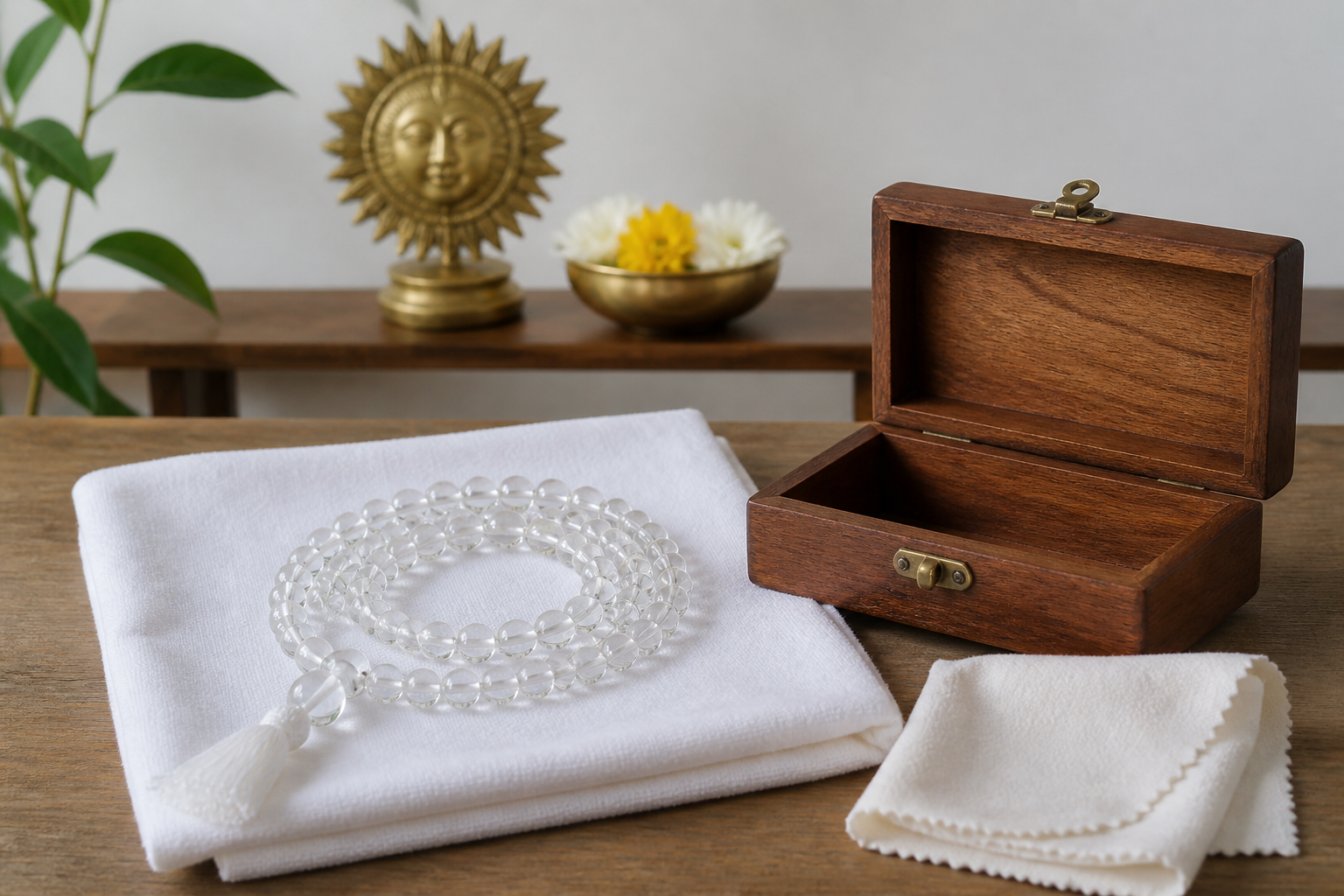
- Place the sphatika on a clean cloth or another clean, stable surface. It should not roll, wobble, or require adjustment once worship begins.
- Keep it close enough to the Surya image or mantra that your gaze does not have to wander between disconnected parts of the altar.
- Arrange the space so gentle dawn light can reach the altar. You are looking for a calm luminosity, not the strongest possible glare.
- Set out the vessel for arghya before beginning. Removing small interruptions helps the ritual proceed as one coherent act.
- Sit or stand where you can maintain a relaxed gaze toward the altar without looking directly at the sun.
After arranging the space, observe it from your normal place of worship. If a sharp reflection makes you squint, reposition the crystal. If moving highlights repeatedly pull your eyes away from the mantra or image, soften the incoming light or change the angle. The purpose is one-pointedness, not an optical display.
Do not practise direct sun-gazing. Surya worship does not require staring at the solar disc. Welcome the mild light of dawn into the worship space, offer arghya with reverence, and let the altar mediate your visual attention safely.
Follow a dawn sequence you can sustain
The most natural setting for this practice is dawn, when the emergence of daylight enacts the meaning of the worship. A household sequence can remain simple. Complexity is not a measure of sincerity, and an elaborate routine that you repeatedly abandon is less useful than a modest one you can maintain.
- Prepare yourself and the worship space with ordinary cleanliness. Place the sphatika, mālā, mantra text, and arghya vessel before you begin.
- Offer arghya to the rising sun without trying to stare at it. Let the offering mark the transition from ordinary morning activity to deliberate worship.
- Return your attention to the Surya image or mantra and allow the breath and posture to settle.
- Choose one established recitation for that sitting. The Surya Gayatri and verses from the Aditya Hridayam are familiar options; use the form you know and can pronounce with care.
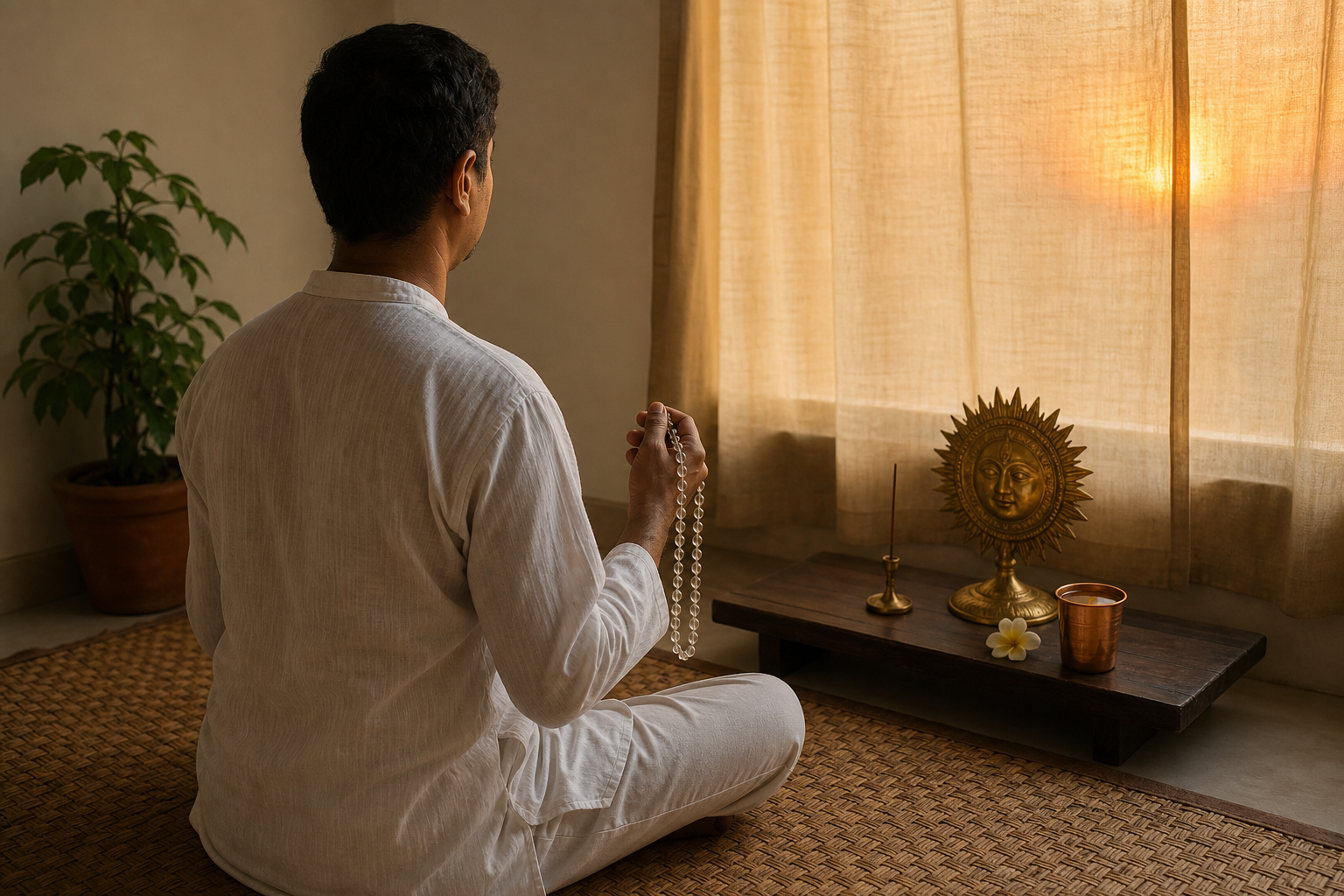
- If you use a sphatika mālā, begin japa without rushing the beads. Let each bead return the mind to the mantra whenever attention drifts.
- Close by identifying one Surya-like quality to carry into the day: clarity in a decision, steadiness in duty, honesty in speech, or disciplined use of time.
The household pattern of dawn arghya followed by japa with a sphatika mālā joins an outward offering to an inward discipline. Arghya acknowledges the visible giver of light. Japa then asks whether your own mind can become less scattered and more transparent to what is true.
If your lineage or teacher gives a particular mantra, sequence, or count, follow that instruction. Otherwise, do not invent a demanding count merely to make the practice feel impressive. Choose a stable recitation and give it full attention. The mālā is a structure for continuity; it is not a substitute for presence.
On a crowded morning, preserve the order even if the practice must be shorter: prepare, offer, recite, and close deliberately. This keeps Surya worship from becoming either a hurried gesture or an occasional ceremony dependent on ideal conditions.
Turn the crystal into contemplation, not decoration
Once the basic ritual is steady, sphatika can support a short contemplation. Look at the crystal without straining and notice three things: it receives light, it appears affected by what surrounds it, and it does not need to generate light of its own. Then apply those observations to the mind.
- When the crystal receives light: ask whether you are willing to see an uncomfortable truth clearly, rather than only seeking reassurance.
- When it appears coloured by its surroundings: notice which emotion, opinion, or social pressure is colouring your judgement.
- When it remains clear beneath changing appearances: return to the witnessing awareness in which those mental states arise and pass.
- When it catches a soft highlight: recall that discernment should reveal your next duty, not remain an attractive idea on the altar.
This contemplation should be brief enough to sharpen the ritual rather than replace it. If you spend the entire sitting chasing reflections, the aid has become a distraction. Return to the mantra. Sphatika has fulfilled its purpose when it helps the mind settle and then becomes unobtrusive.
Care for the object in the same spirit. Periodically rinse the crystal with clean water and dry it gently. Keep it on a clean surface, handle it mindfully, and reserve it for sacred use if that is the discipline you have adopted. The immediate benefit of this care is not mysterious: repeated acts of cleanliness and order protect the devotional atmosphere and train you to approach worship deliberately.
Watch for four common mistakes. Do not treat sphatika as a charm that performs devotion on your behalf. Do not mistake glare for spiritual intensity. Do not turn the traditional language of cooling and radiance into unsupported health claims. And do not let anxiety about obtaining a flawless or expensive crystal displace arghya, mantra, reverence, and conduct. The object serves the sādhana; the sādhana does not serve the object.
Key takeaways
- Sphatika represents a mind made clear enough to receive Surya’s illumination without distortion.
- The traditional pairing balances Surya’s tejas with the crystal’s settling śīta quality: brilliance with composure.
- Place the crystal near the Surya image or mantra where gentle dawn light can reach it without producing uncomfortable glare.
- A practical sequence is preparation, arghya, settled attention, mantra or japa, and a deliberate resolve for the day.
- Never stare directly at the sun; the ritual does not require sun-gazing.
- Keep sphatika clean and sacred, but do not treat it as a replacement for devotion, ethical discipline, or attentive recitation.
At your next dawn worship, make one adjustment rather than redesigning the entire ritual. Clear the altar, position the sphatika in soft light, and choose one quality of Surya to practise after the lamp, water, mantra, and mālā have been put away. That is where the crystal’s symbolism becomes lived dharma.
References
