
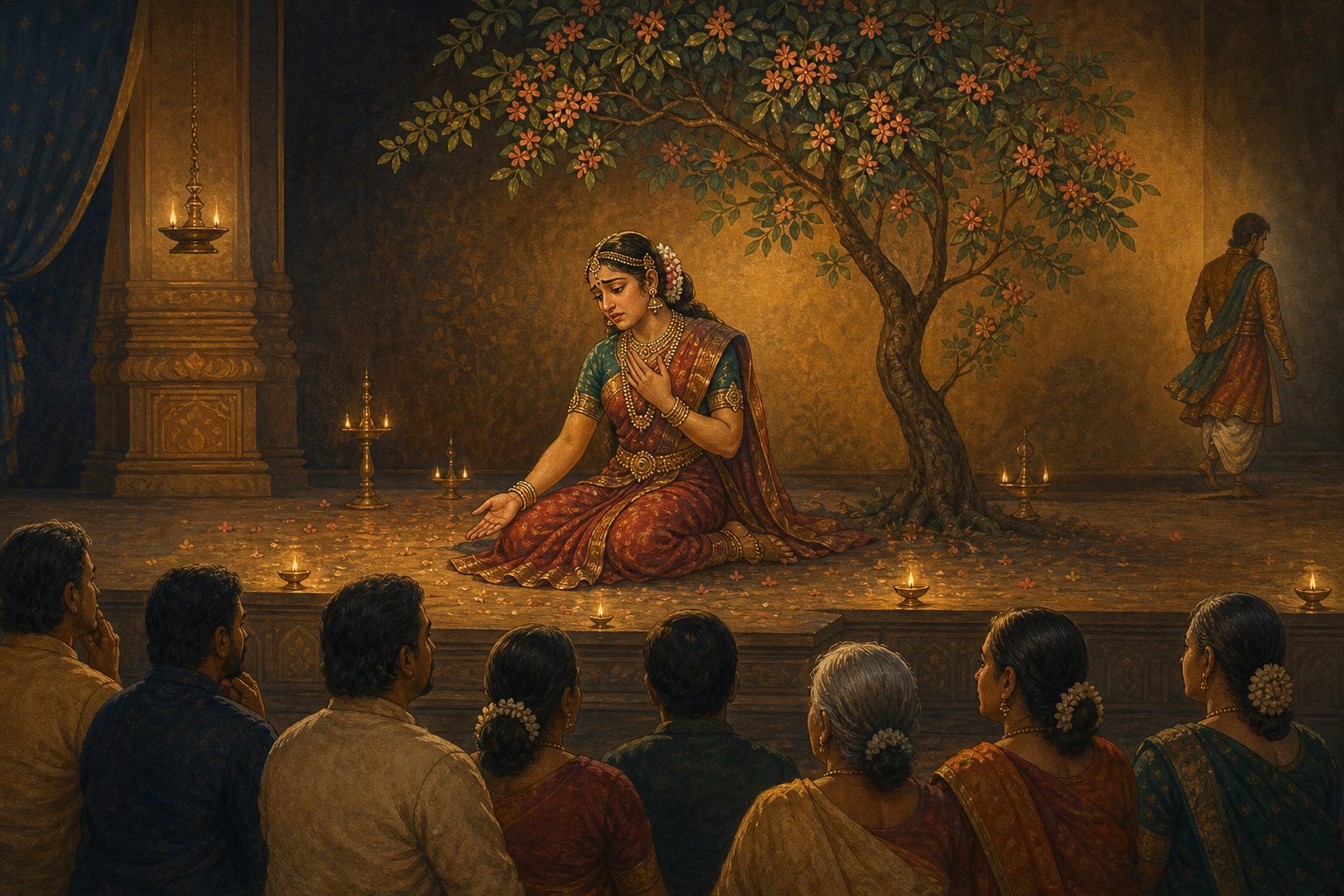
You know the experience: a performance presents grief, longing, wonder, or laughter that does not belong to your own life, yet you feel it deeply. You are moved without mistaking the stage for reality. When the performance ends, the emotion may leave clarity rather than the practical burden that ordinarily accompanies grief or desire.
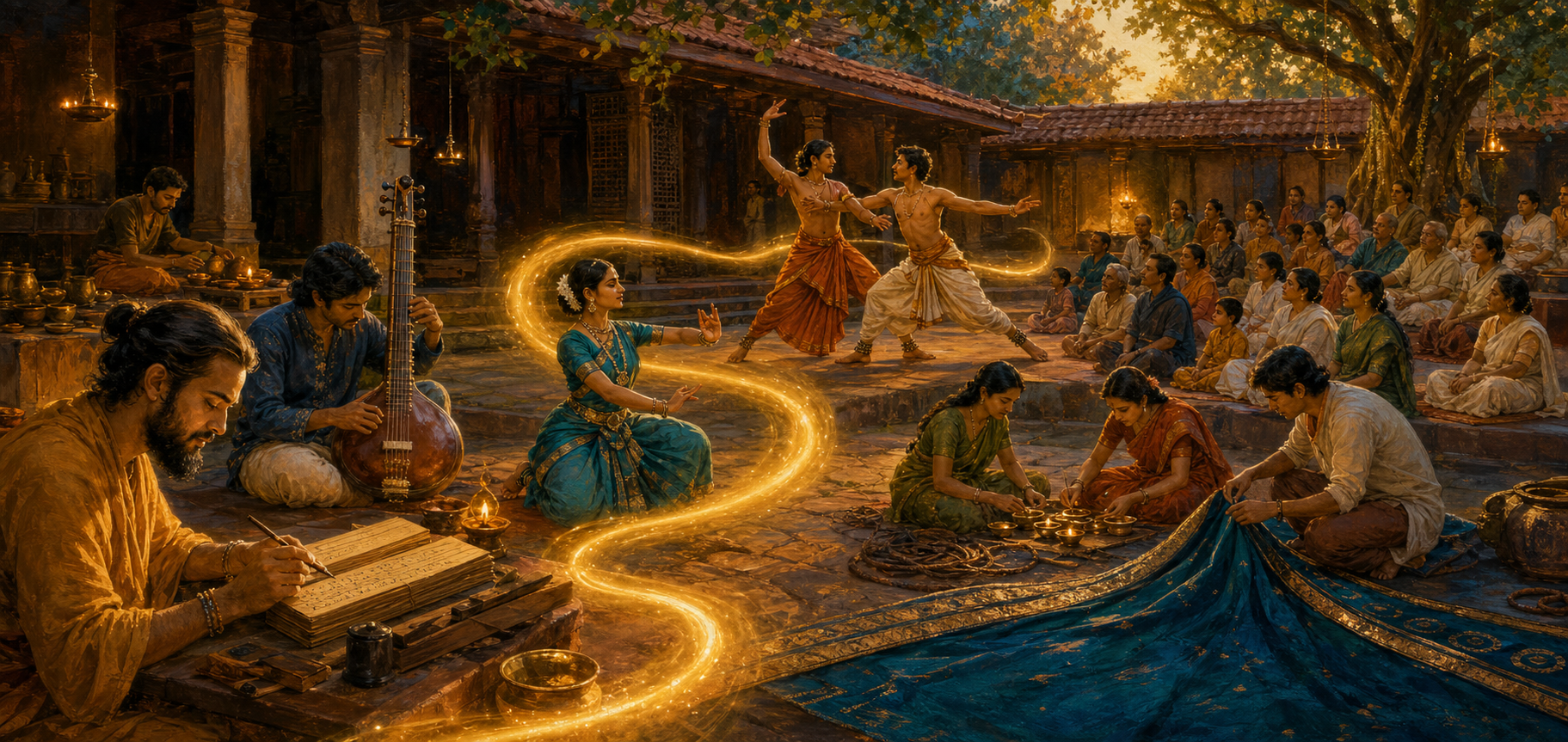
Bhatta Nayaka’s theory of rasa explains this apparent contradiction. Art does not simply transmit a character’s private emotion to you. It transforms represented feeling into something you can share and savor without having to possess it. Once you understand that transformation, you can read poetry, watch theatre, listen to kirtan, or evaluate a performance with much greater precision.
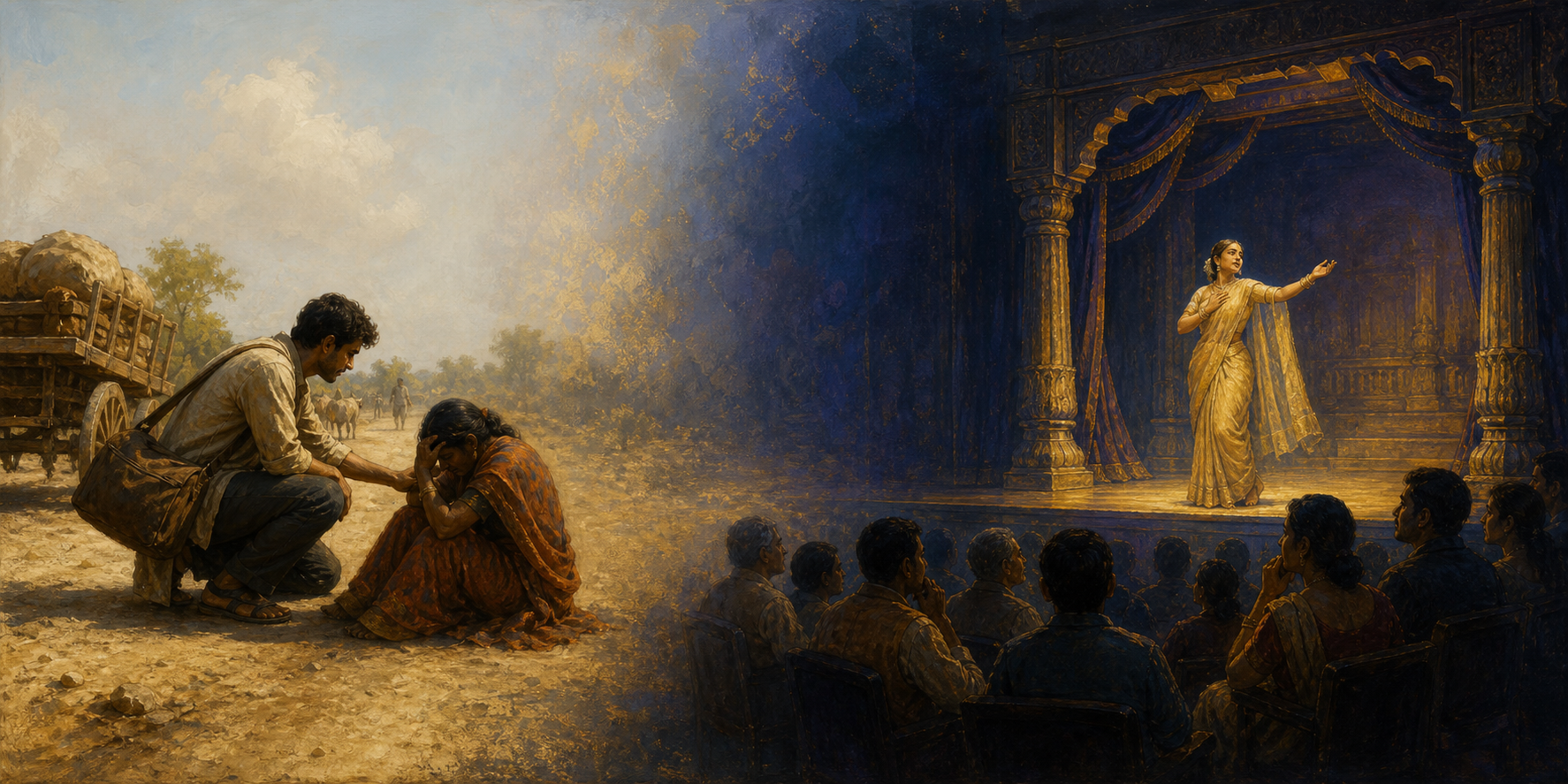
The problem: you feel the emotion, but it is not your emergency
Within the dramatic framework associated with Bharata’s Natyashastra, an emotional presentation involves vibhava, anubhava, and vyabhicari-bhava. Vibhava supplies the determinants: the people, objects, circumstances, and relationships around which a feeling develops. Anubhava comprises the perceivable consequences or expressions of that feeling. Vyabhicari-bhavas are the shifting, transitory states that support and deepen the dominant mood.
These elements help you understand how a scene is composed. They do not, by themselves, explain why its emotional result is aesthetic rather than ordinary. A represented bereavement does not impose the duties of an actual bereavement on you. A staged conflict does not place you in physical danger. The situation can move you profoundly while leaving you free from the need to intervene.
Bhatta Nayaka therefore rejects the claim that rasa is produced in the same manner as an ordinary effect. The represented determinants and consequences are not operating as immediate worldly causes in the spectator’s life. The person before you may be an actor, the palace may be a stage, and the crisis may belong to a remembered sacred narrative. Yet rasa is present. Ordinary cause and effect cannot adequately describe what has occurred.
Inference is also insufficient. You may infer from a trembling voice and downcast face that a character is grieving, but that conclusion is not yet karuna rasa. Recognition tells you what the character feels. Aesthetic experience begins when that intelligible feeling becomes available for direct relish. If inference were enough, identifying the emotion would be equivalent to experiencing the work. Plainly, it is not.
This distinction is the heart of Bhuktivada. Rasa is not manufactured as a new worldly event, nor is it merely deduced as a proposition. It is bhukti: a distinctive enjoyment or savoring. The enjoyment is alaukika, or non-ordinary, because the emotion has been released from the practical claims, personal ownership, and immediate consequences that govern ordinary life.
Bhatta Nayaka’s own Hridaya Darpana is no longer extant, so his position has to be reconstructed through quotations preserved by later thinkers. Even in that reconstructed form, its intervention is clear: the central question is not merely how a work signifies emotion, but how signified emotion becomes something a responsive spectator can savor.
From a represented situation to bhukti: a five-movement map
The following sequence is a practical way to follow the theory. It is not a claim that Bhatta Nayaka presented his ideas as a numbered procedure. Use it to notice where an ordinary emotional description becomes an aesthetic experience.
- The work gives emotion a concrete form. A narrative, poem, dance, or song presents determinants, expressive consequences, and changing supporting states. Without these particulars, there is no shaped mood to encounter.
- Bhavakatva transforms the presentation. Poetic or performative expression loosens the emotion from a narrowly personal setting. The feeling remains embodied in a particular scene, but it is no longer confined to one individual’s private possession.
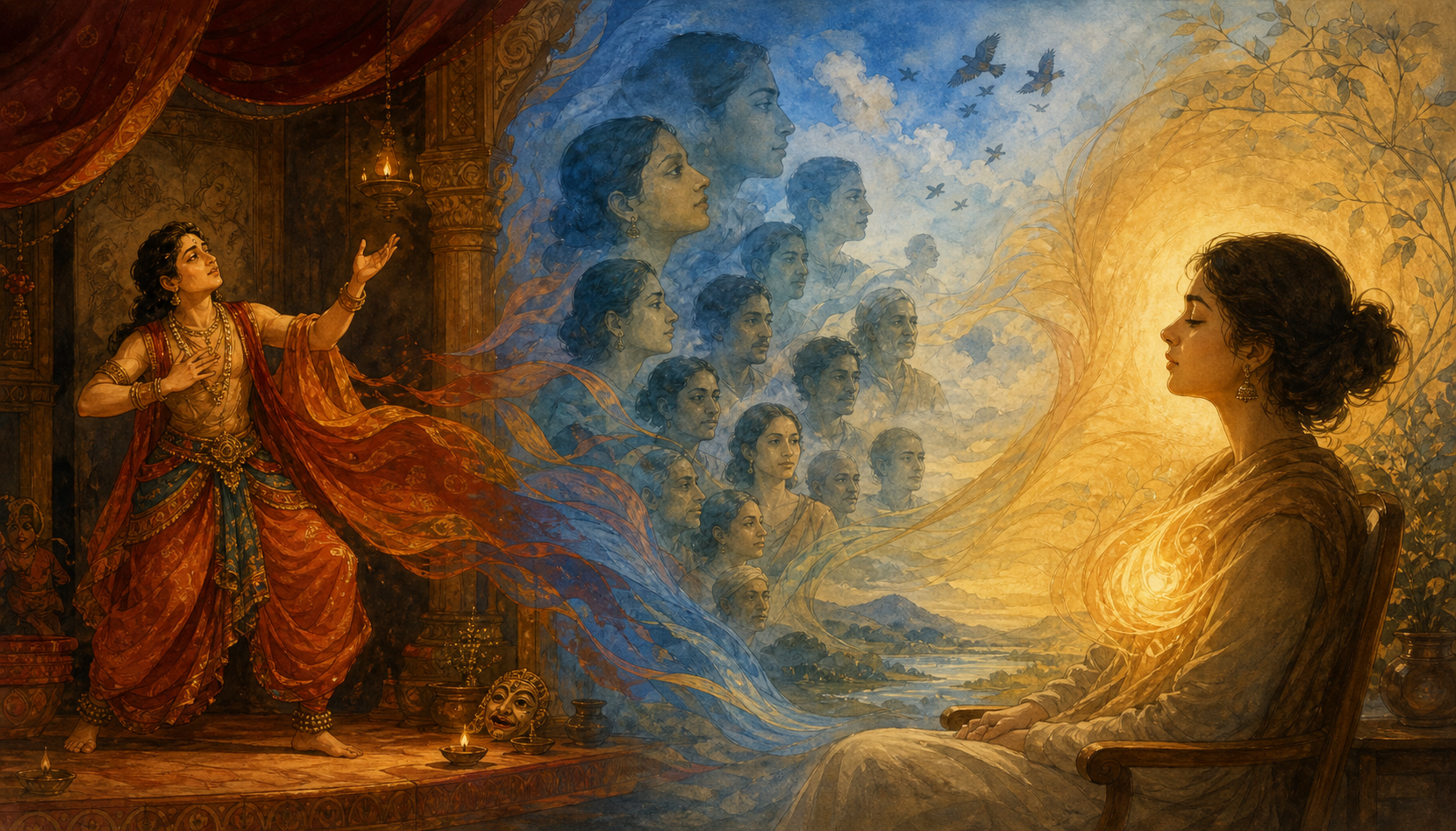
- Sadharanikarana makes the feeling shareable. The emotion is universalized or rendered common. The spectator does not have to become the represented person or reproduce that person’s biography. What was particular becomes accessible as a humanly intelligible field of feeling.
- Bhojakatva enables receptive savoring. A sensitive spectator, the sahridaya, can receive the universalized mood. This is not passive consumption. Attention, responsiveness, and freedom from immediate self-interest allow the presentation to be relished.
- Bhukti is the resulting aesthetic enjoyment. The spectator experiences the mood directly as rasa. The outcome may be tender, sorrowful, comic, wondrous, or otherwise emotionally charged, yet it is enjoyed in a mode different from ordinary pleasure and pain.
Bhavakatva and bhojakatva answer different sides of the same question. Bhavakatva concerns what artistic expression does to represented emotion. Bhojakatva concerns the spectator’s capacity to savor the transformed presentation. Sadharanikarana describes the decisive release from limiting ownership: not simply “his grief” or “my grief,” but grief made available for shared contemplation.
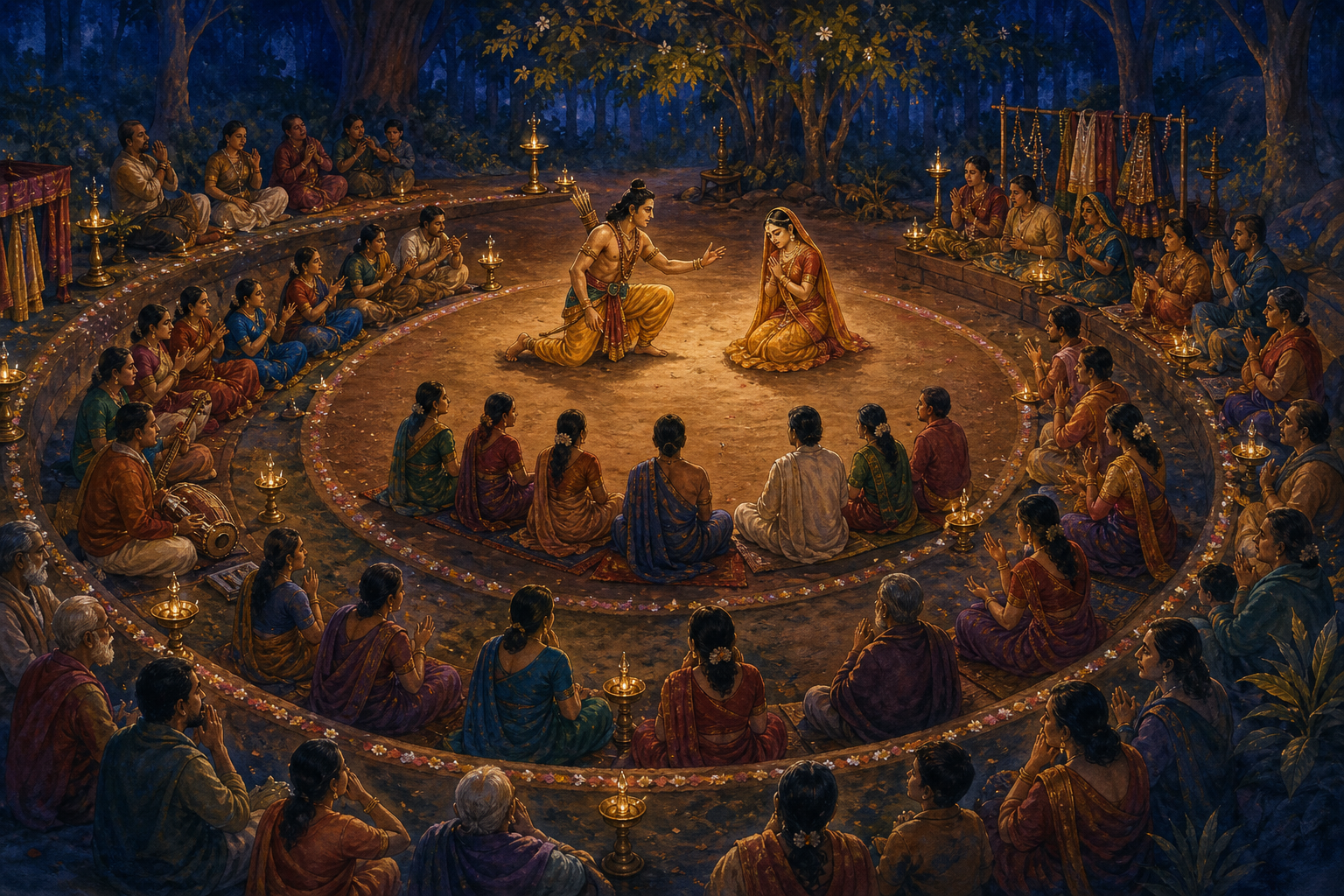
Universalization does not erase the scene’s particulars. A Ramayana performance still has recognizable characters, relationships, gestures, and circumstances. If all particularity disappeared, the work would lose the very form through which its mood becomes perceptible. What falls away is not artistic specificity but the demand that the emotion remain locked inside one person’s practical situation.
Alaukika should therefore not be treated as a loose synonym for supernatural. It identifies a non-ordinary relationship between you and the feeling presented. A familiar emotion can become alaukika when it is experienced without the usual pressure to acquire, escape, defend, repair, or act. You remain emotionally involved, but the involvement is contemplative and relishable rather than possessive.
How to recognize the process in an actual performance
You do not need to turn every performance into a technical exercise. Let the work act first. Afterwards, use four questions to distinguish emotional recognition from rasa.
- What organized the mood? Identify the central circumstances or vibhavas. Then notice the anubhavas through which the feeling became visible or audible, along with the transitory states that complicated it. This keeps your interpretation anchored in the performed work rather than in a mood label imposed from outside.
- Did you merely identify the emotion, or did you savor it? “This character is sorrowful” is an inference. Karuna rasa requires more: the sorrow becomes present to you as an aesthetically relishable mood. The difference is similar to knowing the name of a melody and actually hearing its movement.
- What happened to personal ownership? Notice whether the feeling remained trapped as somebody else’s problem or awakened one of your own private memories. Rasa appears most clearly when neither form of possession dominates. The emotion feels intimate without becoming exclusively autobiographical.
- What practical demand remained? Ordinary fear urges escape; ordinary grief may require action; ordinary desire seeks an object. In aesthetic experience, the mood can be sustained without forcing the corresponding worldly response. That suspension is one sign that the experience has become non-ordinary.
This method works with a Ramayana enactment, a Sattriya recital, a Yakshagana play, or devotional kirtan. It also helps when a performance does not move you. Instead of concluding vaguely that it lacked emotion, inspect the chain. Were the determinants intelligible? Did gesture, voice, rhythm, or language make the emotional consequences perceptible? Did the presentation open the mood beyond an isolated character, or did it merely demand that the audience react?
For a performer or writer, the same questions become diagnostic. More explanation will not necessarily create rasa. If the mood is weak, first examine whether its circumstances, expressions, and supporting states form a coherent pattern. If the audience understands the situation but remains untouched, the problem may lie in bhavakatva: the emotion has been described, but not transformed into something shareable. If the presentation is strong but the audience is distracted or narrowly self-absorbed, bhojakatva is the missing side of the encounter.
For a teacher or critic, this framework prevents a common shortcut. Do not stop at “the scene represents grief” or “the song expresses devotion.” Ask how the composition carries the spectator from representation to relish. That question directs attention to the actual operation of language, performance, and reception.
Four misreadings that obscure Bhatta Nayaka’s insight
Bhukti does not mean that every rasa feels pleasant
Aesthetic enjoyment is broader than liking what happens. Karuna does not require approval of suffering, and a distressing event does not become ethically good because it appears in art. What is enjoyed is the fully formed experience of the mood, freed from the immediate burden of undergoing that event in ordinary life. “Relish” is therefore more accurate than simple pleasure.
Universalized emotion is not generic emotion
Sadharanikarana does not reduce every story to a vague message such as “everyone feels sad sometimes.” A generic summary strips away artistic force. Universalization works through the concrete presentation, not in place of it. The particular performance matters because it gives the shareable feeling its texture, rhythm, and direction.
A shared field does not require identical reactions
Sahridayas need not bring identical memories or temperaments to a performance. Shared accessibility is not mechanical uniformity. The claim is that artistic transformation allows the mood to exceed one private biography and become available to responsive spectators. The theory explains common participation without pretending that every person has the same inner history.
Aesthetic and spiritual experience should not be collapsed
Bhatta Nayaka stands historically after Anandavardhana’s account of dhvani, or suggestion, and before Abhinavagupta’s influential synthesis. Abhinavagupta later described rasa as brahmananda-sahodara, akin to the bliss of Brahman. “Akin to” matters. The comparison points to a resemblance between ego-lightened aesthetic savoring and spiritual bliss; it does not make every powerful performance identical to liberation or spiritual realization.
This restraint also helps when using Bhuktivada across Dharmic traditions. Hindu narrative theatre, Buddhist avadana storytelling, Jain rasa performance, and Sikh kirtan have distinct histories, teachings, and sacred purposes. Bhatta Nayaka’s framework can illuminate how story, performance, and song create a shared field of feeling without claiming that these traditions are doctrinally interchangeable.
When you encounter an unfamiliar Dharmic art, begin with its aesthetic operation before reducing it to a sectarian label. Ask what mood is being shaped, how personal stakes are being universalized, and what kind of attention the gathering makes possible. This approach can reveal a genuine family resemblance among Dharmic practices while preserving their differences.
Key takeaways
- Bhatta Nayaka explains rasa as bhukti, a direct and non-ordinary savoring of emotion, rather than an ordinary effect or a logical inference.
- Vibhava, anubhava, and vyabhicari-bhava shape the represented emotional situation, but they do not operate as immediate worldly causes in the spectator’s life.
- Bhavakatva is the transformative power through which poetic or performative expression releases emotion from narrow personal limitation.
- Sadharanikarana makes the shaped emotion common or shareable without erasing the particular characters, circumstances, and forms that embody it.
- Bhojakatva is the responsive spectator’s capacity to savor the universalized mood as rasa.
- You can test the framework by separating recognition from relish and asking whether the emotion remains vivid after its ordinary practical demands have receded.
At your next performance, resist the urge to decide immediately whether the story was realistic or whether its characters behaved as you would. First notice the moment when their emotion ceases to be merely theirs without becoming merely yours. That transition from possession to shared savoring is where Bhatta Nayaka asks you to look for rasa.
References
