

Your question probably isn’t whether bhakti sounds beautiful. It is whether a distracted person with duties, recurring faults, and an unstable mind can genuinely move toward moksha now—or whether Kali Yuga has made serious sadhana impossible.
The Dharmic answer is demanding and hopeful: the path has become more accessible, not automatic. You don’t have to imitate the spiritual conditions of another age. You have to train remembrance under the conditions of this one, let it correct your conduct, and leave room for grace to accomplish what willpower alone cannot.
Kali Yuga makes the path simpler, not spiritually cheaper
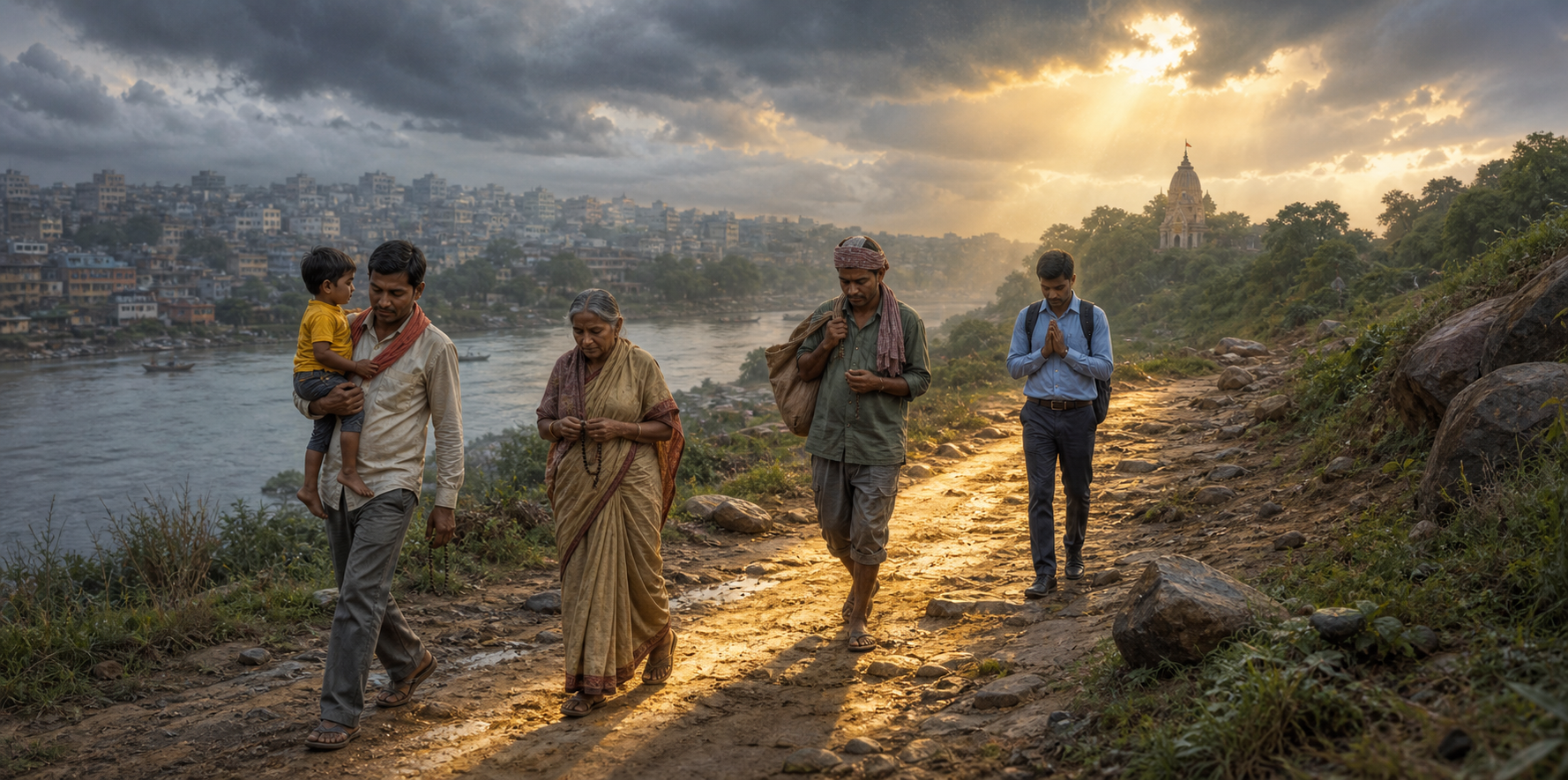
The traditional yuga framework associates Satya Yuga with deep meditation, Treta Yuga with yajna, Dvapara Yuga with ritual worship, and Kali Yuga with nama-japa, kirtana, and heartfelt bhakti. This is an adaptation of practice to human capacity. It is not permission to abandon discipline.
A restless mind has difficulty sustaining the prolonged contemplation associated with a more sattvic age. It can still pronounce, hear, remember, and return to the Divine Name. That return is small enough to repeat in an ordinary day and deep enough to expose the habits that keep the mind bound.
This is why calling Kali Yuga the “fastest” route to liberation needs care. It does not give you a calendar for moksha. It describes the speed with which sincere practice can weaken vasanas—the tendencies, attachments, and reactions that repeatedly pull consciousness outward. A few emotionally intense days cannot establish that this purification has occurred. Its evidence appears in what you desire, how you respond under pressure, and whether remembrance survives inconvenience.
The Kali-Santarana Upanishad places special weight on the Divine Name, while the Bhagavata Purana praises kirtana as a means of freedom in this age. The Bhagavad Gita affirms that a simple offering made with devotion can become spiritually transformative. Their practical implication is not that complexity is bad. It is that lack of wealth, leisure, ritual expertise, or an ideal social environment need not bar you from beginning.
Key takeaways
- Kali Yuga lowers the practical barrier to sadhana; it does not lower the ethical standard.
- The Divine Name gives a distracted mind one clear place to return.
- “Fast” means that bondage can be loosened through wholehearted practice, not that liberation arrives on a predictable schedule.
- Bhakti should work with duty, self-examination, sacred learning, and service.
- Grace is not proved by getting the outcome you requested.
Grace begins where bargaining with God ends
Many seekers quietly treat devotion as a transaction: “If I chant faithfully, this illness, conflict, failure, or uncertainty should be removed.” When relief comes, they call it grace. When it does not, they conclude that their bhakti was inadequate or that the Divine did not respond.
That test is too narrow. Moksha is freedom from bondage, not the successful management of every circumstance. A desired result may come through ordinary means, arrive through an unexpected turn, or not come in the form you wanted. Grace can operate within any of those outcomes by weakening fear, pride, resentment, or the demand to control what cannot be controlled.
Effort and grace therefore aren’t rivals. Your effort turns attention toward the Divine, restrains harmful action, fulfils legitimate duties, studies what is true, and returns after failure. Grace is not a wage earned by that work. It is the unowned help through which remembrance deepens, insight becomes possible, the ego’s grip softens, and a person finds strength that cannot be reduced to self-congratulation.
Karma yoga purifies, bhakti makes the heart receptive, and jnana illumines. Treating one as an excuse to neglect the others distorts the path. Action without surrender can become an egoic campaign for control. Surrender without responsible action can become avoidance. Learning without devotion can inflate pride, while devotion without reflection can mistake impulse for Divine instruction.
When you face a difficult decision, bring surrender down from abstraction by asking three questions:
- What is mine to do? Name the duty, repair, truthful conversation, or act of restraint that dharma requires from you.
- What result am I trying to control? Be specific about the approval, victory, security, vindication, or relief you are demanding.
- Can I offer that result without reducing my effort? Do the work fully, but stop making the Divine responsible for satisfying your preferred script.
This is a usable form of surrender. It does not ask you to become passive. It asks you to release possessiveness over the fruit while remaining accountable for the action.
Build a rule of bhakti that can survive your actual day
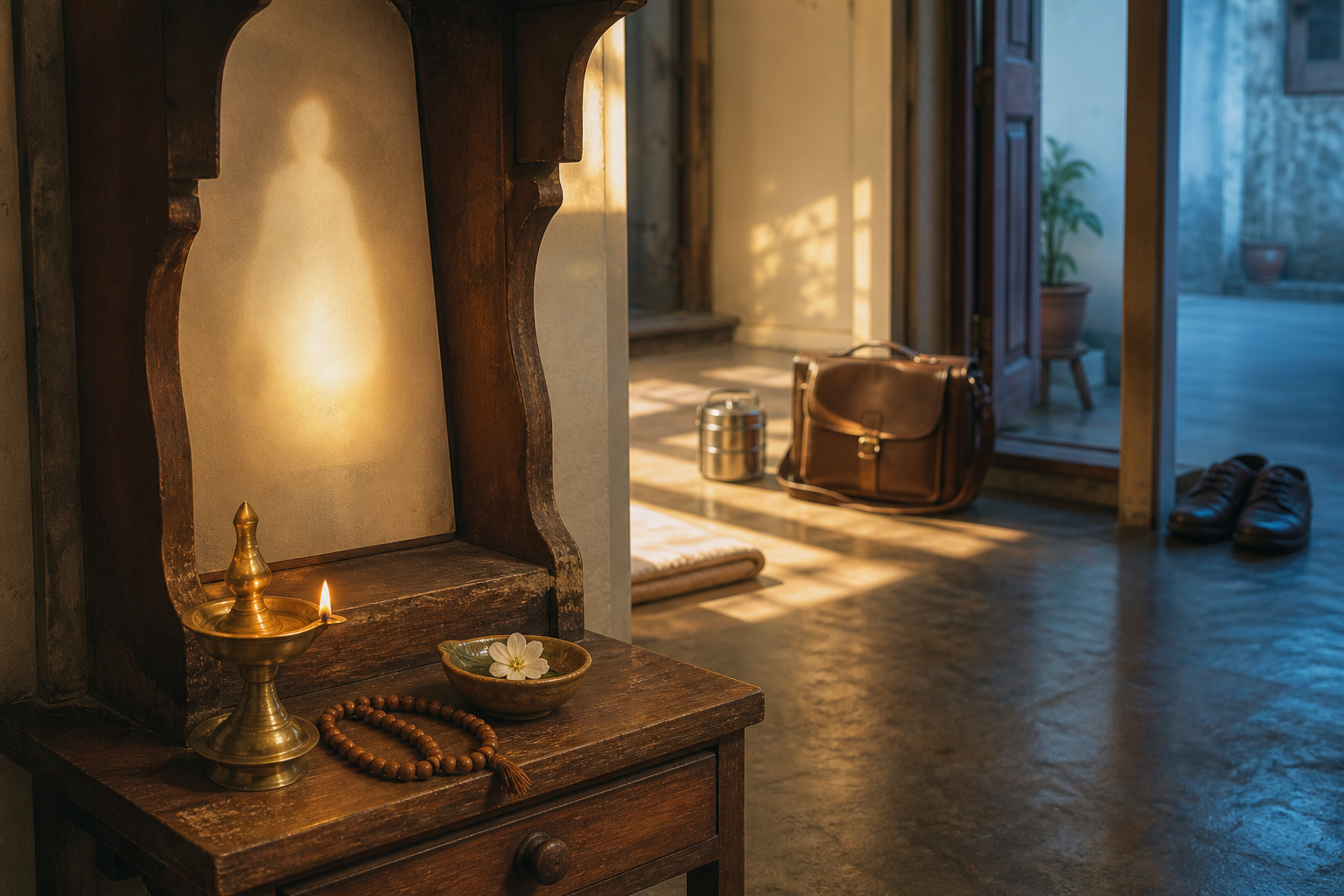
A practice designed for your ideal day will disappear on an ordinary one. Kali Yuga sadhana must be portable enough for work, caregiving, travel, fatigue, and interruption. The answer is not endless simplification. It is a small structure with clear anchors.
- Choose one stable object of remembrance. Use the Divine Name or mantra received through your tradition. If you have formal instruction from a guru, follow it rather than assembling a private mixture whenever novelty fades. Stability lets the practice reveal your mind instead of continually entertaining it.
- Attach japa to an event that already happens. Dawn, the beginning of a commute, a regular walk, or the period before sleep can serve as the cue. Decide on a modest count or a short fixed period that you can maintain. Increase it only after regularity is real.
- Protect the opening repetition from incoming noise. When possible, complete your first practice before messages, headlines, and arguments occupy the mind. The purpose is not to declare technology impure. It is to give remembrance the first claim on attention.
- Use transitions for return. Repeat the Name while waiting, walking, or moving between duties. Do not force unbroken concentration. Notice that attention wandered and return on the next repetition without turning distraction into self-condemnation.
- Give the evening a devotional form. A short kirtana, simple puja, or quiet prayer allows emotion to participate in practice. Sing or offer because love needs expression, not because a particular mood must appear.
- Bind remembrance to seva. Choose one concrete responsibility that benefits someone beyond your ego. Complete it reliably and, where possible, without publicity. Service tests whether devotion has crossed the distance from sentiment to conduct.
- Add study and assimilation. The sequence of shravana, manana, and nididhyasana means hearing or learning a teaching, reflecting until you understand its demand, and contemplating it deeply enough to affect perception. Read a manageable portion, identify one claim, and carry that claim into the decisions of the day.
Quality matters more than impressive volume, but “quality” must not become an excuse for irregularity. A modest practice repeated with honesty is more revealing than an ambitious routine repeatedly abandoned. If you miss an anchor, resume at the next available point. Do not spend the next day dramatizing either your failure or your recovery.
You can also use one recurring disturbance as material for sadhana. If resentment repeatedly appears during japa, don’t merely push it away. Place the actual grievance before the Divine, observe the self-image being defended, and determine whether dharma requires forgiveness, a boundary, an apology, or patient endurance. Then act. Bhakti should help you see the knot and loosen it; it should not perfume the knot while leaving it intact.
Satsang supports this rule by placing remembrance in a community rather than leaving it dependent on private motivation. Choose company that strengthens humility, truthful conduct, and disciplined practice. Charisma, emotional excitement, or sectarian aggression is not evidence that a gathering is carrying you toward liberation.
Ramadasu shows why delayed rescue is not absent grace
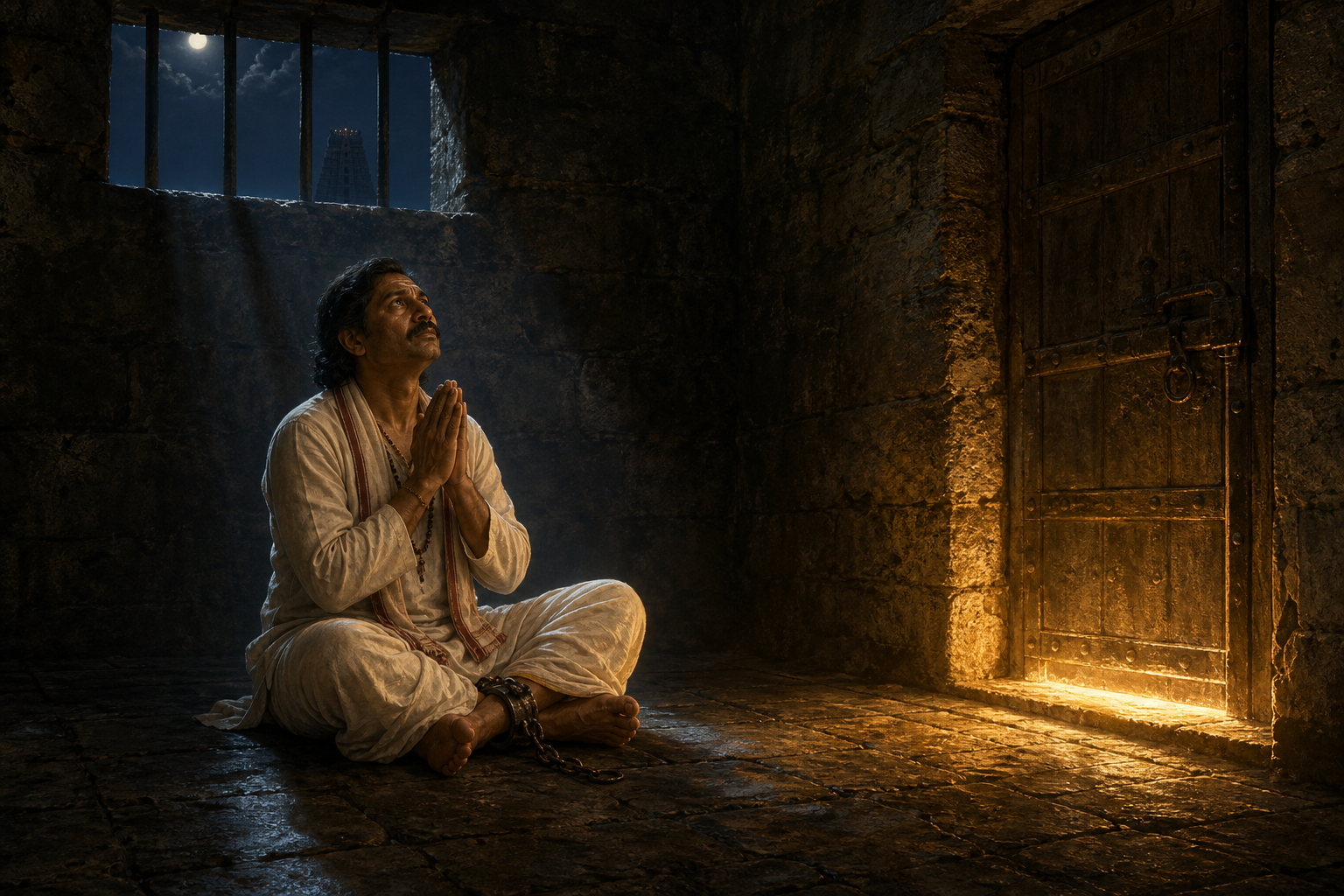
The life remembered through Bhakta Ramadasu gives this teaching human weight. Kancherla Gopanna served as a revenue official in 17th-century Telangana under the Qutb Shahi ruler Abul Hasan Qutb Shah, also known as Tana Shah. His devotion to Sri Rama became bound to the restoration of the temple at Bhadrachalam. When community contributions were insufficient, he was accused of diverting state revenue and was imprisoned at Golconda.
Confinement did not produce immediate outward relief. It became the setting in which Ramadasu’s devotion took durable form through the Ramadasu Keertanalu and the Dasarathi Satakam. This matters when you are tempted to measure grace by speed. A painful condition may remain while prayer becomes more truthful, dependence on status weakens, and devotion begins serving generations beyond the devotee’s own lifetime.
Devotional memory adds an extraordinary ending: Sri Rama and Lakshmana are said to have appeared as young men, repaid the amount with coins bearing Rama’s seal, and brought about Ramadasu’s release. This belongs to hagiographical tradition rather than an ordinary historical claim. You may receive it literally as sacred memory or contemplate the truth it is meant to carry. Either way, its spiritual force does not depend on pretending that prison was brief, easy, or irrelevant.
The episode also sets an essential boundary. A sincere devotional motive does not make public money private religious property. Bhakti does not cancel civic accountability, and invoking God cannot turn every action taken for a temple into dharma. Ramadasu’s memory is powerful precisely because devotion, public duty, suffering, and grace remain in tension; flattening that tension into “faith always gets its way” leaves you with a slogan instead of instruction.
When hardship comes, follow the part of his example that is always available to you: turn anguish into remembrance, truthful expression, and service. Do not romanticize the hardship, claim every choice that preceded it was correct, or demand an extraordinary intervention. Grace may change the situation. It may first change the person who must meet the situation.
Test your bhakti by the bondage it loosens

Devotional feeling can be genuine and still incomplete. Tears during kirtana, peace after puja, or enthusiasm for pilgrimage may nourish the path, but none is a final measure of liberation. The sharper question is whether your practice is weakening the patterns that repeatedly govern you.
Review your practice by looking for changes you can actually notice:
- Attention returns more readily. Distraction still occurs, but you spend less time obeying it before remembering what matters.
- Correction becomes faster. After anger, vanity, dishonesty, or carelessness, you admit the fault and repair its effects instead of protecting your image.
- Duty becomes less dependent on praise. You continue necessary work even when no devotional emotion or social recognition accompanies it.
- Possessiveness loosens. You can work for a result without treating success as proof of spiritual worth or failure as Divine rejection.
- Compassion becomes practical. Seva, patience, generosity, and restraint begin occupying real space in your schedule and decisions.
- Practice becomes steadier and less theatrical. You need less novelty, public display, or comparison with other seekers to keep returning to the Name.
- Learning changes judgment. Scriptural reflection affects what you refuse, what you repair, and what you are willing to sacrifice for dharma.
If the volume of japa rises while contempt, dishonesty, irresponsibility, or sectarian vanity also rises, the practice is not ripening in the way you imagine. The answer is not to abandon the Divine Name. It is to remove the division between the Name you repeat and the conduct you protect from its influence.
This union of remembrance and ethics also clarifies the kinship—and the distinctions—within the wider Dharmic family. Sikh tradition joins Naam Simran with seva; Buddhism joins mindfulness with ethical conduct and meditative discipline; Jainism emphasizes ahimsa, aparigraha, anuvrata, and samayik. These paths do not use identical doctrines of God, grace, self, or liberation. They do share a refusal to separate inward discipline from the way a person lives among other beings.
At your next daily anchor, choose the Name, complete the modest practice you can actually sustain, and then fulfil one duty without bargaining for a special feeling or result. Keep returning long enough for the practice to show you your attachments. In Kali Yuga, sadhana need not be elaborate. It has to be honest, repeated, and allowed to change how you live.
References
- DharmaRenaissance Blog — Bhakta Ramadasu of Bhadrachalam: Unwavering Bhakti, Trials, and the Triumph of Grace
- DharmaRenaissance Blog — Decoding Moksha Across the Yugas: How Kali Yuga Becomes the Fastest Route to Liberation
