
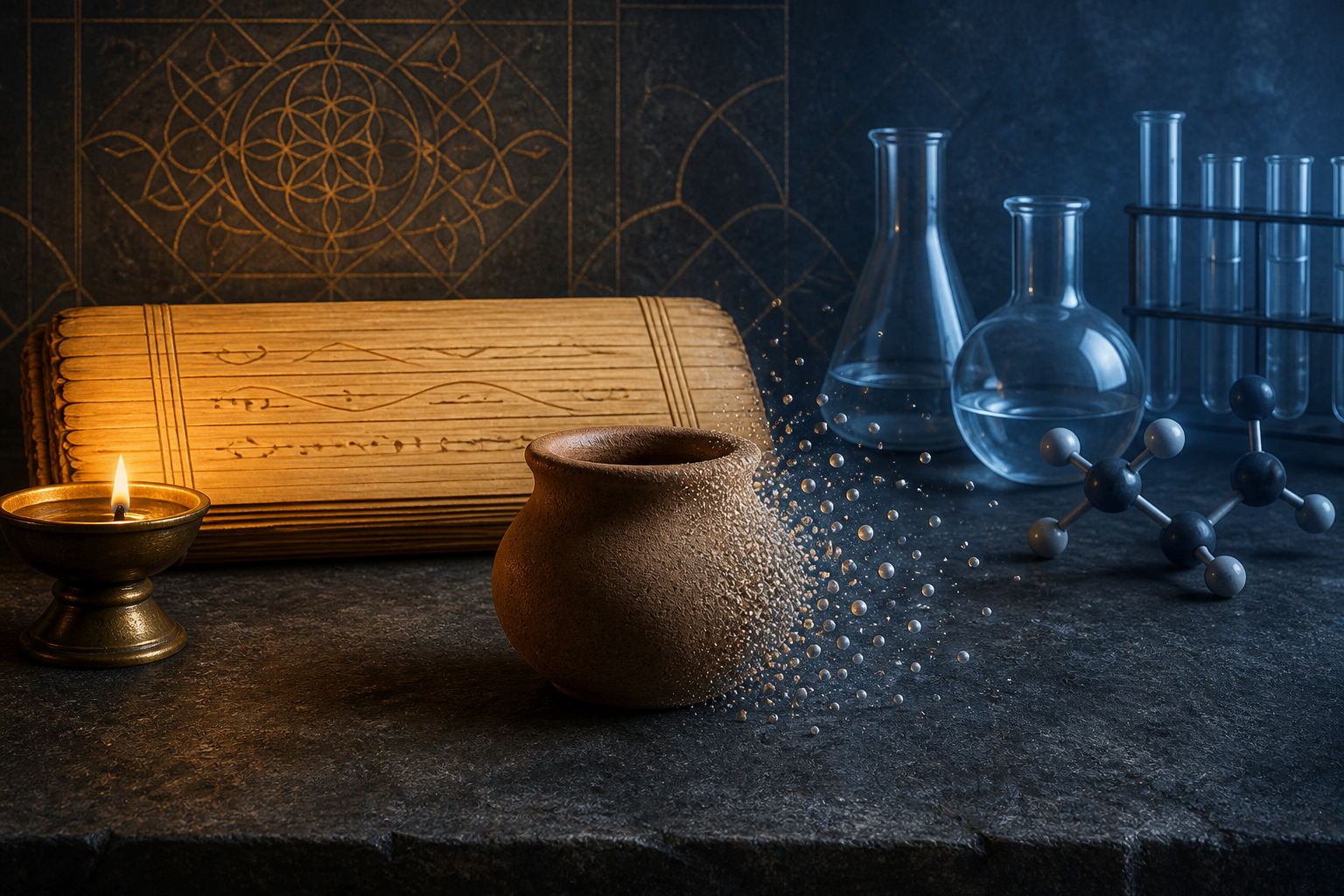
You may have encountered the claim that ancient Hindus discovered the atom before modern scientists did. If you want to defend Bharat’s intellectual heritage without turning a real achievement into a fragile boast, the wording matters.
Vaisheshika did formulate a sophisticated atomism. It reasoned from visible change to imperceptible constituents, explained material formation through combination, and placed matter inside a wider system of qualities, motion and causation. It did not produce modern atomic physics in Sanskrit. Understanding both sides of that distinction gives you a stronger answer than either exaggeration or dismissal.
The accurate claim is stronger than the exaggerated one
Vaisheshika is an ancient Hindu philosophical school traditionally associated with the sage Kanada and the Vaisheshika Sutra. It later developed in close conversation with Nyaya. At the centre of its material theory is parmanu, a minute, indivisible and eternal unit of physical reality. A parmanu is not directly available to ordinary perception; its existence is inferred as an explanation of divisible bodies, material change and continuity.
That is a genuine atomic theory in the philosophical sense: visible bodies are explained through more basic, invisible constituents. It is also part of natural philosophy because it tries to give an orderly account of matter, motion, combination and causation.
The limit appears when parmanu is treated as another name for the modern atom. Modern atomic theory describes atoms through nuclei and electrons, while deeper physical accounts involve quantum fields. Vaisheshika does not describe those structures. Its particles belong to four elemental substrates: prithvi, ap, tejas and vayu, conventionally rendered as earth, water, fire and air. These are classifications within its own ontology, not early names for modern chemical elements or subatomic components.
The most defensible formulation is therefore precise: Vaisheshika developed a systematic form of atomism and anticipated the conceptual move from visible diversity to unseen material constituents. It did not anticipate the measured structure, mathematics or experimental content of contemporary atomic physics.
Key takeaways
- What Vaisheshika achieved: a reasoned model of imperceptible, indivisible units underlying perceptible matter.
- How its world is assembled: atoms combine into dyads and triads, which participate in the formation of larger, perceptible aggregates.
- What makes it intellectually rigorous: it distinguishes substance, quality, motion, universality, particularity and inherence instead of using the word matter as an explanation for everything.
- Where the modern comparison stops: parmanu is not an ancient description of nuclei, electrons or quantum fields.
- How to discuss it responsibly: call it Hindu atomism or systematic natural philosophy, then state whether a comparison is structural, historical or scientific.
How Vaisheshika reasons from visible bodies to parmanu
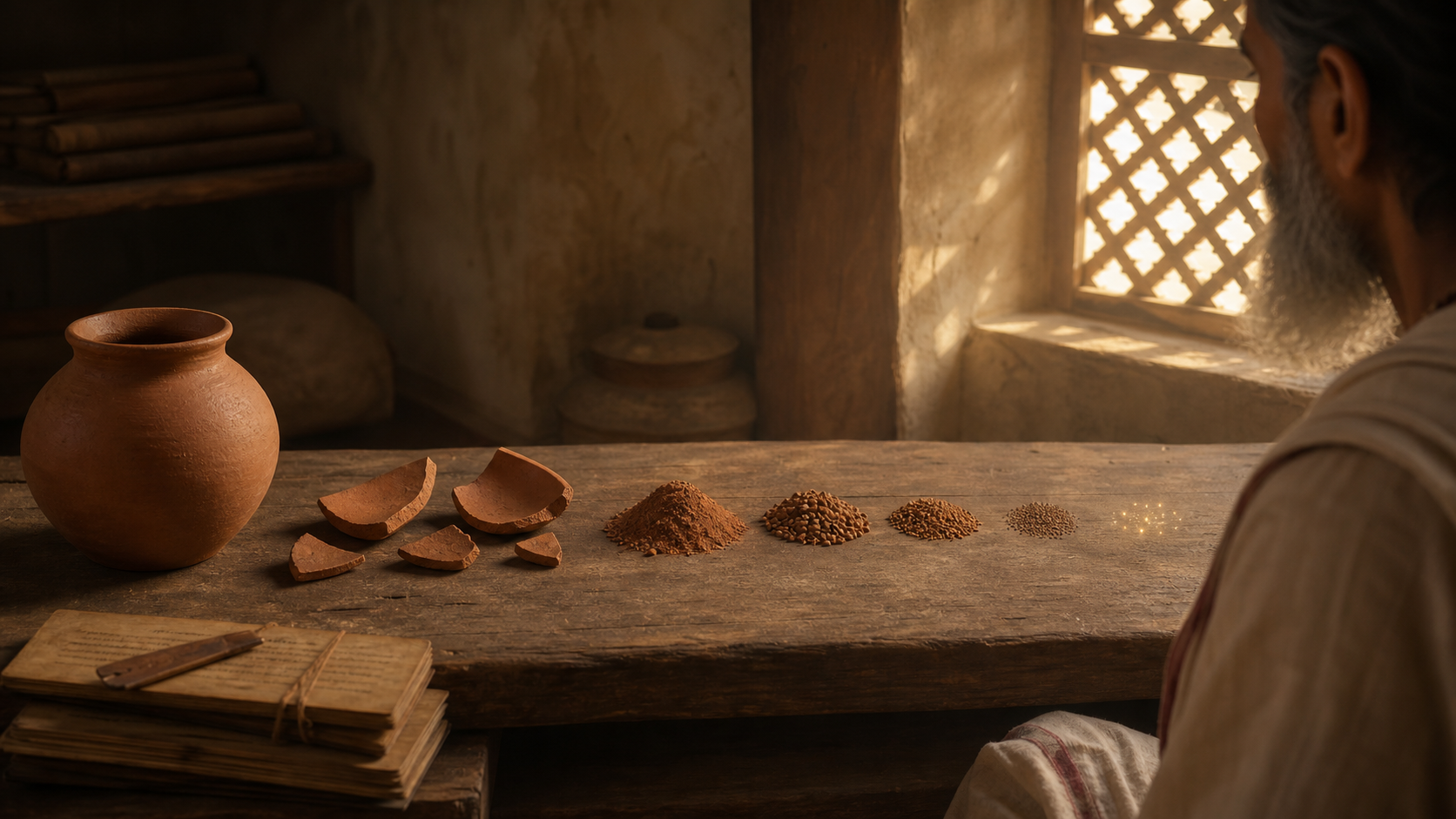
The reasoning is easier to appreciate when you reconstruct it instead of jumping directly from the Sanskrit word parmanu to a diagram from a modern physics textbook.
- Begin with an ordinary body. A visible material object can be divided into smaller parts.
- Continue the division in thought. Each resulting part can be considered in terms of still smaller constituents.
- Ask whether division can proceed without limit. Vaisheshika rejects endless divisibility as an adequate account of finite material bodies.
- Infer a final material unit. The process terminates in an indivisible parmanu that is too subtle for direct perception.
- Explain visible matter through aggregation. Parmanu combine into dyads, called dvyanuka, and triads, called tryanuka, on the way to perceptible bodies.
This is an inferential argument, not a report of an atom seen through an instrument. That difference does not make the argument worthless. It tells you what kind of achievement it is. Vaisheshika uses perception as the starting point and inference, or anumana, to posit entities that perception cannot reach. The unseen is admitted because it performs explanatory work, not merely because it sounds mysterious.
Combination alone is not enough. A complete account must also explain why constituents join, separate and rearrange. Vaisheshika gives motion, or karma, a central role in conjunction and disjunction. Heat frequently initiates the motion involved in material transformation. Space and time provide the setting within which such processes occur.
You can see the method in something as simple as a spark or a grain of sand. The visible event is not treated as self-explanatory. The thinker asks what must exist, what must move and what relations must change for that event to occur. The proposed answer may differ from a modern scientific account, but the explanatory discipline is recognisable.
When you assess an ancient scientific claim, identify its epistemic route. Was the entity observed, measured, experimentally manipulated or inferred from a philosophical argument? For parmanu, the decisive route is inference. Calling that inference an experimental discovery erases the very reasoning that makes Vaisheshika interesting.
Where the comparison with modern science holds and breaks
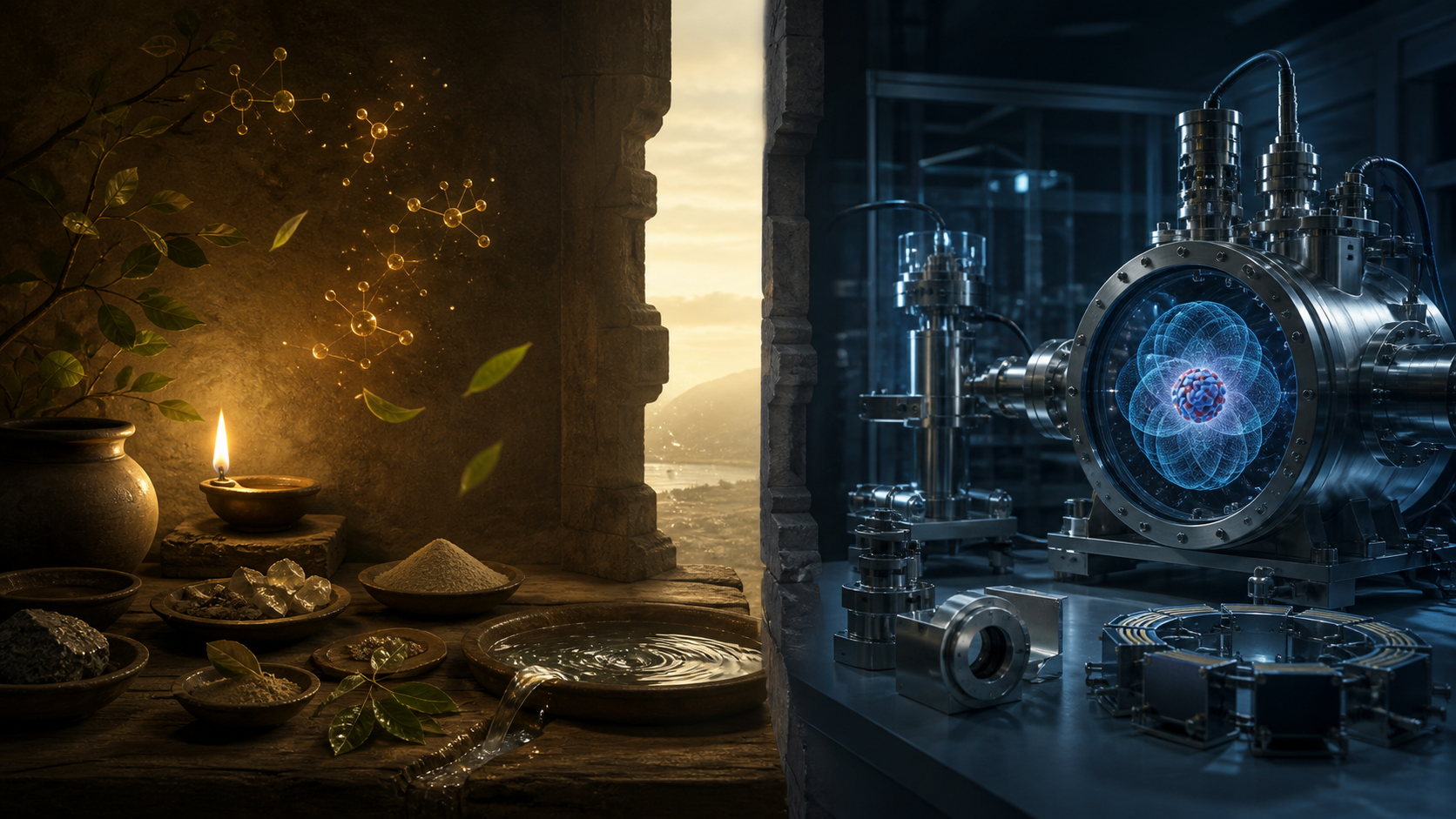
Comparisons are useful when the dimension of comparison is named. They become misleading when a shared word is made to carry an entire modern theory. The following distinctions let you recognise the resemblance without manufacturing identity.
| Question | Vaisheshika atomism | Modern scientific account |
|---|---|---|
| What lies beneath visible matter? | Imperceptible parmanu provide the basic material units. | Atoms have internal structure involving nuclei and electrons; deeper physical descriptions also involve quantum fields. |
| Is the atom divisible? | Parmanu is defined as indivisible and eternal. | The modern atom is composite rather than indivisible. |
| What kinds of basic units are proposed? | Atoms are related to earth, water, fire and air substrates, each associated with distinct qualities. | Those four elemental classes have no one-to-one place in contemporary atomic theory. |
| How does larger matter arise? | Atoms combine into dyads and triads and then into perceptible aggregates. | Contemporary accounts use experimentally constrained descriptions of atomic and material structure; dyads and triads are not interchangeable with modern technical entities. |
| How is change explained? | Motion enables conjunction and disjunction, with heat often initiating material transformation. | Physical changes are investigated through measured interactions, mathematical models and repeatable tests. |
| How are unseen entities known? | Perception supplies the visible problem, and inference supplies the imperceptible constituent. | Inference remains essential, but it is tied to instruments, quantitative predictions, measurements and experimental revision. |
Three different claims are often collapsed here. A structural resemblance means two systems make a similar conceptual move, such as explaining visible wholes through unseen parts. An identity claim says the entities in both systems are the same. A historical priority claim says an earlier thinker possessed the later theory before its recognised development. Vaisheshika supports the first comparison. The available concepts do not establish the other two.
The word anticipated can still be used, but it needs an object. Vaisheshika anticipated an atomistic style of explanation: the diversity of material forms can be grounded in stable, minute constituents and their combinations. It did not anticipate the nucleus, electron or quantum field. That single grammatical discipline prevents a broad resemblance from becoming a false technical claim.
The same care applies to dyads and triads. They show that Vaisheshika did not stop at declaring that tiny particles exist; it also needed a route from imperceptible units to perceptible bodies. That is an important explanatory step. It does not make dvyanuka or tryanuka alternate Sanskrit labels for a modern molecule or another contemporary entity.
Use one practical test whenever you encounter a dramatic equivalence: substitute the full definitions for the two impressive-sounding terms. If the sentence stops making sense once parmanu becomes an eternal, indivisible, element-associated unit and the modern atom becomes a composite structure involving nucleus and electrons, the proposed equivalence was verbal rather than scientific.
The category system is the deeper intellectual achievement
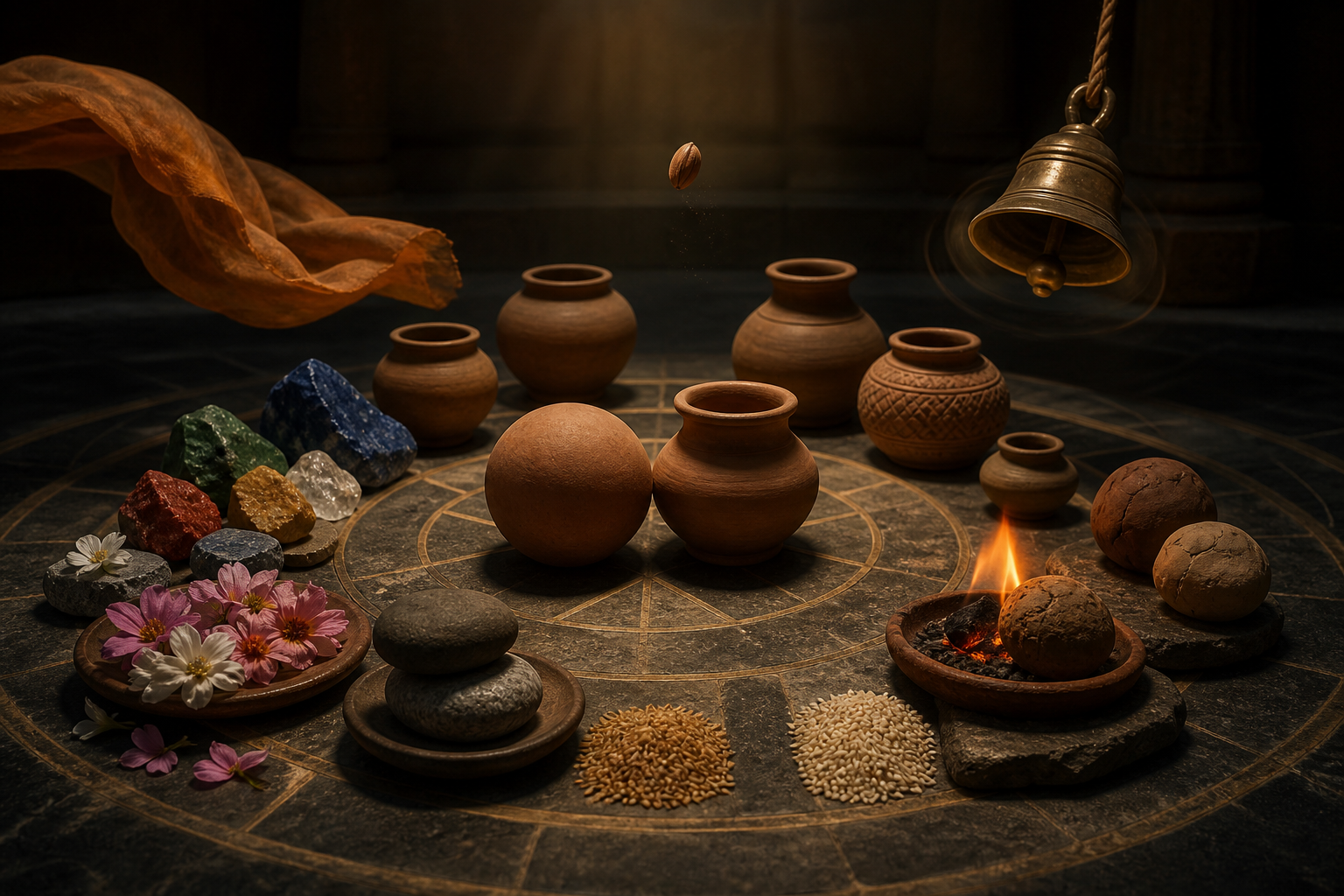
Atomism is only one part of Vaisheshika. Its more durable contribution may be the conceptual architecture that tells you what kind of thing an atom is, how it differs from a quality or a motion, and how parts belong to a whole. Without those distinctions, saying that everything is made of particles would leave most of the explanatory work undone.
- Dravya, substance: the category under which material constituents and other substantive realities are considered.
- Guna, quality: the characteristics through which a substance is described, without confusing a characteristic with the substance that possesses it.
- Karma, motion: the activity involved in material conjunction, disjunction and change.
- Samanya, universality: the common character that allows different instances to be understood as belonging together.
- Vishesha, particularity: the principle by which distinct realities can remain particular rather than collapsing into an undifferentiated existence.
- Samavaya, inherence: the inseparable relation used to explain how a whole belongs with its parts and how qualities belong with what possesses them.
Samavaya addresses constitution without reducing the whole-part relation to mere proximity. Two objects placed beside each other are conjoined, but the relation between a constituted whole and its parts requires a different explanation. This is metaphysical analysis, not a modern account of physical bonding. Its value lies in noticing a problem that simplistic particle talk overlooks: a collection of parts and an intelligible whole are not automatically the same explanation.
Adrishta requires similar care. Vaisheshika uses unseen tendencies to account for regularities that are otherwise unexplained within its framework. Adrishta should not be renamed as a modern force merely because both can appear in causal explanations. Before equating two concepts, ask whether they have the same definition, causal role, means of verification and consequences. A match on only one of those four tests is an analogy, not an identity.
This category-first approach is useful beyond the history of atomism. When someone claims that an ancient term is equivalent to a modern scientific one, separate the proposed entity from its properties, motions and relations. Then ask what evidence licenses each part of the account. Vaisheshika itself encourages this precision: substance, quality and motion are related, but they are not interchangeable words.
How to speak about this heritage without weakening it
Bharat’s philosophical heritage does not need an invented laboratory result to be significant. Vaisheshika shows that ancient Hindu thinkers pursued questions about material constitution through explicit categories, causal reasoning and disciplined inference. Presenting that achievement accurately makes it harder to dismiss and easier to teach.
Use three levels of claim
- State the internal doctrine: Vaisheshika proposes eternal, indivisible parmanu associated with four elemental substrates; combinations produce larger material bodies.
- Name the fair comparison: like modern science, it explains perceptible diversity by reasoning about imperceptible constituents and orderly processes.
- Mark the boundary: its constituents, methods and explanatory categories are not those of contemporary atomic or quantum physics.
This sequence works in a classroom, a family discussion or an online exchange because it does not ask the listener to choose between civilizational respect and intellectual honesty. It gives the Hindu achievement its proper name before introducing the modern comparison.
Avoid saying that Kanada discovered the modern atom unless you can supply evidence for the modern content implied by that sentence. Say instead that the Vaisheshika tradition formulated an ancient Indian atomic theory and used inference to explain how invisible units could underlie visible matter. The second statement is more exact, more informative and better supported.
Recognise shared Dharmic inquiry without erasing differences
Atomistic and fine-grained analyses also appear elsewhere in the Dharmic intellectual world. Jain philosophy speaks of paramanu as an ultimate unit of matter. Buddhist Abhidharma analyses material experience through minute units and rupa-kalapas. Sikh thought approaches cosmic intelligibility through knowledge, unity and hukam, or order.
These parallels show a wide Dharmic willingness to investigate reality rather than a single particle theory shared unchanged by every tradition. Jain, Buddhist and Vaisheshika terms should not be treated as synonyms merely because they address minute material reality. Sikh reflection on hukam affirms an ordered cosmos but should not be converted into an atomistic doctrine it was not presented as making. Compare the questions, methods and intellectual dispositions first; compare the answers only after defining them.
If you want one reliable formulation to carry forward, use this: Vaisheshika developed a rigorous philosophical atomism in which imperceptible parmanu, combination and motion explain the emergence and transformation of perceptible matter. Its resemblance to modern science lies in the search for underlying structure and orderly causation, while its particles and standards of proof remain those of a distinct ancient system.
The next time a sweeping ancient-science claim appears, do not begin by accepting or rejecting it. Define the Sanskrit concept, reconstruct the reasoning that supports it, and identify the exact dimension of comparison. That practice honours the tradition in a way that survives scrutiny.
References
