

You can be financially responsible, own useful things, and still feel pursued by the next purchase. A better phone, a larger home, or a stronger investment balance promises relief. The relief arrives, but it does not stay. Soon the mind finds another gap to close.
Aparigraha offers a practical way out of this cycle without asking you to abandon prosperity, family obligations, or ordinary enjoyment. It asks for something more demanding than minimalism: learn to possess without allowing possessions to define your security, status, or worth.
Material anxiety begins before anything is purchased

The important moment is often not the payment. It is the period of repeated attention before it. You notice an object, return to it mentally, imagine yourself owning it, compare your present life with that imagined life, and gradually turn a preference into a requirement.
The Bhagavad Gita maps this inner sequence with unusual precision: dwelling on objects encourages attachment; attachment gives rise to desire; frustrated desire disturbs judgement and mental balance. The danger is not that every desire becomes destructive. It is that repeated attention can harden desire into a self-reinforcing cycle before you have consciously decided whether the object serves your life.
Modern consumer life keeps that sequence well supplied. Advertising gives dissatisfaction a visual form. Social media supplies people against whom you can measure yourself. Shopping platforms remove the pause between wanting and acquiring. Once the object arrives, adaptation begins: what felt exceptional becomes normal, expectations rise, and attention moves to the next upgrade. This is commonly called the hedonic treadmill.
You can detect the cycle by listening to the promise attached to a purchase. A functional desire sounds like this: this tool will perform a task my present tool cannot. An anxious desire sounds different: once I own this, I will feel established, respected, safe, successful, or no longer behind. An object may solve the first problem. It cannot reliably settle the second.
This distinction also prevents a serious misreading of Aparigraha. If your income does not cover food, housing, medicine, debt commitments, or the needs of dependants, you are facing a material shortfall, not merely excessive attachment. Make the financial problem visible, reduce avoidable costs where possible, and seek qualified financial or community support. Spiritual language should not be used to disguise an actual lack of necessities.
Material anxiety is different. It persists even when the immediate need has been met because the mind has tied security to continual acquisition. Aparigraha works on that tie.
Aparigraha means right relationship, not forced poverty
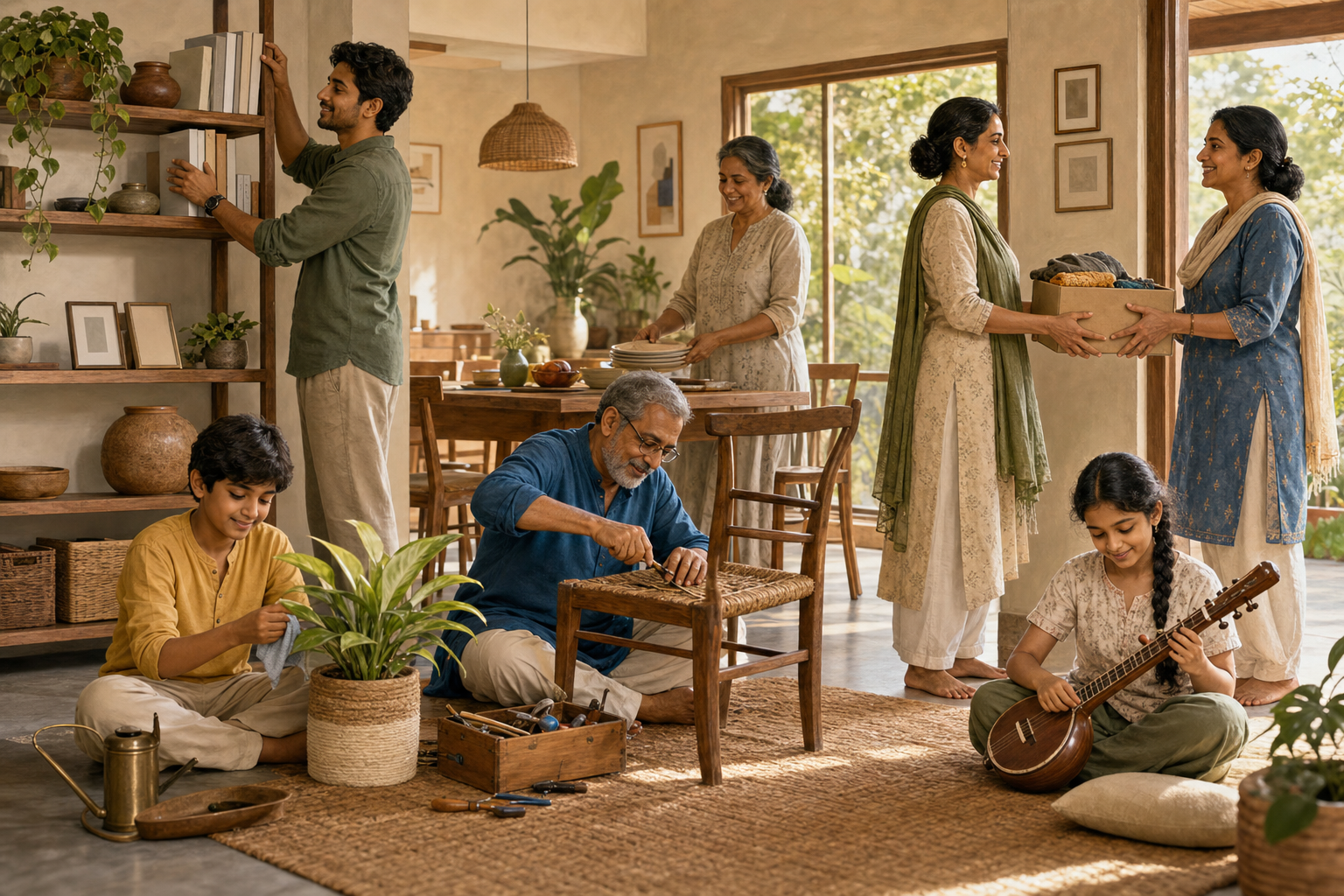
Aparigraha is often translated as non-hoarding or non-possessiveness. Both translations are useful, but neither means that every possession is suspect. A home, savings, tools, clothing, books, sacred objects, and resources for caring for others can all support dharma. The question is whether you govern these things or organize your identity around defending, displaying, and increasing them.
For a householder, rejecting artha, or material prosperity, is not the goal. The Dharmic model places artha and kāma, prosperity and legitimate enjoyment, within the guidance of dharma and the longer movement toward mokṣa. Wealth is therefore neither proof of virtue nor evidence of spiritual failure. Its acquisition, purpose, use, and effect on the mind determine its ethical character.
A possession is generally serving you well when it has a clear function, was acquired without violating your duties, can be maintained without disproportionate strain, and does not require constant comparison for you to enjoy it. Possession becomes grasping when accumulation continues after function has been met, losing the object feels like losing status or selfhood, or protecting it repeatedly takes priority over relationships, integrity, and peace.
- Keep what supports duty. Essentials, work tools, family resources, and objects used in worship or service do not need to be discarded to prove detachment.
- Use what you keep. A useful object left untouched while duplicates accumulate is a signal to examine fear, fantasy, or habit.
- Maintain before replacing. Repair and reuse interrupt the assumption that novelty is the normal answer to dissatisfaction.
- Share genuine surplus. Dāna and seva turn resources outward, provided generosity does not endanger essential obligations to yourself or others.
- Release without drama. Letting go is a practice of discernment, not a performance of austerity or a competition over who can own the least.
This direction appears across Dharmic traditions without making their teachings interchangeable. Aparigraha has a central place in Yoga philosophy and an especially rigorous place in Jain ethics. Buddhist analysis examines tanhā, the craving that keeps dissatisfaction in motion. Sikh teaching cultivates santokh, or contentment, alongside seva. These paths differ in doctrine and discipline, yet each challenges the belief that peace will finally arrive after one more act of acquisition.
Use a deliberate reset instead of an emotional purge
A sudden disposal spree can reproduce the same impulsiveness as compulsive shopping. It may also waste useful goods, create regret, or affect family members who never agreed to participate. Begin with one bounded category that regularly creates friction: clothing, devices, subscriptions, kitchen duplicates, stored decorations, or shopping apps. Do not discard shared property, essential supplies, work equipment, documents, medicine, or meaningful family objects merely to complete an exercise.
Then work through the category in this order:
- Name the function. For every item or subscription, complete the sentence: this exists so that I can do what? If you cannot name a present function, identify whether you are keeping it for a realistic future need, sentiment, fear, or an imagined version of yourself.
- Notice the acquisition trigger. Ask what was happening when you wanted it. Was there a genuine task, physical need, convenience, comparison, boredom, disappointment, or fear of being left behind? You are looking for a recurring trigger, not an excuse to condemn yourself.
- Separate use from identity. Ask whether you would still want the object if nobody else could see it, praise it, or know what it cost. A no does not automatically make the purchase wrong, but it reveals that social meaning is carrying more weight than function.
- Apply viveka before buying. Check whether something you own already performs the required function, whether repair would solve the problem, what ongoing space and attention the new object will demand, and which duty the expense will support or displace.
- Use one-in, one-out for discretionary goods. When you bring in a non-essential duplicate or upgrade, choose what will leave. This makes the real cost visible: the purchase consumes not only money but also space, maintenance, and attention.
- Regulate the invitation to want. Pratyāhāra, the disciplined management of sensory attention, can include intervals away from shopping feeds, promotional email, influencer content, and casual browsing. A digital sabbath is useful when it removes the cues that repeatedly restart comparison.
- Redirect surplus deliberately. Give usable goods where they can serve, offer time through seva, or practice dāna within your means. Do not give away necessities or ignore binding financial responsibilities. The purpose is to loosen possessiveness while strengthening duty.
Gratitude belongs inside this reset, but it should remain concrete. Before browsing for an upgrade, name what the present object still does well. Before interpreting another person’s possession as evidence that you are behind, name a relationship, skill, duty, or opportunity already sustaining your life. Gratitude is not denial of an unmet need. It prevents a fulfilled need from being falsely presented as an emergency.
Abhyāsa, repeated practice, matters more here than a dramatic act of renunciation. Viveka helps you distinguish need from projection. Vairāgya allows you to experience desire without automatically obeying it. Dhyāna helps you watch the mind construct urgency. Together, these disciplines interrupt craving at different points: attention, judgement, attachment, and action.
Let wealth carry responsibility instead of identity

Aparigraha becomes stable when it changes your definition of enough. If enough remains undefined, every comparison can revise it upward. Define it through duties rather than appearances: what protects basic stability, supports dependants, enables honest work, allows legitimate enjoyment, and leaves room for generosity?
This does not require treating every pleasure as a moral failure. Kāma has a place in householder life when it remains consistent with dharma. Beauty, celebration, craftsmanship, hospitality, and recreation can nourish life. The warning sign is not enjoyment itself. It is dependence: needing repeated acquisition to escape silence, repair self-esteem, or remain socially visible.
Use these questions before a significant discretionary purchase or upgrade:
- What precise function will this serve that is not already being served?
- Which duty does the purchase support, and which commitment could it delay or weaken?
- Would I still choose it if it remained invisible to everyone outside my household?
- What continuing burden will it add in maintenance, storage, insurance, subscriptions, or attention?
- Am I replacing something that has failed, or trying to replace an uncomfortable feeling?
- If I do not buy it, what exactly do I fear will happen?
You do not need a spiritually impressive answer. You need an honest one. If the object has a sound function, fits your responsibilities, and can be enjoyed without making it a measure of personal worth, buying it may be entirely compatible with Aparigraha. If the answer exposes comparison, fear, or compulsive novelty, let the desire remain unanswered long enough for its emotional claim to weaken.
Wealth aligned with dharma can support a household, education, community wellbeing, hospitality, worship, dāna, seva, and lokasaṅgraha, the welfare and cohesion of the wider world. In that relationship, wealth becomes an instrument. Artha serves stability when it is governed by purpose; it feeds anxiety when accumulation becomes the purpose.
If anxiety remains persistent, overwhelming, or disruptive to sleep, work, relationships, or daily functioning, do not treat Aparigraha as a substitute for appropriate mental-health care. Spiritual practice can clarify your relationship with desire, but it is not a diagnosis or a complete response to every form of anxiety.
Key takeaways
- Aparigraha does not require owning nothing. It asks you to stop treating possession as the foundation of identity and inner security.
- Distinguish an actual material shortfall from comparison-driven anxiety. The first requires practical financial action; the second also requires work on attention and attachment.
- Interrupt desire before purchase by naming the function, identifying the trigger, checking what you already own, and counting the continuing burden.
- Use repair, reuse, one-in-one-out, sensory restraint, gratitude, dāna, and seva as repeatable practices rather than staging a reckless purge.
- Householder prosperity can support dharma when it protects legitimate duties, permits balanced enjoyment, and contributes to the welfare of others.
- Seek appropriate professional support when anxiety is persistent or disrupts ordinary functioning.
Choose one shelf, subscription group, device category, or shopping feed today. Name what function each thing serves, remove one unnecessary invitation to compare, and let one useful surplus item move toward someone who can use it. Freedom from material anxiety grows through such clear decisions: not fleeing the world, but refusing to let the world of objects occupy the centre of the mind.
References
