
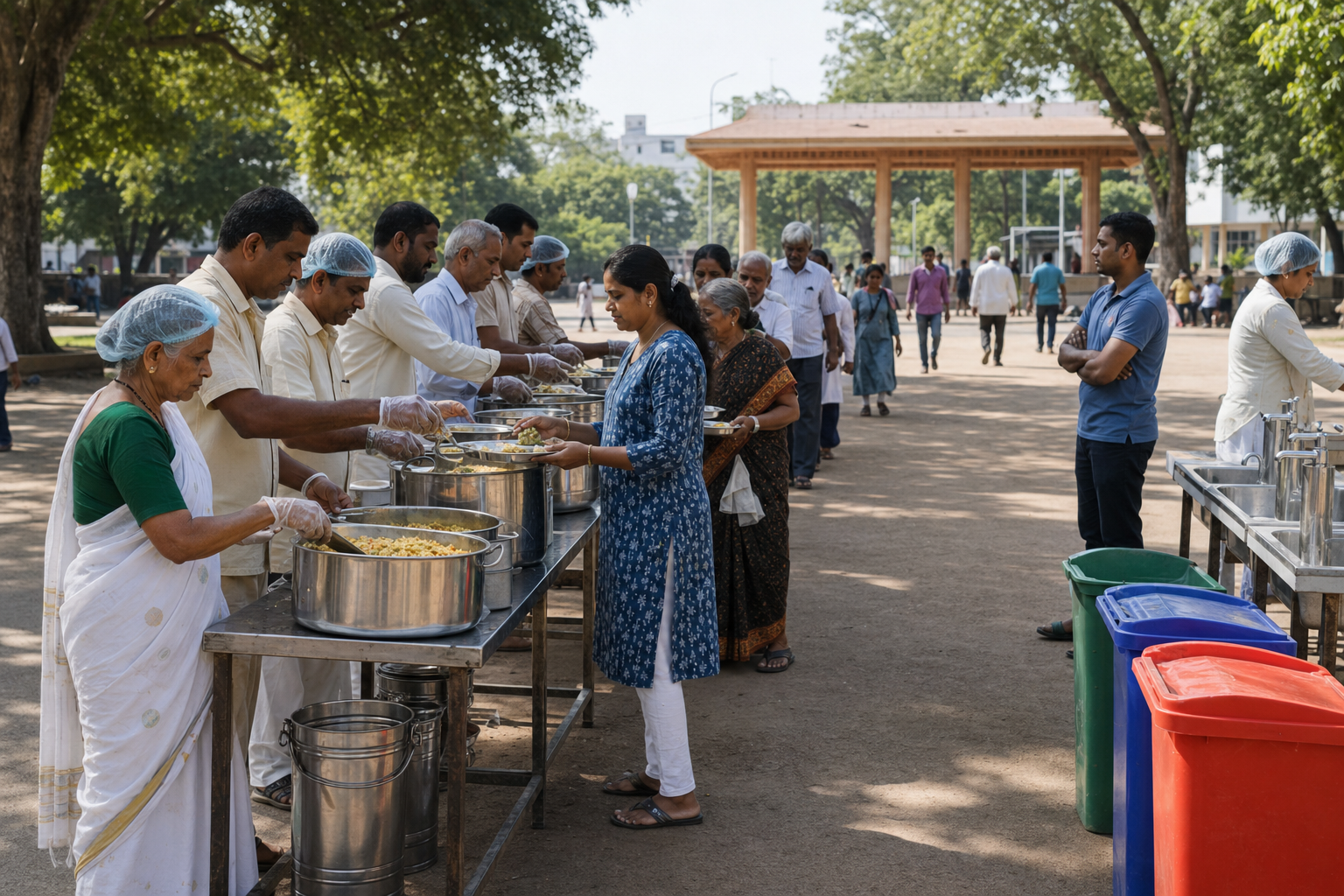
If your temple committee or seva group finds that a government ground is available for another community’s observance but unavailable for annadhanam, do not begin by asking for a religious favour. Ask the public authority to apply the same written rules to comparable events.
That framing matters. It turns a vague dispute about official discretion into a clear question: is civic space being administered on equal, transparent terms? It also gives you a practical path forward – document the venue’s prior use, submit a complete operational plan, and insist that any refusal be explained in writing.
Equal access means consistent rules, not unconditional permission

In a case brought by K Rajamani, Justice GR Swaminathan of the Madras High Court permitted annadhanam on a government-owned public ground that had long hosted Easter observances. The essential principle is straightforward: a venue administered by the State should not operate as the preserve of one tradition when another community seeks it for a lawful and peaceful purpose.
This does not mean every application must be approved exactly as submitted. An authority may still consider scheduling conflicts, public order, traffic, sanitation, safety and disruption. Equal treatment means that these requirements must be relevant, clear and applied consistently. It does not mean exemption from ordinary civic responsibilities.
When you assess whether treatment is genuinely unequal, compare like with like:
- The venue: Was the same government-owned ground made available, rather than a privately controlled or materially different location?
- The use: Was it used for a comparable community, cultural or religious gathering?
- The authority: Did the same department or local body control permission?
- The operational impact: Were attendance, food service, traffic, sound, duration and cleanup demands broadly comparable?
- The conditions: Are you being asked to meet requirements that were also imposed on other organizers?
A strong equality claim rests on comparable facts. Saying only that another faith received permission may be emotionally compelling, but it leaves officials room to point to differences in dates, crowd management or facilities. Identify what was similar, what was different and why any difference does or does not justify the result.
Do not base the request on the claim that Hindus deserve preference because they are the majority, or that annadhanam is too virtuous to be regulated. Neither argument is needed. The sounder position is that Hindu citizens may use shared civic infrastructure under the same neutral rules as everyone else.
Give the authority an application it can decide fairly

An equality argument can be weakened by an incomplete event proposal. If officials do not know who is responsible for waste, queues or vehicle movement, they can treat the application as an unresolved operational risk. Remove that ambiguity before permission becomes contentious.
- Confirm who controls the ground. Identify the public body responsible for bookings and permissions. Do not rely on an informal assurance from a person who may not have authority to approve the event.
- Request the written criteria. Ask for the application form, applicable conditions, required clearances, fees, security deposits and decision process. If there are no published criteria, ask the authority to state the criteria it will use for your request.
- Describe the event truthfully. State that the proposed activity is annadhanam connected with a Hindu observance or community initiative. There is no need to conceal its religious character, and no benefit in exaggerating it.
- Set out the operating plan. Include the requested date and hours, expected nature of attendance, food preparation and distribution arrangements, serving area, queue management, drinking water, waste collection and restoration of the ground.
- Address shared-space effects. Explain how volunteers will manage entrances, nearby roads, sound, emergency access and interaction with residents or other users. If you can adjust the layout or timing to reduce disruption, say so in the application.
- Name responsible coordinators. Give the authority clear contacts for venue management, food service, volunteers and post-event cleanup. Responsibility should be identifiable before the event, not improvised after a problem occurs.
- Create a reliable record. Submit the request through a channel that provides acknowledgement. Keep the application, attachments, receipt, correspondence and every later revision together.
- Ask when and how the decision will be issued. A defined decision point helps organizers avoid endless informal follow-ups and makes unreasonable delay easier to identify.
This preparation serves two purposes. It demonstrates that the organizers take public safety and civic order seriously. It also narrows the authority’s room to replace objective concerns with shifting or unexplained objections.
Separate the rights question from the operating question. Your rights case is that the venue must be administered without arbitrary religious preference. Your operating case is that this particular annadhanam can be conducted responsibly. You need both.
If permission is refused, ask for reasons before alleging bias

An oral refusal is difficult to evaluate and even harder to challenge. The immediate goal is not a heated exchange at the office counter. It is a written decision that identifies the rule, the facts and any possible remedy.
Suggested wording: Please provide the decision in writing, identify the rule or operational concern on which it is based, and state whether a change in date, layout, duration or event arrangements would allow the application to be reconsidered. Please also clarify whether the same condition applies to comparable events held at this ground.
Then test the answer carefully:
- If the ground is unavailable, ask whether the conflict concerns the entire venue and requested period or whether an alternative slot is available.
- If safety is cited, ask which part of the plan is inadequate and what modification would satisfy the requirement.
- If sanitation or traffic is cited, respond with a revised arrangement rather than treating every condition as hostility.
- If a written rule is cited, check whether it governs comparable gatherings and whether it was applied to prior users.
- If officials rely on an unwritten restriction, ask who adopted it, how applicants are informed of it and whether it is applied consistently.
- If the reasons change from one communication to the next, preserve each version. Shifting explanations can matter when arbitrariness is later examined.
A refusal is not necessarily discrimination. The requested date may be booked, the proposal may leave genuine safety questions unanswered, or the venue may be unsuitable for the planned scale. Equal access requires an honest comparison, including facts that do not favour your position.
Escalation becomes more appropriate when officials will not issue a written decision, cannot identify a consistent rule, apply a unique burden to the Hindu event, or permit a comparable observance while rejecting annadhanam without a material distinction. Ask for the available administrative review route. If the event is approaching or a refusal may affect legal rights, consult a lawyer familiar with local constitutional and administrative practice. The proper remedy depends on the actual order, authority and jurisdiction; a favourable court decision elsewhere should not be treated as automatic permission for every ground.
Make annadhanam visible as seva, not a claim of possession
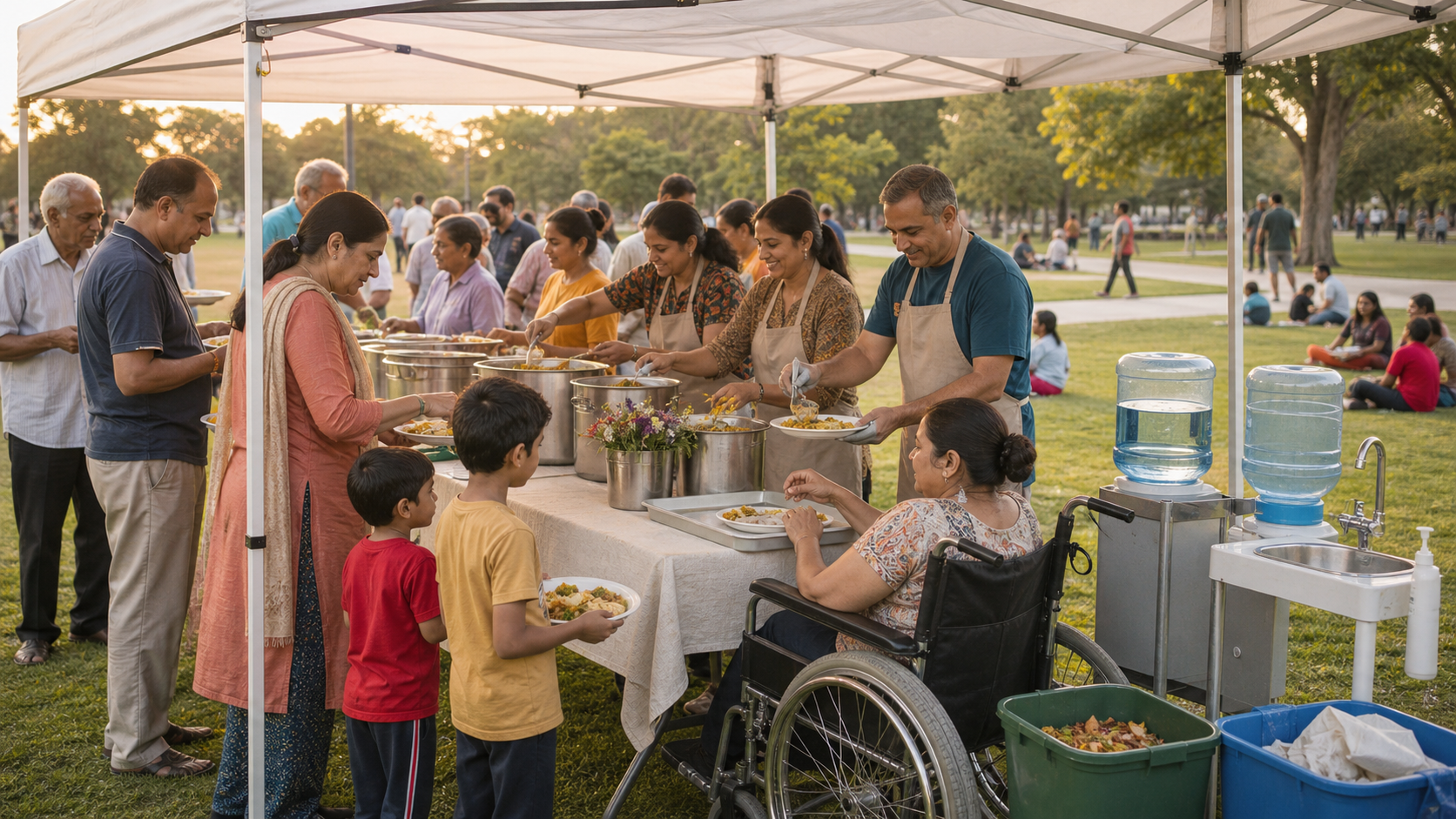
Annadhanam is centered on sharing food without distinction. That service-oriented character belongs naturally in a civic space, where people encounter one another beyond the boundaries of a temple complex or private hall. It also resonates with the wider Dharmic commitment to compassion and seva found, in distinct forms, across Hindu, Buddhist, Jain and Sikh traditions.
Yet the social value of annadhanam should not be confused with the legal basis for equal access. Feeding people is worthy, but officials should not have to decide which religious practice is worthy enough to enter public space. Neutral administration protects the event more securely than official approval of its theology.
This distinction also carries a responsibility. A public ground is not conquered territory, and permission for one day is not ownership. Organizers strengthen the case for future access when they welcome recipients without distinction, keep passageways usable, deal respectfully with neighbours, follow the agreed conditions and return the ground in good order.
The principle must be reciprocal. If Hindu organizers expect neutral access for annadhanam, we should support the same content-neutral rules for other peaceful communities. That is not a retreat from Hindu interests. It is the rule that prevents public institutions from quietly turning shared facilities into exclusive enclaves.
Good conduct during the event is therefore more than public relations. It creates evidence that annadhanam and orderly civic use are compatible. A calm volunteer team, a clear serving flow, disciplined waste handling and prompt cleanup make it harder for vague apprehensions to become the basis of the next refusal.
Key takeaways for organizers
- Frame the request as equal access to State-administered space, not a request for religious favour.
- Compare the same venue, authority, type of use and operational demands before claiming unequal treatment.
- Submit a complete plan covering food service, queues, sanitation, traffic, safety, volunteer responsibility and cleanup.
- Accept relevant conditions when they are clear and consistently applied to comparable events.
- Ask for every refusal, delay and required modification in writing.
- Respond to genuine operational problems, but question religiously selective or shifting standards.
- Seek local legal advice when an arbitrary refusal threatens the event or requires formal challenge.
If you are preparing an application now, collect three things before sending it: evidence of the ground’s comparable prior use, the authority’s written criteria, and your own operational plan. Together, they turn a general appeal for fairness into a concrete request that the administration must evaluate on its merits.
References
