
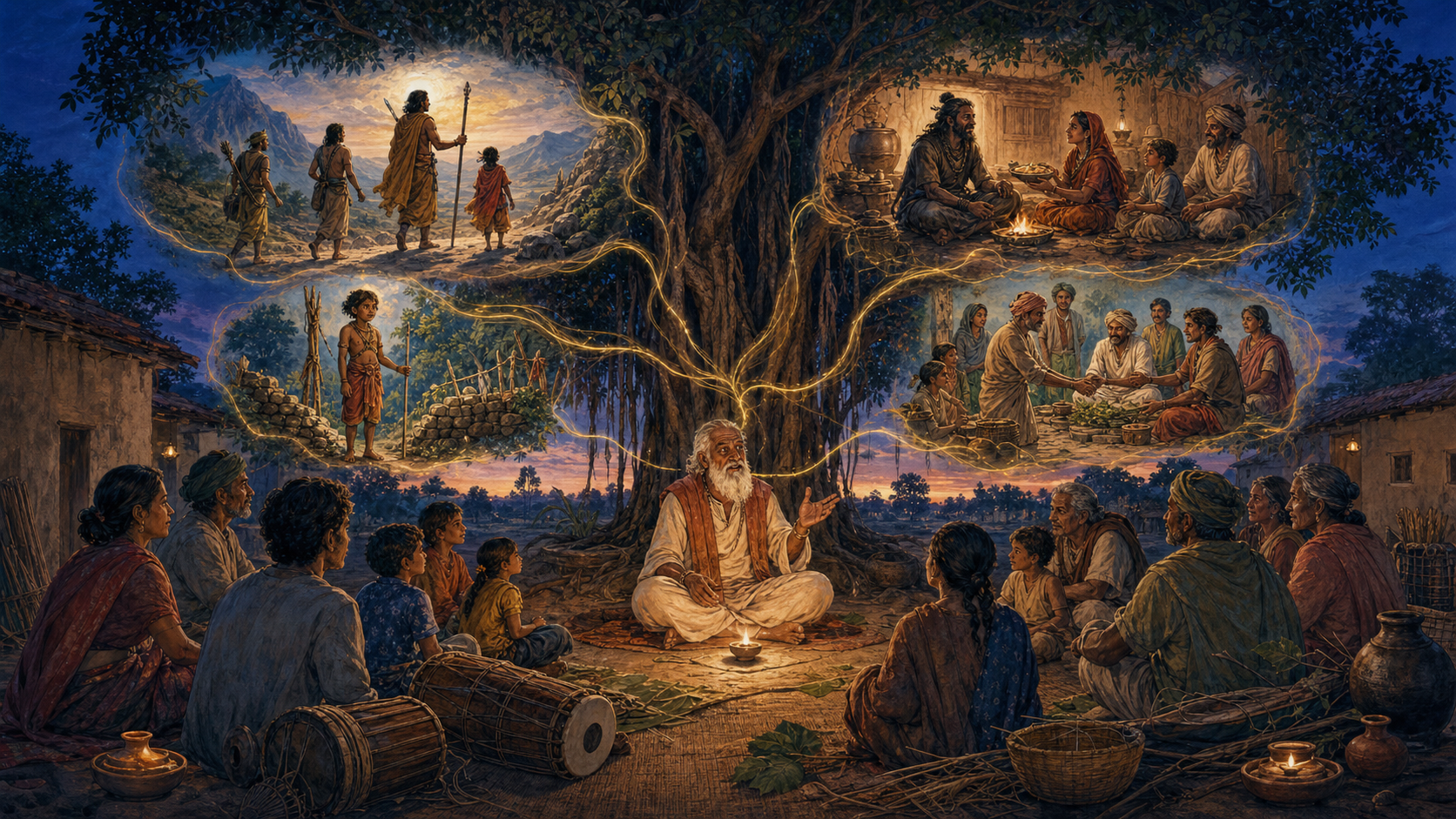
You hear two versions of a sacred story. One follows the familiar epic closely; the other changes a character’s motives, makes an antagonist into local kin, or introduces a guardian unknown outside one village. Which version should you trust?
Before choosing between them, ask a better question: what kind of truth is each version carrying? A folk narrative may preserve theology, ethical reasoning, ritual memory, local identity, or several of these at once. Reading those layers carefully lets you respect plurality without surrendering moral judgement.
Key takeaways for reading a folk sacred story
- Do not treat every variation as a rival historical claim. First determine whether the story is explaining a ritual, testing an ethical choice, preserving community memory, or describing sacred geography.
- Judge characters through intention, consequence, restraint, and responsibility. Sympathy can clarify why someone went wrong without turning the wrong into dharma.
- Keep the local setting attached to the narrative. Place-names, festivals, seasons, ritual roles, and names used by devotees often explain what the story is meant to do.
- Compare dharmic traditions through shared questions, not forced sameness. Ahimsa, compassion, seva, renunciation, courage, and self-mastery can connect traditions whose doctrines remain distinct.
- When you document an oral account, preserve variants and identify interpretations as interpretations. A polished composite can erase the very plurality you intended to save.
Plurality is disciplined interpretation, not anything-goes relativism
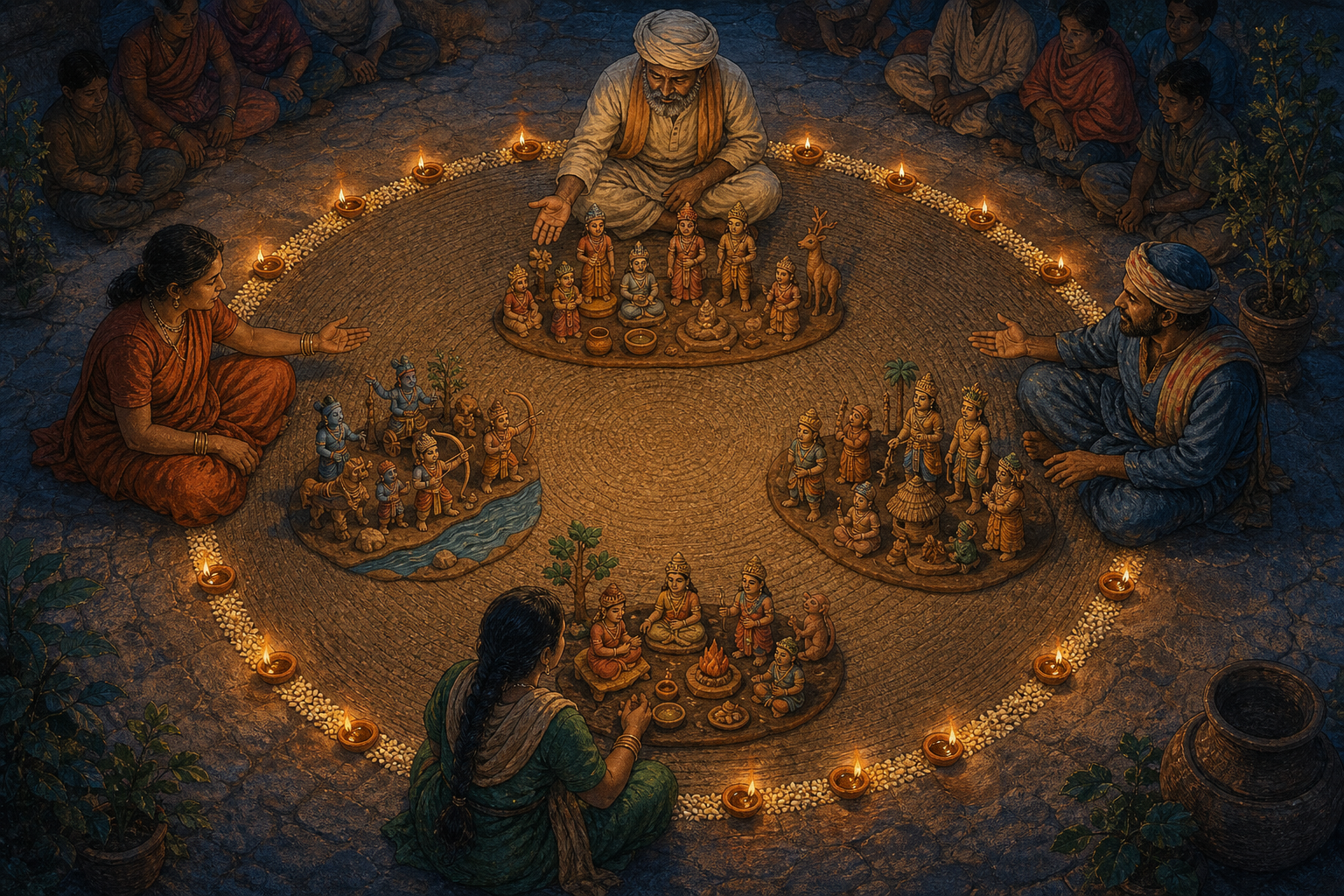
A sacred narrative can live at several levels. A textual recension may organize the story into a sustained theological vision. A regional poem may deepen a particular rasa or devotional relationship. A performance may adjust emphasis for its audience. A temple legend may explain why a guardian is invoked at a certain place and time. These forms overlap, but they do not answer exactly the same questions.
Trouble begins when we demand the same kind of proof from every level. If a village guardian narrative is principally tied to worship, boundaries, and communal remembrance, the absence of that figure from a better-known text does not make the tradition meaningless. Conversely, ritual importance does not by itself prove that every narrated event occurred as literal history. Respect does not require confusing categories.
Folk Ramayanas make the distinction especially visible. Oral and performative forms can shift their emphasis with audience, place, and social need. Tamil, Maharashtrian, Adivasi, and Southeast Asian tellings give different weight to devotion, kinship, sovereignty, ecology, and political responsibility. Their changes of perspective keep the epic ethically active: listeners must consider why a person acts, what follows, and which boundary has been crossed.
That flexibility still has limits. A plural reading does not mean that every choice becomes righteous once a character receives a sympathetic backstory. It means that dharma cannot be judged responsibly by labels alone. Intention matters, but it does not cancel consequence. Injury may explain anger, but it does not sanctify retaliation. Learning and devotion may increase a ruler’s stature, but they also increase the responsibility attached to pride and misuse of power.
When someone claims that a folk variant either destroys the tradition or overturns all moral standards, test the claim against three questions: What actually changed in the plot? What ethical judgement does the telling invite? What ritual or communal purpose does the change serve? Often the altered viewpoint enlarges the moral inquiry without reversing its conclusion.
Read the moral structure before judging the unusual detail
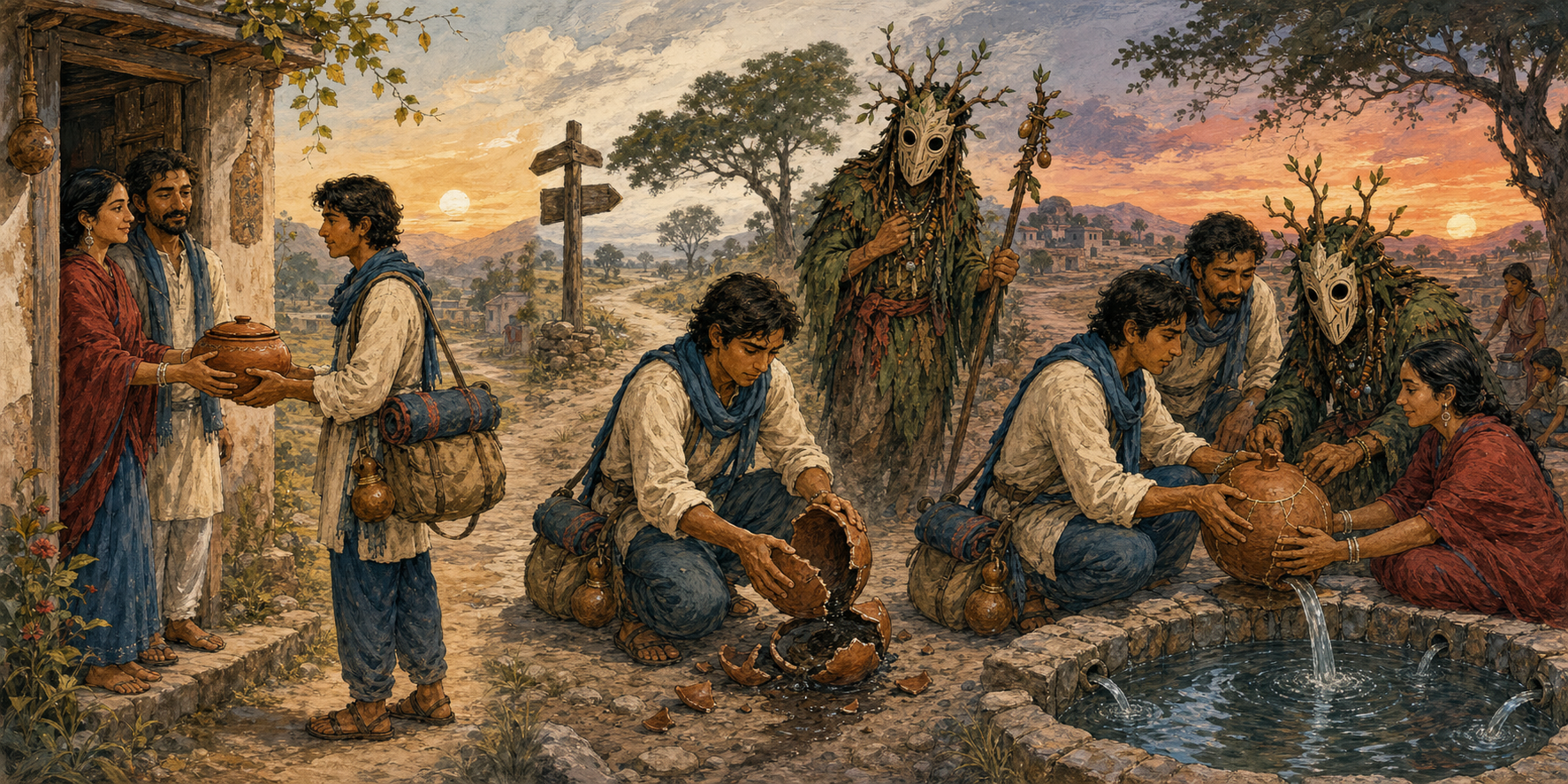
You can read a folk sacred narrative in five passes. This method works in a family katha, a classroom, a performance, or a recorded oral account.
- Name the actual conflict. Is it between loyalty and justice, a vow and its consequences, family obligation and public duty, courage and pride, or protection and cruelty? A precise conflict is more useful than a quick division into good people and bad people.
- Identify intention without treating it as acquittal. Ask what the person feared, desired, misunderstood, or believed duty required. Then ask whether the chosen act respected the agency and dignity of others.
- Trace the consequences. Folk narratives often teach through the distance between what a character meant to achieve and what the act produced. Follow the effects on family, kingdom, community, land, and the character’s own inner condition.
- Look for proportion and boundary. Maryada asks not only whether a goal appears legitimate, but whether the means, scale, and exercise of power remain within an ethical limit.
- Notice what the performance asks the audience to feel. Veera, karuna, raudra, and shanta can move listeners through courage, sorrow, anger, and composure. Feeling compassion for a transgressor may prepare the audience for self-examination; it does not automatically endorse the transgression.
Consider how this changes familiar Ramayana judgements. Ravana’s learning, rulership, and devotion to Shiva make his pride more instructive, not less serious. Kaikeyi becomes more than a stock villain when fear, courtly pressure, and maternal protectiveness enter the frame, yet the damage caused by her demand still has to be faced. Attention to Surpanakha’s humiliation raises a question about wounded dignity and disproportionate response. Vali’s confrontation with Rama opens a debate about justice, authority, and the permissible reach of sovereignty.
These re-readings resist demonization without erasing accountability. That distinction is essential. If your interpretation produces only contempt for a character, you may have missed the warning about tendencies that also exist in ordinary people. If it excuses every act because the character suffered or possessed admirable qualities, you have abandoned the narrative’s moral causality.
A useful discipline is to complete two sentences after hearing a contested episode: The character becomes understandable when we notice this motive. The character remains responsible because this action caused this consequence or crossed this boundary. If you cannot complete both, keep listening before reaching a verdict.
Let a local guardian remain rooted in the local world
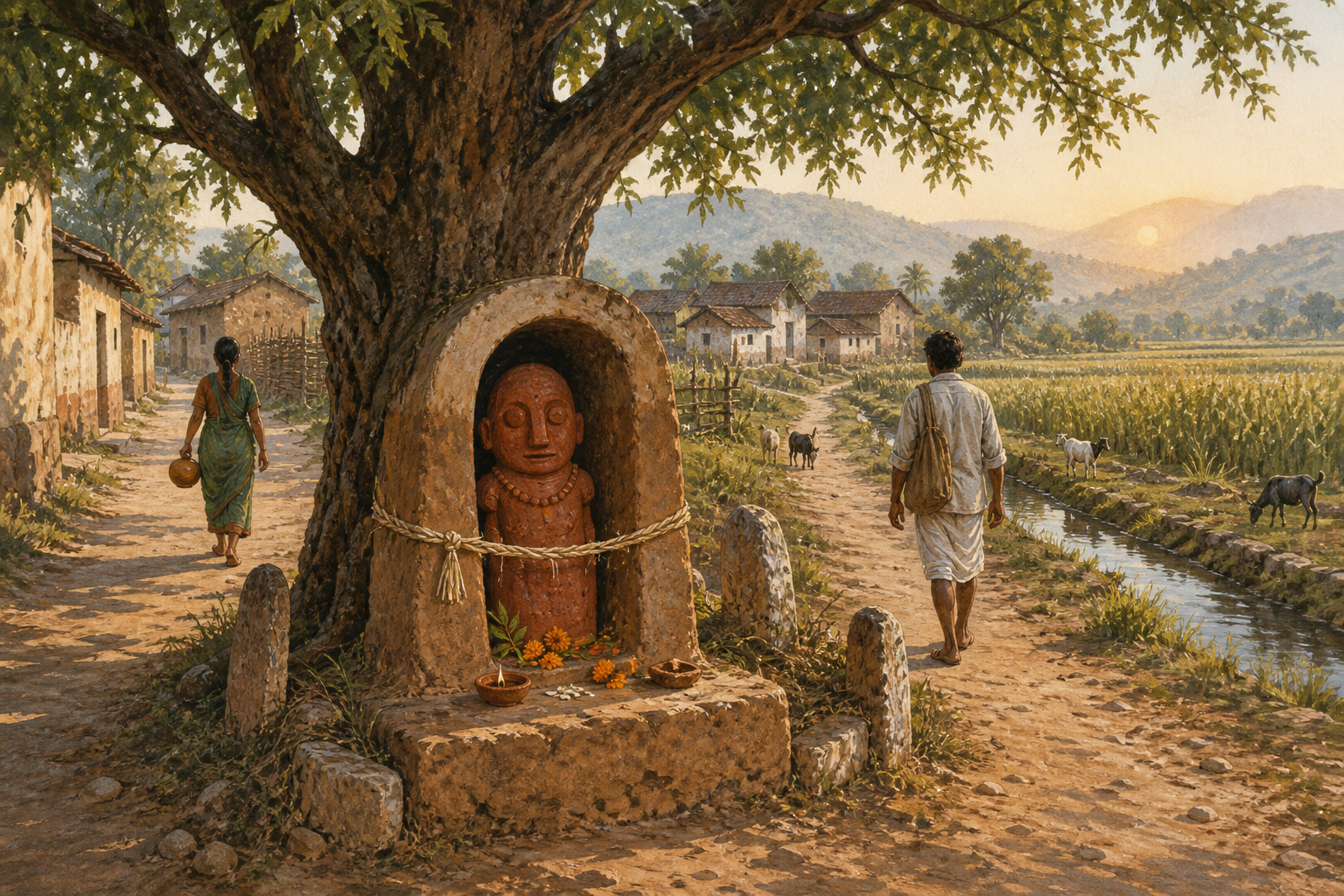
Some narratives are less concerned with reworking a great epic than with making a sacred place intelligible. Jamirta in Sirajganj, Bangladesh, preserves the memory of Nishachar Thakur, also called Nilkunda, as the headless attendant of Mahakal Bhairav. The account belongs to the ritual landscape around the Paglanath temple and is remembered especially during Kali Puja on Agrahayan Amavasya. Here, guardian, deity, temple, riverine place, and night of worship form one sacred ecology.
If you detach the headless guardian from that ecology, the most unusual visual feature can swallow the meaning of the tradition. The figure then risks becoming an exotic curiosity. Within the local devotional frame, however, Nishachar serves Mahakal Bhairav, protects a precinct, and participates in a night devoted to Kali. The narrative concerns vigilance, service, danger, boundary, and sacred protection.
Some interpret the missing head as the removal of ego and the priority of duty over personal recognition. That is a meaningful symbolic reading, but it should remain visibly identified as a reading. The responsible formulation is that the headlessness can be understood as egoless service, not that its one settled meaning has been conclusively decoded.
This restraint matters because symbols can carry more than one association within a living tradition. Local devotees may emphasize protection, a storyteller may emphasize fearlessness, and a later interpreter may emphasize humility. Recording the differences preserves depth. Collapsing them into a single authorized explanation may create apparent neatness at the cost of living memory.
If you are documenting a temple legend or family account, use this practical sequence:
- Record the name exactly as the speaker uses it, including alternate names and local pronunciation where possible.
- Note the place, festival, lunar occasion, season, shrine, and ritual action connected with the telling. These are part of the narrative’s meaning, not decorative background.
- Ask when people usually tell the story and what listeners are expected to remember, avoid, honor, or do afterward.
- Keep each version attached to its teller or setting. Do not silently merge disagreements into a smoother account.
- Separate testimony from analysis. Use clear phrases such as local devotees remember, one interpretation understands, or the ritual associates.
- Avoid sensational framing. A fierce, uncanny, or headless form should first be read through its sacred function and community vocabulary.
- Where practical, let the community review the names, ritual details, and public presentation before the account circulates beyond its original setting.
This approach does not freeze the story. Oral traditions naturally develop through retelling. It protects the chain of context so that future readers can see which details belong to local memory, which belong to ritual practice, and which arose through later interpretation.
Find shared dharma without pretending the paths are identical
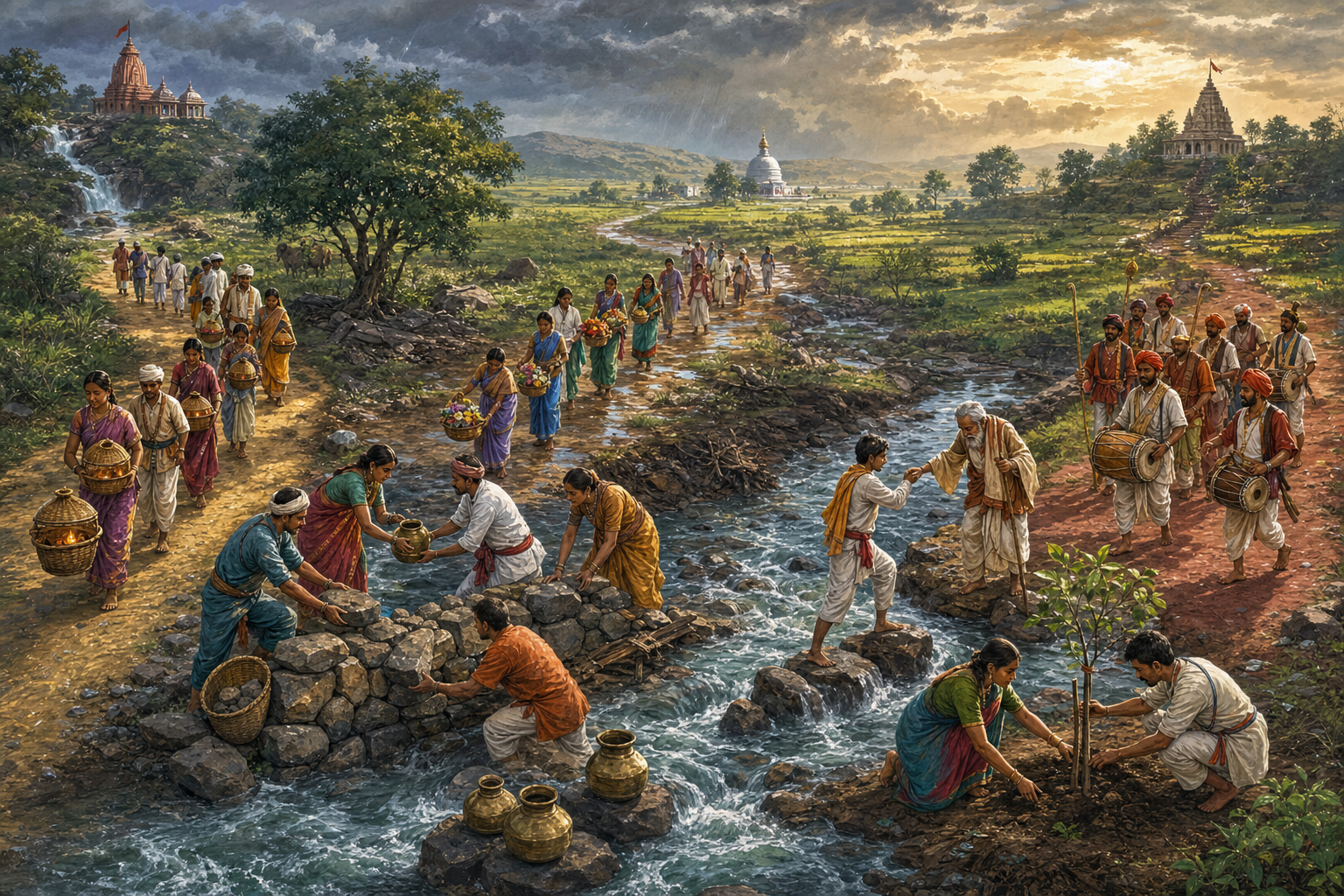
Plural dharma becomes most useful when it enables a real conversation among Hindu, Buddhist, Jain, and Sikh ways of reading sacred life. It becomes least useful when it turns those paths into interchangeable expressions of a vague spirituality.
The Ramayana family provides a concrete example. The Jain Paumacariya reimagines the narrative through ahimsa and self-restraint, making violence and valor subjects of moral scrutiny. The Buddhist Dasaratha Jataka gives particular weight to compassion, impermanence, and renunciation. In Sikh sabad, Ram can name the all-pervading Divine, directing attention toward divine presence and virtue rather than requiring allegiance to one literal narrative form. Hindu tellings themselves range across devotional, philosophical, literary, regional, and performative emphases. These distinct uses of a shared narrative vocabulary reveal relationship without doctrinal collapse.
The same care applies to shared values. Seva, courage, self-discipline, compassion, truthfulness, renunciation, and community welfare can create ethical meeting ground. Yet each tradition places those virtues within its own account of liberation, authority, practice, and the human condition. Shared ethical ground is a basis for mutual learning; it is not evidence that every metaphysical claim means the same thing.
When comparing two tellings, make three notes rather than one. First, write the virtue or problem they share. Second, write how each tradition interprets that issue in its own vocabulary. Third, preserve the difference that cannot honestly be translated away. For example, two narratives may both question violence while locating moral authority, renunciation, and liberation differently. The comparison becomes stronger when that difference remains visible.
This method also helps in community discussion. Begin with an episode, not a claim that all religions are the same. Ask what each telling fears will go wrong, which discipline it proposes, and what transformation it expects from the hearer. Participants can then recognize a civilizational conversation without being asked to surrender the integrity of their path.
Folk narratives are especially suited to this work because they make moral reasoning participatory. An audience can grieve with a wrongdoer, challenge a ruler, honor a guardian, and still distinguish dharma from adharma. The story becomes a place to practise judgement before judgement is demanded in life.
The next time an unfamiliar sacred story unsettles you, keep its local names, identify its ritual setting, and test its choices through motive, consequence, and boundary. Then ask someone who lives within the tradition what the story requires of its hearers. That conversation is where plural dharma becomes a discipline rather than a slogan.
References
- DharmaRenaissance Blog — Nishachar Thakur of Jamirta: Headless Guardian of Mahakal Bhairav on Kali Puja Night
- DharmaRenaissance Blog — Why Folk Ramayanas Embrace Both Virtue and Transgression: Plural Voices, Deeper Dharma
