
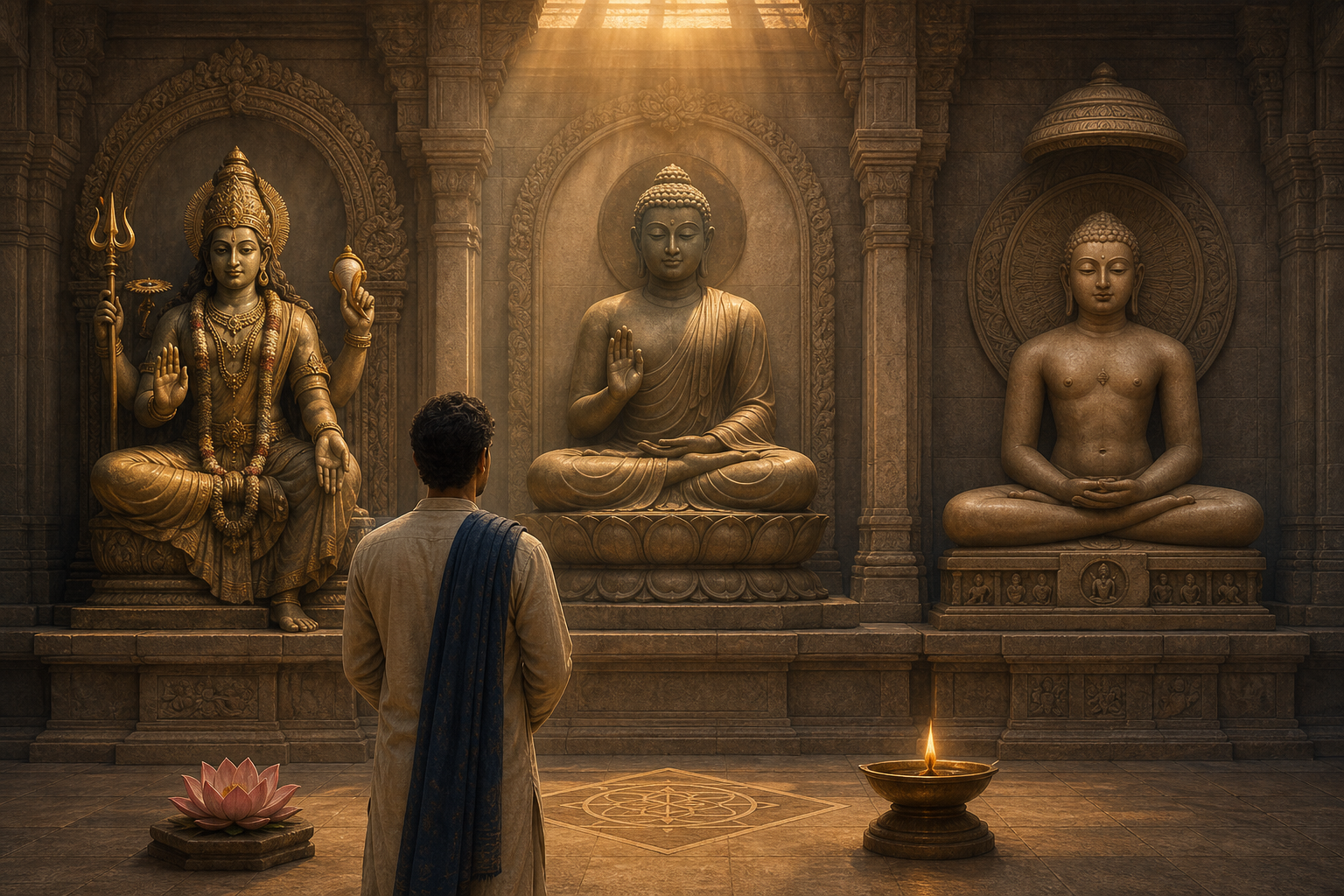
You stand before a murti, a Buddha image, a Tirthankara icon, or a sacred sign and recognize that every detail matters. Yet the many hands, gestures, objects, and postures can leave you with a basic question: what are you meant to understand, and how should that understanding affect the way you live?
The answer is not to memorize a catalogue of symbols. Sacred form works through relationships: posture modifies gesture, an attribute gains meaning from the deity who holds it, and the whole composition directs attention toward a spiritual quality. Once you learn to read those relationships, an unfamiliar image stops being a puzzle and becomes a practical aid to contemplation.
Begin with encounter, not instant interpretation
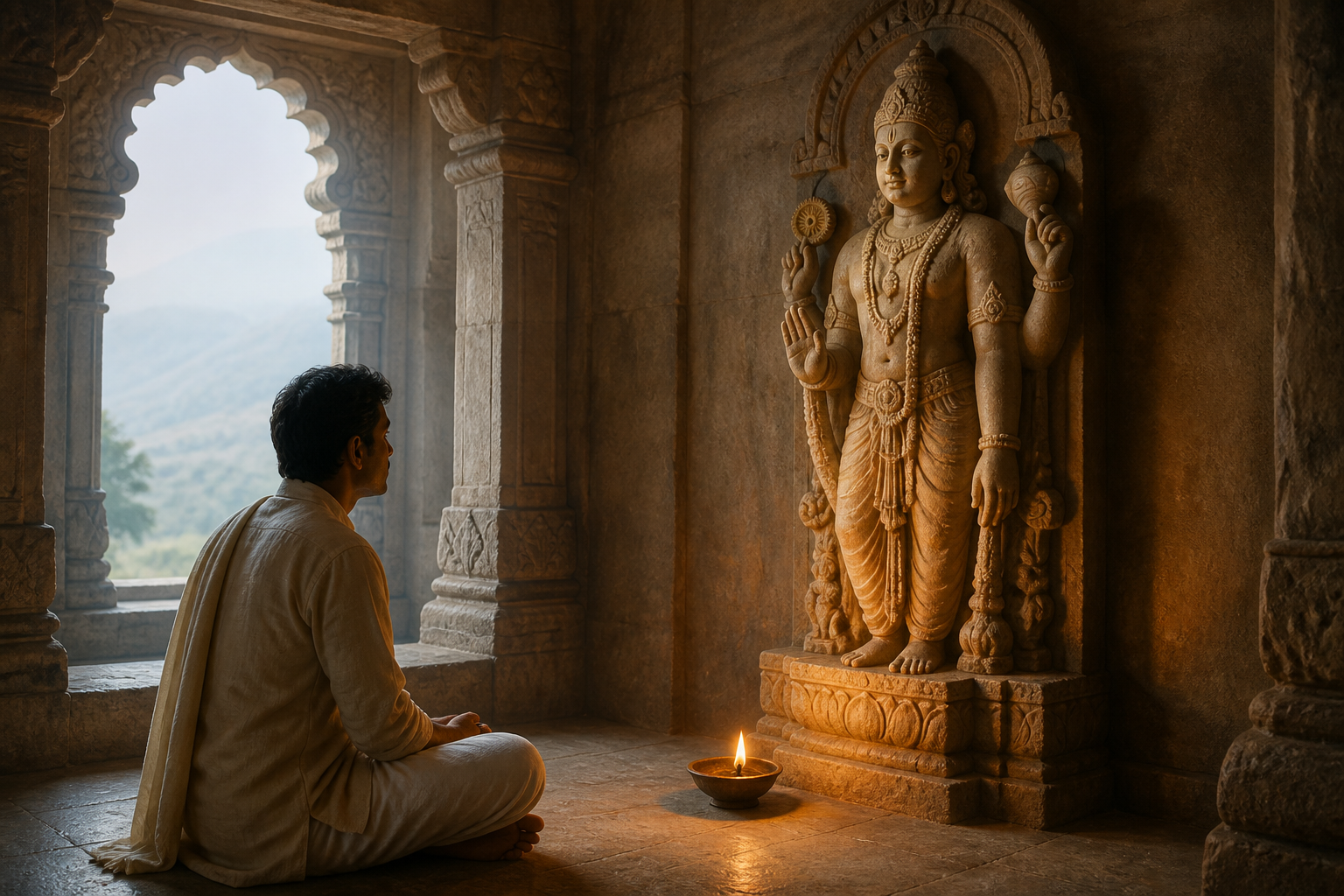
A sacred image is not merely an illustrated doctrine. In devotional life, it gives the eyes somewhere to rest, the mind a centre, and the emotions a disciplined direction. A murti does not reduce the Infinite to stone, metal, paint, or wood. It allows a mind accustomed to visible things to approach what cannot be contained by any visible thing.
This is why form and formlessness need not be treated as rivals. Murti-puja begins with the perceptible and guides attention from the gross, or sthula, toward the subtle, or sukshma. The form is a support for attention, not a boundary placed around Bhagavan.
During darshan, resist the urge to identify every object immediately. Give the whole form your attention first. Notice three things before reaching for an explanation:
- Where does your gaze settle? It may be drawn first to the face, the hands, the seat, a weapon, a lotus, or the relationship between several figures.
- What quality does the entire form convey? Look for repose, vigilance, protection, abundance, disciplined power, intimacy, or contemplative distance.
- How does energy move through the composition? A lifted hand may address you directly, while an upright torso, lowered gaze, relaxed leg, or circular arrangement may turn attention inward.
This first pass prevents three common errors. Literalism mistakes a sacred form for a claim about ordinary anatomy. Reductionism assigns one permanent definition to every hand or object. Dismissal sees only an idol or an attractive artefact and never asks what kind of attention the form was created to cultivate.
Setting matters as well. A sculpture in a gallery can be examined for form and historical style, while a consecrated murti within worship is encountered through darshan, mantra, offering, and an established devotional relationship. The physical form may be similar, but the viewer’s participation is different. Before interpreting an image, therefore, ask where it belongs, how its community approaches it, and what practice surrounds it.
Read sacred form through five connected layers
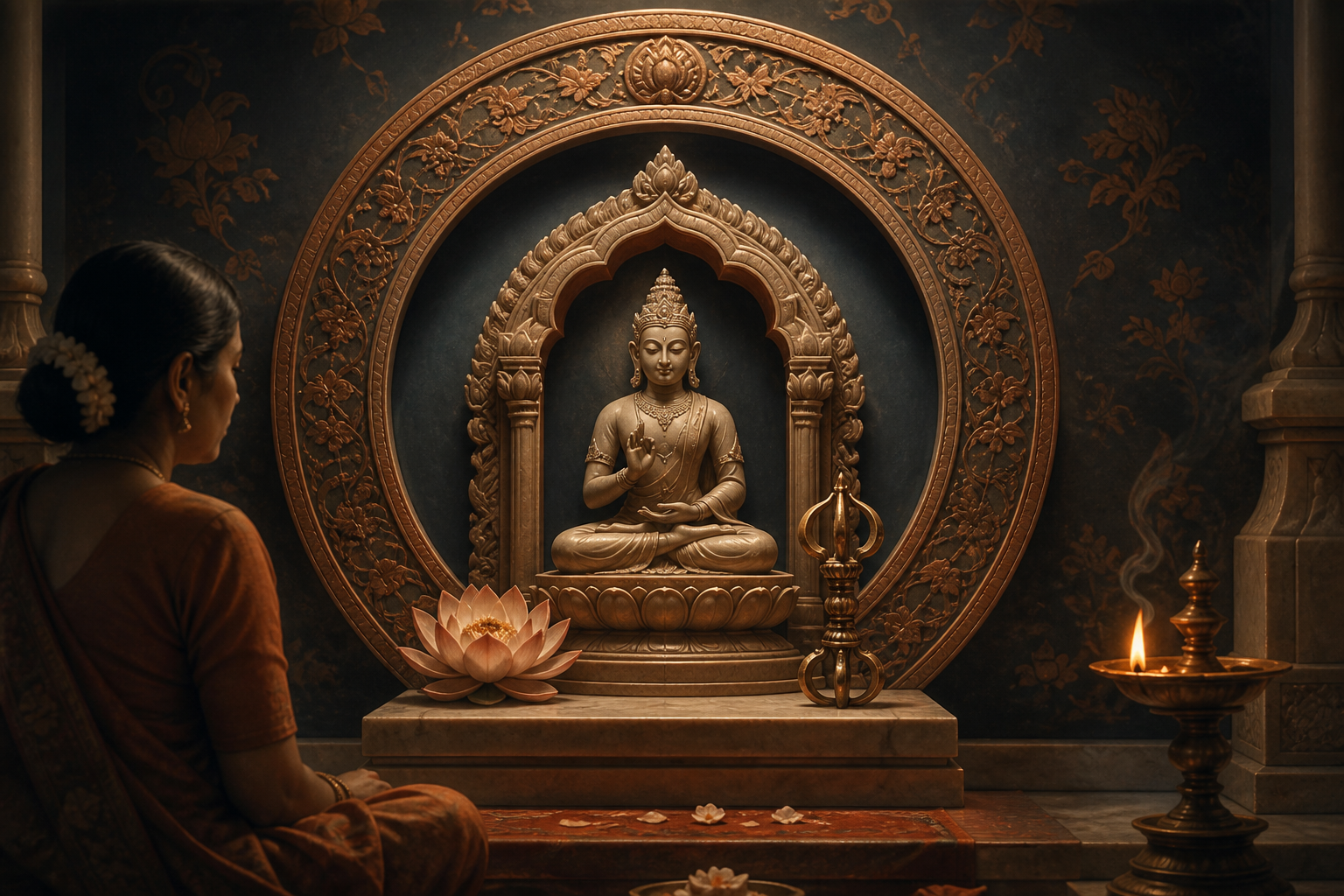
A reliable interpretation moves from the whole to the parts and then back to the whole. Use the following sequence whenever you meet a form you do not yet understand.
- Identify the tradition and setting. Determine whether you are looking at a Hindu murti, a Buddhist image or mandala, a Jain Tirthankara icon, a Sikh sacred sign, or another form. Note whether it belongs to temple worship, home practice, teaching, meditation, procession, or artistic display. Do not transfer ritual assumptions from one tradition to another.
- Read the posture before the accessories. Is the figure upright, formally meditative, reclining, standing, or partly at rest? Posture establishes the governing mood. A relaxed limb means something different when the spine remains alert than when the entire body is shown in repose.
- Observe gesture, gaze, and attributes. A mudra addresses the devotee through the body. An object may evoke protection, knowledge, prosperity, disciplined power, refined enjoyment, or liberation. Treat that meaning as provisional until you have considered the identity of the figure and the surrounding symbols.
- Ask what the elements do together. Does a protective gesture temper a weapon? Does a lotus soften an image of sovereignty? Does bodily ease coexist with an upright, vigilant axis? Sacred symbolism often resides in the balance between elements, not in one isolated item.
- Translate the form into a question for your conduct. Ask what quality the image places before you and where that quality is presently needed. Interpretation becomes practice when protection leads to courage, abundance to stewardship, knowledge to discernment, and serenity to deliberate action.
This method also permits comparison without erasing difference. Buddha images and mandalas, Jain images of the Tirthankaras, Hindu murtis, and Sikh reverence for the sacred word and Ik Onkar can all discipline attention and awaken virtue. They are not interchangeable objects, and their theologies and ritual uses should not be collapsed into one system. The family resemblance lies in what disciplined remembrance can do to the mind, not in an assertion that every tradition teaches or worships in the same way.
When you compare forms across the Dharmic family, compare functions carefully. Ask how a form concentrates attention, presents an ideal, or calls forth a virtue. Then return to the vocabulary and practice of the tradition from which that form comes. This preserves both shared civilizational insight and genuine diversity.
Two worked readings: many hands and poised repose
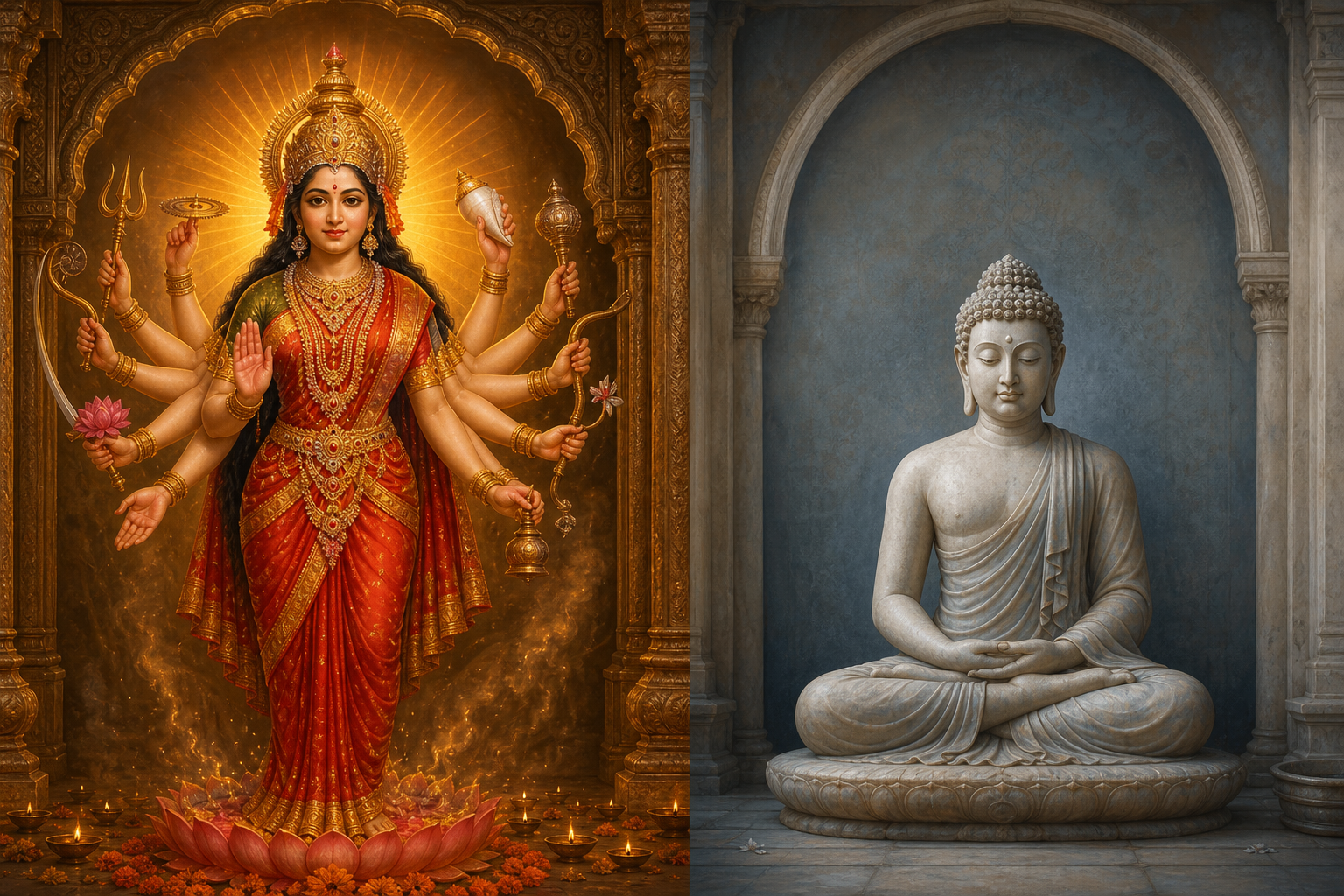
Two features show why relationship is more important than a fixed symbol dictionary. Multiple arms expand the range of divine action, while a half-seated posture joins stillness to readiness. Neither can be understood by naming one detail and ignoring the composition around it.
Four arms: completeness rather than excess
When Vishnu, Lakshmi, Ganesha, or a form of Devi appears with four arms, begin with the most visible fact: the divine is not confined by ordinary human capacity. The multiplication of arms communicates the ability to sustain several dimensions of cosmic and human life at once.
A particularly fruitful Hindu reading connects the four hands with the four Purusharthas, the aims through which a human life is ordered: dharma, artha, kama, and moksha are presented as an integrated vision rather than four rival ambitions.
- Dharma concerns right conduct, responsibility, and the order that should govern choice. Ask: what duty, promise, or ethical boundary must guide me here?
- Artha concerns resources, capability, livelihood, and material stewardship. Ask: what must be built, preserved, earned, or shared so that rightful responsibilities can actually be fulfilled?
- Kama includes pleasure, beauty, affection, and aesthetic fulfilment. Ask: which desires bring gratitude and relationship into better order, and which ones scatter attention or weaken restraint?
- Moksha points toward liberation and inner freedom. Ask: what attachment, fear, or false identification prevents me from acting clearly?
The practical force lies in their balance. Dharma without the means to sustain it can become fragile. Artha without ethical direction becomes corrosive. Kama without discernment becomes restless consumption. A pursuit of moksha that ignores responsibility and compassion can be used as an excuse to withdraw from duties. The four-armed form asks you to hold the whole of life together.
Do not permanently staple one aim to the same hand in every image. The meanings of particular attributes vary with deity, region, and tradition. A lotus may evoke purity and prosperity; abhaya mudra may communicate protection; a fruit or sweet may suggest wholesome enjoyment; and a scripture, chakra, or gesture of knowledge may direct attention toward wisdom and liberation. These are possible resonances within a composition, not universal labels that override the living tradition around the image.
When you encounter a four-armed murti, make one complete reading before investigating individual objects. Identify which Purushartha is already receiving most of your energy and which is being neglected. Someone pursuing artha, for example, should not merely ask whether prosperity is increasing. The sharper question is whether dharma is governing the way it is acquired, whether it supports a refined rather than compulsive kama, and whether it leaves any inward freedom.
Ardhaparyanka: calm that remains ready to act
Ardhaparyanka means half-seated and describes a semi-seated, semi-reclined posture found in Hindu and Buddhist classical and tantric iconography. Its meaning emerges from an apparent tension: part of the body is at ease, but the figure as a whole remains composed and available.
Read its geometry carefully. The relaxed leg and bodily openness suggest ease, compassion, and approachability. The supported, upright torso and composed head communicate vigilance, authority, and self-command. The posture joins contemplative stillness with the potential for purposeful action.
Either half by itself produces a poorer interpretation. If you notice only the relaxed limb, you may mistake repose for passivity. If you notice only the upright axis, you may see rigid command where the form also communicates accessibility. The sacred meaning resides in their coexistence: power is present but not agitated; compassion is open but not weak.
The contrast with other postures makes the point clearer. Full shayana emphasizes complete reclining, while padmasana presents the settled geometry of formal meditation. Ardhaparyanka occupies the space between them. It depicts inward collection that can still turn outward when a response is required.
You can use the posture as a diagnostic image before a difficult conversation or demanding duty. Ask whether you are inwardly collected, whether you remain available to the person or problem before you, and whether your next action can arise from steadiness rather than reaction. The aim is not to imitate the deity’s physical position. It is to recognize the mental discipline that the posture makes visible.
Turn interpretation into a repeatable spiritual practice
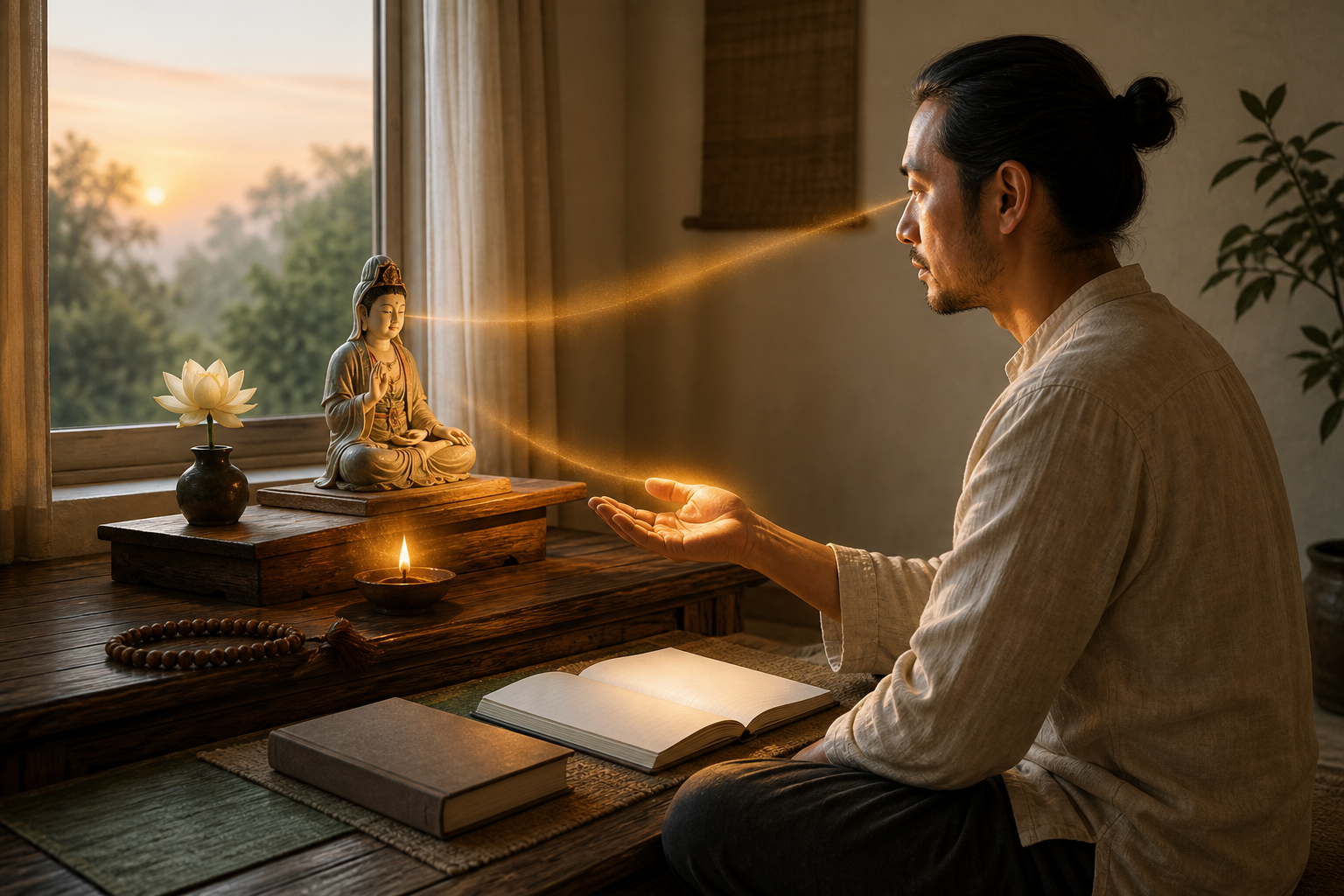
Sacred symbolism becomes useful when it changes attention and conduct. You do not need to decode an entire iconographic programme in one sitting. Work with one form, follow one line of meaning, and carry one resulting obligation into your day.
- Choose one form rather than many. Stay with a murti, image, mandala, or sacred sign already meaningful within your practice. Repeated attention reveals relationships that rapid browsing hides.
- Respect its devotional setting. If the form belongs to temple, family, or lineage practice, follow the worship discipline you have received. A personal interpretive exercise can deepen established practice, but it should not be used to invent ritual rules for a consecrated form.
- Gather the senses. Where appropriate to your tradition, a lamp, mantra, bhajan, fragrance, or quiet visual attention can help collect a distracted mind. Sensory ritual supports one-pointed attention, or ekagrata, by giving thought and feeling a common direction.
- See the whole before naming the parts. State the governing quality of the form in plain language: protective strength, poised compassion, disciplined abundance, meditative clarity, or another quality supported by what you actually see.
- Move from object to quality to obstacle. If you see abhaya mudra, move beyond identifying it. Consider the protection or courage it signifies, then name the fear preventing that quality from appearing in your conduct. If you see a lotus, examine whether your use of prosperity remains joined to purity of purpose.
- Close with one concrete act. Let a four-armed form prompt a neglected Purushartha, an image of knowledge prompt a more discerning decision, or Ardhaparyanka prompt a calm but timely response. Without this final movement, symbolism can remain spiritually attractive but practically inert.
A fourfold breath reflection can make the Purushartha reading more immediate. Bring dharma, artha, kama, and moksha into awareness one at a time. With the inward breath, attend to the quality you need; with the outward breath, release the obstruction you can honestly identify. Then ask how the four aims should correct one another in the decision before you. The exercise is not a substitute for mantra, puja, or instruction received from a teacher. It is a way to turn visual symbolism into moral examination.
Not every seeker will relate to form in the same way. The principle of Ishta allows devotion to begin with a form or approach suited to one’s disposition, while direct contemplation of the formless also has a place within Dharmic thought. Beginning with form and moving toward the subtle is a valid path, not a demand that every practitioner follow an identical route. You do not need to manufacture an emotional response. You need an honest form of attention.
Judge your interpretation by its fruit. A reading that produces only clever terminology has stopped too early. A sound reading should make a virtue clearer, expose an imbalance, deepen disciplined remembrance, or reveal a specific duty. That is how you distinguish living symbolism from decorative trivia.
Key takeaways
- Sacred form directs the mind beyond the material image; it does not confine the Divine within matter.
- Read context and posture before assigning meanings to individual hands, gestures, or attributes.
- Treat iconography as a relational grammar. The meaning of one element depends on the deity, the surrounding elements, the tradition, and the setting.
- Four arms can present the integrated claims of dharma, artha, kama, and moksha, but individual attributes should not be mapped mechanically across every image.
- Ardhaparyanka communicates readiness held within repose: an image of compassion, authority, and action governed by inner steadiness.
- Comparison across Hindu, Buddhist, Jain, and Sikh practice is most useful when it identifies shared disciplines of attention without erasing theological and ritual differences.
- Complete every interpretation with one question about conduct and one action you can take.
The next time you encounter a sacred form, delay the quick label. See the whole, notice how its elements balance one another, and identify the quality it asks you to embody. When that quality shapes your next decision, the symbol has begun to do its real work.
References
- DharmaRenaissance Blog — Decoding Four-Handed Hindu Deities: Powerful Insights into the Purusharthas
- DharmaRenaissance Blog — Ardhaparyanka Unveiled: Powerful Symbolism of the Half-Seated Posture in Dharmic Art
- DharmaRenaissance Blog — Bhakti and the Worship of Form: Why Murti-Puja Guides the Mind Toward the Infinite
