
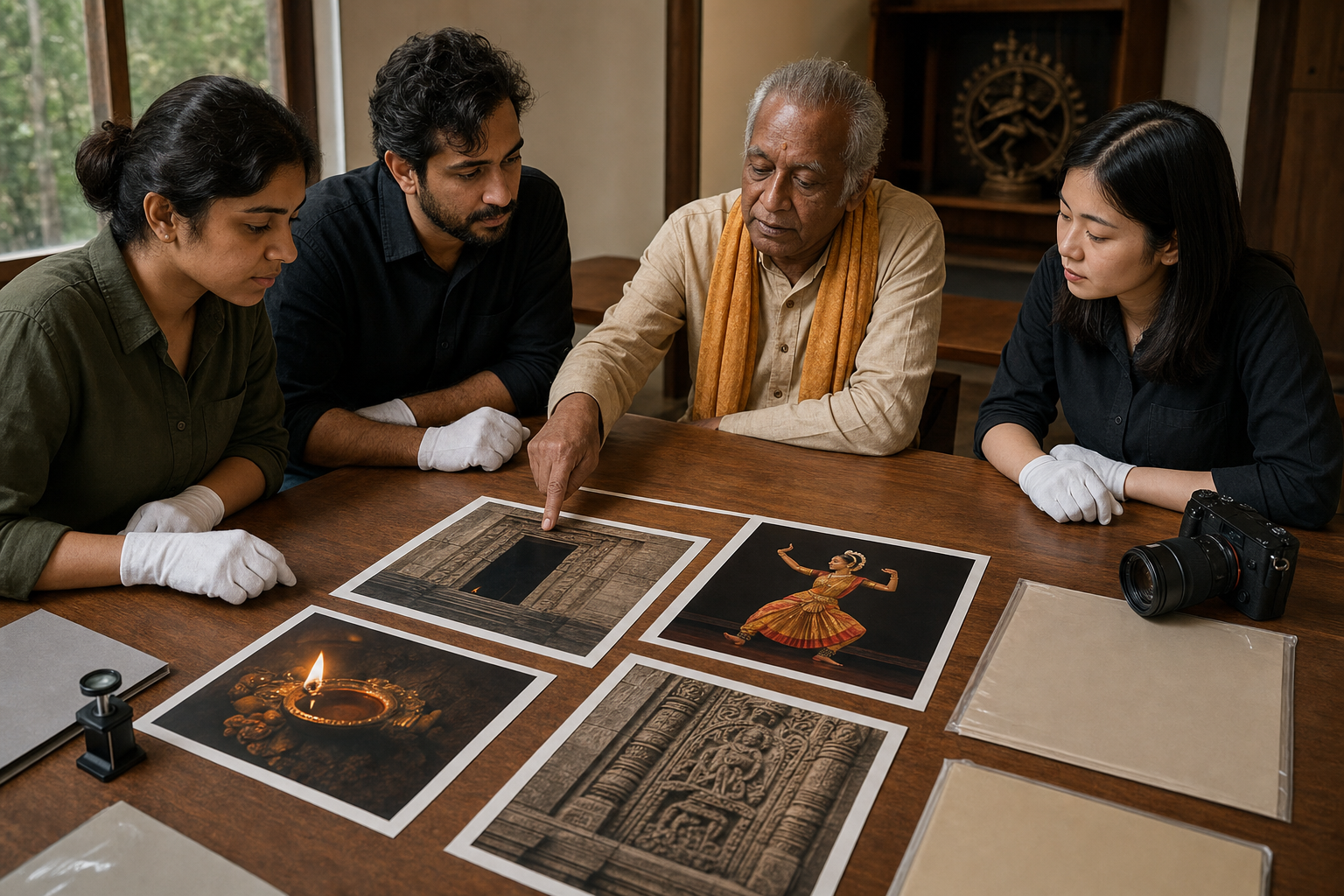
You have a temple photograph, a dance clip, a Deity image, or an animated retelling in front of you. The immediate questions look technical: what to crop, what to caption, which sequence to use. The deeper decision is whether your media helps a viewer approach the tradition on its own terms or reduces it to a detachable aesthetic.
You can make that decision methodically. Whether you are preparing a classroom presentation, documentary, exhibition, community display, article, or social post, test the work against four things: what it claims to show, which visual language it uses, whose tradition it names, and what permission governs its use.
Decide whether you are documenting, interpreting, or presenting devotionally
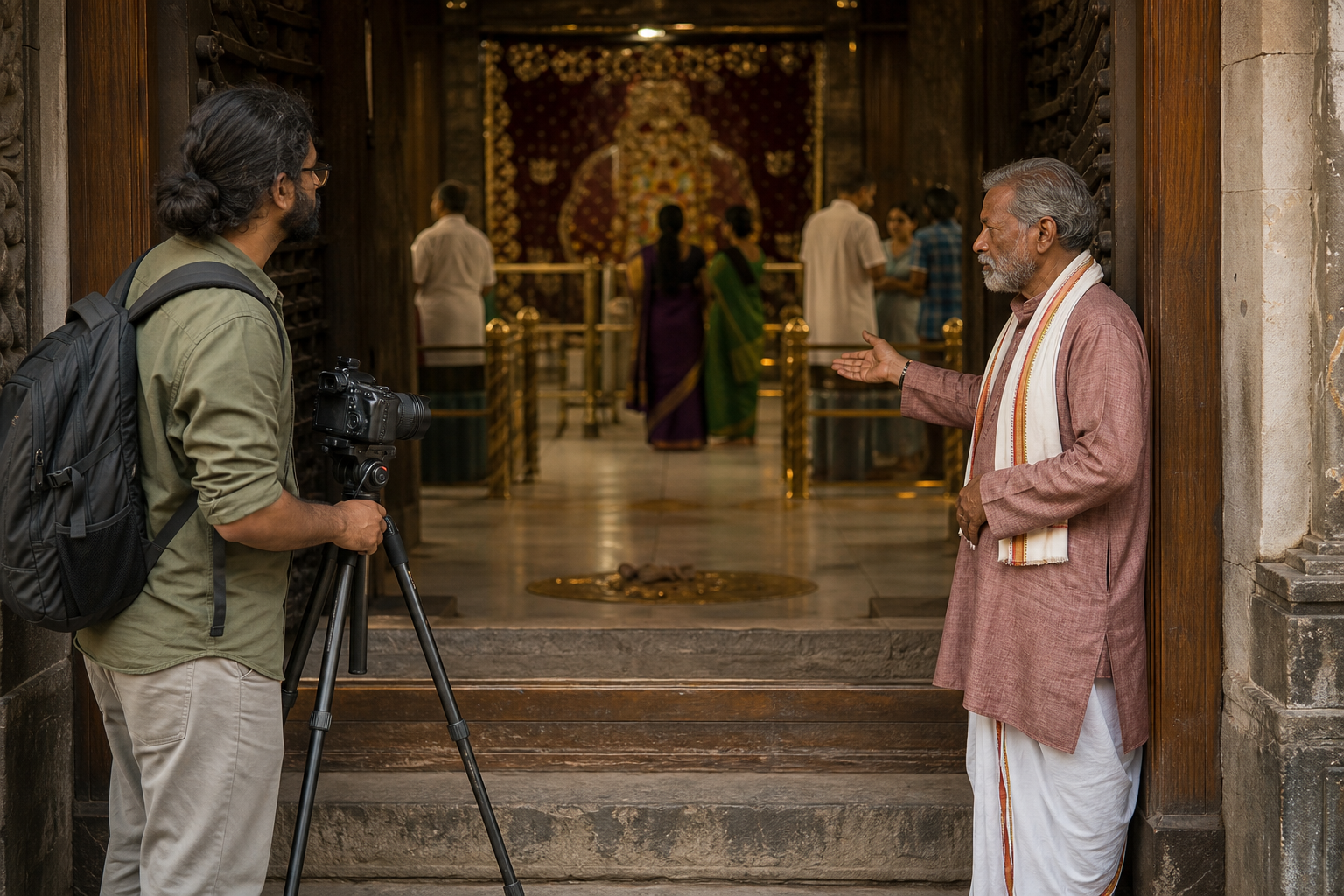
A sacred image can perform several functions, but your audience needs to know which function leads. Confusion begins when an interpretation is presented as documentation, or when a devotional image is treated as neutral decoration.
- Documentary record: The camera records an actual place, object, performance, festival, or ritual setting. Your caption should identify what is verifiable and distinguish the recorded occasion from any reconstruction. Do not supply a date, ritual name, or symbolic meaning simply because it seems likely.
- Interpretive adaptation: A filmmaker, animator, photographer, or designer reshapes inherited material through a new medium. Name both the tradition and the adaptation. Stylisation is not a defect, but it should not masquerade as an unmediated view of practice.
- Devotional presentation: The primary purpose is reverence, remembrance, contemplation, or worship. Composition, accompanying text, and placement should support that purpose. If the same image appears in a secular setting, give viewers enough context to understand why practitioners may encounter it differently.
The Talking Hands of Travancore, a Russian film produced in 1981, combines animation with Kerala’s Kathakali vocabulary to evoke Kali-associated mythic intensity. Its psychedelic colour, symbolic movement, and emphasis on sensation make it an interpretive work rather than a straightforward record of a ritual or a line-by-line illustration of one narrative. A useful introduction therefore names the cross-cultural adaptation before discussing what its imagery may mean.
Before editing, complete this sentence: “This is a documentary record, interpretive adaptation, or devotional presentation of [verified subject], associated with [tradition or place], prepared for [audience and use].” If you cannot fill a blank without guessing, investigate it or leave the claim narrower. The label should govern your crop, soundtrack, transitions, caption, and title.
Preserve the visual grammar, not just the recognisable symbol
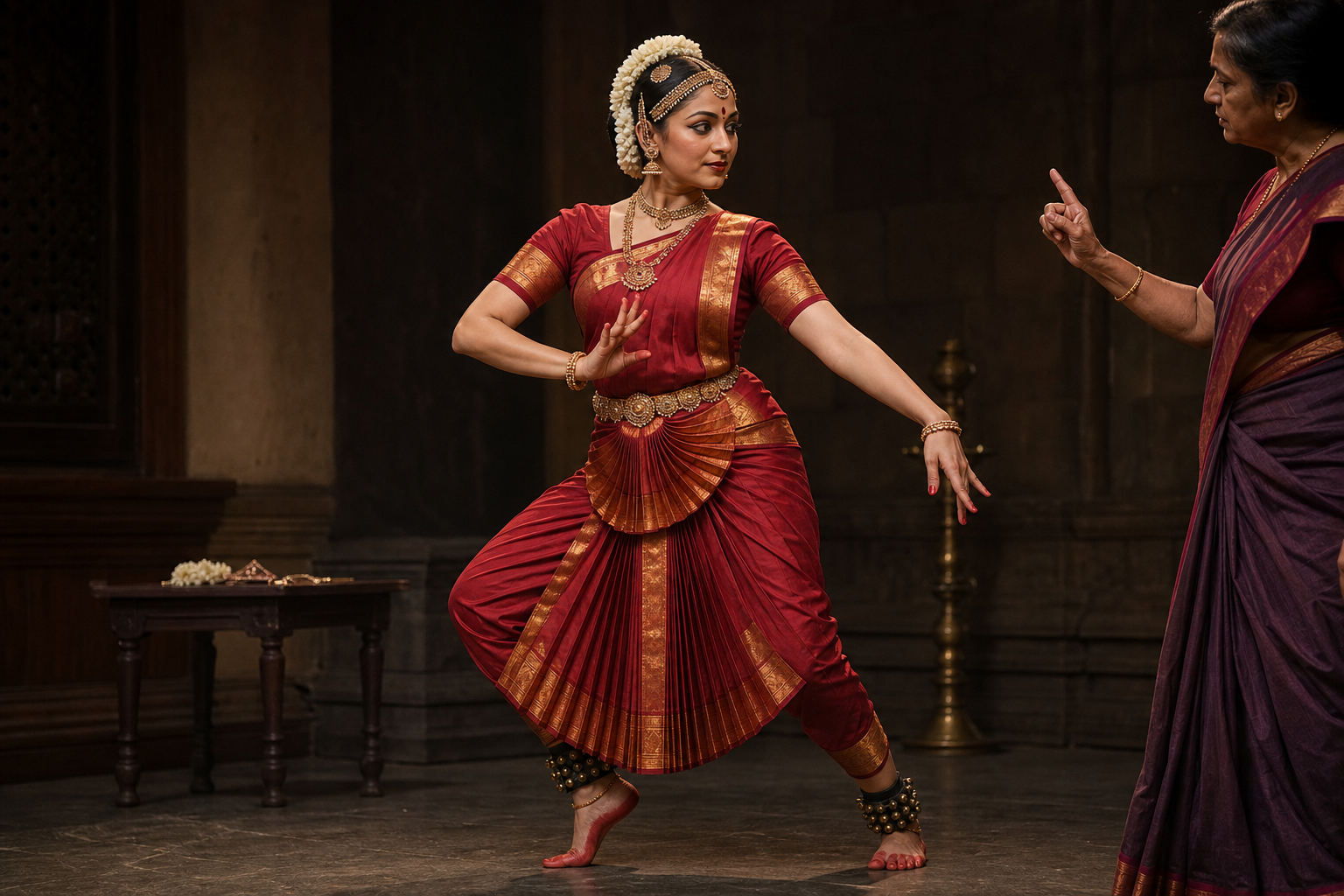
Sacred representation carries meaning through relationships. A hand gesture, facial expression, architectural axis, procession, riverbank, colour, or sequence may matter because of how it relates to everything around it. Extracting the most dramatic element can leave you with an attractive image that no longer communicates what made the scene intelligible.
Read a visual through four layers before you crop or rearrange it:
- Identity: Who or what is shown? Record the exact name only when you can verify it.
- Relationship: Which people, objects, spaces, or directions give the subject its context? A detail may depend on an altar, stage, temple, landscape, or surrounding action.
- Action: Is the image showing worship, performance, procession, teaching, construction, contemplation, or another activity? Describe the visible action before assigning an interpretation.
- Expressive mode: What do gesture, rhythm, colour, sound, and composition ask the viewer to notice or feel? Separate what is visibly present from what you infer.
This distinction is essential with classical performance. In Kathakali, codified abhinaya, mudras, stylised facial expression, and muscular movement work together as an embodied language. The hands are not interchangeable ornaments. Neither are the face, posture, rhythm, and dramatic mood. A close crop that preserves the eyes but removes the hands may destroy the very relationship through which the performance communicates.
If you cannot identify a particular mudra, do not improvise a doctrinal meaning. Call it a hand gesture within a Kathakali performance vocabulary and seek a qualified identification before making the caption more specific. The same restraint applies to rasa. Raudra, the fierce mode associated with the Kali imagery in this film, is intensified by colour, sound, movement, and expression together; isolating a single frame can make its force look like generic anger or horror.
A sacred landscape requires a similarly layered approach. A useful record of Sri Mayapur-dhama extends beyond a single monumental view: Deities, temples, holy rivers, natural surroundings, festivals, and ritual life collectively document the place. If you are building a photo essay or archive, collect an establishing view, a view of people or practice within the space, and details that preserve architecture, gesture, or material culture. Record file names and captions while the context is still available.
Repeated views can also preserve change. Imagery of the Temple of the Vedic Planetarium records architecture, ritual activity, and an evolving sacred landscape. For a project intended to support comparison over time, retain the original metadata, avoid presenting an undated image as a dated milestone, and use consistent subject labels. A beautiful archive becomes historically useful only when later viewers can tell what they are comparing.
Create Dharmic unity through precision, not sameness
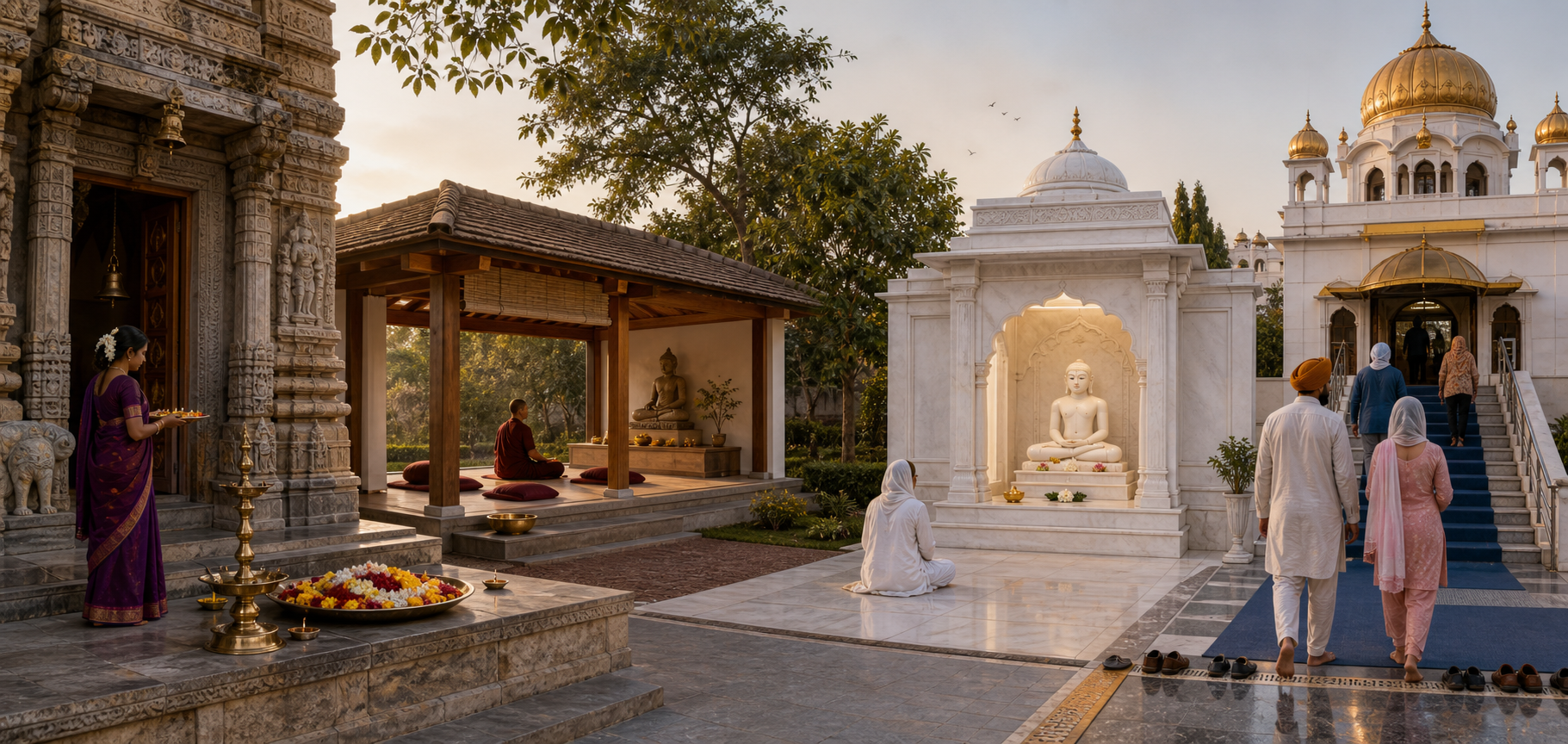
Hindu, Buddhist, Jain, and Sikh visual traditions can resonate around reverence for sacred places, contemplative practice, and service to community. Those resonances are meaningful, but they do not make every image, gesture, shrine, or doctrine interchangeable. The strongest civilisational connection begins by naming the particular tradition accurately.
- Name before comparing. Identify the person, place, practice, lineage, and medium as far as the available evidence permits. Introduce a shared value only after the specific subject is clear.
- Compare the same dimension. Compare approaches to sacred space with approaches to sacred space, or forms of contemplative representation with other such forms. Do not treat a theological symbol in one tradition as the automatic equivalent of a performance gesture in another.
- Distinguish origin from reception. A work may arise in one culture and interpret the vocabulary of another. Keep the creator’s setting and the inherited form visible in the same caption.
- Describe resonance, not identity. Say that two representations illuminate a related ethical concern when that is supportable. Do not claim that they mean the same thing merely because both appear peaceful, ascetic, fierce, or sacred.
Cross-cultural work makes this discipline especially important. When a Russian experimental production works with Kerala’s Kathakali language, the animation, South Indian performance vocabulary, Kali-associated imagery, and cross-border interpretation all belong in the account. Admiration does not remove the obligation to name lineage.
A reliable caption can follow this order: verified subject; tradition or place; visible action or artistic medium; documentary, interpretive, or devotional status; creator or institution; and usage credit. For example: “Animated interpretation of Kali-associated fierce energy through Kathakali-derived abhinaya and mudras; Russian production, 1981.” That wording tells viewers what kind of claim they are receiving without pretending that one sentence exhausts the tradition.
Before publishing a comparative visual, ask three questions. Would a practitioner recognise how the tradition has been named? Would a newcomer know which tradition supplied each element? Have you presented common ground as a relationship between distinct traditions rather than evidence that their differences do not matter? If any answer is no, narrow the claim and strengthen the labels.
Treat access, credit, and cropping as forms of stewardship
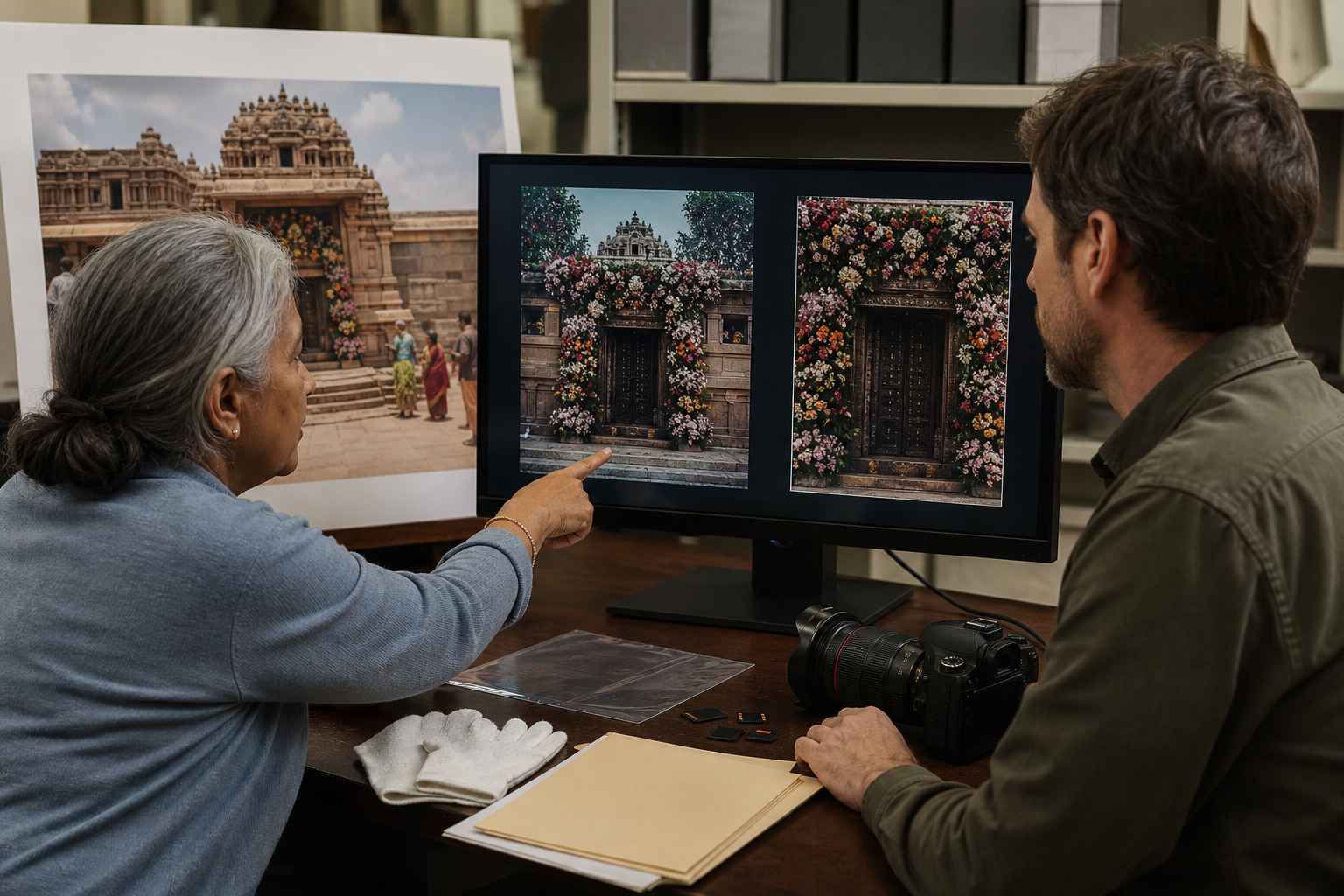
A download button is a delivery mechanism, not a universal licence. Technical quality and permission are separate questions. The high-resolution Sri Mayapur collection is made available for uses such as presentations, educational displays, community events, and personal meditation, with availability intended for non-commercial use. That makes it valuable for teaching and community work, but it does not make every commercial reuse acceptable.
Use this rights workflow for every borrowed image or clip:
- Read the terms where you obtained the file. Check the gallery page, folder, and any notice attached to the individual asset. Save the wording or link with your project records.
- Classify your actual use. Personal reflection, classroom teaching, a community display, editorial publication, sponsored content, merchandise, and client work are not automatically governed in the same way.
- Record provenance immediately. Keep the original file name, creator’s name when supplied, institution, download location, restrictions, and date of access with the master file.
- Place credit near the media. Credit ISKCON Mayapur and the devotee photographer where applicable, rather than leaving attribution in an unrelated page or omitting the individual creator when that information is available.
- Ask when the boundary is unclear. If an asset is limited to non-commercial use, do not assume that a religious, educational, or nonprofit purpose resolves every sponsored, fundraising, paid-distribution, or merchandise use. Pause commercial publication and seek written permission, or choose an asset with explicit compatible terms.
Keep the untouched master and edit a copy. That protects the archival value of the highest-quality file and gives you a clean reference if a crop or colour treatment later proves misleading. High resolution is useful because it preserves detail for projection, displays, study, and archiving; it is not permission to remove context or make an uncertain identification appear authoritative.
Review the crop as carefully as the caption. Do the hands remain visible when gesture carries meaning? Have you removed an architectural or ritual relationship needed to understand the scene? Does overlaid text cover a Deity, face, sacred object, or identifying detail? Does a collage place images from different traditions together without telling the viewer which is which? Change the layout if the design depends on such losses.
Write both a caption and alternative text. The caption supplies cultural and interpretive context; alternative text tells a person who cannot see the image what is visibly important. Avoid stuffing either field with every possible doctrine. Start with the subject and action, then include the detail that matters to your purpose. If an interpretation is contested or uncertain, put that uncertainty in the caption instead of presenting it as visual fact.
Fierce imagery deserves particular care. In a Kali-associated adaptation, conflict can be read through the conquest of chaos and falsehood, dissolution of ego, restoration of balance, and protection of the vulnerable. A thumbnail or promotional line that reduces the same imagery to exotic violence strips away that interpretive field. If your format is too small to carry the necessary context, select a less ambiguous visual or link directly to a fuller explanation.
Key takeaways: a five-pass test before publication
- Claim: State whether the media is documentary, interpretive, or devotional. Make the title, caption, editing, and soundtrack consistent with that status.
- Context: Verify the subject, tradition, place, medium, and visible action. Omit uncertain dates, ritual names, and symbolic identifications rather than guessing.
- Integrity: Check whether cropping, sequencing, colour, or added sound removes a gesture, relationship, mood, or architectural context needed for understanding.
- Lineage: Name the particular tradition before drawing a Dharmic or cross-cultural connection. Present common ground as resonance between distinct paths, not proof of sameness.
- Stewardship: Confirm that the intended use fits the permission, retain provenance, credit the creator and institution where applicable, preserve the master file, and provide a clear caption and alternative text.
For your next upload, place a draft classification, caption, and rights line beneath the visual before you design the page. Read those three lines without looking at the image. If they do not identify what viewers are seeing, how it relates to a tradition, and whether you may use it as planned, do not publish yet. Revise the claim, choose a more suitable visual, or obtain the missing permission first.
References
- DharmaRenaissance Blog — Discover ISKCON Mayapur’s Stunning High-Resolution Photos of Sri Mayapur for Free Download
- DharmaRenaissance Blog — Fierce Grace of Kali: A 1981 Russian Psychedelic Short Through Kathakali’s Talking Hands
