
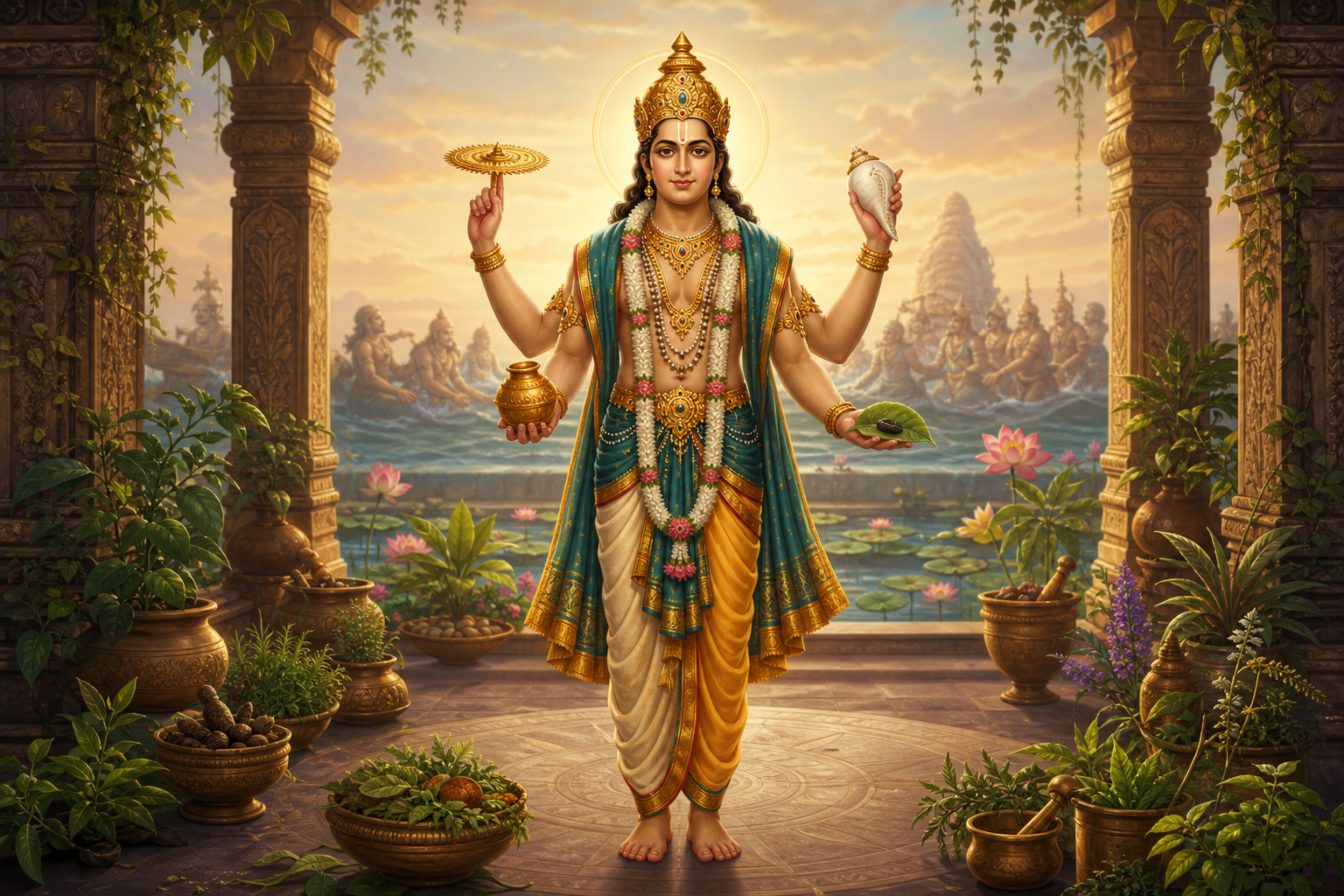
You may have looked at an image of Dhanvantari and wondered whether that small, unsettling leech really belongs beside the amrita of the Samudra Manthana. It does—but not as a celebration of bloodletting for its own sake.
The leech makes a disciplined healing principle visible: remove a limited excess, at the place where it is causing trouble, by the gentlest suitable means. Understanding that principle lets you read the symbol without dismissing it as superstition or treating it as permission to attempt a medical procedure yourself.
The leech makes a clinical principle visible
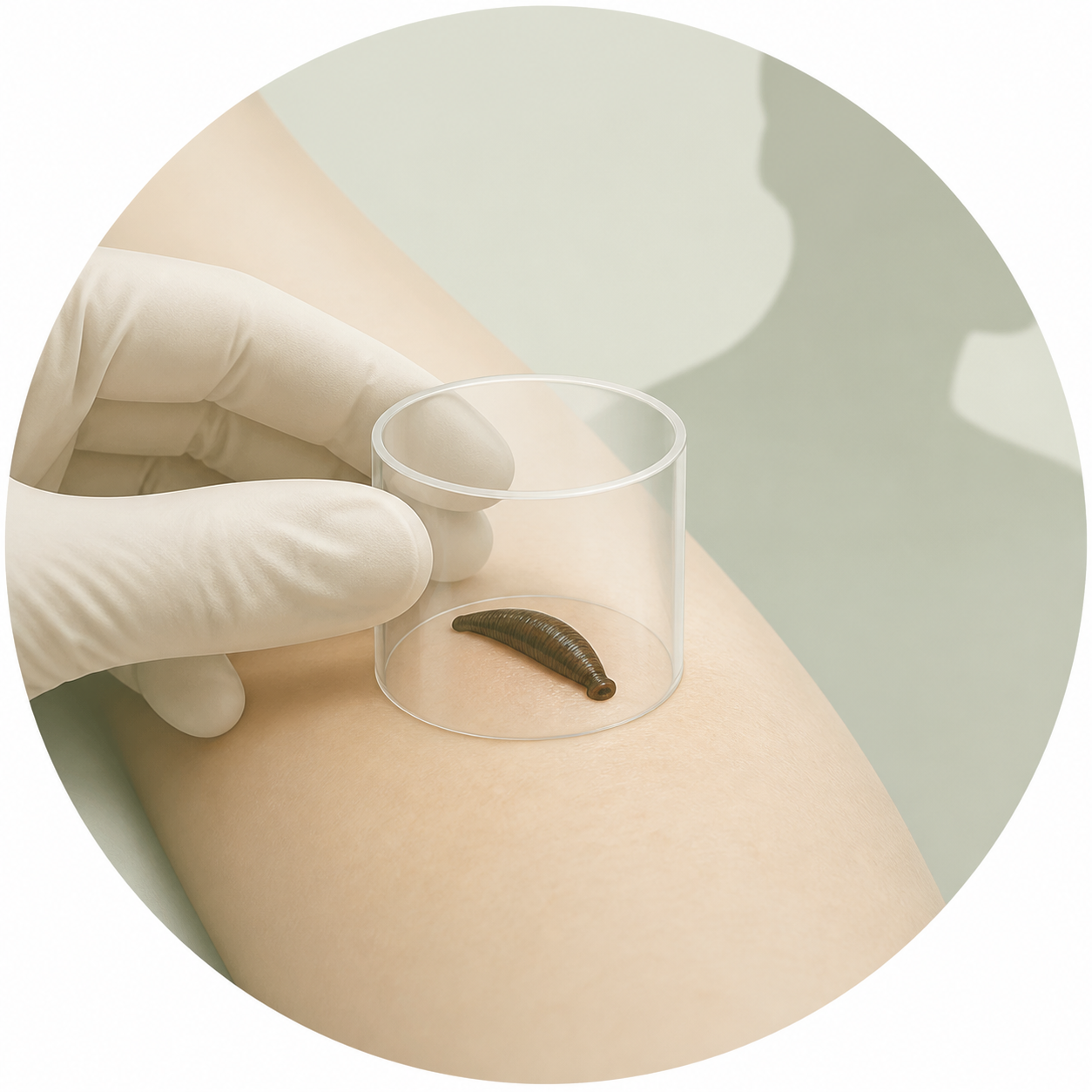
Dhanvantari emerges from the churning of the cosmic ocean bearing amrita, so his symbolism naturally carries ideas of life, restoration, and healing. The leech adds something less majestic but more practical. It brings the promise of healing down from the cosmic level to a particular therapeutic act performed on a particular part of the body.
The central idea is not that blood is inherently bad or that health requires constant purging. It is that a healer may sometimes remove a small, localized excess so that balance and normal flow can return. The therapeutic goal is restoration, not extraction without limit.
This distinction matters because the language of purification is easily misunderstood. In a ritual setting, purification may carry moral or spiritual associations. In this Ayurvedic setting, it refers to a controlled clinical response to a perceived imbalance. It should not be converted into a vague claim that everybody has toxins requiring leech treatment.
When you encounter the leech in Dhanvantari imagery, therefore, notice the measure of the intervention. The creature acts locally, removes only a limited quantity, and represents relief obtained without beginning with the most aggressive instrument. The image teaches proportion: do what the condition requires, but do no more than the condition requires.
Jalaukavacharana is a procedure, not a general detox

Jalaukavacharana is described in the Sushruta Samhita as a form of Rakta Mokshana, or therapeutic bloodletting. A suitable leech is applied so that it draws a small quantity of blood through superficial vessels. This is a defined procedure within Ayurvedic medicine, not a synonym for wellness cleansing.
The traditional indications are framed through Rakta and Pitta dushti. They include selected inflammatory swellings, certain skin disorders, and localized venous congestion. These are broad Ayurvedic categories, not instructions for self-diagnosis. Redness, heat, pain, or swelling can have different causes, and the appearance of one such feature does not establish that leech therapy is appropriate.
The intended action is local and precise: reduce congestion and, in a suitable case, ease heat, swelling, or pain. That specificity is important. A practitioner proposing leech therapy should be able to name the condition being addressed, the exact area being treated, and the reason local blood removal is expected to help. A promise of whole-body detoxification is not an adequate clinical explanation.
Ayurveda classifies the procedure as mridu upakrama, a gentle intervention. Here, gentle is comparative. Leeches attach and detach naturally, avoiding the initial use of a sharp bloodletting instrument. This helps explain the traditional view that the method can be considered for delicate patients, including children, older people, and those with low pain tolerance.
Gentle does not mean trivial or automatically safe. The procedure still involves the skin, blood, a living organism, hygiene, and patient selection. The classical description of suitability for a group is not modern medical clearance for every individual in that group.
Restraint connects Dhanvantari with ahimsa and seva
The leech fits Dhanvantari’s healing symbolism because it represents restraint in the use of therapeutic force. Ahimsa does not make all interventions impossible. In medicine, it points toward avoiding needless injury and choosing the least harmful adequate measure. A limited procedure can therefore express ahimsa when it is necessary, proportionate, and competently performed.
This ethical sensibility has echoes across the Dharmic traditions. Hindu, Buddhist, and Jain approaches do not define ahimsa in precisely identical ways, and they should not be flattened into one system. Yet each gives moral weight to the reduction of avoidable harm. Sikh seva adds a closely related emphasis on healing as service rather than self-display.
That shared ground gives you a practical test for any treatment presented as Dharmic. Is there a clear need? Is the intervention proportionate to that need? Is the patient being treated with competent care rather than used to advertise a dramatic remedy? A sacred label cannot rescue an unnecessary or poorly performed procedure.
Vaidyas have traditionally invoked Dhanvantari when beginning healing work, placing the encounter among healer, patient, and remedy within a sacred trust. Remembrance during Dhanvantari Trayodashi, or Dhanteras, reinforces the same obligation. Reverence should make clinical discipline stricter, not optional. Competence is part of compassion.
Modern medical use is real, but the overlap is narrow

Medical leeches such as Hirudo medicinalis are used in reconstructive surgery to relieve venous congestion. Congestion can occur when blood reaches an affected area more effectively than it can drain away. In that defined setting, a leech serves as a local tool for restoring flow while the tissue is being managed by a surgical team.
The resemblance to the Ayurvedic logic is meaningful: both uses are targeted, local, and concerned with relieving obstructed or excessive accumulation. It shows that a living organism employed in ancient medicine can retain a legitimate clinical function under modern conditions.
But the comparison has limits. Reconstructive use does not prove every traditional indication for leech therapy, establish every Ayurvedic diagnostic category in biomedical terms, or validate commercial detox claims. Nor does a narrow modern indication make the older practice irrelevant. The responsible conclusion is smaller and stronger: leeches can be medically useful when the problem, mechanism, handling, and supervision are clearly defined.
If someone invokes modern surgery to justify an unrelated wellness treatment, ask them to show the clinical bridge between the two. The same instrument can be appropriate in one setting and inappropriate in another. Evidence for local venous congestion cannot simply be transferred to every skin complaint, inflammatory symptom, or general feeling of ill health.
How to assess a proposed leech treatment safely

The classical safeguards begin with a suitable nirvisha, or non-poisonous, leech, careful hygiene, and a clear indication. Those requirements already rule out an improvised home session with a wild or informally obtained leech. Symbolic admiration is not training, and familiarity with Ayurvedic vocabulary is not proof that someone can perform the procedure safely.
Before consenting, ask what diagnosis is being treated, why leech therapy is preferred for that diagnosis, how the leeches are selected and handled, who supervises the procedure, and what aftercare or escalation plan will be used. A credible practitioner should answer in plain language. If the explanation never becomes more precise than purification, ancient wisdom, or removal of bad blood, do not proceed.
A persistent or worsening symptom deserves assessment by an appropriately qualified medical professional before any bloodletting procedure. Where Ayurvedic care is being considered, involve a practitioner with actual training in Jalaukavacharana and work within the medical and professional rules that apply where you live. Leech therapy should never replace diagnosis or necessary surgical and medical care.
The same caution applies to people described in the classical tradition as suitable for a gentle intervention. A child, an older adult, or a person with low pain tolerance still requires individual evaluation. Mridu describes the character of the technique relative to sharper methods; it does not erase the need to decide whether the procedure itself is appropriate.
Key takeaways
- In Dhanvantari symbolism, the leech represents limited, targeted purification and the restoration of balance—not indiscriminate bloodletting.
- Jalaukavacharana is a form of Rakta Mokshana used within Ayurveda for selected local conditions, not a general detox treatment.
- Its classification as mridu upakrama means gentler than sharp-instrument methods; it does not mean risk-free or suitable for self-treatment.
- Modern reconstructive surgery confirms a narrow medical role for leeches in relieving venous congestion, not every claim made for leech therapy.
- A sound decision requires a diagnosis, a precise indication, appropriate leech selection, careful hygiene, trained supervision, and a follow-up plan.
The next time you see a leech beside Dhanvantari, read it as an instruction in measure. If you are considering the therapy itself, carry that discipline into your decision: insist on a diagnosis, a specific clinical purpose, safe handling, and qualified care before consenting. That rigor does not diminish the sacred symbolism. It fulfils it.
References
