
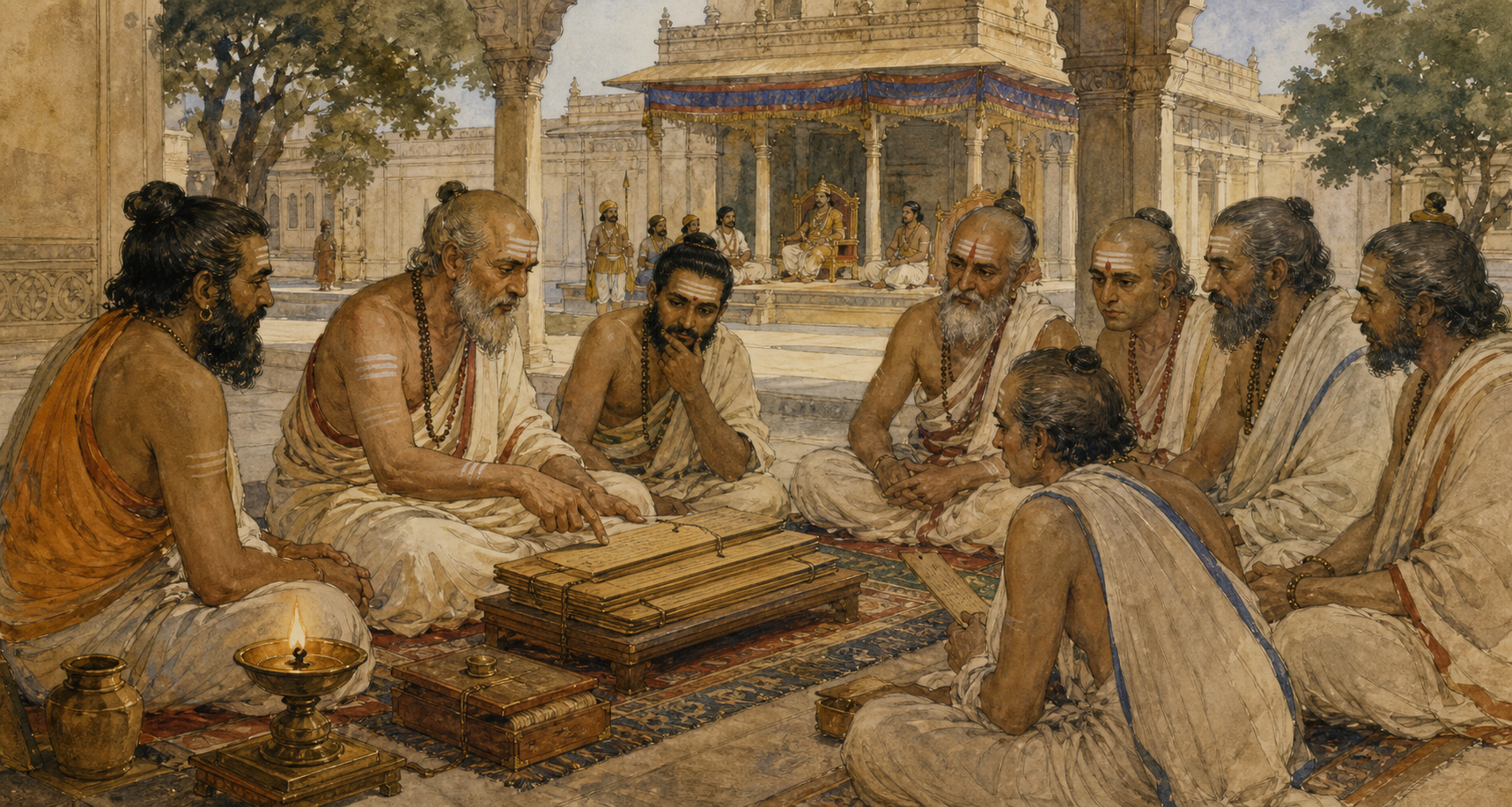
You may have encountered Madanaparijata while trying to answer a deceptively simple question: what did dharma mean as jurisprudence in medieval Bharat? The danger lies in reading too quickly. Treat the work as a modern statute book, and you flatten dharma into enforceable rules. Treat it as merely religious literature, and you miss its reasoning about conduct, responsibility, ritual, and social order.
A better approach is to read it as carefully organized normative thought. The method below will help you identify what kind of claim a passage makes, how much historical weight it can carry, and how to compare its ethical concerns with other Dharmic traditions without erasing important differences.
Begin with the genre, not an isolated rule
Composed by Vishveshwara Bhatta approximately between 1360 and 1390 CE, Madanaparijata is an extensive Dharmashastra digest. That description should govern how you read it.
A digest gathers and organizes inherited normative reasoning. Its value does not lie only in the individual positions it preserves. Selection, arrangement, explanation, and the effort to make different materials intellectually coherent are also part of its contribution. The structure is evidence of jurisprudential thought, not disposable packaging around a collection of rules.
This matters because Dharmashastra cannot be reduced to the modern category of state-made law. Dharma can encompass personal duty, ethical discipline, ritual propriety, social responsibility, and questions of governance. A prescription may therefore do several kinds of work at once. It can direct conduct, cultivate restraint, maintain a relationship, and uphold a conception of social order.
Before drawing a conclusion from any passage, ask four preliminary questions:
- Is the passage prescribing conduct, defining an ideal, explaining a duty, or organizing a procedure?
- Who is its stated addressee: an individual, a social role, a ritual participant, an interpreter, or a ruler?
- Does its reasoning operate mainly at a personal, ethical, ritual, social, or governmental level?
- What do the surrounding passages add to the statement you first noticed?
Do not begin by extracting a sentence that seems familiar, severe, or useful in a present controversy. Begin by locating its function. In your notes, describe Madanaparijata as a medieval Dharmashastra digest rather than an unqualified statute code. That one choice of language prevents several later errors.
Keep the courtly setting in view without making it explain everything
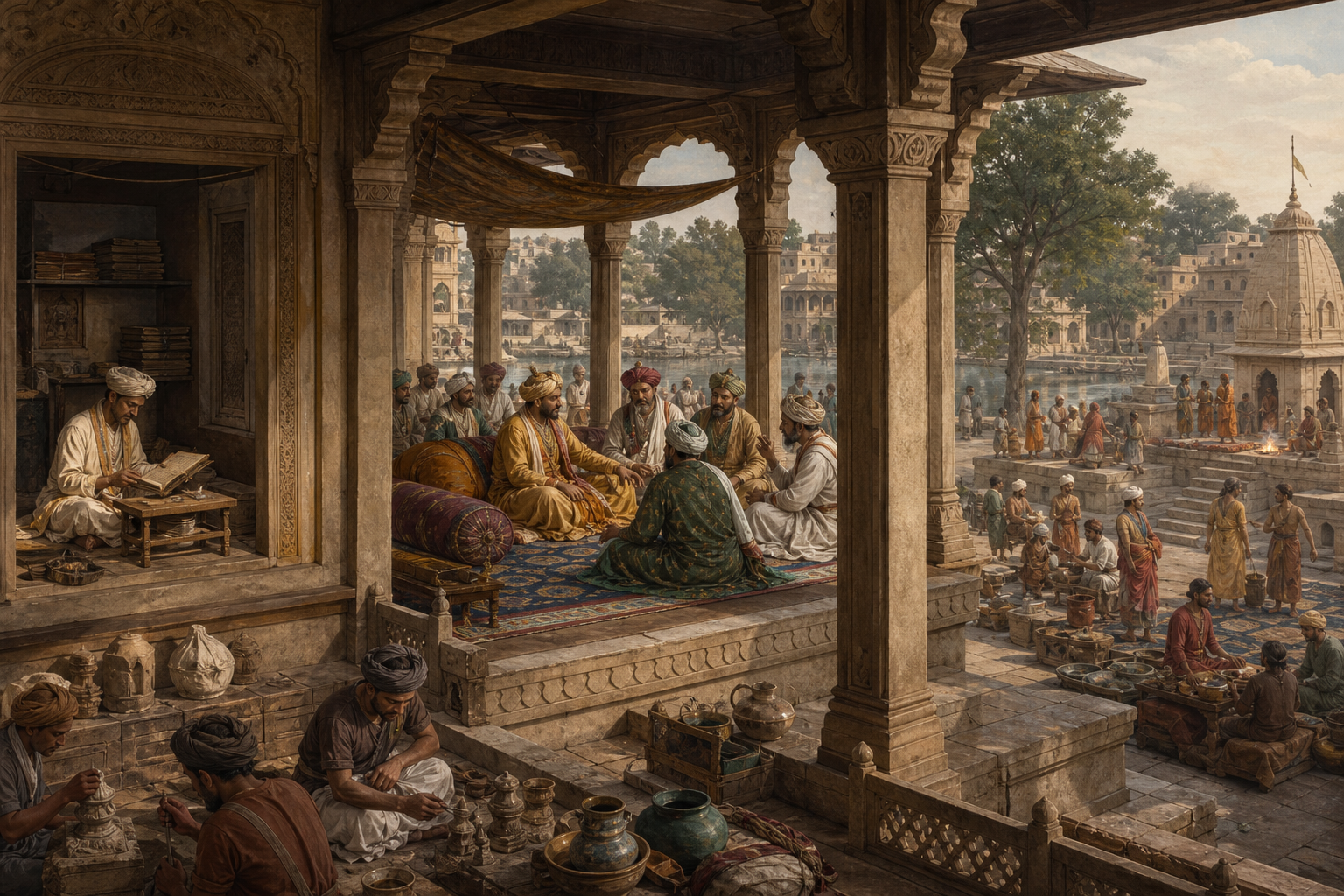
Vishveshwara Bhatta served as a court pundit to King Madanapala, a regional ruler north of Delhi. This setting places learned interpretation close to questions of counsel, jurisprudence, and governance. It helps explain why a systematic presentation of dharma could have practical as well as scholastic importance.
The context supports questions, however, not automatic answers. A court connection does not by itself turn every proposition into a royal command. It does not prove that every rule was enforced, that every subject followed it, or that one regional court represented all of Bharat. Those would be separate historical claims requiring separate evidence.
Put four pieces of metadata at the top of every serious reading note: the approximate date range, the author’s name, the connection to Madanapala’s court, and the work’s genre. Keep those facts attached when you quote or paraphrase. The disciplined formulation is, ‘Madanaparijata prescribes or frames this position.’ The careless formulation is, ‘People in medieval India did this.’ The first reports textual evidence. The second converts a norm into an unsupported description of an entire society.
This distinction is especially important when a passage appears politically convenient. Courtly proximity can tell you that jurisprudence and governance occupied the same learned environment. It cannot tell you, without further evidence, exactly how an individual proposition moved from scholarly formulation to public administration.
Read every passage through duty, purpose, and order

Madanaparijata becomes easier to understand when you stop looking for a single modern equivalent of ‘law.’ Read each passage through three linked lenses:
- Duty: What action, restraint, responsibility, or standard of conduct is being presented, and to whom does it apply?
- Purpose: What ethical quality or human good does the position appear to protect, such as restraint, compassion, responsibility, or communal well-being?
- Order: What relationship, ritual arrangement, social expectation, or governing responsibility would be maintained by following it?
The three answers may overlap. That overlap is not a defect to be tidied away. It is part of a worldview in which personal virtue, ritual life, public responsibility, and social harmony can reinforce one another. A modern reader trained to separate religion, morality, and law into sealed compartments can otherwise miss the argument being made.
Use a compact reading record for each passage:
- Location: Record the edition, translation, and exact textual location you are using.
- Plain meaning: Paraphrase the position before approving, rejecting, or comparing it.
- Addressee: Identify the person, role, or institution to which the duty is directed.
- Scope: Note every condition or limitation stated in the passage or its immediate context.
- Function: Mark the legal, ethical, ritual, social, or governing work the position performs.
- Evidence status: Label your explanation as explicit when the reasoning is stated and as inferred when you have reconstructed it.
The last step is crucial. If a passage states a duty but not its rationale, do not quietly insert a rationale and then attribute it to Vishveshwara Bhatta. You may propose an interpretation, but label it as interpretation. Intellectual sympathy does not excuse imprecision.
Translation requires the same care. The English word ‘law’ often carries assumptions about legislation, courts, police power, and uniform enforcement. Keep the term dharma visible when ‘law’ would narrow the meaning. If you cannot consult the Sanskrit, record which translation you used and avoid building a sweeping conclusion on one English word.
Draw only the conclusions the evidence can carry

Three different claims are often collapsed when medieval Dharmashastra enters modern debate:
- A normative claim: Madanaparijata presents a duty, ideal, or interpretive position.
- A historical-practice claim: People in a particular place and period actually behaved in that way.
- A present-day judgment: The position should be accepted, adapted, rejected, or legally applied now.
A passage can directly establish the first claim. It may offer clues relevant to the second, but actual practice needs corroborating historical evidence. The third requires a fresh argument about present circumstances, institutions, obligations, and consequences. Antiquity alone neither validates nor invalidates a rule.
Use verbs that preserve these boundaries. Write that the text ‘prescribes,’ ‘organizes,’ ‘frames,’ ‘distinguishes,’ or ‘seeks to reconcile.’ Avoid saying that it proves how all Hindus lived, what every Hindu community believed, or what modern law must be. A single digest cannot bear those claims.
Read within those limits, Madanaparijata can help you examine the sophistication of medieval Sanskrit jurisprudence, the integration of ethics with ritual and social duty, and the continuity of dharma as an interpretive concern. It can serve as one point of evidence in a larger account of change and continuity. It cannot, by itself, supply that entire account.
The same discipline should shape comparisons with Buddhism, Jainism, and Sikhism. Begin with shared questions rather than assumed identical answers: What constitutes right conduct? How is restraint cultivated? What does compassion demand? How does personal discipline relate to communal welfare? Then examine how each tradition frames, grounds, and applies its answer using evidence from that tradition.
This method allows you to recognize a broader Dharmic vocabulary without turning distinct paths into interchangeable versions of one system. Madanaparijata can illuminate Hindu Dharmashastra. It should not be made to speak on behalf of Buddhist, Jain, or Sikh authorities.
Key takeaways for your next reading
- Identify Madanaparijata as a late 14th-century Dharmashastra digest, not a modern statute book.
- Treat its organization as part of its jurisprudential contribution, not merely as a container for isolated rules.
- Keep Vishveshwara Bhatta’s connection to Madanapala’s court in view, but do not equate courtly scholarship with universal enforcement.
- Analyze every passage through its addressee, scope, ethical purpose, ritual setting, and ordering function.
- Separate what the text prescribes from what people historically practiced and from what anyone should do now.
- Compare Dharmic traditions through common questions while allowing each tradition to provide its own answers.
Your next step can be small and exact. Choose one passage and make a six-line record: textual location, plain paraphrase, addressee, scope, function, and the precise claim it supports. If your final claim is broader than the evidence recorded above it, narrow the claim. That habit will make Madanaparijata more useful to you as history, jurisprudence, and a serious encounter with the intellectual life of dharma.
References
