
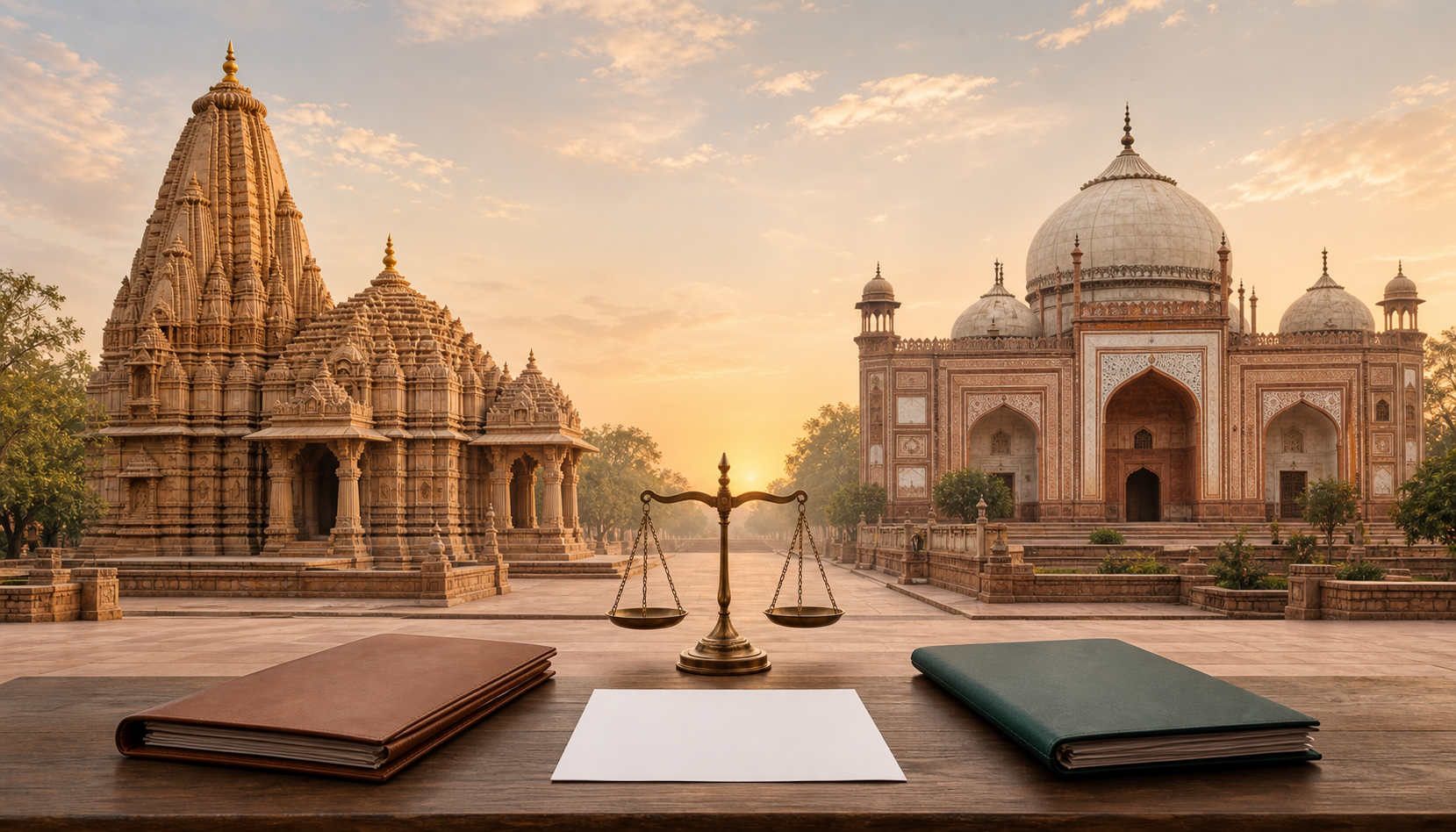
If you came here to learn whether the Shahi Idgah committee has agreed to move, the answer is no. The latest meeting produced a relocation proposal, a refusal to reopen what the committee considers settled, and another date for talks. The underlying court dispute continues.
The useful way to follow this case is to keep three things separate: the Dharmic importance of Krishna Janmabhoomi, the terms offered in a compromise meeting, and what a court has actually decided. When those are collapsed into one story, a proposal can be misreported as an order and a difficult negotiation can be mistaken for a final defeat.
Where the matter stood after the 7 August meeting

As of 7 August 2026, the Krishna Janmabhoomi-Shahi Idgah dispute remained before the High Court. A separate attempt at settlement was taking place after the Supreme Court directed the local court to organize a special Lok Adalat, following applications submitted in June that sought a negotiated resolution.
Representatives connected with Shri Krishna Janmasthan and the secretary of the Idgah committee participated in the latest session. The Hindu side proposed that the Idgah be removed from the disputed location and offered to provide land for a new Idgah 100 kilometres away.
The Idgah committee did not accept that premise. Its stated position was that a settlement had already been reached in 1968, leaving no reason for another compromise. After approximately 90 minutes, the meeting ended without an agreement. A further discussion of possible options was scheduled for 18 August.
That sequence matters. The Supreme Court’s intervention concerned an effort to explore settlement; it was not a decision ordering relocation. The Hindu proposal was an offer made in that process; it was not an accepted arrangement. The committee’s reliance on the 1968 settlement was its position in the discussion; it was not, merely by being asserted there, a fresh judicial ruling on the pending claims.
The offer exposes the real divide between the parties
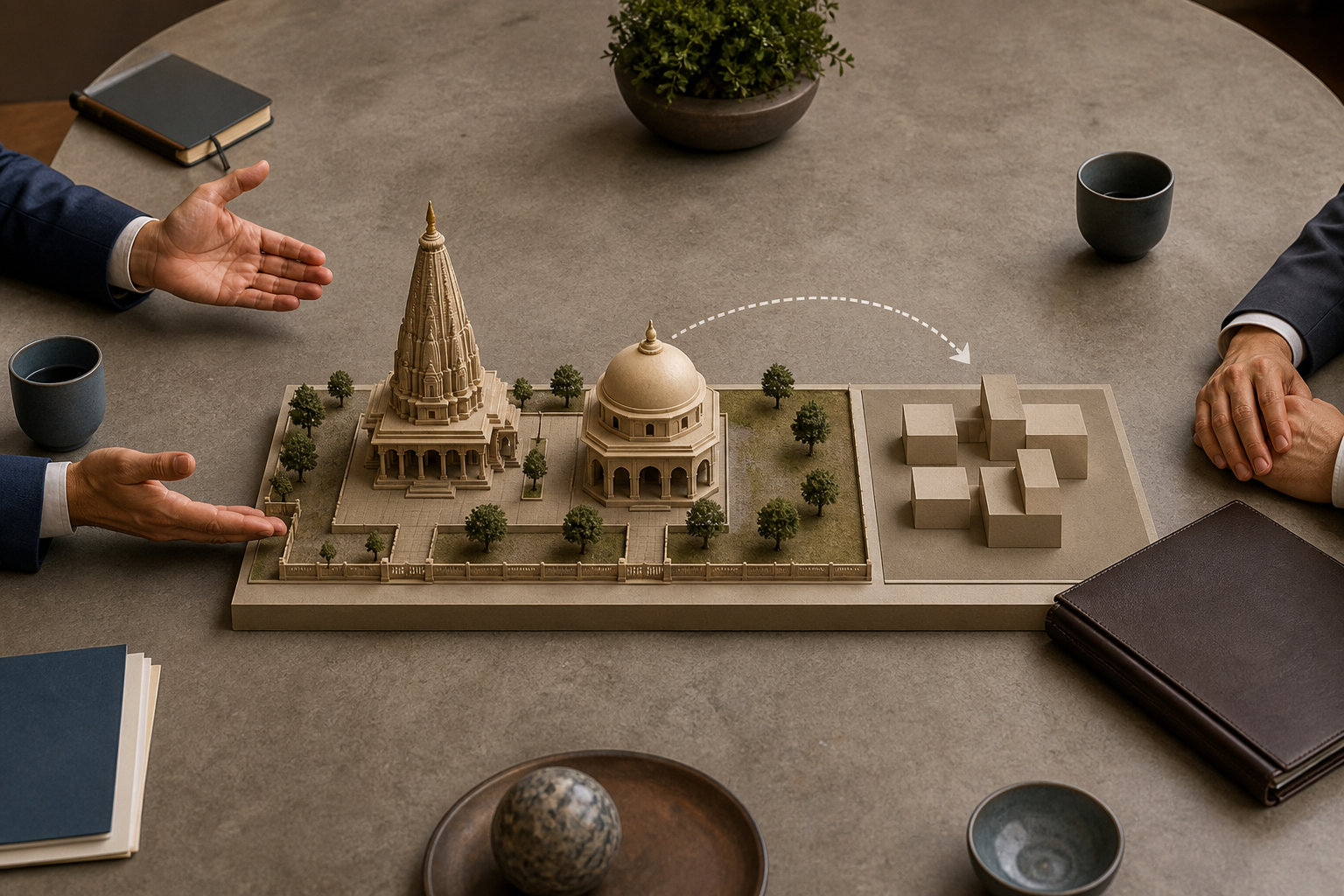
This is not an ordinary negotiation over whether one parcel can be exchanged for another of comparable size. For devotees, Janmabhoomi means the place associated with Bhagavan Krishna’s birth. Sacred geography cannot simply be transferred with a building. The structure of the Hindu proposal therefore implies a clear hierarchy: the location is treated as indispensable, while an alternative arrangement for Islamic worship is presented as negotiable.
The offer of new land is significant in another way. It frames restoration of the contested sacred site alongside continued provision for worship elsewhere. A pro-Dharmic case does not become weaker by stating that element plainly. It shows what the proposed accommodation contains without pretending that the other side has accepted it.
The committee’s response operates at a different level. It did not merely object to the proposed distance or request a different parcel. By invoking the 1968 settlement, it disputed the need to bargain again. One side was discussing a remedy; the other was challenging the premise that a new remedy was required. Until that mismatch changes, repeating the same offer in different words is unlikely by itself to produce agreement.
This distinction also prevents a common mistake. The settlement discussion does not, on its own, establish the legal validity of the 1968 arrangement, determine the parties’ rights, or settle the historical questions attached to the site. Those issues belong to the litigation and its evidence. Negotiation positions reveal what each participant is prepared to discuss; they do not substitute for adjudication.
What the 18 August session can and cannot establish

The scheduled 18 August meeting is a checkpoint, not a promised date of resolution. Its stated purpose is further discussion of options. Unless the parties change their underlying positions, another meeting may record movement, narrow the disagreement, or end without consensus. None of those outcomes should be announced in advance.
When you read the next update, pay attention to the verbs. Proposed means one participant placed an option on the table. Considered means it was discussed. Accepted means the parties agreed to it. Recorded or ordered refers to a formal legal step. Those words are not interchangeable.
If a compromise is reported, verify what was actually accepted: removal from the present site, the location and control of replacement land, the timetable, and the legal form in which the terms were recorded. A vague claim that the dispute has been settled tells you very little unless the operative terms are available.
If the session fails, that still will not decide the merits of the High Court case. It would show only that voluntary agreement was not reached at that stage. Conversely, renewed talks would not prove that either side had conceded its legal case. Negotiation can continue precisely because litigation remains uncertain, lengthy, or difficult for everyone involved.
How to support the cause without spreading a false victory

The strongest public advocacy begins with an exact status line: the Hindu side offered replacement land 100 kilometres away if the Idgah were removed; the committee invoked the 1968 settlement and declined that premise; the meeting ended without agreement; further talks were scheduled; and the court dispute remained pending. That formulation is less dramatic than a victory slogan, but it can survive verification.
Do not say that the Supreme Court ordered the Idgah to move. Do not say that the committee accepted alternative land. Do not describe a scheduled discussion as a final deadline. Each claim would go beyond the reported facts and would be easy to disprove, weakening trust when accurate information is most needed.
When sharing an update, preserve the date and the link rather than circulating a cropped headline. A negotiation can change quickly, and an undated screenshot may continue travelling after the position has changed. If you organize, donate, or speak publicly around the case, check the actual court orders and obtain qualified legal advice before making claims about what conduct is permitted.
Most importantly, do not treat a report of talks as permission for physical interference at the site. Such action creates legal and public-order risks, can endanger people, and can damage a lawful claim. Dharmic restoration requires discipline: clear historical memory, precise language, peaceful advocacy, and respect for the judicial process through which enforceable rights are determined.
You can defend the sacred character of Krishna Janmabhoomi without turning every procedural development into a civilizational verdict. The immediate question is whether a workable legal path to restoration can emerge. The larger principle is that accommodation elsewhere does not make a birthplace interchangeable with ordinary land.
Key takeaways
- No agreement to relocate the Shahi Idgah had been reached as of 7 August 2026.
- The Hindu side offered land 100 kilometres away for a new Idgah if the existing Idgah were removed from the contested location.
- The Idgah committee relied on a 1968 settlement and questioned why another compromise was needed.
- The Supreme Court-directed settlement effort is distinct from a judgment on the merits of the pending High Court dispute.
- The next discussion was scheduled for 18 August, but the meeting itself should not be treated as a guaranteed resolution date.
On 18 August, look first for a formal change in position, not a louder restatement of familiar claims. Until terms are accepted and properly recorded, describe the development for what it is: an attempt to find a negotiated route while the legal contest continues.
References
