
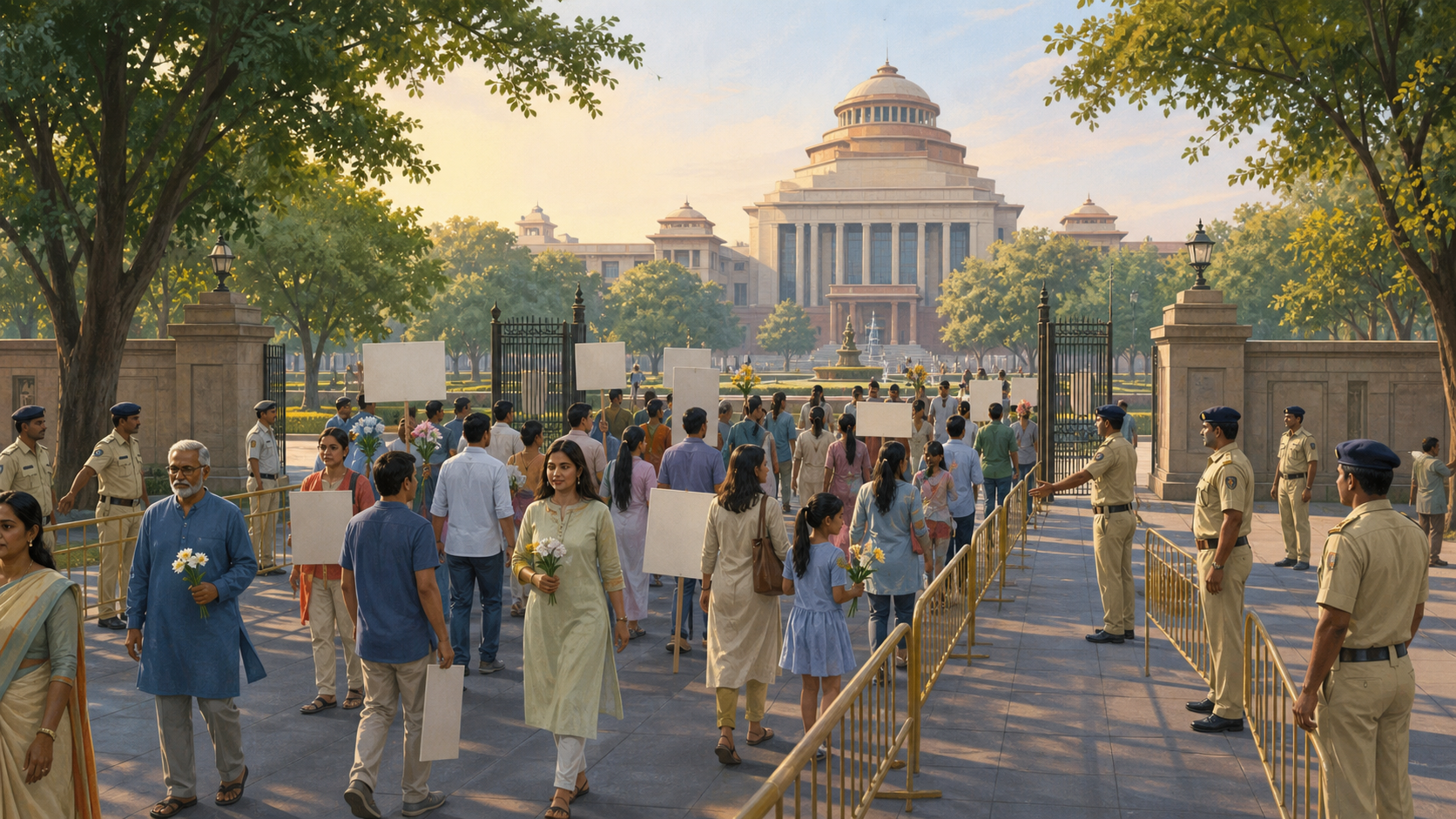
Your procession is peaceful, your route is mapped, and the permission response says only that law and order may be affected. You now need to know whether the state may simply stop the event.
Not merely by invoking those words. Article 19 protects peaceful assembly, while Article 19(3) allows reasonable restrictions connected to public order. The practical question is whether officials are managing an identifiable risk with a focused measure or suppressing a lawful gathering through a general prohibition.
A constitutional right can be regulated, but not erased
Peaceful assembly does not give an organizer an unconditional right to dictate every logistical detail. Authorities may impose a time window, divert a route, require security arrangements, or introduce other safeguards when those conditions respond to a real public-order concern.
The constitutional fault line lies between regulation and suppression. A condition preserves the gathering while reducing a defined risk. A blanket restriction eliminates the gathering without showing why a narrower response would fail.
Article 19(3) does not turn the phrase law and order into a complete explanation. Restrictions on peaceful assembly should be specific, supported by evidence, proportionate and limited in time. Officials must connect the measure they choose to the problem they expect. Otherwise, constitutional scrutiny becomes impossible.
A Karnataka dispute over a proposed RSS route march in Bengaluru makes the distinction concrete. The High Court rejected the indiscriminate use of blanket restrictions while leaving room for route changes, time limits and security protocols. The state retained its responsibility to maintain order, but that responsibility had to be exercised through calibrated measures rather than a sweeping prohibition.
That principle matters if you support the RSS, and it should matter if you do not. A constitutional freedom gains strength when its protection depends on peaceful conduct rather than an organization’s identity or political popularity. If vague apprehension is enough to stop one disfavoured group, the same reasoning can later be directed at a Hindu yatra, a Buddhist gathering, a Jain procession, a Sikh event or a civic demonstration.
Test a restriction with four concrete questions
What exact risk has the authority identified?
Look for facts connecting the proposed date, place, route or format to the feared disruption. A reference to traffic, crowd movement or a security concern may begin the analysis, but the order should explain how that concern arises in your particular application. General unease about an organization or procession is not the same as an evidence-based assessment.
When reading an order, underline its factual statements and circle generic phrases such as public interest, possible tension or law-and-order concern. If the circles greatly outnumber the facts, ask the authority to provide the specific grounds for its decision in writing.
Why does that risk require this particular measure?
The response should fit the problem. If officials identify a difficult stretch of road, a diversion may address it. If two events compete for the same place or time, a revised window may separate them. If crowd management is the issue, entry arrangements, organizer coordination and security protocols may reduce it.
An outright refusal needs more reasoning because it removes the exercise of the right altogether. Ask which narrower conditions were considered and why they were judged inadequate. That question does not deny the state’s public-order role; it requires the state to perform that role constitutionally.
How wide is the restriction, and when does it end?
Check the order’s reach. Does it address the proposed route on the proposed date, or does it sweep across unrelated places, groups and future events? Does it identify a definite period, or continue without a clear endpoint?
A public-order concern may justify action in the place and period where the concern exists. Extending the same restraint beyond that setting requires a separate explanation. Specificity in geography, time and affected activity is one of the clearest ways to distinguish a preventive safeguard from an indiscriminate curb.
Where are the reasons and the path to review?
A reasoned written decision creates accountability. It shows whether officials examined your application individually, considered alternatives and connected their conditions to evidence. It also gives you something definite to correct, answer or challenge.
If the refusal is conveyed orally, request a written order stating the deciding authority, date, conditions, reasons and available method for reconsideration or appeal. Do this promptly. A vague conversation cannot be reviewed as effectively as a dated record.
Build a permission request that makes proportionality possible

Your application should be easy to assess rather than easy to fear. State the gathering’s peaceful purpose, proposed date, start and finish window, assembly and dispersal points, route, expected attendance and responsible organizer. Include the arrangements you propose for volunteers or marshals, traffic movement, emergency access, sound, vehicles and communication with police.
Separate what is essential from what is adjustable. The ability to communicate a message or conduct a religious procession may be central, while a particular road, starting time or duration may be negotiable. Offering workable alternatives lets officials manage risk without cancelling the event’s substance.
Keep the original application, route map, attachments, acknowledgement, correspondence and final decision together. After any meeting or telephone conversation, send a brief written confirmation of what was discussed. This record helps reveal whether authorities considered the actual plan or responded to the event only in general terms.
If officials propose a route diversion or time change, ask how the condition addresses the stated concern. If it still allows meaningful assembly, incorporating it may be the soundest way to protect both the event and the public. If it makes the gathering unworkable, explain that effect precisely and propose a less restrictive option.
Do not convert a constitutional disagreement into a confrontation at the venue. General principles cannot establish whether a particular order is legally valid, and proceeding in defiance can expose participants to consequences that depend on facts and procedures not covered here. If you are considering a court challenge or have been warned of legal action, consult a qualified Indian lawyer promptly and follow lawful directions while the dispute is reviewed.
A neutral rule is stronger than a partisan victory
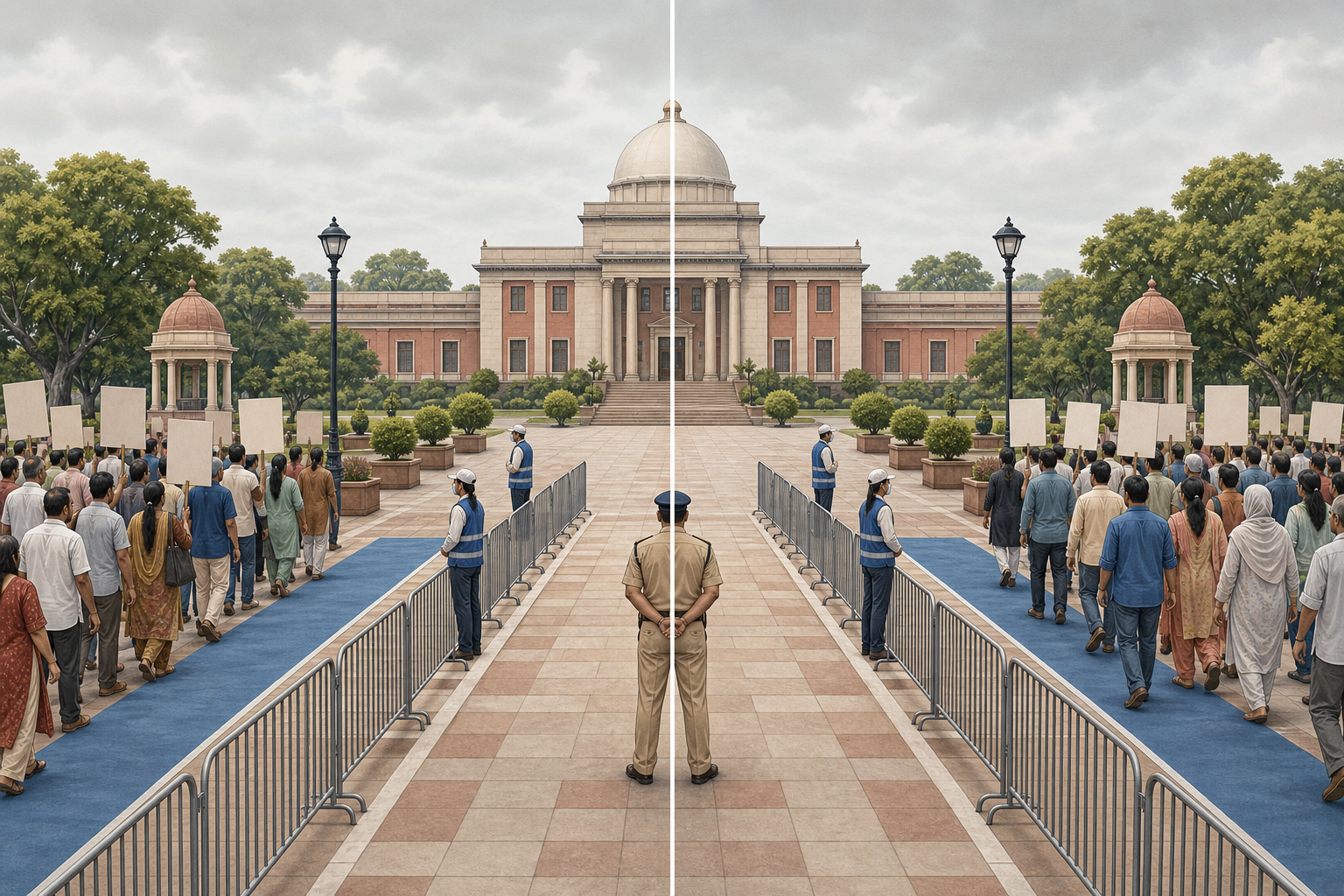
The sound constitutional position is neither that every procession must follow its preferred route nor that officials may prohibit gatherings whenever controversy is possible. Organizers must keep the assembly peaceful and cooperate with proportionate safeguards. The state must manage actual risks through the minimum necessary interference and explain what it has done.
This balance is especially important in Bharat, where processions, yatras, commemorations and public religious observances are part of civic life. Hindu, Buddhist, Jain and Sikh communities all benefit when permission decisions follow stable rules rather than political convenience. Equal treatment also protects people whose views differ from our own, which is how a constitutional compact survives changes of government.
Administrations can reduce conflict by publishing standard permission procedures, requiring reasoned decisions, identifying a prompt review channel and training police in crowd management. If your community regularly organizes public events, ask the local authority for its application criteria, required documents and review contact before the event season begins. Predictability is easier to secure before a dispute than after a last-minute refusal.
Citizens should also resist the temptation to judge restrictions solely by whether their preferred group wins. The durable demand is equal constitutional discipline: peaceful organizers accept focused safety measures, police address concrete risks, and administrators justify every substantial restraint.
Key takeaways
- Article 19 protects peaceful assembly, while Article 19(3) permits reasonable public-order restrictions; neither side of that balance can be ignored.
- A valid restriction should identify a particular risk and connect that risk to the route, time, place, format or other facts of the proposed gathering.
- Before accepting an outright prohibition, ask why a route change, time window, security protocol or another narrower condition would not address the concern.
- A detailed application and complete written record make case-by-case assessment, negotiation and review more effective.
- Do not treat a general constitutional principle as permission to disregard an order. Obtain qualified legal help promptly when a live dispute may carry legal consequences.
If you are planning a procession, prepare a one-page operational note before treating the date and route as final. If the state objects, place its order beside the four questions above, request specific written reasons and propose the narrowest workable condition. That turns a constitutional principle into a usable record while helping to keep both the right and the street secure.
References
