
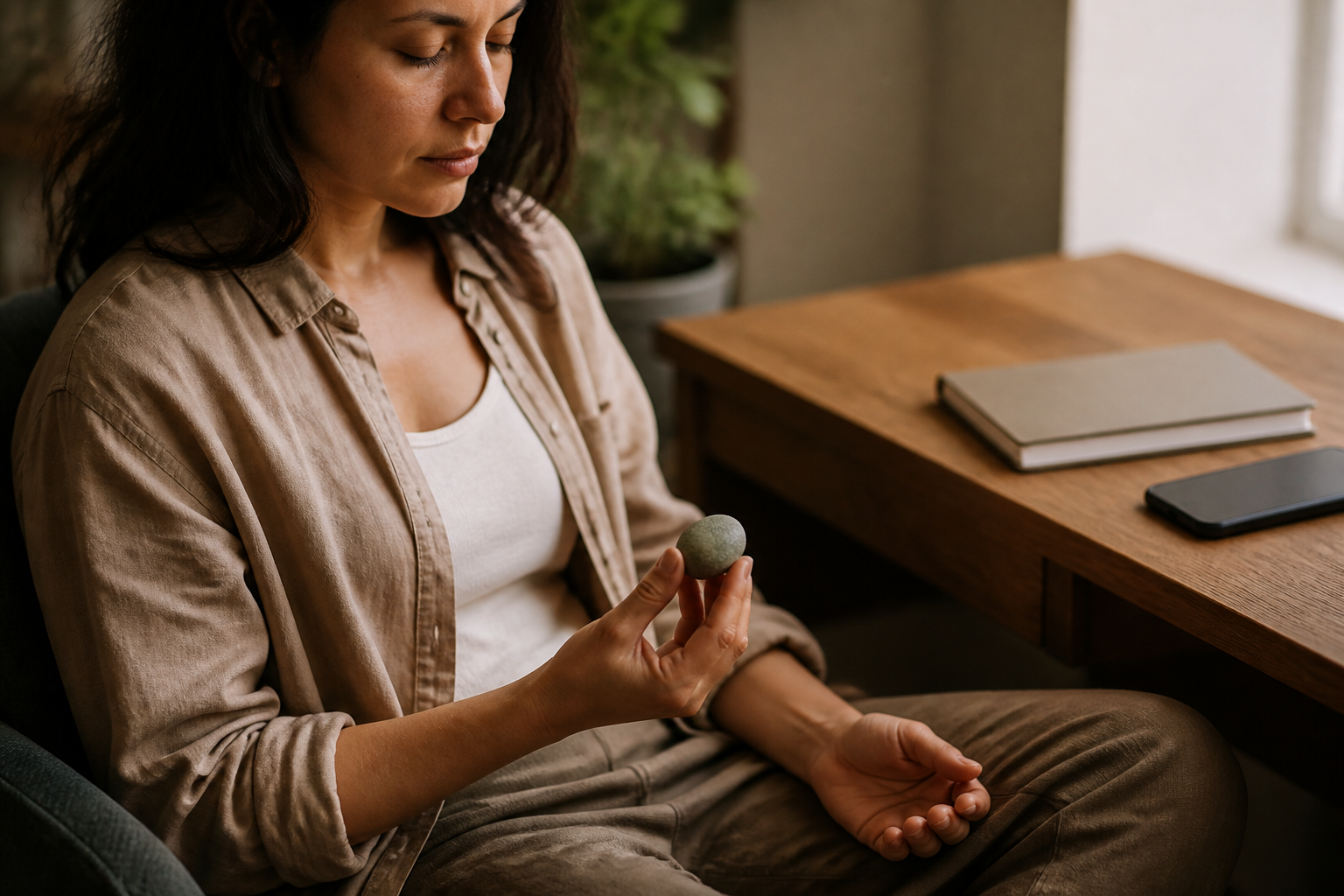
Your mind is racing, your shoulders are tight, and another notification arrives before you have decided what to do with the last one. You do not need a perfect meditation setting at that moment. You need a small interruption between the pressure you feel and the response you are about to make.
A pebble, coin, bead, or piece of fabric can provide that interruption. Held with attention and paired with three steady breaths, an ordinary object becomes a cue to stop reacting, return to remembrance, and choose your next action deliberately.
The object is a doorway, not the practice
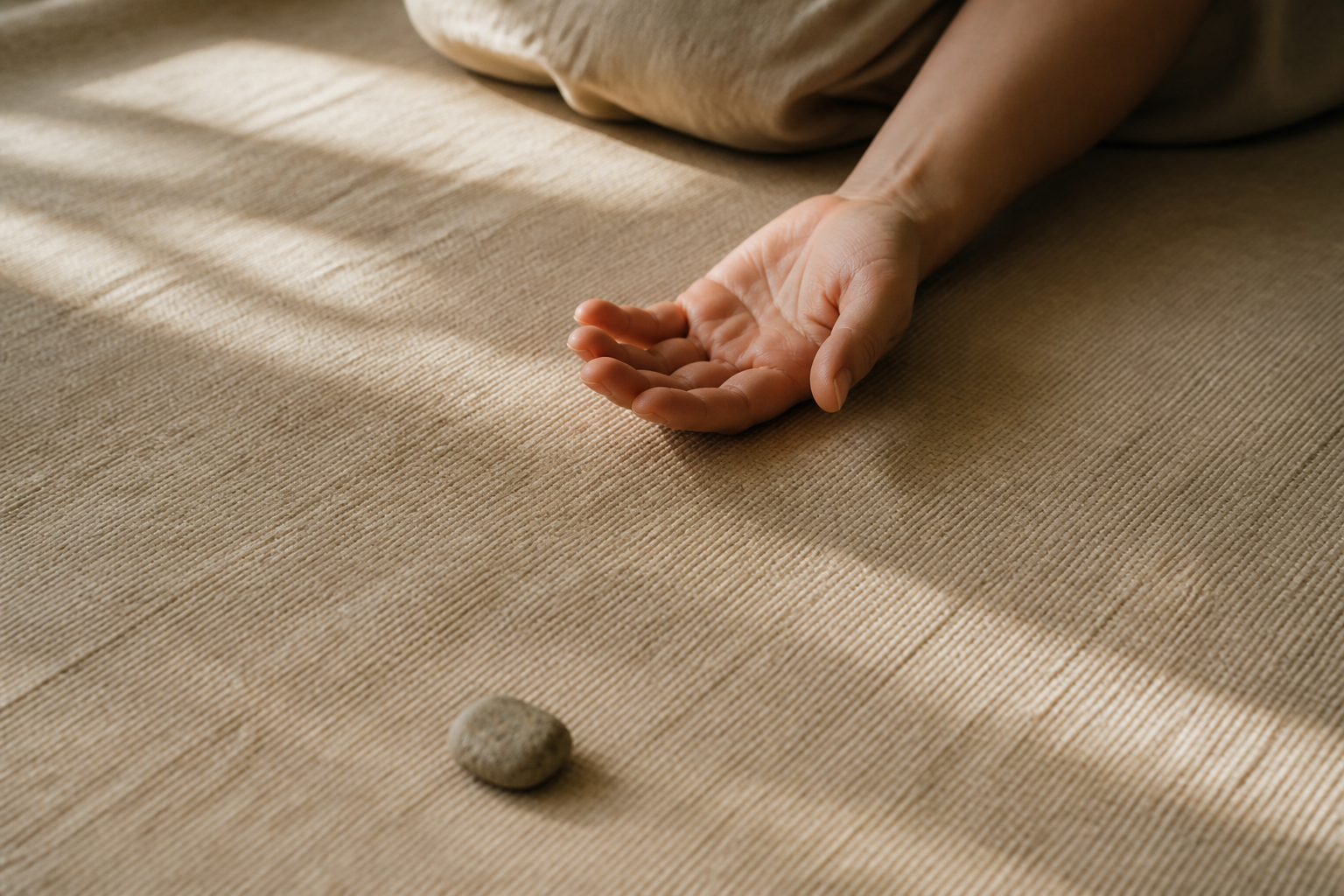
Tactile grounding works by giving your attention a concrete task. Instead of continuing an argument in your head or rehearsing everything that might go wrong, you notice what is already in your hand: weight, texture, temperature, edges, and pressure against the skin.
This sensory contact does not erase the problem. It interrupts the mental momentum surrounding it. A familiar pocket object can create enough space for the breath to slow, the shoulders to release, and attention to widen. The useful part is the space between impulse and action, not any special property attributed to the object.
An amethyst is not inherently better than a pebble. A costly spiritual accessory is not better than a coin you already carry. If you believe the object must possess a hidden power before the practice can work, you have shifted agency away from awareness and into the object. The object is only a reminder: pause here.
This distinction also gives you a sensible test. Do not ask whether the object made you calm. Ask whether touching it helped you notice what was happening before you spoke, sent the message, opened another tab, or abandoned the task. Even when agitation remains, that moment of noticing is useful.
Grounding is not suppression. You are not trying to deny anger, fear, grief, or urgency. You are locating those experiences within a larger field of awareness so that they do not make the next decision alone.
What makes a tactile pause Dharmic

A stress technique does not become Dharmic merely because you hold a bead or add a Sanskrit word. Its orientation matters. The pause should move you from scattered attention toward awareness, from forgetfulness toward remembrance, and from reflex toward conduct shaped by dharma.
There is a clear family resemblance among Hindu japa with mala beads, Buddhist attention to contact and breath, the steady awareness cultivated in Jain samayik, and the repeated remembrance of Sikh simran. Each gives wandering attention a form to return to. Their philosophies, disciplines, and sacred meanings are not interchangeable, however. A pocket coin is not a substitute for a mala, and a brief grounding exercise is not the same practice as samayik or simran.
You can preserve that distinction by giving your brief pause three clear movements:
- Attend: feel the object and notice the breath as they are, without demanding an immediate change.
- Remember: return to a mantra, sacred remembrance, or simple awareness consistent with your path.
- Respond: use the recovered space to choose the next truthful, restrained, compassionate, or necessary action.
The third movement is essential. If holding an object merely helps you feel better while you continue avoiding a duty, repeating a harmful habit, or preparing a cruel response, the pause has stopped short of practice. Calm is not the final measure. Clearer conduct is.
If you already have a mantra or form of remembrance received through your tradition, follow that discipline rather than improvising a replacement. If you do not, silently noting the incoming and outgoing breath is enough. A natural breath phrase such as so-ham can also accompany the movement of breathing. Keep the phrase gentle; this is recollection, not a contest in concentration.
Treat sacred objects according to the customs attached to them. If your mala belongs to a formal japa practice, you do not have to turn it into an all-purpose stress tool. A separate, ordinary pocket object may be more suitable for meetings, commutes, and other daily transitions.
Build a practice you can use in an ordinary day

Choose an object that will not become the story
Select something small enough to carry and comfortable enough to hold. It should have a noticeable surface or weight, but it should not be sharp, fragile, or so valuable that losing it creates fresh anxiety. A smooth stone, familiar coin, wooden bead, or folded piece of textured fabric will do.
Neutrality helps. A keepsake associated with bereavement, conflict, or an intense relationship may pull you into memory instead of contact. If the first object starts a chain of stories, replace it without ceremony. You are choosing a reliable cue, not declaring a lifelong symbol.
Keep the same object within reach for one week. Repetition makes the sequence easier to remember. Constantly changing the object encourages you to evaluate objects when the skill you need to develop is returning attention.
Use the three-breath sequence
- Stop safely. Pause what can be paused. If you are in a car, do this only while parked, never while driving.
- Make contact. Hold the object without squeezing it. Notice its temperature, weight, and texture. Let those sensations be more important than explaining why you feel unsettled.
- Take three slow, even breaths. Breathe through the nose if that is comfortable. Do not force the deepest possible inhalation; smooth and unstrained is the aim.
- Add remembrance. Use your established mantra, repeat so-ham with the breath, or simply note the inward and outward movement.
- Notice without grading. Your shoulders may soften and your attention may broaden, or you may still feel agitated. Either response is information. Do not manufacture serenity.
- Name the next action. Put the object down or return it to your pocket, then identify what dharma asks of you now: listen, wait, speak carefully, finish the task, apologise, set a boundary, or rest.
The final step prevents grounding from becoming a private refuge from responsibility. You are not retreating from the world. You are returning to it with more freedom over how you participate.
Attach the practice to a predictable transition
Do not wait until you are completely overwhelmed. Choose a transition that already occurs in your day and let it remind you to practise for the week:
- Before entering a meeting, feel the object and complete the three breaths before deciding how you want to show up.
- At the beginning or end of a commute, use it while safely parked so that agitation from one part of the day is not carried automatically into the next.
- At night, hold it for a minute instead of beginning another round of scrolling. Let the cue mark the movement from stimulation toward rest.
- Before answering a message that provokes you, ground first and reread the words after the third breath.
At the end of the week, do not score the practice by how peaceful you felt. Ask whether you remembered the cue, which transition made it easiest to use, and whether it changed any action that would otherwise have been automatic. Keep the trigger that worked. Change the one you repeatedly forgot.
Troubleshoot the practice without creating a crutch
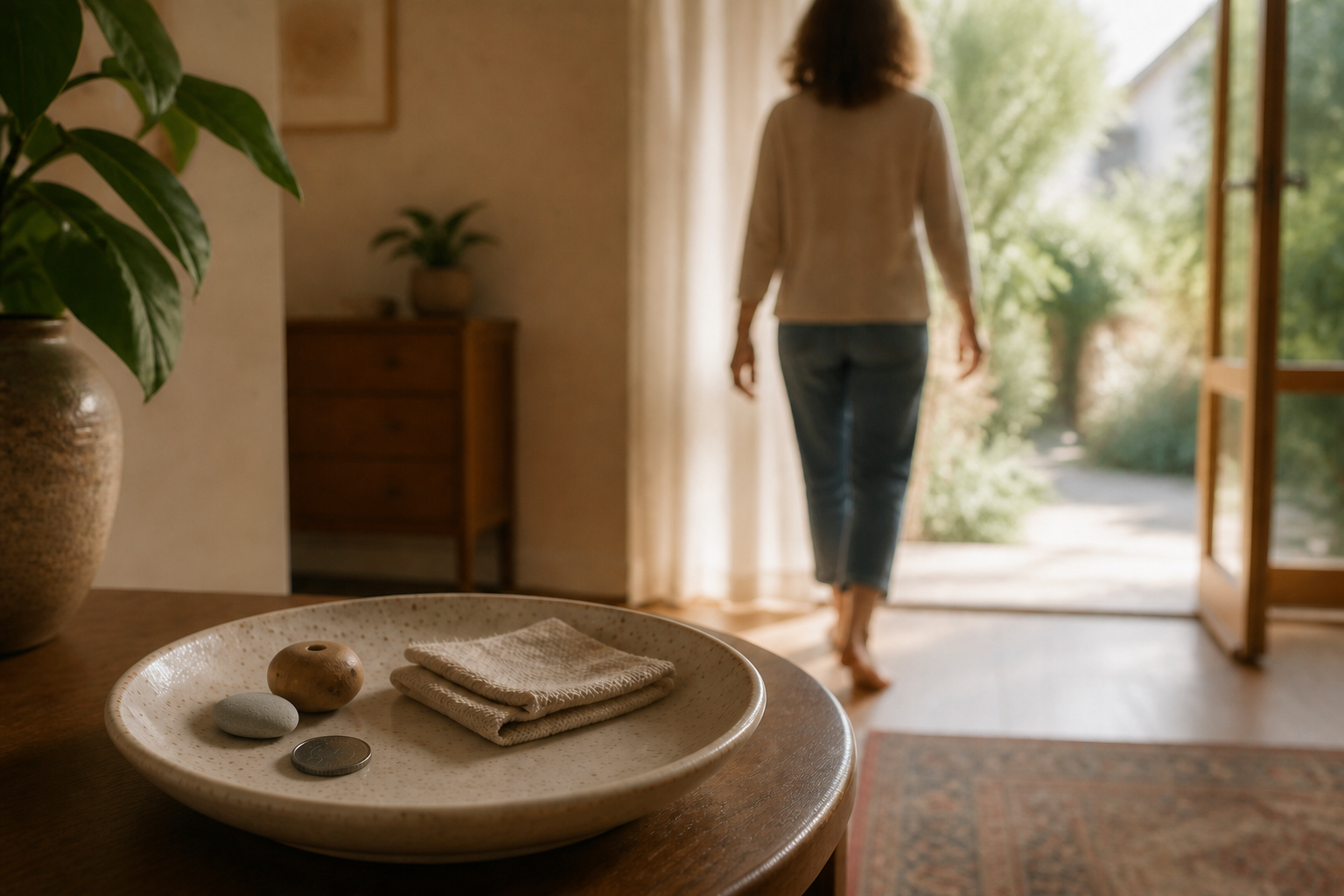
A useful grounding practice should increase your capacity to return, not convince you that you are helpless without a particular object. The following adjustments address the most common ways the routine can drift:
- Nothing seems to happen: reduce the demand for a dramatic result. Feel one physical quality clearly, complete the three breaths, and take the next deliberate action. The interruption itself is the practice.
- Your thoughts become louder: stop analysing their content during the sequence. Return to temperature, weight, texture, and breath. You can examine the problem after you are no longer feeding its momentum.
- The object evokes a strong memory: choose a more neutral item. Sentimental meaning is unnecessary and can make grounding harder.
- You keep forgetting: move the object to the point of transition: beside your keys, near the device used for meetings, or in the pocket you naturally reach into. A cue hidden in a drawer cannot cue you.
- You feel dependent on it: occasionally perform the same sequence with the fabric of your clothing, contact between your fingertips, or another ordinary sensation. You are transferring the skill to awareness itself.
- You use the pause to postpone action: name the duty waiting after the third breath. If you repeatedly begin another grounding cycle instead, the practice has become avoidance.
- You feel self-conscious in public: keep the object in your pocket. No one needs to see the movement, and you do not need to explain it.
Tactile grounding is a modest contemplative aid, not a treatment for a medical or psychological condition. Stop if contact or breath attention intensifies distress or evokes traumatic memories. Severe, persistent, or disabling symptoms call for support from a qualified mental-health or medical professional; a pocket practice should complement appropriate care, never replace it.
There will also be moments when the right response is immediate practical action rather than inward attention. If a situation is unsafe, move to safety and seek appropriate help. Grounding is valuable when it improves your ability to respond; it should never delay a necessary response.
Key takeaways
- The object has no required material or mystical power. Its function is to cue attention, breath, and choice.
- Use the same small object for one week and attach it to a predictable transition rather than waiting for extreme overwhelm.
- Feel temperature, weight, and texture; take three slow, unforced breaths; then name the next action.
- The pause becomes Dharmic when remembrance leads back to responsible and compassionate conduct.
- Respect the distinct meanings of japa, Buddhist mindfulness, Jain samayik, and Sikh simran instead of presenting them as interchangeable techniques.
- Measure success by reduced automaticity, not by whether every use produces calm.
Place one ordinary object where your next predictable transition will happen. When you reach it, take the three breaths and then do the next right thing. That small act, repeated without drama, is how a grounding trick begins to mature into abhyasa.
References
