
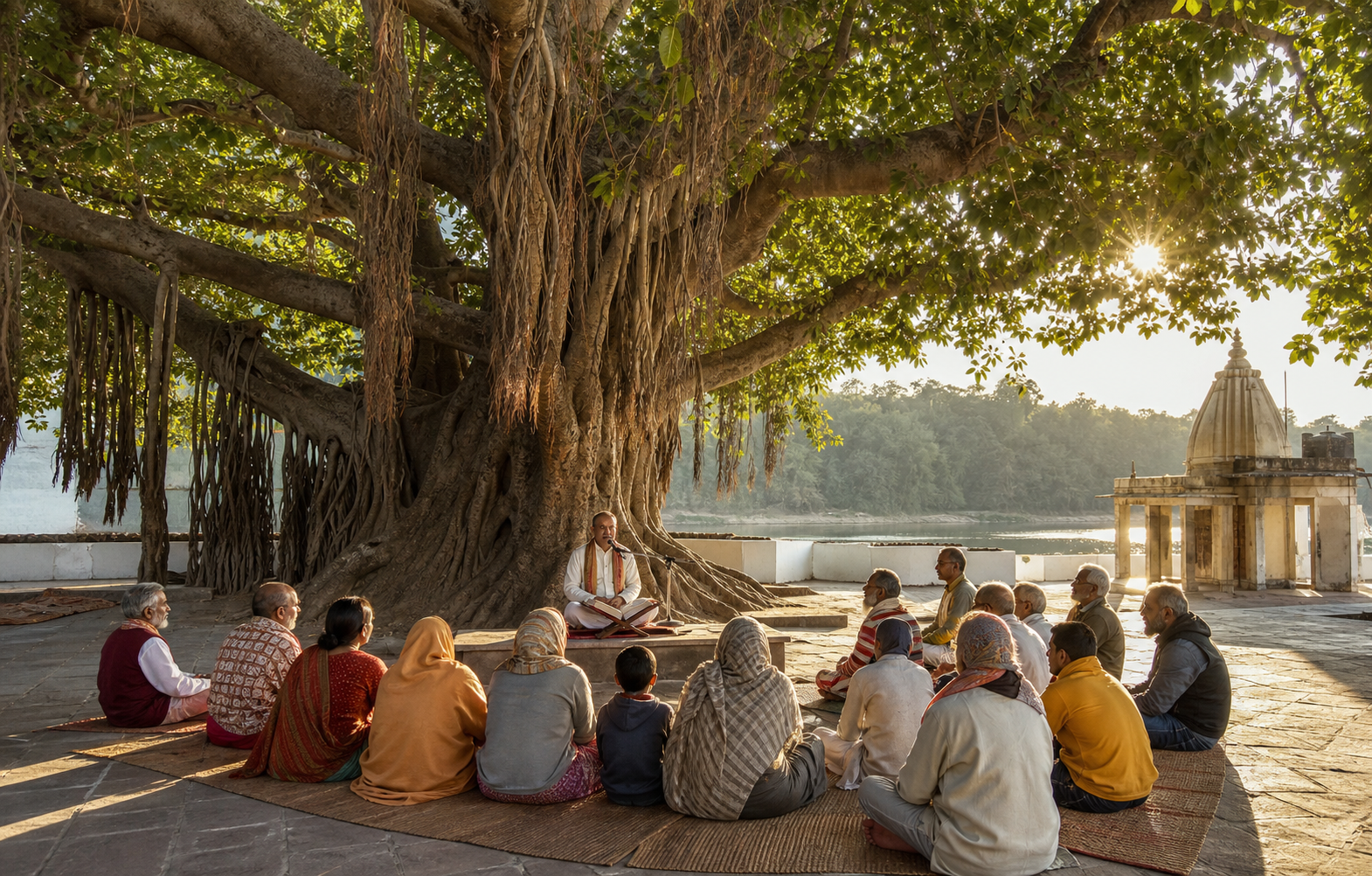
If you are considering a pilgrimage to Shukratal, the practical question is not simply what there is to see. It is how to enter a place whose meaning rests on hearing. Arrive only to photograph an old banyan, and the central experience can pass unnoticed.
Shukratal asks for a slower itinerary: understand the sacred memory, sit with the sound of recitation, and leave with one practice that changes how you listen. That approach turns a brief temple visit into an encounter with the living Srimad-Bhagavatam tradition.
Key takeaways for your Shukratal pilgrimage
- Shukratal is a pilgrimage town on the Ganga in Uttar Pradesh’s Muzaffarnagar district, approximately 72 kilometres from Haridwar.
- Living tradition identifies it as the place where Sukadeva Goswami recited the Srimad-Bhagavatam to Maharaja Pariksit over seven days beneath the Akshaya Vat.
- The monumental banyan at the Sri Sukadeva Temple and ashrama is venerated locally as the tree associated with that recitation and as being 5,100 years old.
- Early morning and late afternoon usually suit quiet darshan, reading, and reflection better than a rushed visit in the middle of a crowded itinerary.
- Ask the local caretakers about current worship, recitation, photography, and seva arrangements rather than assuming that every part of the precinct is open to every activity.
- Leave with a defined listening practice. Otherwise, the pilgrimage can remain a powerful memory without becoming a durable part of your sadhana.
Shukratal preserves a sacred memory centred on listening
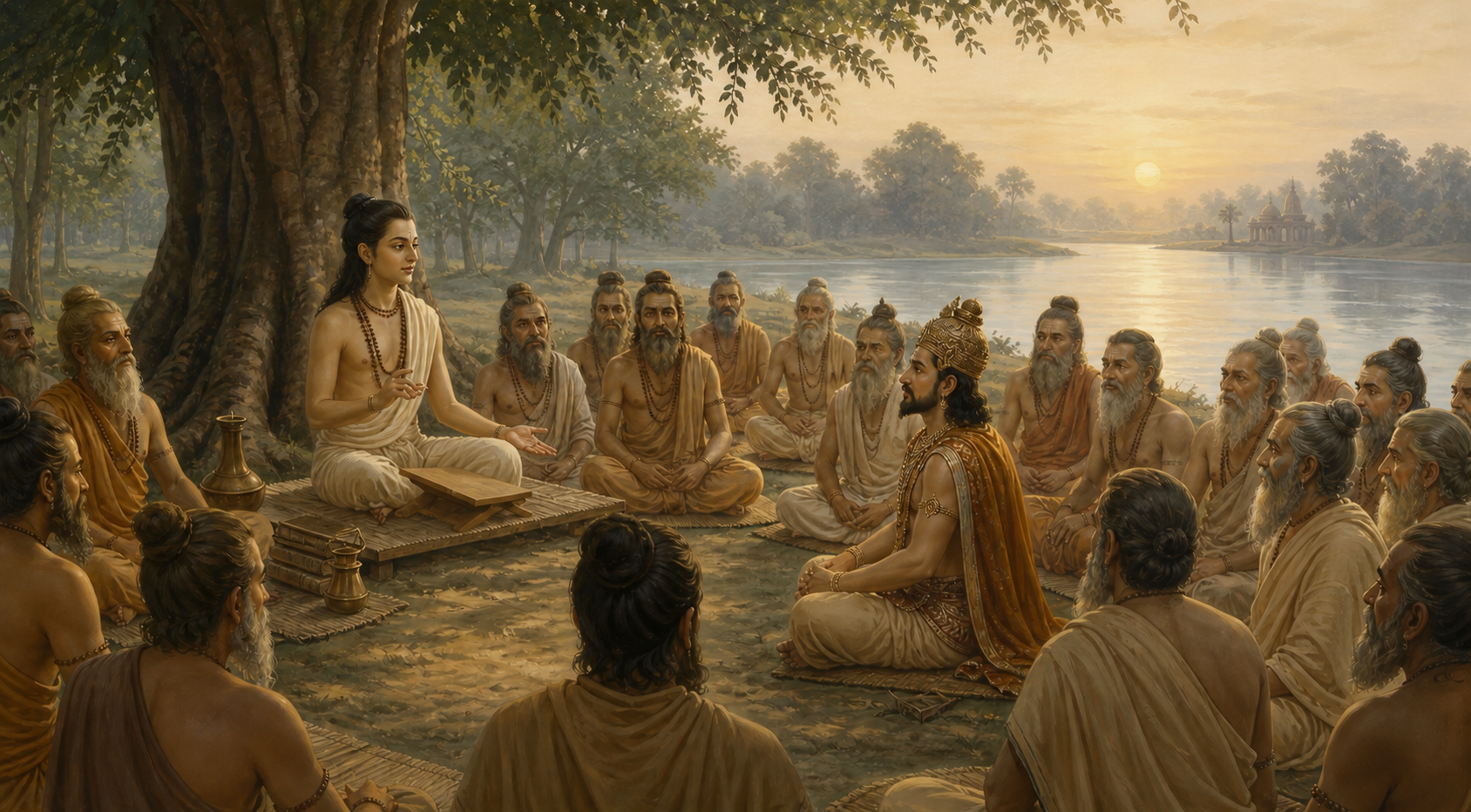
The Srimad-Bhagavatam, also called the Bhagavata Purana, reaches Shukratal through a relationship between speaker and listener. Sukadeva Goswami speaks. Maharaja Pariksit listens. An assembly of sages receives the narration. The sacred act is not merely the delivery of information; it is sustained attention to dharma.
Pariksit belongs to the lineage familiar from the Mahabharata: he is the son of Abhimanyu and the grandson of Arjuna. Shukratal’s living memory places his seven-day hearing of the Bhagavatam beneath the Akshaya Vat, with 80,000 sages present. These details explain why the temple complex is not best approached as an ordinary monument. Its organising image is a community gathered around sacred speech.
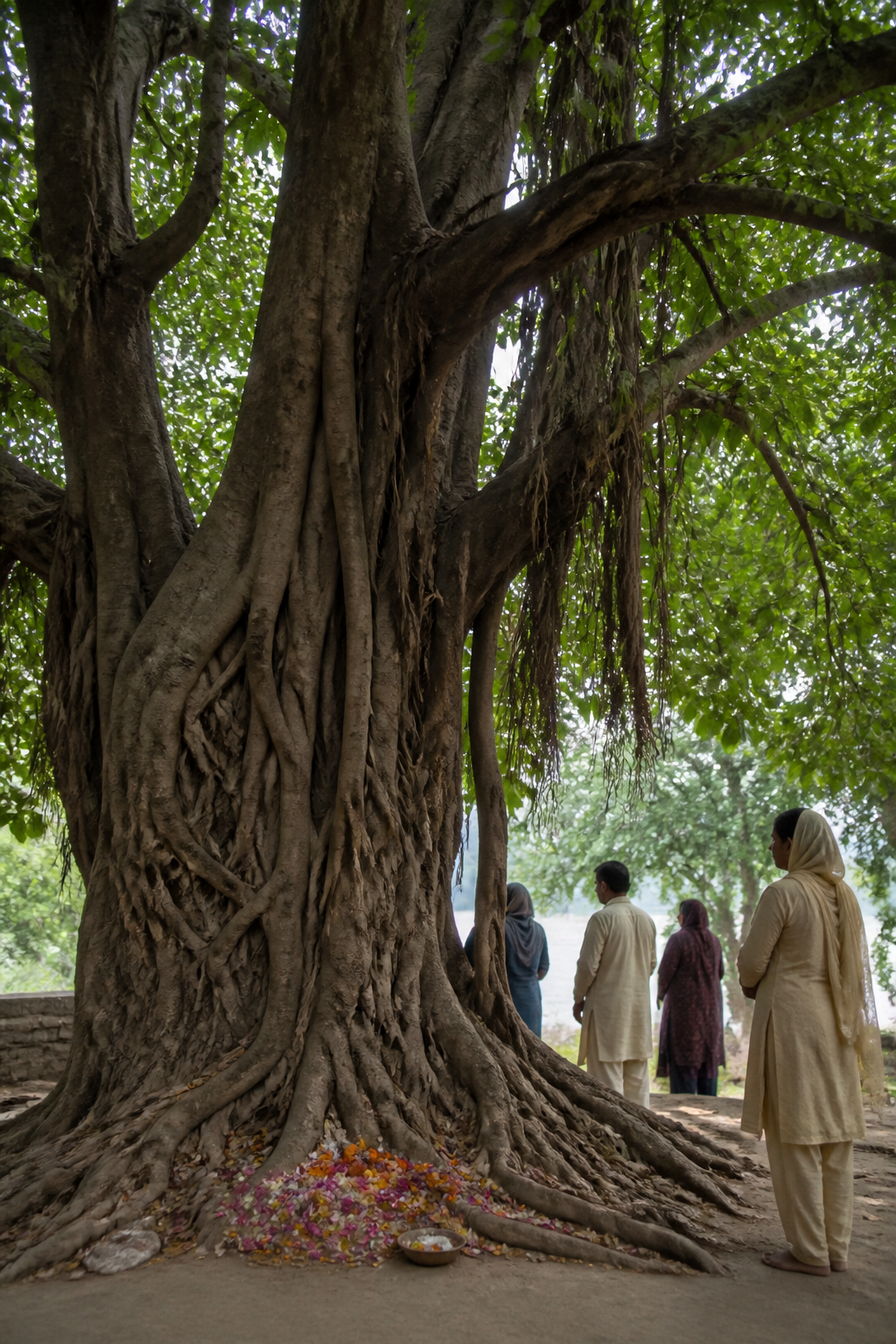
There is also a useful distinction between reverence and careless historical language. The banyan in the Sukadeva ashrama is venerated as the Akshaya Vat beneath which the recitation occurred, and locally as being 5,100 years old. If you describe the site to others, retain that devotional framing. Saying that the tree is venerated or identified by the living tradition is both respectful and precise; presenting a sacred attribution as though it were an archaeological measurement makes a different claim.
This distinction need not weaken your pilgrimage. A tirtha carries meaning through worship, memory, repeated narration, community, and place. You can take that continuity seriously without pretending that devotion and modern historical verification are the same mode of knowing.
The Akshaya Vat changes how you should listen
The great banyan is not simply an object to inspect. Its spreading branches shape the ashrama itself, placing visitors under a canopy associated with the Bhagavatam’s transmission. The most fitting response is therefore not to collect the quickest possible darshan, but to become still enough to notice how the place directs your attention.
Begin by resisting the urge to document everything immediately. Stand or sit where visitors are permitted, let your attention settle, and listen for any recitation taking place in the precincts. You do not have to understand every word before the act of hearing becomes meaningful. First receive the cadence. Then follow with a passage you can read or understand, and finally ask what the teaching requires from you.
This sequence matters because listening can otherwise become passive consumption. The Bhagavata tradition joins hearing with reflection and ethical movement. A useful question beneath the tree is not merely, “What did I hear?” but, “What in my conduct must become clearer because I heard it?” That might concern devotion, compassion, service, restraint, or the quality of attention you give another person.
Notice three relationships while you are there: the living tree and the built temple, the sound of present recitation and the memory of the ancient narration, and the individual pilgrim and the gathered community. Those relationships reveal why Shukratal is a living sacred landscape rather than a display of disconnected religious objects.
Plan the visit around attention rather than mileage
Shukratal can be reached by road from Haridwar and other nearby centres in western Uttar Pradesh. The approximate distance from Haridwar is useful for orientation, but it is not a reliable journey time. Road conditions, the chosen route, local traffic, and stopping points can change. Confirm the practical route before departure and avoid placing a tightly timed onward commitment immediately after your visit.
A simple pilgrimage sequence will help you give the site more than hurried attention:
- Prepare one question before travelling. Choose a real spiritual or ethical question rather than a list of facts you want to collect. It will give direction to your listening.
- Aim for a quieter period. Early morning or late afternoon generally offers a more contemplative setting for darshan, reading, and silence.
- Learn the precinct before beginning your practice. Ask a caretaker where you may sit, whether a Bhagavatam recitation is scheduled, what conduct is expected near the Akshaya Vat, and whether photography is appropriate.
- Offer darshan before documentation. Enter the Sri Sukadeva Temple and approach the banyan with the restraint due to an active place of worship. Do not touch the tree or enter restricted areas without permission.
- Listen before reading. If recitation is underway, receive it without treating it as background sound. Afterwards, read a manageable passage and relate it to the question you brought.
- Spend time with the wider setting. The Ganga, the ashrama, the canopy, and the recited word belong to one spatial experience. Do not reduce the pilgrimage to a single stop beneath the tree.
- Ask about simple seva. Follow the needs and instructions of the ashrama rather than inventing a service that may create work for others.
- Record one commitment before leaving. Write a single sentence naming what you will practise at home. A small, definite commitment is more useful than a page of impressions.
Good conduct here is not complicated. Keep your voice low around people who are reading, reciting, or meditating. Make room for worshippers. Treat the banyan as a venerated presence rather than a prop. If a local rule is unclear, ask. Reverence becomes visible through these ordinary decisions.
Let the pilgrimage deepen dharmic kinship
Shukratal is specifically a Hindu tirtha formed by the Srimad-Bhagavatam tradition. Honouring its wider dharmic resonance does not require turning it into a generic interfaith site or claiming that Hinduism, Buddhism, Jainism, and Sikhism teach identical doctrines.
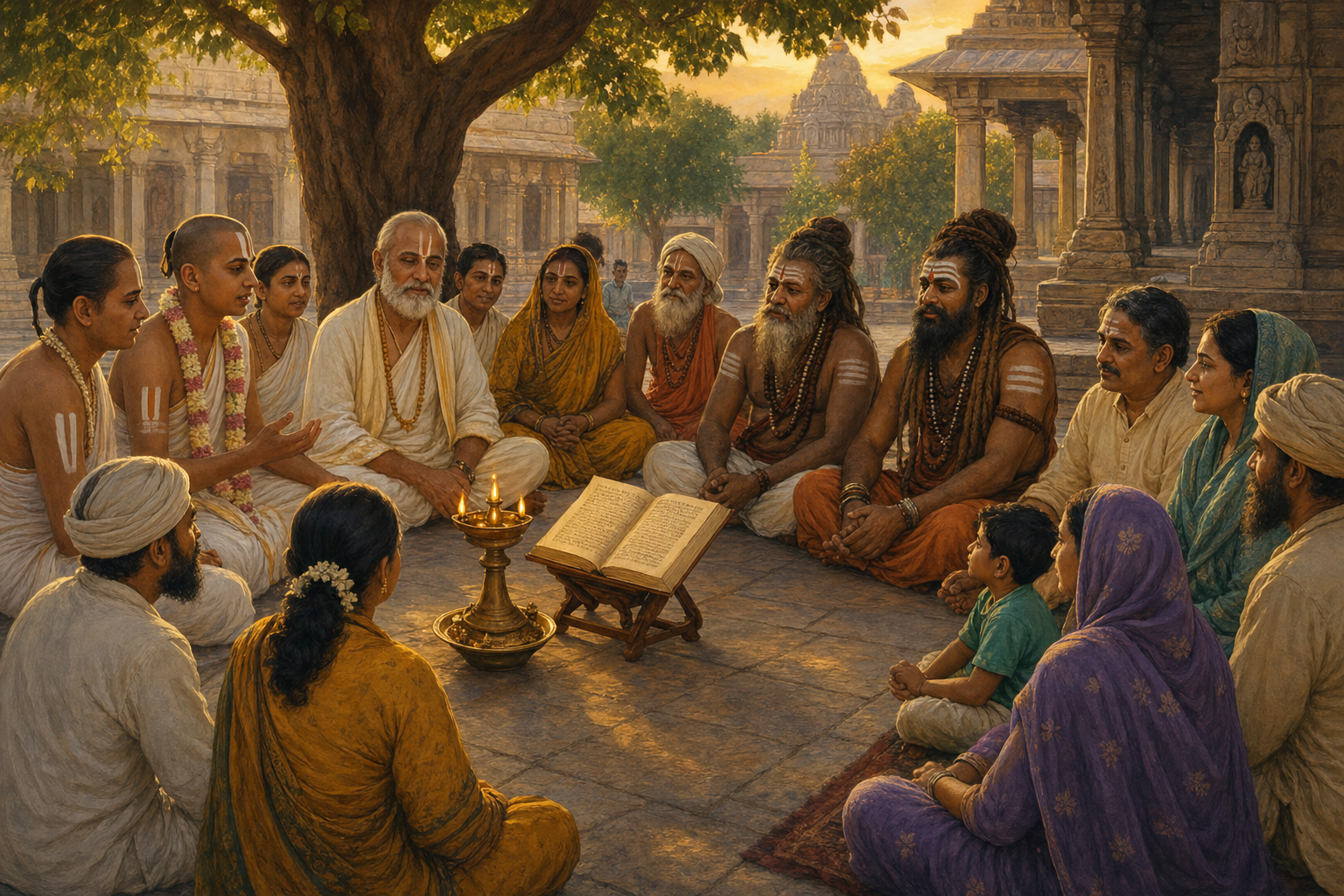
The kinship appears at the level of disciplined practice. Dharmic communities repeatedly gather around teaching, whether expressed through forms such as sangha or sangat. Hearing is expected to mature into reflection, compassion, wisdom, self-restraint, seva, ahimsa, or inner stillness. The language and theological foundations differ, but the refusal to separate insight from conduct creates a genuine field of recognition.
If you come from another dharmic tradition, enter Shukratal as a respectful guest rather than searching only for equivalents to your own vocabulary. Listen to what this particular place preserves. You can then ask where its discipline of attentive hearing meets your own path, while allowing real differences to remain real.
Bring the seven-day pattern home
You do not need to imitate a full ceremonial Bhagavata recitation to carry its central discipline home. Use the remembered seven-day arc as the frame for a modest personal practice:
- Keep the same place and general time for seven days so that listening becomes an appointment rather than an afterthought.
- Begin each session with quiet attention instead of immediately searching for an interpretation.
- Read aloud or listen to one manageable portion of the Srimad-Bhagavatam. If you need help choosing a starting point, ask a knowledgeable teacher or caretaker rather than treating a randomly opened page as unquestionable personal instruction.
- Write one sentence about the ethical or devotional demand you noticed. Avoid trying to summarise everything.
- Before the next session, perform one concrete act shaped by that demand, especially through seva, compassion, restraint, or ahimsa.
- On the seventh day, review the actions rather than merely counting how much text you covered. The measure is whether hearing entered conduct.
This home discipline is not a substitute for learning from qualified teachers, nor is it equivalent to the traditional recitation remembered at Shukratal. It is a way to keep the pilgrimage from ending at the ashrama gate.
Before you leave for Shukratal, protect enough unhurried time to hear something from beginning to end. The site’s gift is not the idea that ancient sound remains trapped beneath a tree. It is the opportunity to become a listener through whom sacred hearing turns into dharmic action.

References
