

You may have to choose between protecting what is right and protecting yourself from loss. In that moment, Abhimanyu’s final stand offers something more useful than a call to be fearless: it gives you a way to judge whether a costly action can still be a victory.
The lesson is demanding. Death does not automatically become sacrifice, and sacrifice does not automatically become Dharma. You must examine the purpose, the responsibility accepted, the methods used, and the moral order left behind. Only then can you distinguish principled courage from pride, recklessness, or someone else’s misuse of your loyalty.
What Abhimanyu lost and what he did not surrender

On the thirteenth day of the Kurukshetra War, sixteen-year-old Abhimanyu entered the Chakravyuha knowing how to penetrate it but not how to make his way out. Arjuna had been drawn elsewhere by the Samshaptakas, and the Pandava position required someone capable of breaking the formation. Abhimanyu accepted that task.
That sequence matters because it identifies his motive. He did not enter merely to display skill or acquire fame. A strategic danger threatened the cause for which he was already fighting, and he possessed knowledge that could answer the immediate need. His decision joined ability to responsibility.
Inside the formation, he disrupted the Kaurava ranks and continued to fight despite being heavily outnumbered. Senior warriors, including Drona, Karna, Kripa, Ashwatthama, and Kritavarma, surrounded him and attacked together. The assault continued as he was deprived of his weapons. Even then, he resisted with a chariot wheel until the combined attack killed him.
If you count only bodies remaining on the field, Abhimanyu lost. Ethical judgment uses a second ledger. It asks what he was protecting, whether fear made him abandon his responsibility, whether he surrendered his principles to obtain safety, and what his opponents had to do in order to overcome him.
That second ledger does not deny the tragedy. His youth, death, and the grief that followed remain real. Moral victory is not a consoling name for every loss. It means that physical force achieved one result without gaining mastery over the fallen person’s governing commitments. Abhimanyu’s life was taken, but his duty was not converted into cowardice or betrayal.
Use this distinction whenever someone calls a defeat proof that a cause was foolish. Separate the visible outcome from the ethical outcome. Ask what was lost materially, what was preserved morally, and which methods produced the result. A scoreboard can tell you who prevailed; it cannot, by itself, tell you who remained aligned with Dharma.
Dharma-Yuddha judges the road as well as the result
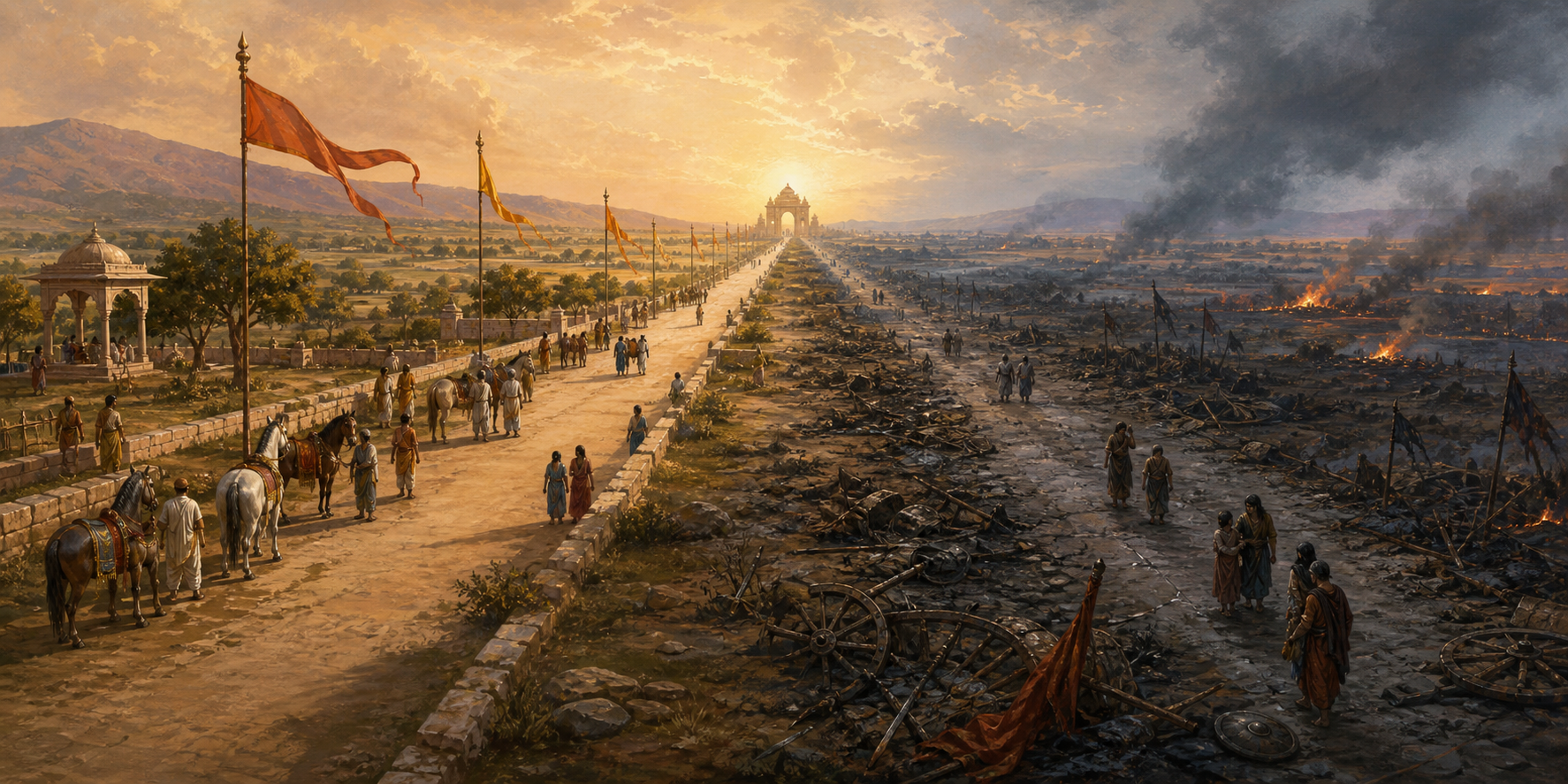
Dharma-Yuddha does not permit you to separate a desirable objective from the way you pursue it. The means form part of the outcome. If victory requires the abandonment of every restraint that made the cause just, the winner may possess the field while damaging the very order the struggle was supposed to defend.
This is the ethical hinge of Abhimanyu’s death. The simultaneous assault by numerous senior warriors violated the norms governing combat. Their numerical and tactical advantage explains how they killed him, but it does not justify the method. Indeed, the method becomes part of the verdict.
A rule matters most when following it is inconvenient. If it disappears as soon as it obstructs success, it was never a restraint; it was only a preference. That principle reaches far beyond warfare. It applies when a political faction fabricates a claim for a supposedly noble cause, when an institution changes its procedure to silence an inconvenient person, or when a community answers an insult with collective blame.
Before entering a serious conflict, therefore, write down the methods you will not use. Do this before anger and urgency narrow your judgment. Your list may include lying, humiliating someone who can no longer answer, threatening relatives, inventing evidence, attacking an entire community for one person’s act, or breaking an agreed process because the likely decision displeases you.
Then apply the reciprocity test: would you defend this method if your opponent used it against you? If the answer is no, a Dharmic label cannot cleanse it. Dharma is not the automatic property of your faction, family, institution, or preferred leader. Every act must answer for itself.
This also explains why Abhimanyu’s ethical victory does not depend on pretending that force was powerless. Force killed him. What it could not do was make the violation righteous. When you face an apparent triumph achieved through a pile-on, a broken promise, or the removal of another person’s ability to respond, notice both realities: the result may stand, and the means may still condemn it.
Incomplete knowledge is a constraint, not a virtue
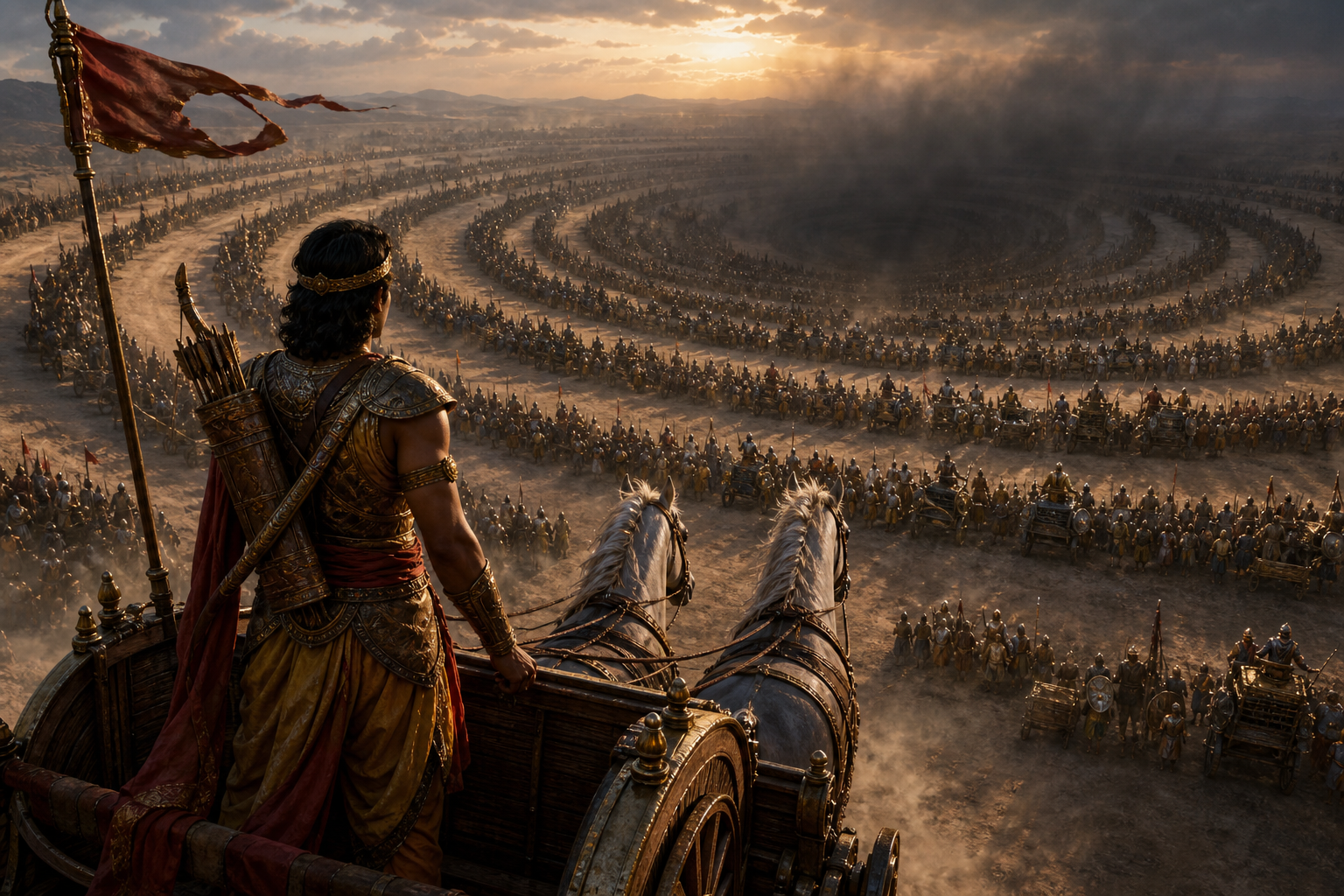
The best-known feature of Abhimanyu’s decision is also the easiest to misuse. He knew the way into the Chakravyuha but not the way out. The lesson is not that preparation is unnecessary, that escape planning is cowardly, or that a sincere person should enter every unwinnable situation.
His incomplete knowledge carried moral weight because it met an immediate strategic necessity. He acted with the capacity available to him in the moment and accepted risk for a purpose larger than personal display. The missing knowledge was a cost he bore, not an achievement to imitate.
When you must decide before you know everything, use five questions:
- What exactly must be protected? Name the person, principle, community, or responsibility. Winning is too vague.
- Why is the duty yours? Identify your role, promise, competence, or relationship to the danger.
- Which unknowns can still be reduced? Seek available facts, advice, training, and support before treating uncertainty as inevitable.
- What backup or exit remains possible? Courage does not forbid reinforcement, documentation, escalation, delay, or an orderly withdrawal.
- Which restraints remain binding under pressure? Decide what you will refuse to do even if the other side abandons its standards.
Separate reducible uncertainty from irreducible uncertainty. If one conversation, document, rehearsal, or ally could materially improve the decision, obtain it. Once the available uncertainty has been reduced, ask whether the remaining risk can be borne without deserting a genuine responsibility. This keeps prudence from becoming endless delay and keeps bravery from becoming avoidable self-destruction.
Leaders have an additional obligation. Never use Abhimanyu’s name to romanticize a preventable lack of preparation or support. If you send someone into a difficult assignment, provide the knowledge, authority, backup, and exit planning that you can. Another person’s courage is not a resource with which you may conceal your own negligence.
Likewise, you are not required to reenact a battlefield in ordinary life. Resigning from a compromised role, asking for help, pausing a confrontation, or choosing a safer channel can be the responsible action. The proper question is not whether withdrawal looks heroic. It is whether staying or leaving better protects the duty at stake without needless harm.
A four-part test for ethical victory
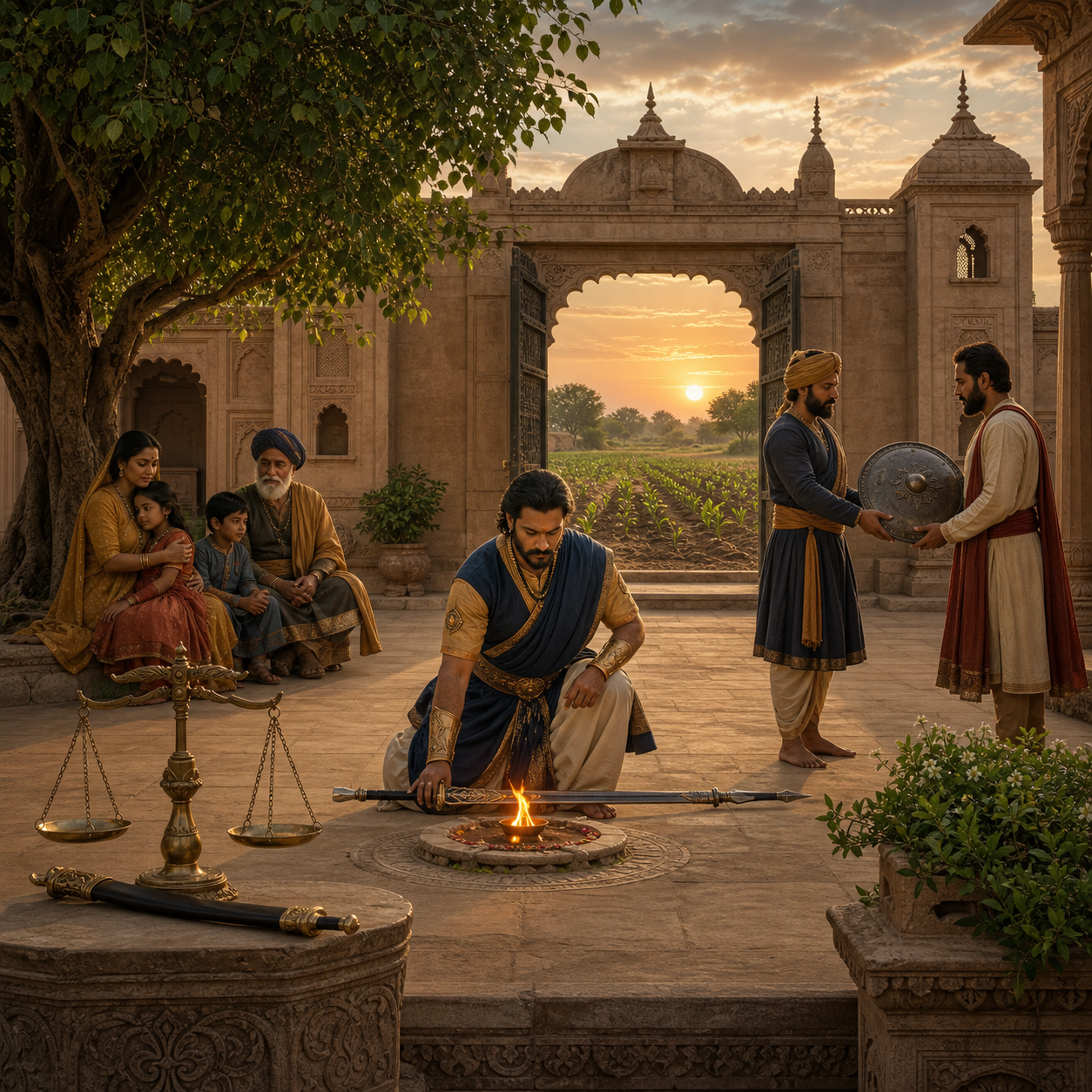
Claims of moral victory are easy to make after a painful defeat. Test them rather than accepting the label. Four questions expose whether the claim rests on Dharma or merely protects the ego from an unwanted result.
- The purpose test: What worthy good did the action protect? Status, revenge, and the desire to appear brave are not enough.
- The responsibility test: Did the person have a real duty and accept the cost personally, or did a leader transfer the danger to someone with less power?
- The means test: Did the conduct remain within defensible limits when pressure increased? A noble objective cannot excuse every method.
- The moral-residue test: What survives the action – greater truth, accountability, solidarity, and restraint, or only fear and an appetite for retaliation?
Abhimanyu’s stand survives these questions. His purpose was tied to the defence of the Pandava cause. His battlefield responsibility matched his ability to enter the formation. He accepted the immediate danger himself. His resistance disrupted the Kaurava ranks and helped safeguard the Pandava line, while the combined method used against him made the opposing breach visible.
No single test should be ignored. A worthy purpose pursued through corrupt means is not a complete ethical victory. A disciplined act without a just purpose may be efficient but not Dharmic. A sacrifice demanded by leaders who avoid the cost themselves calls for scrutiny, not automatic reverence. A response that leaves only indiscriminate hatred may reproduce the disorder it claims to avenge.
The aftermath of Abhimanyu’s death adds a further lesson. Arjuna’s grief became a vow to slay Jayadratha the following day, and Sri Krishna’s counsel guided the strategy through which that vow was fulfilled. The vow altered morale and the course of the next day’s battle. Grief did not remain formless; it acquired a defined object, a deadline, and disciplined action.
Modern conflicts require different remedies, but the ethical sequence remains useful. When a serious breach occurs:
- Name the violated rule in plain language.
- Identify the responsible act and actor without assigning guilt to an entire family, faith, caste, nation, or community.
- Choose a remedy connected to the breach: correction, restitution, removal from authority, a fair hearing, or another proportionate form of accountability.
- Keep the methods you considered binding before the injury occurred.
- Define the point at which accountability has been achieved so that justice does not quietly become limitless vengeance.
This is how you prevent outrage from surrendering the very moral ground that made the outrage legitimate. Ethical victory requires accountability. It does not require you to imitate the violation.
Carry the lesson beyond the battlefield without misusing it
Abhimanyu’s memory belongs within the Hindu understanding of Kshatra Dharma, but its ethical resonance can be recognized across the Dharmic family. Selfless duty, compassionate purpose, disciplined resolve, seva, and courage speak respectively to important Hindu, Buddhist, Jain, and Sikh moral concerns.
These traditions should not be flattened into one identical doctrine of warfare. Their teachings on force, renunciation, non-harm, service, and worldly duty retain real distinctions. The shared insight is narrower and therefore more useful: fearlessness acquires moral value when it serves something beyond the ego and remains answerable to discipline.
That insight protects the episode from four common misuses. Do not invoke Abhimanyu to shame a frightened person into accepting avoidable danger. Do not use his sacrifice to excuse leaders who failed to plan. Do not assume that suffering proves your side is righteous. And do not treat another person’s Adharma as permission to abandon your own limits.
Key takeaways
- External defeat and ethical defeat are different judgments; examine both.
- A Dharmic cause must remain accountable for the methods used in its defence.
- Incomplete knowledge can justify urgent action only after reducible uncertainty has been addressed.
- Respect for courage must never erase a leader’s duty to provide training, support, and a viable exit.
- After a violation, pursue specific and proportionate accountability without converting grief into collective hatred.
Before your next difficult stand, write five lines: what you are protecting, why the duty is yours, what you still do not know, which method you will refuse, and what a just resolution would look like. If those lines are unclear, prepare further before acting. If they are clear and the cost remains unavoidable, Abhimanyu’s example asks you to hold courage and conscience together.
References
