
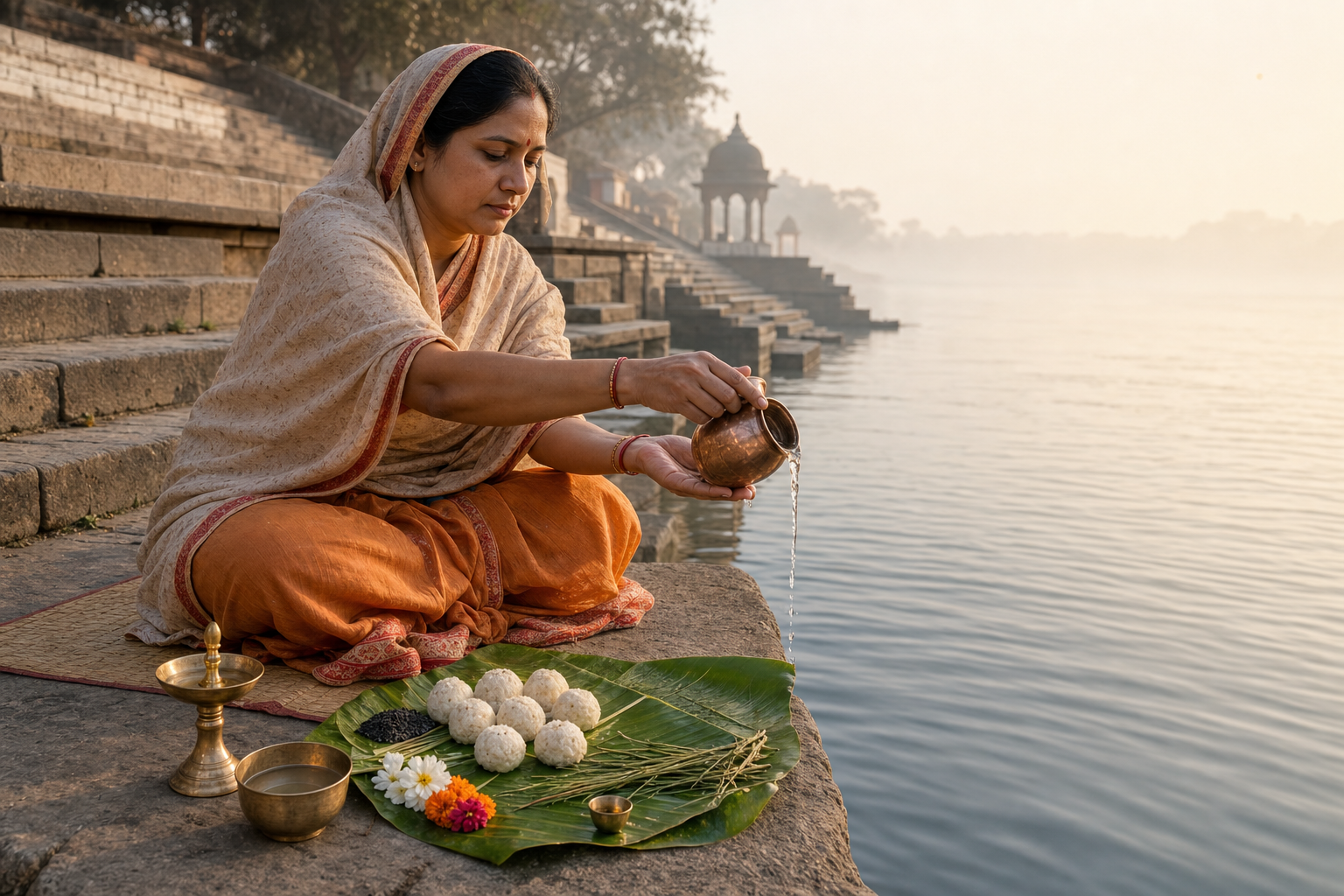
You may be the daughter who cared for a parent, the widow holding a household together, or simply the relative willing to ensure that an ancestor is remembered. If someone tells you that the observance must lapse because no suitable man is present, you do not have to accept that as the only Hindu position.
Women can undertake ancestral observances in many Hindu traditions. The important qualification is that permission and procedure are separate questions: your relationship establishes a genuine duty of remembrance, while your family, region, and sampradaya help determine the form that duty should take.
Start with the duty, then identify the rite
Families often use Shradh, Tarpan, and Pinda Daan as though they were three names for the same act. They are related, but each points to a distinct aspect of ancestral observance.
- Shradh is the larger act of remembering and honoring those who came before you. Its center is shraddha: sincere reverence expressed through prayer, offerings, gratitude, and responsible conduct.
- Tarpan is an offering of water made with remembrance. Til and kusha may be used where the family tradition calls for them and they are available.
- Pinda Daan involves symbolic food offerings, commonly prepared from sanctified rice according to the applicable custom. The offering represents care, nourishment, and continuity within the lineage.
A family may include all three within a larger observance, perform only one, or connect them with dana, annadana, recitation, and prayer. Do not assume that an elaborate combination is automatically more authentic. A clearly understood observance conducted according to your tradition is better than collecting unrelated procedures from several regions.
The first question, therefore, is not merely, “May a woman do Shradh?” Ask two more useful questions: “What responsibility do I bear toward this ancestor?” and “Which observance does our tradition prescribe in these circumstances?” Those questions move the discussion from a blanket prohibition to dharmic responsibility and sound ritual practice.
A woman’s claim rests on relationship and responsibility
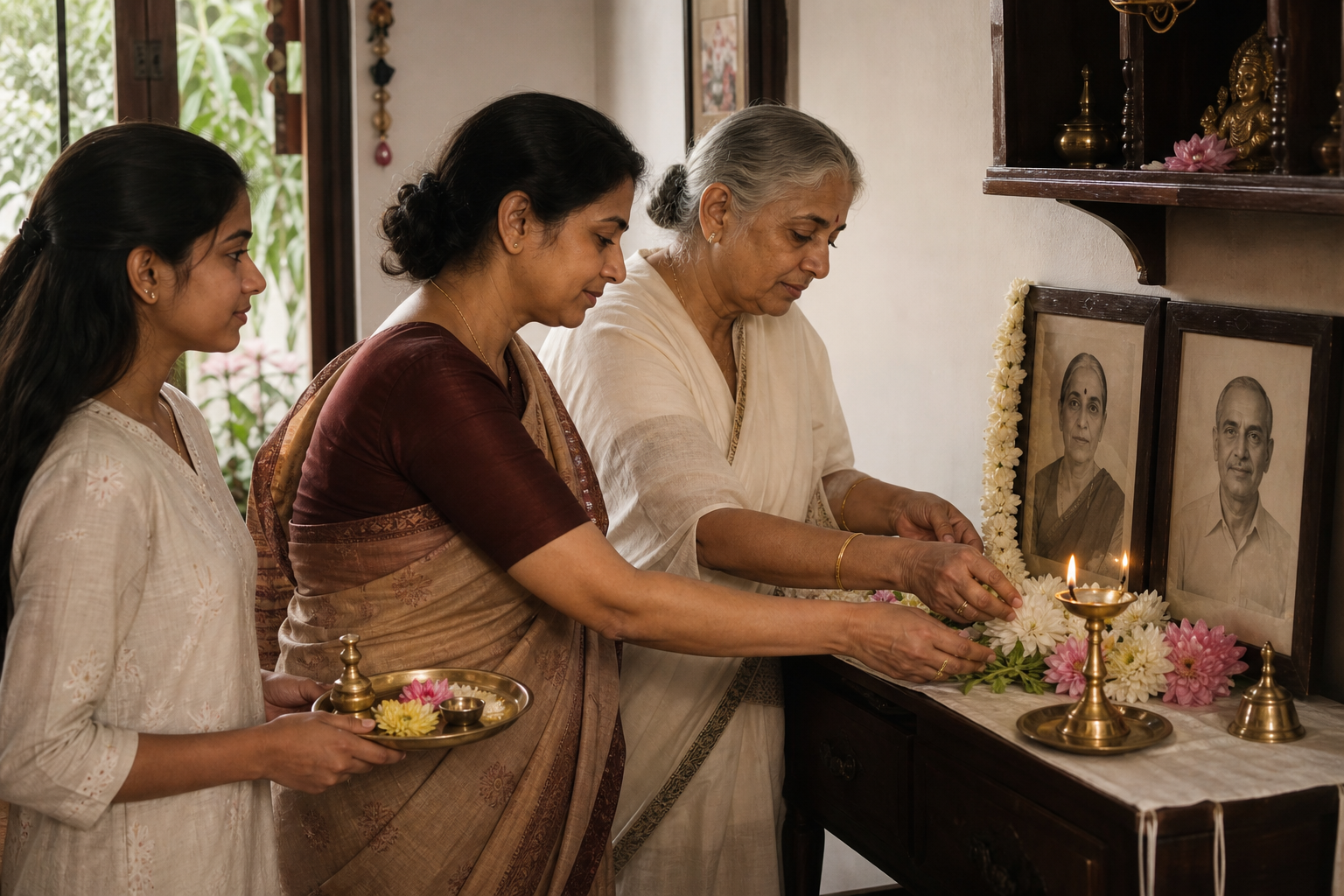
Hindu thought describes enduring obligations known as rin. Rishi Rin concerns the debt to sages, Acharya Rin the debt to teachers, and Matri-Pitri Rin the debt to parents and ancestors. These are not merely privileges attached to a male role. The underlying principle is that Matri-Pitri Rin belongs to every child, irrespective of gender.
This matters because ritual arguments sometimes begin at the wrong end. A local arrangement gives the eldest son a particular responsibility, and that arrangement is then treated as though it proves that daughters, wives, and mothers have no ancestral duty at all. The conclusion does not follow. A customary first role for one relative does not erase the bandhu, or real familial relationship, of everyone else.
Nor has Hindu practice been uniform across Bharat. Dharmashastra, Grihya traditions, regional usage, and household teaching have produced different procedures. In circumstances where responsibility, proximity, or capacity made a woman the natural custodian of the observance, daughters, wives, and mothers have undertaken ancestral duties. Some communities retain a more restrictive convention; others explicitly accommodate women.
Desha-kala-paristhiti, attention to place, time, and circumstance, helps explain this flexibility. Apaddharma, the dharmic response to necessity, also prevents a family duty from being abandoned merely because the conventional performer is unavailable. These principles should not be used as excuses to disregard every inherited form. They allow a living tradition to meet an actual circumstance without surrendering its purpose.
Use the following test when deciding what you should do:
- Establish your relationship. Are you the daughter, wife, mother, or other responsible relative of the person being remembered?
- Establish the practical situation. Is the customary performer present, willing, capable, and prepared to carry out the duty?
- Identify the governing tradition. Determine which household, regional, or sampradaya practice the family ordinarily follows.
- Name the precise observance. Ask whether the immediate question concerns Tarpan, Pinda Daan, a fuller Shradh, or a remembrance through prayer, dana, or annadana.
- Seek procedure, not a vague verdict. A knowledgeable elder or priest should be able to explain what is done, why it is done, and which parts may vary in your circumstances.
If you are the person carrying the relationship and the responsibility, being a woman is not by itself a reason to let the duty disappear. The exact ritual form can still be settled with care.
Prepare the family conversation before the ritual day
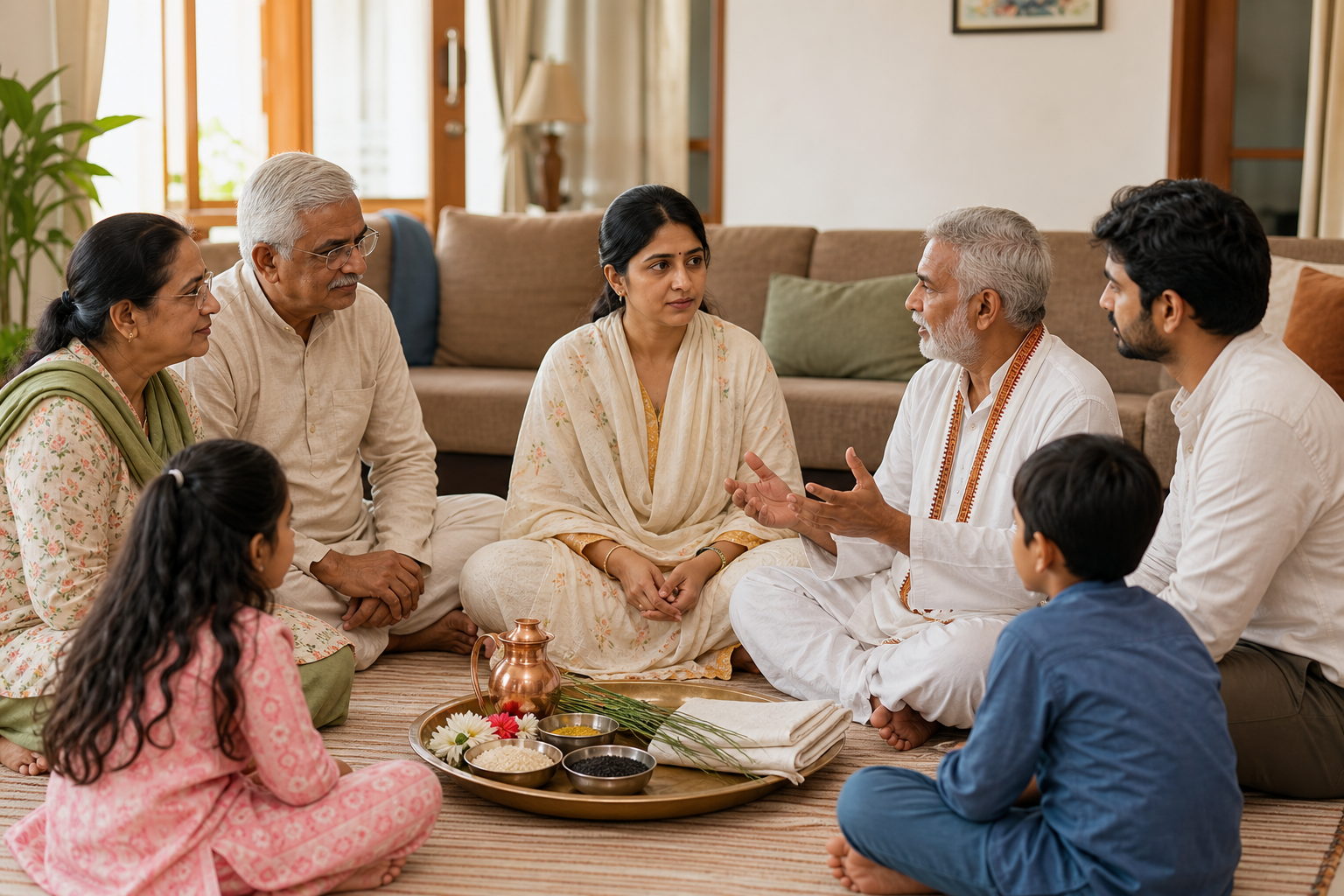
An ancestral observance should not become a contest for status. At the same time, preserving family peace does not require you to accept an unsupported claim that women are inherently incapable of expressing Pitri Rin. The best way through disagreement is to make every question precise before the appointed day.
Begin by stating your intention plainly: you want to honor the ancestor, preserve the family’s samskara, and perform the duty with dignity. Then ask the relatives who know the household practice to describe it. Do this early enough that nobody encounters a disputed change while offerings are already being prepared.
- Which calendar and customary period does the household follow, including any Pitru Paksha observance?
- Which ancestors are named, and how are their names and relationships stated?
- Does the family ordinarily perform Tarpan alone, Pinda Daan, a fuller Shradh, or a combination?
- Which materials are required, and which are customary rather than indispensable?
- Which parts require guidance from an officiant, and which parts may be performed personally?
- Is the objection to a woman based on a specific sampradaya procedure, a regional convention, or only a recent family assumption?
The last question is especially useful. People often say “tradition does not permit it” when they actually mean “this is not how our immediate household has done it.” A household custom deserves a respectful hearing, but it should be described accurately. It is not automatically a rule for every Hindu family.
If a priest declines to guide you, ask for the basis of the decision and whether the restriction applies to every ancestral act or only to a particular liturgical role. Then seek another informed view from someone familiar with the same regional or sampradaya tradition. A random collection of favorable opinions will not clarify your practice; a reasoned explanation from someone who understands its lineage might.
Where relatives agree that a customary male performer will conduct the principal rite, a woman need not treat that arrangement as proof that her own remembrance is meaningless. Depending on family practice, she may participate, pray, arrange annadana, give dana, recite sacred verses, or undertake a separate act of remembrance. Where no such performer is available, the family can directly consider her as the responsible karta rather than allowing the observance to lapse.
A practical way to carry out the observance
There is no responsible universal script for every Hindu household. Mantras, orientation, materials, sequence, and calendrical details can vary. The framework below helps you prepare a simple and coherent observance; where your tradition requires a particular officiant or procedure, use the framework to organize that guidance rather than treating it as a replacement.
- Choose the scope. Decide whether you are preparing Tarpan, Pinda Daan, a fuller Shradh, or a remembrance centered on prayer and dana. Do not promise a ceremony whose procedure nobody present understands.
- Confirm names and relationships. Write down the ancestors to be remembered and verify family names with an elder where possible. Accurate remembrance is more important than hurried display.
- Prepare a clean, quiet place. Gather only the materials required by your practice. For Tarpan, this may include water, til, and kusha where used and available. For Pinda Daan, prepare the prescribed rice offering according to family guidance.
- Make the sankalpa clear. State whom you are remembering, your relationship to them, and your intention to discharge the duty with reverence. If you have been given a traditional formulation, follow it carefully.
- Perform the chosen offering. Offer water for Tarpan and pinda for Pinda Daan only in the manner you have undertaken to follow. Do not add actions simply because they appeared in a video or belong to another regional tradition.
- Include prayerful remembrance. Recite the verses or prayers your family uses, or maintain contemplative remembrance where a simpler observance is appropriate. Bhava is not decoration around the rite; it is what prevents a correct-looking action from becoming empty.
- Extend remembrance into ethical action. Dana, annadana, feeding living beings, service, and prayers for the welfare of all can carry ancestral gratitude beyond the immediate offering.
- Close according to the same tradition. Follow any concluding prayers or directions you have received. Afterwards, record the procedure and family decisions so the next generation is not forced to reconstruct them during a period of grief.
If kusha, til, a suitable priest, or another customary requirement is unavailable in the diaspora, do not quietly invent a substitute and declare it universally valid. Ask which elements your tradition regards as essential and which it allows you to adapt. When a formal procedure cannot be settled, prayer, remembrance, dana, annadana, and compassionate service still allow you to honor the ancestor while you seek sound guidance.
This distinction protects both sincerity and discipline. Saying that bhava matters does not mean that form never matters. Saying that procedure matters does not justify abandoning gratitude when an ideal arrangement is impossible. Hindu practice holds the two together: a meaningful intention expressed through the most appropriate form available to you.
Questions families usually need answered
Can a daughter perform Shradh when there is no son?
Yes, there is a sound dharmic basis for a daughter to undertake the duty rather than leave it undone. Her relationship to her parents and ancestors is real, and Matri-Pitri Rin is not extinguished by the absence of a male heir. She should determine the appropriate procedure through her family or sampradaya tradition.
What if an eldest son is present?
His customary role does not turn a daughter into an outsider. The family should distinguish designation from exclusion. It may retain the established karta for the principal rite while enabling women to participate and undertake acts of remembrance, or it may agree that the woman who bears the practical responsibility will perform the observance. The suitable arrangement depends on the tradition and the family’s actual circumstances.
Is sincere intention enough by itself?
Sincere intention is central, but it is not a reason to treat every procedure as interchangeable. Bhava gives the rite its moral and devotional life; inherited form gives that intention a disciplined expression. Learn the applicable procedure where you can. When circumstances prevent a fuller rite, choose an honest, comprehensible act of remembrance rather than performing unfamiliar gestures mechanically.
What should you do when relatives strongly disagree?
Separate three issues: whether women bear ancestral duty, who the household custom normally designates, and what the specific rite requires. Ask each person to identify which issue is actually disputed. Seek tradition-specific guidance, make the decision before the ceremony, and keep the focus on the ancestor rather than on winning a family argument. If the formal question cannot be resolved immediately, you can still pray, give dana, arrange annadana, or serve in the ancestor’s memory without pretending that the procedural disagreement has vanished.
Before your next ancestral observance, write down the name of the rite, the family tradition you intend to follow, the person taking responsibility, and the guidance still needed. That one page can turn an anxious argument into a workable plan. If responsibility has come to you, accept it with humility: remember faithfully, learn the form carefully, and do not let gender alone sever a living bond with your ancestors.
References
